


Updated: July 2026 — by Monica Bonalto
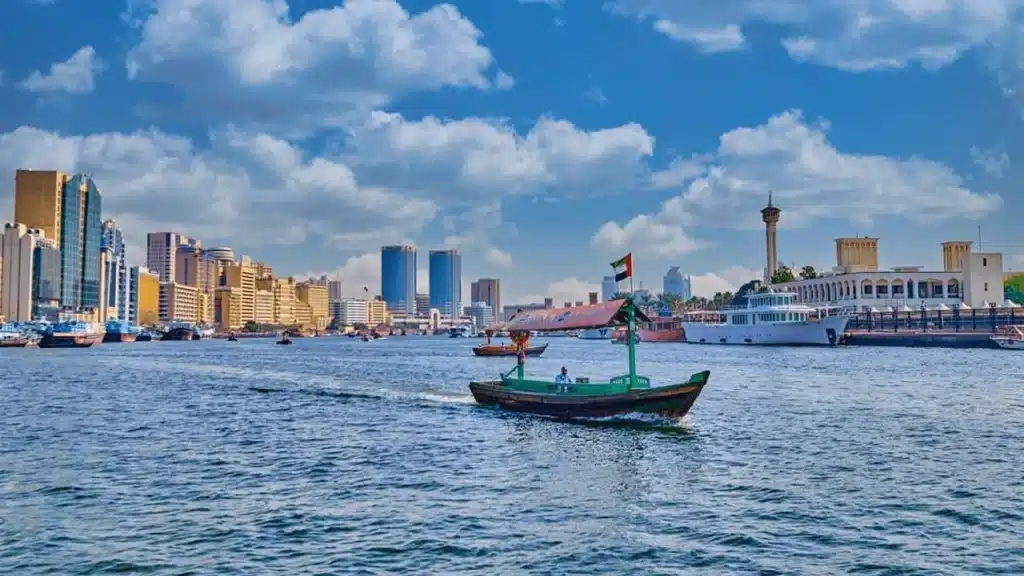
The cheapest boat ride anywhere in all of Dubai costs just one single dirham, and it’s genuinely also one of the best things to do in the entire city: an abra crossing right across Dubai Creek from Bur Dubai to Deira, wooden hull, open sides, with no fixed schedule beyond “whenever it fills up.” It’s genuinely the kind of thing local residents take for granted and visitors remember fondly for years — and it genuinely sums up Bur Dubai, the historic heart of the whole city, better than any simple list of sights ever could.
Genuinely walkable, characterful and easy to reach, Bur Dubai packs an awful lot of the city’s heritage into a fairly small area. Here’s exactly how to explore it properly, as part of our main Dubai guide.
Al Fahidi’s wind towers, and why they were built
Al Fahidi’s heritage quarter dates to the 1890s, built by Persian merchant families from the Bastak region who traded in pearls and textiles and gave the district its old name, Al Bastakiya. Its rooftop wind towers — barjeel — are a genuine piece of pre-electricity engineering: open on all four sides to catch the breeze and funnel it down through narrow shafts, cooling the courtyard houses below long before air conditioning existed. It sits right beside the Creek, with the textile souk, the genuinely busy Meena Bazaar and the waterfront promenade at Al Seef all within easy walking distance. The whole heritage quarter covers roughly 3.8 hectares in total, a small enough footprint that it’s genuinely walkable in just an hour or two, quite unlike most of the rest of Dubai.
The quarter itself was originally built in the early 1900s by merchants from Bastak, over in Persia, who settled here after the ruling sheikh offered generous tax breaks to traders willing to relocate — which is why the architecture genuinely reads as much Persian as it does Emirati: narrow shaded lanes, gypsum walls, courtyard houses, and more than 55 fully restored buildings still standing across the whole district today. The barjeel wind towers genuinely weren’t decorative; each individual one was carefully angled to catch and funnel the prevailing wind straight down into the house below, doing the job of proper air conditioning a full century before anyone ever had power to run one.
Dubai’s oldest building, mid-restoration
Al Fahidi Fort dates all the way back to 1787, making it genuinely the oldest surviving structure anywhere in Dubai, and it has done duty over the years as a defensive stronghold, royal residence, seat of government, prison and armoury before finally reopening as Dubai Museum in 1971, the very same year the UAE itself was formed. It then closed again in 2025 for a genuinely comprehensive restoration and modernisation project and remains shut at the time of writing, so do check current status before building a visit specifically around it — the surrounding Al Fahidi lanes, happily, are still fully open in the meantime.
Where to eat, from Meena Bazaar to Al Seef
Bur Dubai is genuinely a treasure-trove of authentic, well-priced food, running from Meena Bazaar’s South Asian classics right through to the waterfront restaurants over at Al Seef. Start with the best restaurants in Dubai and the best dining offers, and definitely don’t skip the hunt for the best ramen in Dubai — this stretch punches well above its weight for it.
Al Ustad Special Kabab has genuinely been grilling away in Al Fahidi for 46 consecutive years now and still draws proper queues for what regulars confidently call the best kebab anywhere in the Middle East. Sind Punjab has run continuously since 1977 in Meena Bazaar, sending fresh butter naan out of the tandoor roughly every 90 seconds alongside a dal tadka that local residents genuinely rate as the UAE’s very best. Over in Al Seef, Kailash Parbat comfortably covers the pure-vegetarian end of the spectrum, while Bukhara at the Grayton Hotel properly handles the tandoor-and-kebab side of North Indian cooking for anyone genuinely wanting a proper sit-down version of those same flavours.
Free things worth doing
Wander the wind-tower lanes, ride an abra right across the Creek and browse the souks at leisure — almost none of it costs anything at all. Tucked down the narrow Hindi Lane, a genuinely narrow alley of shops selling religious offerings and gold-embossed prints, sits a small Hindu temple dedicated to Shiva and Krishna that has faithfully served Dubai’s Hindu community since 1958 — for decades it remained one of only a small handful anywhere in the entire Gulf. Just a few minutes away, the Grand Mosque’s minaret rises a full 70 metres, genuinely the tallest in Dubai, above a roof of nine large and 45 smaller domes; faithfully rebuilt in 1998 to match its original 1900 structure, it comfortably holds up to 1,200 worshippers and isn’t open to non-Muslim visitors inside, but it remains a genuinely striking landmark to simply walk past. See free things to do and things to do in Dubai for the much wider list, or go even deeper with the best free things to do in Dubai and the UAE.
Sheikh Saeed Al Maktoum House, on the Shindagha waterfront a short walk from Al Fahidi, was built in 1894 as the residence of Dubai’s ruling family and today holds a museum of photographs and artefacts tracing the city’s growth from pearling town to the skyline it has now. It’s free-adjacent territory in every sense: entry is minimal, the courtyard architecture alone is worth the visit, and it pairs naturally with a walk along the Creek before or after.
Sleeping inside the old town
XVA Art Hotel remains the district’s best-known boutique stay — a full 15 rooms tucked around quiet courtyards inside genuine wind-tower architecture right in Al Fahidi, with its own award-winning restaurant attached. Barjeel Heritage Guest House sits close by and comfortably covers the budget end of the very same heritage experience, offering spacious rooms without the design-hotel price tag attached. For something rather closer to a standard hotel stay while still genuinely being inside the old town, Al Seef Heritage Hotel adds a third solid option along the promenade, trading just a little character for rather more conventional everyday comforts.
The one-dirham crossing, and getting around on foot
The Metro’s Al Fahidi and Sharaf DG stations, together with the Creek abras, together make getting around genuinely cheap and easy — that one-dirham crossing again — and the old town is best explored on foot. Dubai Creek itself runs about 14 kilometres inland before the 2007 canal extension carried it further still out to sea, and it was properly dredged deeper back in the 1950s and 1960s specifically so that larger trading vessels could reach Bur Dubai and Deira — the actual reason both districts originally grew up facing each other across the water in the first place.
Abras have been faithfully ferrying people back and forth across the Creek between Bur Dubai and Deira since at least the 1950s, making them genuinely the oldest form of public transport still running anywhere in the city — long before the Metro ever existed, and long before the first paved road too. The fare genuinely hasn’t moved from a single one dirham, paid simply in cash to the driver as you step aboard, and the roughly five-minute crossing genuinely remains one of the few things in Dubai that costs almost nothing and delivers a proper view every time.
When the old town is best explored
The cooler months from roughly October to April are genuinely ideal for walking around the old town; go either early or late in the day to properly beat the midday heat, and try to catch an abra right at sunset.
Top things to do in Bur Dubai
- The abra crossing — One dirham for a wooden-hull, open-sided boat straight across Dubai Creek from Bur Dubai to Deira — no fixed schedule beyond whenever it fills up, and genuinely one of the best things to do in the city.
- Dubai Frame — the 150-metre gold-framed observation structure at Zabeel Park, on Bur Dubai’s edge, giving a literal side-by-side view of Old Dubai looking one way and the new skyline looking the other.
- Al Fahidi Historic District — Wind-tower lanes dating to the 1890s, built by Persian merchant families from the Bastak region — walkable, characterful, and still fully open even while the district’s oldest building undergoes restoration.
- Al Ustad Special Kabab — Grilling away in Al Fahidi for 46 consecutive years, still drawing queues for what regulars call the best kebab anywhere in the Middle East.
- Sind Punjab — Running continuously since 1977 in Meena Bazaar, sending fresh butter naan out of the tandoor all day.
- Al Seef — The modern waterfront strip along the Creek, with restaurants and a promenade built to echo the old town beside it.
- Meena Bazaar — The South Asian textile-and-spice quarter that gives the neighbourhood’s food scene its backbone — come hungry, leave with fabric you didn’t plan on buying.
Bur Dubai, quickly answered
How much does the abra across the Creek cost?
Just one single dirham for the traditional shared abra — genuinely the cheapest ride anywhere in the city, and still one of the very best.
Is the Dubai Museum at Al Fahidi Fort open?
It’s currently been undergoing major restoration, so do check current status before properly planning your visit — the fort itself remains still well worth seeing from outside.
What are wind towers, and are they still standing?
Barjeel are rooftop wind-catchers that genuinely cooled homes long before air conditioning existed; Al Fahidi’s are original 1890s examples and remain still standing throughout the whole quarter today.
Is Bur Dubai walkable?
Yes — it’s genuinely one of the most walkable old districts anywhere in the city, with the Metro and abras comfortably covering anything beyond a simple strolling distance.
Is Bur Dubai budget-friendly?
Very much so — food, the abra crossing and most of the sightseeing here all cost little to almost nothing, a genuinely sharp contrast to Dubai’s pricier beach districts.
Across the Creek
Deira sits directly across the water from here, reachable by that very same one-dirham abra crossing. Back to the main Dubai guide.
Are Bur Dubai and Deira the same place?
No — they’re the two historic halves of Old Dubai, split by Dubai Creek and linked by the AED1 abra crossing. Bur Dubai sits on the western bank (Al Fahidi, Meena Bazaar), Deira on the eastern bank (Gold Souk, Spice Souk).
Dress code and visiting during Ramadan
Modest dress is worth keeping in mind near the Grand Mosque and the small Hindu temple on Hindi Lane — covered shoulders and knees are the sensible default, with a light scarf handy if you plan to duck inside. Bur Dubai also shifts noticeably during Ramadan: daytime hours change at many restaurants, and the old town comes properly alive again after Iftar, so it’s worth checking specific opening hours if visiting during the holy month.