


A full 1.2 million square metres of golf course, 2 million square feet of mall, and a metro line that genuinely won’t reach it until 2032 — Dubai Hills runs on an altogether different scale to the rest of the city. It’s a genuinely master-planned neighbourhood built around an 18-hole course and a sprawling central park, anchored by one of Dubai’s biggest malls, and it’s steadily become a genuine favourite for local families rather than just a suburb people simply pass through. The wider Dubai Hills Estate master plan spans a full 6.8 million square metres and is designed to eventually house well over 100,000 residents across some 30 separate neighbourhoods, though only part of that ambitious plan is actually built out today.
Handily placed between Downtown and the southern suburbs, Dubai Hills pairs everyday convenience with proper open space. Here’s how to make the most of it, as part of our main Dubai guide.
Updated: July 2026 — by Monica Bonalto
How it’s laid out
The community genuinely centres on Dubai Hills Park and the golf course, with Dubai Hills Mall serving as the retail-and-dining hub and quick, easy links to Al Khail Road for the rest of the city. Dubai Hills Estate is a genuine joint venture between Emaar Properties and Meraas, first announced back in 2013 as part of the wider Mohammed Bin Rashid City master development, and it’s built out as a genuine patchwork of named sub-communities rather than a single uniform block — Maple and Sidra for villas and townhouses, Parkway and Golf Place closer to the fairways, and Park Heights and Collective for apartments nearer the mall. The wider masterplan spans more than 11 million square metres as part of Mohammed Bin Rashid City, with a projected population of around 135,000 residents once fully built out — one of the largest single-developer communities anywhere in Dubai. Healthcare and schooling have followed the rooftops: King’s College Hospital Dubai Hills, a 100-bed multispecialty facility run by the London teaching hospital of the same name, opened within the estate, while GEMS Wellington Academy sits close by, teaching the British curriculum alongside the International Baccalaureate. Further sub-communities keep adding to the list: Park Point sits along the park-side belt, Fairway Vistas offers five- and six-bedroom villas directly overlooking the fairways, Executive Residences covers mid-rise apartments aimed at working professionals, and Vida Residences Club Point, a pair of 19-storey branded towers right on the golf course, is due for completion in 2029.
A course big enough to notice
The Dubai Hills golf course, designed by Gary Johnston of European Golf Design, covers around 1.2 million square metres in total — roughly the size of 63 football pitches — and its full 18 holes wind directly right through the community rather than sitting hidden behind a gate. Playing the full length from the back tees stretches to 7,283 yards, with a course rating of 74.8 and a slope of 138 — numbers serious golfers will recognise as a genuinely demanding championship layout, not just a resort curiosity. The par-72 course is managed day to day by Troon Golf, the same international operator behind several other big-name Dubai layouts, which keeps conditioning consistent even through the peak winter season when tee times book out fastest. The clubhouse’s Dubai Hills Golf Club restaurant is open to non-members too, so it’s a legitimate lunch stop even if you’re not playing.
One of Dubai’s biggest malls, still growing
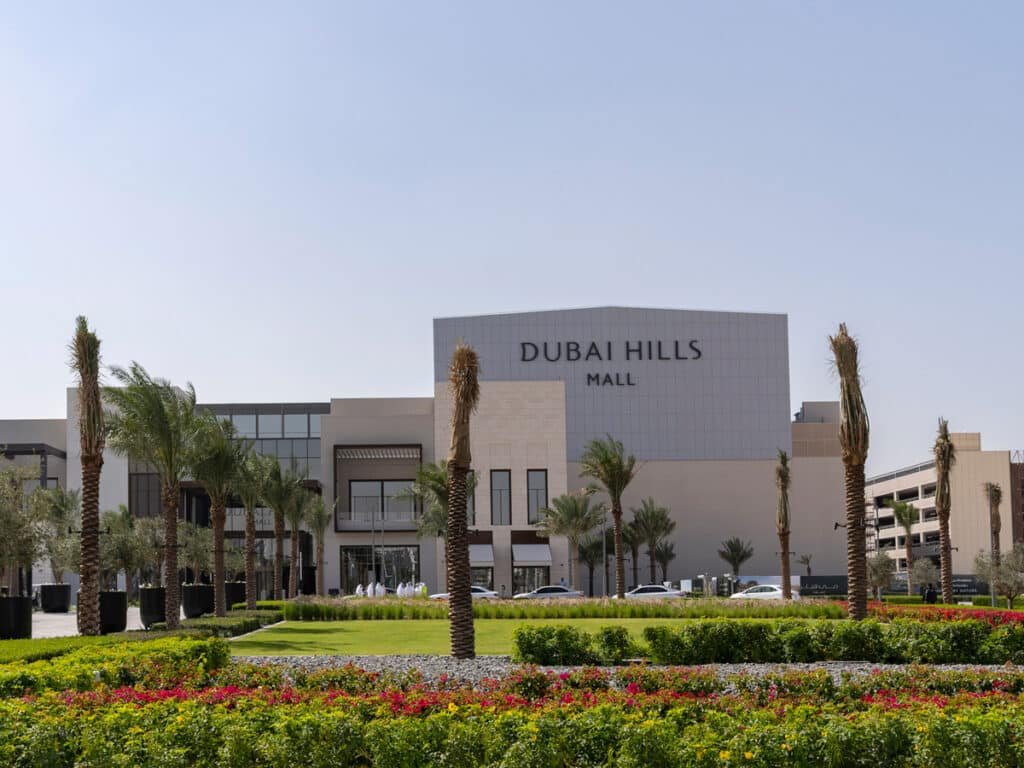
Dubai Hills Mall opened its doors on 17 February 2022 and covers close to 2 million square feet, across more than 650 stores anchored by Carrefour, Marks & Spencer and the Inditex group of brands, and both it and the surrounding community centres bring a fast-expanding line-up of restaurants and cafes for every budget. Sit-down options genuinely range from Bosporus for Turkish grills to Din Tai Fung for Taiwanese dumplings, Pincode by Kunal Kapur for modern Indian cooking, Rosa’s Thai, and Miyabi for proper sushi. It came with a 15-screen Roxy Cinemas multiplex from the very start — including Xtreme, the Middle East’s biggest cinema screen with laser projection and Dolby Atmos — plus Adventure Park by Emaar, an 11-zone indoor attraction spanning a Jump Park, Ninja Park and Cave Maze among others, and The Storm, an indoor roller coaster that launches riders 50 metres in five seconds along a 670-metre track at up to 77 kilometres an hour, billed as the world’s fastest indoor coaster — so it genuinely works as a destination in its own right rather than simply a pass-through stop. Start with the best restaurants in Dubai and find a deal in the best dining offers.
The park is the actual draw
Dubai Hills Park is genuinely the centrepiece — nearly 180,000 square metres in total, planted with some 1,800 trees and palms, of splash pad, skate park, running tracks and green space — alongside the golf and the mall’s family attractions. General entry and the full 2.5-kilometre jogging track are entirely free, while the splash pad and skate park run on an all-access pass priced at roughly AED 55 for residents and AED 85 for everyone else; there’s also a fenced-off, 475-square-metre dog park set aside for anyone travelling with a pet. A genuinely large amount of it costs nothing at all, and it’s a regular feature in our guide to the best free things to do in Dubai and the UAE. Our roundup of things to do in Dubai has plenty more nearby, from Al Barari to Downtown, if you fancy a change of scene.
Where to stay
Primarily a genuinely residential community, Dubai Hills suits rather longer stays in serviced apartments best, with the beaches and Downtown just a short drive away. Rove Dubai Hills, Emaar’s genuinely popular mid-range hotel brand, is the one clear exception — it sits directly right on the golf course with rooms looking straight over the fairways, a considerably rarer setup than the marina or beachfront views most other Dubai hotels tend to sell. It’s part of the same affordable-but-stylish Rove chain found at City Walk, Downtown and the Marina, so expect the same compact, well-designed rooms and self-service check-in rather than a full-service luxury stay.
Getting there and around, and the metro that’s coming
Al Khail Road is currently the most practical way in by car; the Dubai Metro’s new Gold Line, approved by Sheikh Mohammed bin Rashid Al Maktoum in April 2026 as a fully underground, AED 34 billion project spanning 42 kilometres and 18 stations across the city, includes a Dubai Hills station but isn’t due to open until September 2032. In the meantime, RTA shuttle buses connect the community to the Mall of the Emirates and Equiti Metro stations, running frequently enough through the day to make a car genuinely optional for anyone happy to plan a little ahead, though most residents still find their own vehicle far more convenient for the wider commute.
Best time to visit
The cooler months from roughly October to April are genuinely ideal for the park and golf alike, when early mornings and late afternoons make the outdoor spaces properly comfortable rather than merely tolerable; weekends are consistently busiest at the mall, so a weekday visit is generally the better call if you’d rather browse without the crowds. Its steadily expanding dining scene turns up regularly in our best brunch in Dubai picks too.
Insider tip: book a Rove Dubai Hills room specifically on the course side rather than the community side — the golf-course view rooms genuinely cost roughly the same as the standard rooms but rarely sell out first, since most guests booking Rove simply default to the community-facing rooms without ever properly checking the alternative, so it genuinely pays to ask specifically at booking rather than assume the better view costs extra.
Top things to do in Dubai Hills
- Dubai Hills Golf Club — a par-72 championship layout stretching to 7,283 yards from the back tees (rating 74.8, slope 138), managed day to day by Troon Golf.
- Dubai Hills Mall’s entertainment floor — Roxy Cinemas’ Xtreme screen (the Middle East’s biggest, with laser projection and Dolby Atmos), the 11-zone Adventure Park by Emaar (Jump Park, Ninja Park, Cave Maze), and The Storm indoor roller coaster (0-77km/h in 5 seconds along a 670-metre track).
- Dinner at the mall — Bosporus for Turkish grills, Din Tai Fung for Taiwanese dumplings, Pincode by Kunal Kapur for modern Indian, Rosa’s Thai, or Miyabi for sushi.
- Dubai Hills Park — the green, walkable centre the whole community is built around, a genuine break from the mall-and-golf routine.
Dubai Hills, quick questions
Is Dubai Hills good for a family visit, not just residents? Yes — Dubai Hills Park, the golf course restaurant and the mall’s Adventure Park and Storm roller coaster are all genuinely open to everyone, and it works well as a half-day trip even if you’re staying elsewhere in Dubai.
Is there a metro station at Dubai Hills? Not yet — the planned Gold Line extension genuinely isn’t due until September 2032, so a car, taxi or the RTA shuttle bus is currently the only practical way in.
Can visitors play the Dubai Hills golf course? Yes, it’s genuinely open to non-members and visiting golfers alike, not just residents of the community.
How far is Dubai Hills from Downtown Dubai? Around 15 to 20 minutes by car via Al Khail Road, depending on the traffic at the time.
Is Dubai Hills Mall the same as Dubai Hills Estate? No — Dubai Hills Estate is the much wider residential and golf community; Dubai Hills Mall is simply its retail and cinema hub, which opened its doors on 17 February 2022.
Explore more
Head back to the main Dubai guide to explore even more of the city’s many neighbourhoods.
Is there anything to do in Dubai Hills besides golf and shopping?
Yes — between Adventure Park’s 11 zones, The Storm roller coaster, Roxy Cinemas’ Xtreme screen and the central park, there’s a full afternoon here even if you never touch a golf club.