Close Menu
What's Hot in UAE What's Hot in UAE
    Facebook X (Twitter) Instagram
    Facebook X (Twitter) Instagram YouTube Bluesky Reddit TikTok Threads
    What's Hot in UAE What's Hot in UAE
    • LATEST NEWS
    • GOING OUT
      • UAE Nightlife: The Ultimate Guide to the Region’s After-Dark Culture
      • Nightlife
      • Concerts
      • Events & Entertainment
      • Restaurants
      • Beach & Pool Clubs
      • Family
    • LIFESTYLE
    • SNEAKERS
    • LIVING IN THE UAE
    • UAE Guides
      • Dubai
        • Dubai Hills
        • Dubai Marina
        • Downtown Dubai
        • JBR
        • Palm Jumeirah
        • Business Bay
        • DIFC
        • Jumeirah
        • Bur Dubai
        • Deira
        • JLT
        • City Walk
        • Dubai Happy Hours
        • Al Barsha
        • Bluewaters Island
        • La Mer
        • Jumeirah Village Circle
        • Umm Suqeim
        • Meydan
        • Sheikh Zayed Road
        • Dubai Creek Harbour
        • The Greens
        • Mirdif
      • Abu Dhabi
        • Yas Island
        • Saadiyat Island
        • Al Maryah Island
        • Al Reem Island
        • The Corniche
        • Khalidiyah
        • Al Raha Beach
        • Masdar City
      • Ajman
        • Ajman Corniche
        • Al Jurf
        • Al Zorah
      • Fujairah
        • Fujairah City
        • Dibba
        • Al Aqah
        • Masafi
      • Ras Al Khaimah
        • Al Marjan Island
        • Al Hamra
        • Jebel Jais
        • RAK City & Old Town
        • Mina Al Arab
      • Sharjah
        • Al Majaz
        • Al Qasba
        • Al Nahda
        • Al Khan
        • Al Qasimia
        • Khor Fakkan
      • Umm Al Quwain
        • UAQ Marina & Corniche
        • Old Town UAQ
    What's Hot in UAE What's Hot in UAE
    Home » Why Planetary Alignments Fascinate Us — And What They Really Mean
    Living in the UAE

    Why Planetary Alignments Fascinate Us — And What They Really Mean

    By Editorial TeamJanuary 14, 2025Updated:May 28, 20264 Mins Read
    Facebook Twitter LinkedIn Email Reddit Copy Link
    Follow Us
    Facebook X (Twitter) Instagram YouTube TikTok
    A twilight sky over the ocean with the moon and a few stars visible, along with a silhouette of a lifeguard tower on the right side of the image.
    Share
    Facebook Twitter LinkedIn Email Bluesky Reddit WhatsApp Threads Copy Link

    Planetary alignments capture our imagination because they represent a rare intersection of celestial precision and human curiosity. Whether sparked by astrology, mythology or astronomy, these events turn our gaze skyward, prompting questions that have echoed through millennia. In this article, we unravel the mechanics, significance and cultural resonance of planetary alignments, offering a comprehensive, enduring resource designed to educate, fascinate and delight.

    What Exactly Is a Planetary Alignment?

    A planetary alignment happens when two or more planets appear close together in the sky as seen from Earth. Unlike precise orbital alignment, this is a perspective effect driven by the planets’ positions along their orbital paths.

    • Conjunctions: Two planets aligning visually.
    • Triple or Multiple Conjunctions: Three or more planets clustering.
    • Grand Alignments: Several planets sharing a broad alignment over months.
    • Syzygy: A strict three-body alignment (e.g. Sun–Earth–Moon during eclipses).

    Despite appearances, planets don’t align neatly in a straight cosmic line—they only appear to do so from our vantage point.
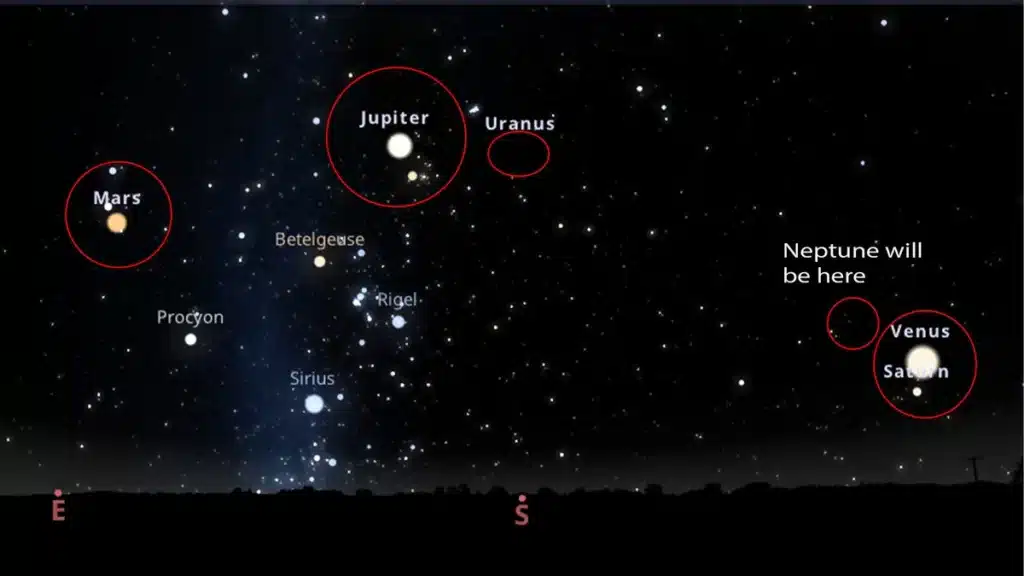
    A night sky map showing the locations of Mars, Jupiter, Uranus, Venus, and Saturn labeled with red circles. The positions of notable stars like Betelgeuse, Rigel, Procyon, and Sirius are also marked. The text indicates where Neptune will appear. The horizon is marked with directions 'E' for east and 'S' for south.

    For a complete practical guide to life in the Emirates, explore our full Living in the UAE hub.

    How Often Do Alignments Happen?

    Contrary to sensational claims, planetary alignments occur routinely. While mild conjunctions take place several times annually, grand alignments involving four or more planets typically recur every two to five decades. Full alignments of all eight major planets are extremely rare—some astronomers predict the next around the year 2492.

    Why Planetary Alignments Have Captivated Cultures

    Astronomically speaking, alignments are harmless coincidences. But culturally, they have held immense power:

    1. Ancient Civilisations: The Babylonians, Greeks and Mayans aligned monumental structures and calendars with planetary events.
    2. Astrology: Throughout history and into today, many believe alignments influence personalities, events and energies.
    3. Modern Fascination: Today, alignments inspire photography, science festivals and evenings at stargazing clubs.

    While science dismisses cosmic influence on human affairs, the symbolic dimensions remain potent and enduring.
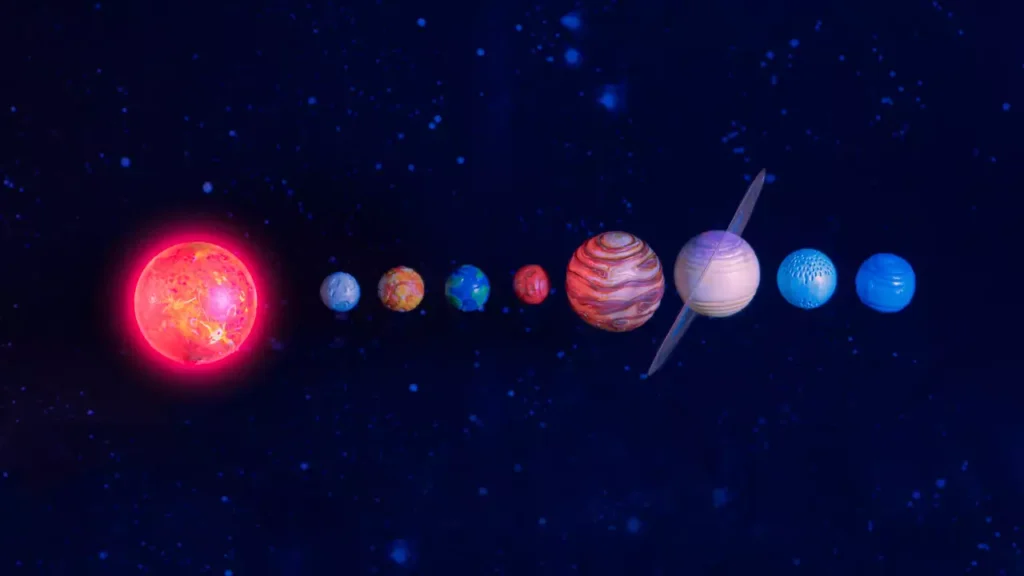
    Illustration of the solar system showing the Sun and the eight planets in order: Mercury, Venus, Earth, Mars, Jupiter, Saturn, Uranus, and Neptune, all set against a starry background.

    The Science Behind Alignments

    Each planet orbits the Sun at different speeds:

    • Mercury: 88 days
    • Venus: 225 days
    • Earth: 365.25 days
    • Mars: 687 days
    • Jupiter: 11.86 years
    • Saturn: 29.45 years
    • Uranus & Neptune: over 84 and 165 years respectively

    These varying orbits create constantly shifting celestial configurations. By measuring elongation angles—the angles between planets and the Sun—astronomers can precisely predict when alignments will occur using ephemeris software like Stellarium.

    An illustration of the solar system planets Jupiter, Saturn, Uranus, and Neptune aligned against a backdrop of stars and the Milky Way. Jupiter and Saturn are on the left, with visible rings on Saturn, while Uranus and Neptune are on the right.

    Myth, Reality and Misconceptions

    Many myths surround planetary alignments:

    • Doomsday Prophecies: Despite claims about earthquakes or climate chaos, none stand up to scientific scrutiny.
    • Influence on Weather or Behaviour: Gravitational effects from planets are minuscule—far weaker than the Moon’s influence on tides.
    • Mayan Alignment Myths: Misinterpretations led to the “end of the world” narrative in 2012, which was not supported by their records.

    What alignments do cause is renewed interest in astronomy and rich metaphors in art, literature, music and cinema—from Pink Floyd’s “Eclipse” to Andrei Tarkovsky’s Solaris.
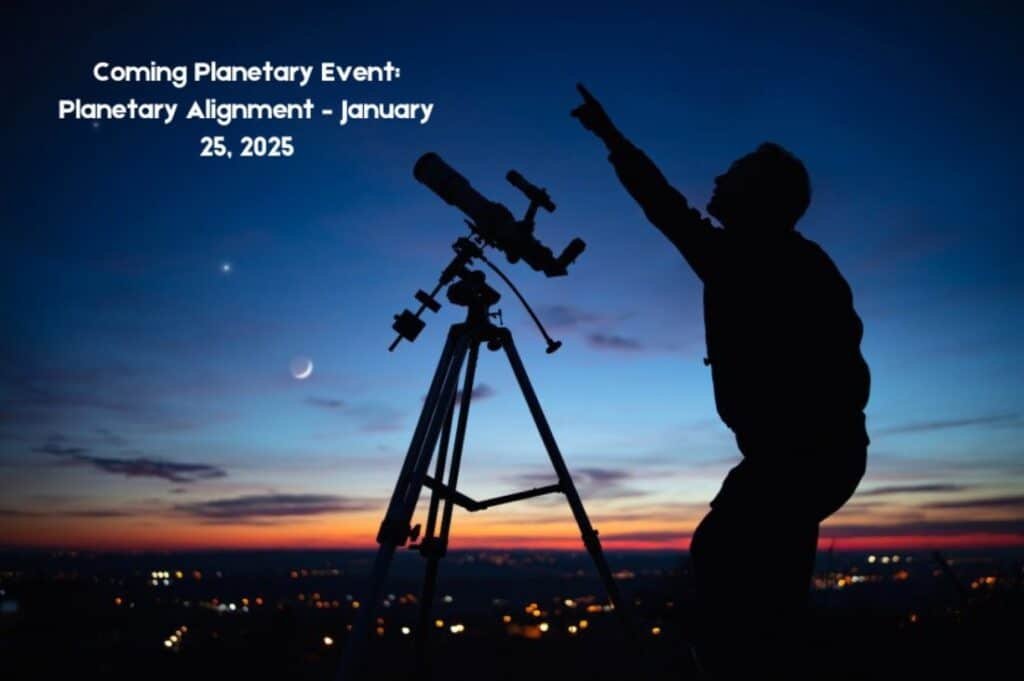
    Silhouette of a person pointing towards the sky with a telescope at sunset, with a crescent moon and a distant star visible, accompanied by text announcing a planetary alignment event on January 25, 2025.

    Viewing Alignments from the UAE

    The UAE is ideally positioned for mid‑latitudinal skywatching:

    For memorable experiences, organise a desert stargazing camp or a boat trip around Palm Jumeirah.

    Check the International Astronomical Union (IAU) website or your local observatory for dates during pre-dawn or early evening hours.

    Use free mobile apps like SkyView or Stellarium Mobile to locate planets against a clear desert horizon.

    Best visibility comes when alignments occur within 10° of the ecliptic pathway.

    A night sky showing a crescent Moon and planets identified with labels: Jupiter, Venus, Mars, and Saturn, against a dark blue background above the silhouette of a landscape.

    The Planetary Alignment on January 25th

    How to Photograph a Planetary Alignment

    Want to capture the event? Follow these tips:

    1. Use a tripod and wide-angle lens (14–24 mm).
    2. Set ISO between 800–1600; aperture at f/4 or lower.
    3. Use manual focus set to infinity.
    4. Use a remote shutter or timer to reduce camera shake.
    5. Bracket exposures between 3–10 seconds depending on ambient light.
    6. Layer images in post-production software like Lightroom or Photoshop.

    Include foreground elements—like dunes or palm silhouettes—to give context and scale to the sky.
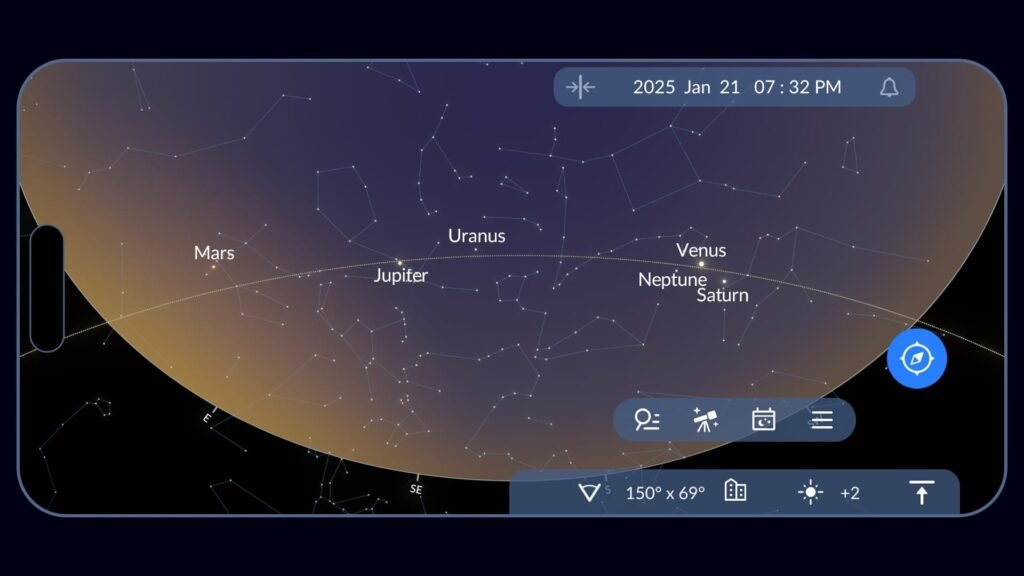
    A mobile astronomy app showing the positions of Mars, Jupiter, Uranus, Venus, Neptune, and Saturn in the night sky on January 21, 2025, at 7:32 PM.

    Cultural and Psychological Significance

    Planetary alignments remind us that we are part of something bigger. Scientists and sociologists describe the communal awe as “cosmic synchrony”: an emotional, collective moment when people reconnect with the universe. These events encourage science communication, spark creativity in art and music, and invite public gatherings at observatories, planetariums, and science festivals.

    Looking Ahead: Upcoming Alignments

    Future multi‑planet alignments include:

    2029–2030: Recurrent alignments spanning Venus, Mars and Saturn over several nights

    September 2026: Venus–Mars–Jupiter near sunrise

    May 2028: A five‑planet alignment visible pre‑dawn

    Share. Facebook Twitter Email Bluesky Threads
    Previous ArticleAvicii’s Legacy Revisited: “Avicii – I Am Tim” Documentary Now Streaming on Netflix
    Next Article Peter Brandt Warns of Bitcoin Price Crash to $75K: Key Levels to Watch
    Editorial Team's avatar
    Editorial Team
    • Website
    • Facebook
    • X (Twitter)
    • Pinterest
    • Instagram

    Our Editorial Team has a diverse background in everything from Music to Cryptocurrency, to Sneakers, Tech and Couture Fashion. We aim to bring you the biggest and the best in lifestyle news.

    Related Posts

    Aerial rendering of a luxury island resort with a tall tower, marina, beaches, and yachts under a blue sky

    Ras Al Khaimah Tourism Hits Record High as Domestic Arrivals Surge

    Woman hailing a taxi on a palm-lined city street with skyscrapers and traffic in the background

    Dubai Taxi Hacks 2026: 7 Ways to Save Money on Every Ride

    People strolling along a palm-lined shopping promenade at dusk past cafes and boutiques with string lights

    Moving to Dubai? 15 Things to Do as Soon as You Arrive (Complete Checklist)

    Smiling man in a blue shirt holds up an Emirates ID card by a waterfront skyline

    Emirates ID Perks 2026: 8 Things Your Card Can Do That You Didn’t Know About

    Four friends chat and laugh while walking through a modern outdoor shopping district with skyscrapers behind them

    Dubai Slang Guide 2026: 30+ Words and Phrases You Actually Need to Know

    Emirates Post building entrance with blue doors, steps, and two red letter boxes

    Why Dubai Has No Postcodes (And Exactly How to Send Mail Here)

    Editors Picks
    White and blue sneaker with elephant-print accents against a blurred city lights background

    Air Jordan 3 True Blue Retro Release: Everything You Need to Know

    July 26, 2026
    Aerial rendering of a luxury island resort with a tall tower, marina, beaches, and yachts under a blue sky

    Ras Al Khaimah Tourism Hits Record High as Domestic Arrivals Surge

    July 25, 2026
    Three Emirates airplanes are parked at a busy airport terminal with a modern, arched design in the background, set against a city skyline.

    International airlines cancelling Dubai flights: Which carriers are affected

    July 24, 2026
    Tangem Crypto Wallet
    What's Hot in UAE
    Facebook X (Twitter) Instagram Pinterest YouTube Bluesky Reddit TikTok SoundCloud
    • COOKIE POLICY
    • Corrections Policy
    • Editorial Policy
    • Editorial Team
    • PRIVACY POLICY
    • CONTACT US
    • ABOUT US
    © 2026 What's Hot in UAE. Designed by The Creative One Agency.

    Type above and press Enter to search. Press Esc to cancel.

    Ad Blocker Enabled!
    Ad Blocker Enabled!
    Our website is made possible by displaying online advertisements to our visitors. Please support us by disabling your Ad Blocker.