
In June 2024, 50 Cent said his X account and website had been hacked to promote the $GUNIT token, and denied any association with it. His statement was a celebrity account of the incident, not an independent calculation of money stolen or realised trading proceeds. Reports subsequently noted that the amount in his post was…
Key Takeaways
- In June 2024, 50 Cent announced his X account and website were hacked to promote the $GUNIT token; he denied any connection to it.
- The reported $300 million loss or profit from the incident is unverified and should not be treated as fact.
- Previous claims of 50 Cent profiting from Bitcoin in 2014 were denied in court; he stated he never generated significant profits from it.
- The hacking incident underscores the cybersecurity vulnerabilities of online platforms and highlights potential cryptocurrency scams.
- 50 Cent’s quick public clarification helped mitigate further damage from the incident, emphasizing the importance of cybersecurity.
In June 2024, 50 Cent said his X account and website had been hacked to promote the $GUNIT token, and denied any association with it. His statement was a celebrity account of the incident, not an independent calculation of money stolen or realised trading proceeds. Reports subsequently noted that the amount in his post was edited. The historical claim should therefore not be presented as a verified $300 million loss or profit. This article explains the reported incident and the distinction between a promoted token’s price, market capitalisation and actual proceeds.
The Incident
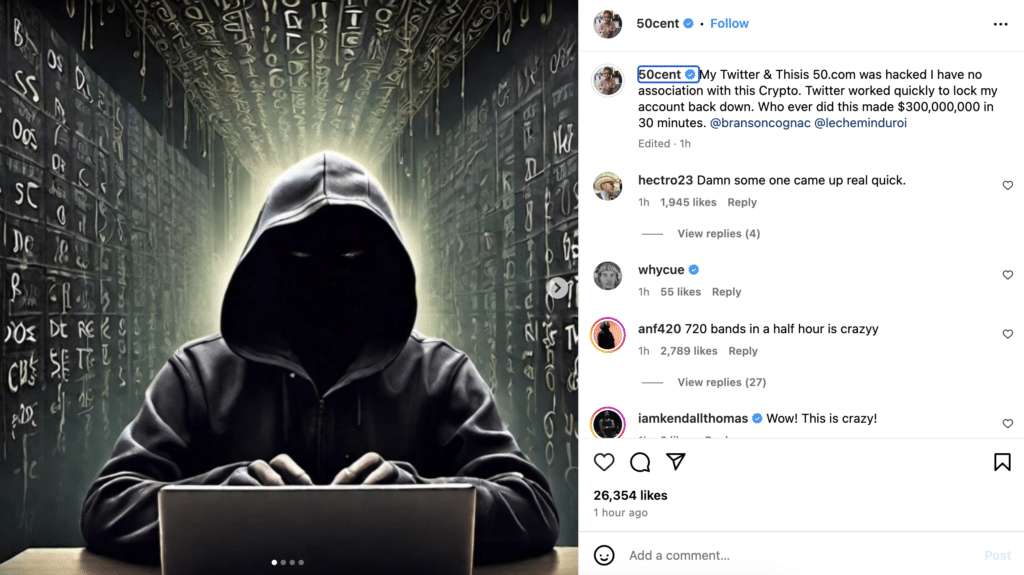
50 Cent took to Instagram to explain the situation: “My Twitter & Thisis50.com was hacked, I have no association with this Crypto,” he wrote, addressing concerns about the 50 Cent Cryptocurrency Scam.
“Twitter worked quickly to lock my account back down. Whoever did this made $300,000,000 in 30 minutes.”
Screenshots of a token’s chart can show a quoted price or market-cap figure, but do not establish how much an attacker received. Market capitalisation multiplies an eligible supply by a marginal quoted price; liquidity and actual executed trades are different data. A large chart value is not proof that the same amount was paid in, taken out or lost by victims. Treat the amount claimed in the celebrity’s original statement as unverified rather than a blockchain-certified total.
Previous Cryptocurrency Involvements
This isn’t 50 Cent’s first brush with cryptocurrency. Back in 2018, there were reports that the rapper had made millions from Bitcoin.
TMZ claimed that 50 Cent had amassed a significant amount of Bitcoin through sales of his album “Animal Ambition” in 2014. At that time he offered Bitcoin as a payment option.
It was reported that he had collected about 700 bitcoins, valued at approximately $662 each at the time. This amounted to between $7 million and $8.5 million.

However, 50 Cent later denied these claims in court. He stated that while he did accept Bitcoin payments, he did not hold onto the cryptocurrency. Therefore, he did not profit from it.
According to court documents, he clarified in bankruptcy court that he had never owned or used Bitcoin in a way that generated significant profits.
The Impact
This latest hacking incident, which has become known as the 50 Cent Cryptocurrency Scam, highlights the vulnerabilities of online platforms and the potential for significant financial scams involving cryptocurrencies.
50 Cent’s swift action and public clarification helped prevent further damage. However, the event underscores the importance of solid cybersecurity measures.

Celebrity Statements and Confirmed Losses Are Different
Verify a promotion through an independent official channel, particularly when it directs users to a new token or a wallet address. A familiar account can be compromised; a denial by its owner is useful context but not a complete forensic report. To establish losses or proceeds, identify transactions, addresses, timing and a reproducible method. The contemporaneous report records the edited claim; neither version proves audited proceeds. For the broader risk, read our meme-token guide.