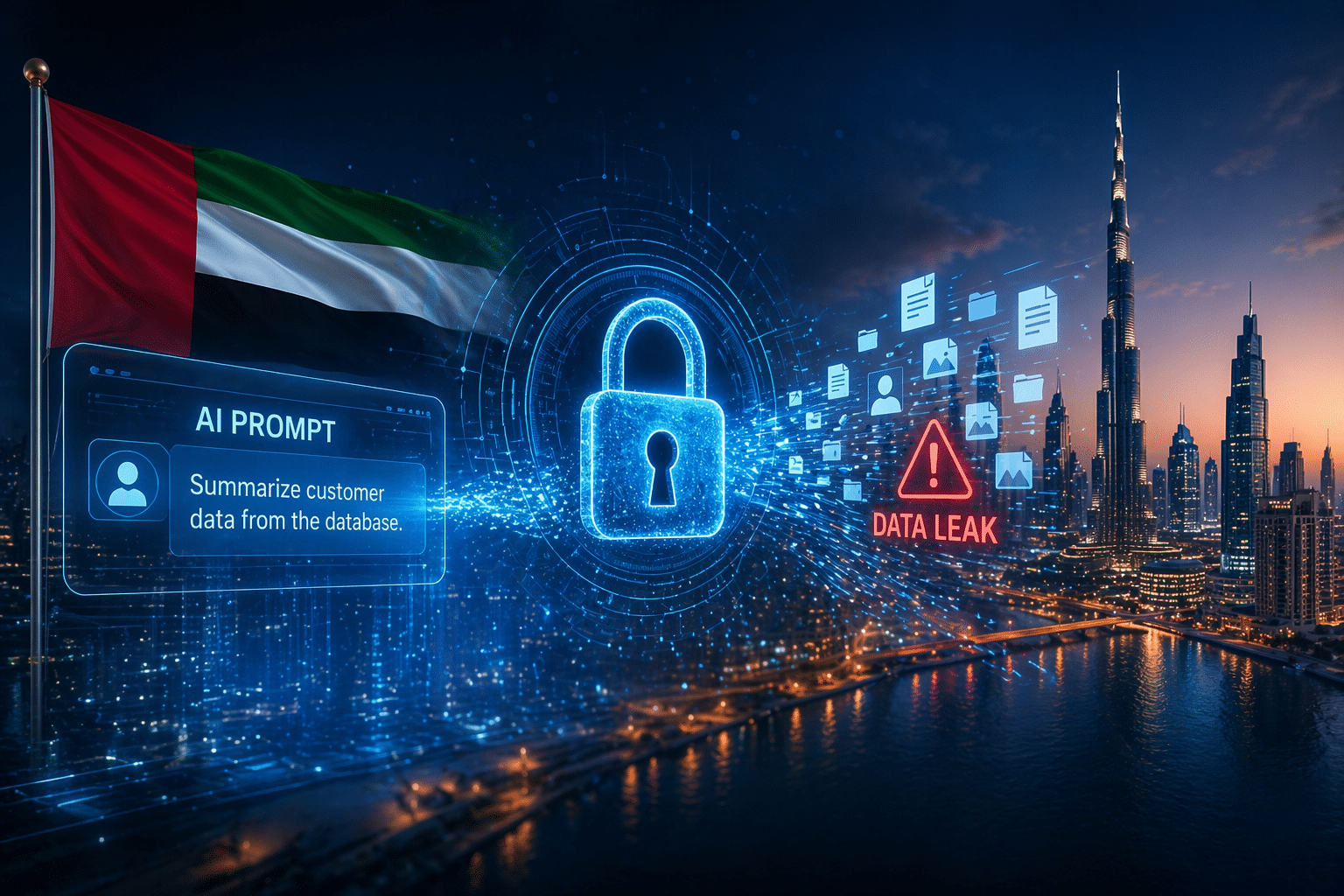
You are typing into an AI chatbot, expecting privacy, but every prompt could be a silent data leak. In the UAE, where digital innovation moves at lightning speed, this often-overlooked risk is becoming a critical concern for both individuals and businesses. The convenience of AI tools, from drafting emails to generating business ideas, masks a complex reality: your sensitive information might not be as confidential as you think. This definitive guide cuts through the noise, offering localised insights and actionable advice to protect your digital footprint from AI prompts and data leaks in the UAE.
TL;DR: Every AI prompt carries a data leak risk; understand how AI learns and protect your sensitive information.
As artificial intelligence (AI) tools become an undeniable part of daily life across the Emirates, from quick email drafts to complex code fixes, experts are issuing a stark warning. The simple act of typing into a chatbot may carry risks many people do not fully understand. Cybersecurity leader Davide Del Vecchio, CISO at Careem, highlighted this growing concern, stating, “while AI systems offer convenience and speed, they may also quietly expose sensitive information.” With more and more UAE residents incorporating AI into their daily lives, more scenarios are starting to appear where security vulnerabilities are beginning to emerge. This article will explore how AI models process your data, the specific implications for the UAE, and provide essential strategies to safeguard your sensitive information.
In This Article
- Understanding the Silent Threat: How AI Chatbots Learn and Leak Data
- AI Prompts Data Leaks in the UAE: What Residents Need to Know
- Safeguarding Your Secrets: Practical Strategies for Individuals and Businesses
- Beyond the Basics: Unmasking the Nuances of AI Data Retention and Anonymisation in the UAE
- Frequently Asked Questions
Understanding the Silent Threat: How AI Chatbots Learn and Leak Data
AI chatbots learn by recognising patterns in massive datasets, not by ‘remembering’ information like humans. When users input sensitive data, even if not explicitly saved, the system can absorb patterns, leading to ‘signal leakage’. This means your input subtly influences future AI responses, potentially exposing sensitive information without direct repetition, challenging the perception of privacy.
At its core, artificial intelligence, particularly large language models (LLMs), operates by identifying statistical relationships and patterns within the vast amounts of text data they are trained on. These sophisticated models process text by breaking it down into ‘tokens’ and converting them into numerical representations called ’embeddings’. They then analyse these embeddings to predict the next most probable word or phrase based on the input they receive and their extensive training data. This intricate process, while incredibly powerful for generating coherent and contextually relevant responses, introduces a unique vulnerability known as ‘signal leakage’. This is a key aspect of how AI learns and contributes to AI data privacy risks.
As Davide Del Vecchio, CISO at Careem, explained, “people usually think of data leaks as hacks or cyberattacks, but with AI, the risk is different. It’s about how these systems learn from what you type.” Your seemingly private conversation contributes to the model’s ongoing learning, subtly shaping its future behaviour and potentially exposing patterns derived from your sensitive inputs. This subtle absorption of information means that even without direct storage of your specific query, the underlying patterns can be absorbed, impacting the overall chatbot privacy landscape. Understanding this mechanism is crucial for mitigating signal leakage AI risks.
The Illusion of Privacy: Why Your Chatbot Conversations Aren’t Always Confidential
The common user misconception is that once a chatbot conversation ends, the input disappears, leaving no trace. This sense of privacy can be highly misleading, directly addressing the question of is typing into a chatbot private. Depending on the platform’s terms of service and underlying architecture, the information you type could be stored, reviewed by human operators, or directly used to improve the system’s future performance. Even if your exact words are not saved or repeated verbatim, the AI system absorbs the patterns from that data. This means your confidential information AI chatbots receive, such as a business plan or deeply personal query, while not explicitly reproduced, could still influence how the AI responds to other users, creating a subtle, indirect form of exposure. Davide Del Vecchio’s insight that “the risk is different. It’s about how these systems learn from what you type” underscores this fundamental shift in data security and highlights the significant AI privacy implications. Complete anonymity, even with the best intentions from platform providers, remains a significant challenge, as conversations often contain identifying clues such as names, locations, or unique experiences.

AI Prompts Data Leaks in the UAE: What Residents Need to Know
UAE residents face growing AI data leak risks as AI tools integrate into daily life. Key concerns include unintentional sharing of sensitive personal or business information, the evolving regulatory landscape, and the need for greater awareness. Residents should treat AI as a public space, avoid sensitive inputs, and understand how AI platforms handle their data to safeguard digital privacy.
The rapid integration of AI tools into daily life in the UAE, from drafting emails to seeking personal advice, is unequivocally leading to the emergence of novel security vulnerabilities for residents and businesses alike. This makes understanding AI prompts data leaks in the UAE more critical than ever. As a plugged-in local publication, What’s Hot in UAE understands that the digital landscape here is dynamic, and staying informed comes first for protecting the personal data AI UAE users provide. Anecdotal evidence suggests that many expat residents in communities like JBR or Abu Dhabi’s Reem Island are increasingly using public AI tools for personal advice, ranging from visa queries to health concerns. They often do so under the mistaken impression of complete confidentiality, especially given their distance from familiar support systems. This highlights a critical need for increased awareness among the diverse community that calls the UAE home, to address the inherent AI risks that data leaks in Dubai and other Emirates pose. Whether you’re planning your next weekend getaway or seeking advice on a complex work project, the data you feed into an AI tool could have unforeseen consequences, making this a vital digital privacy guide for the UAE.
UAE Data Protection Laws and AI: Navigating the Evolving Landscape
The UAE’s Federal Data Protection Law (Federal Decree-Law No. 45 of 2021) provides a solid framework for personal data, establishing rights for individuals and obligations for data controllers and processors. This law is a significant step towards safeguarding digital privacy in the Emirates and forms the bedrock of UAE data protection laws that AI applications must consider. However, its application to ‘signal leakage’ from AI models, where patterns rather than explicit data are absorbed, presents a complex legal challenge that regulatory bodies, such as the UAE AI Office, are still actively addressing. As the initial research highlighted, laws and regulations around AI are still catching up, and while existing privacy rules offer some protection, many questions remain unanswered about how data is handled and stored within these rapidly evolving AI systems. This ongoing development is crucial for establishing clear UAE AI data regulations and guiding AI ethics data handling that UAE businesses must adhere to. Businesses operating in the UAE must pay close attention to these developments, ensuring their AI usage aligns with both the spirit and letter of local data protection mandates.
Safeguarding Your Secrets: Practical Strategies for Individuals and Businesses
To safeguard against AI data leaks, individuals should treat AI tools like public spaces, avoiding sensitive inputs such as passwords or confidential documents. Businesses should implement strict AI usage policies, consider enterprise-grade AI solutions, and prioritise ‘zero-retention’ options. Regular cybersecurity awareness training for employees is also crucial to prevent inadvertent data exposure.
Protecting personal data that AI systems interact with requires a proactive and informed approach. The expert advice to “treat AI like a public space” is a simple yet powerful rule of thumb for how to prevent AI data leaks. If you would not share something on the open internet, it is best not to share it with a public AI tool. This includes passwords, financial information, confidential work documents, and deeply personal details. Increased cybersecurity awareness, UAE residents and businesses need careful and informed AI use, which is not just a recommendation; it is a necessity in our interconnected world. By adopting smart prompting habits and implementing secure policies, both individuals and organisations can significantly mitigate the risks of AI data leaks, offering essential data security tips that UAE users can implement immediately.
For Individuals: Smart Prompting Habits for Digital Privacy
For the everyday user, cultivating smart prompting habits is key to maintaining digital privacy and enhancing AI consumer data privacy. Before typing anything into an AI chatbot, pause and consider the sensitivity of the information. Avoid sharing passwords, bank account details, Emirates ID numbers, or any deeply personal health or relationship advice that could identify you or others. These are crucial chatbot safety tips for everyday interactions. Always check the privacy policy of the AI platform you are using, looking for statements about data retention and usage. Many platforms are now introducing “private mode” or “zero-retention” options, which prevent your inputs from being stored or used for future model training. These features, when available, are highly recommended for the solid personal data protection that AI users seek. For instance, expat residents in communities like JBR or Abu Dhabi’s Reem Island, who often turn to public AI tools for personal advice on everything from visa queries to health concerns, should be especially vigilant. Their comfort with these tools does not guarantee confidentiality, and unique experiences or location details can inadvertently become identifying clues. For more detailed guides on navigating life in the Emirates, check out our UAE Expat Guides.
For Businesses: Implementing Secure AI Policies and Solutions
Businesses, especially those in the competitive UAE market, face a unique set of challenges regarding business AI data security. Many startups operating out of Dubai Internet City or Abu Dhabi’s Hub71 are using readily available public AI tools for everything from pitch deck summaries to market analysis. In their fast-paced environment, they often prioritise speed over a thorough assessment of data retention policies. This can inadvertently expose proprietary information, making it vital to prevent AI data leaks that business operations might encounter.
In response, several companies have restricted or banned the use of public AI tools, opting instead for specialised enterprise versions that offer stronger privacy protections and data governance, enhancing enterprise AI privacy. Major financial institutions in DIFC and ADGM, along with government entities, are increasingly investing in private or locally-hosted enterprise AI solutions from providers like Microsoft Azure OpenAI Service or Oracle Cloud Infrastructure. This strategic shift is specifically to comply with UAE data residency regulations and mitigate the risks highlighted by signal leakage. What’s more, amidst the intense competition in the UAE’s real estate market, some property agents and individual landlords are reportedly using public AI tools to draft property descriptions, rental agreements, or even respond to tenant queries. This practice potentially inputs sensitive details about properties or clients into systems not designed for such confidentiality. Implementing clear internal AI usage policies, providing regular employee training on data security, and exploring enterprise-grade AI solutions are crucial steps for any business operating in the UAE today.

Beyond the Basics: Unmasking the Nuances of AI Data Retention and Anonymisation in the UAE
AI data retention and anonymisation are complex. Many platforms store inputs for system improvement, and achieving true anonymity is challenging due to identifying clues within conversations. In the UAE, where digital trust is vital, understanding these nuances is crucial. Users must recognise that ‘private mode’ options exist, but transparency around data usage remains an ongoing industry challenge, impacting overall data sovereignty.
While many AI providers claim to anonymise or remove personal details from stored data, achieving complete anonymity is exceedingly difficult. This presents significant data anonymisation challenges AI developers and users face. Conversations often include identifying clues such as names, locations, or unique experiences that, when combined, can de-anonymise data. This is particularly relevant in a diverse and interconnected hub like the UAE, where UAE digital trust and data sovereignty are paramount. The implications of AI data retention policies – or the lack thereof – extend far beyond simple storage. They determine how long your data, or patterns derived from it, could influence the AI’s behaviour and potentially be accessed. Understanding these nuances is crucial for any user, as it addresses a significant content gap often overlooked by more superficial guides, highlighting the need for greater AI privacy transparency.
The Transparency Conundrum: What AI Companies Aren’t Always Telling You
Transparency is another challenge in the AI landscape, contributing to significant AI transparency challenges. Many platforms use general terms like “improving user experience” in their privacy policies, which may not clearly explain how user data privacy AI platforms actually handle and use it or retained. This lack of clear communication can mask extensive data collection and processing practices, leaving users in the dark about the true extent of their data’s journey. The evolving demands for greater transparency in the AI industry are a direct response to this conundrum. Users have a fundamental right to know how their digital interactions are shaping the AI models they engage with. As AI continues to integrate into daily life, this demand for clarity will only intensify, pushing companies towards more explicit and understandable AI data usage policies.
Frequently Asked Questions
How do AI chatbots ‘leak’ data if they don’t remember conversations?
AI chatbots learn by identifying patterns in vast datasets, including user inputs. Even if a specific conversation isn’t stored verbatim, the patterns from your sensitive data can be absorbed, subtly influencing the AI’s future responses. This ‘signal leakage’ means your input indirectly shapes the model, potentially exposing sensitive information without direct repetition.
Is using AI tools for work in the UAE risky for business data?
Yes, using public AI tools for work in the UAE can be risky. Employees might unknowingly input confidential business plans, financial data, or client information into systems not designed for enterprise-level security. This can lead to proprietary data exposure and non-compliance with local data protection laws. Businesses should implement strict policies and consider private AI solutions.
What are ‘private mode’ or ‘zero-retention’ options in AI?
These are features offered by some AI platforms that aim to enhance user privacy. ‘Private mode’ or ‘zero-retention’ options mean that your inputs are not stored by the platform or used to train the AI model. This significantly reduces the risk of signal leakage and offers a more confidential interaction, though it may impact the AI’s ability to learn from your specific feedback.
How does the UAE data protection law apply to AI data leaks?
The UAE’s Federal Data Protection Law (Federal Decree-Law No. 45 of 2021) provides a framework for personal data protection. While it offers safeguards, its application to the nuanced concept of ‘signal leakage’ in AI models is still evolving. Regulatory bodies are actively addressing how existing laws can best protect individuals from indirect data exposure through AI learning processes.
Can I truly anonymise my data when using AI chatbots?
Achieving complete anonymisation is challenging. Even if direct identifiers are removed, conversations often contain unique clues like locations, specific experiences, or combinations of details that could potentially re-identify an individual. While AI companies strive for anonymisation, users should assume a degree of identifying potential remains, especially with highly personal inputs.

Conclusion
The rise of artificial intelligence has brought undeniable benefits: speed, efficiency, and accessibility that were unimaginable just a few years ago. Yet, as Davide Del Vecchio cautions, this convenience must be matched with awareness. AI systems are not just tools; they are learning engines shaped by the data we provide. Every prompt, no matter how trivial it seems, contributes in some way to that learning process. While the risks may not always be visible or immediate, they are real and evolving. The path forward lies in balance. Organisations must invest in secure technologies and clear policies, while individuals must adopt more mindful habits when using AI. Trust in these systems will not come from innovation alone, but from transparency, responsibility, and informed use. What’s Hot in UAE remains your definitive local guide for navigating these challenges, ensuring you stay plugged-in and protected in the digital age.
Disclaimer: This article provides general information and is not legal advice. For specific guidance on data protection laws or cybersecurity, consult a qualified professional in the UAE.