Every few years, a financial concept emerges that splits the room between those who get it and those who feel quietly left behind. For the better part of this decade, cryptocurrency has been that concept. Cryptocurrency Explained for Beginners is a topic that dominates headlines, dinner conversations, and increasingly, investment portfolios — yet for most…
Every few years, a financial concept emerges that splits the room between those who get it and those who feel quietly left behind. For the better part of this decade, cryptocurrency has been that concept. Cryptocurrency Explained for Beginners is a topic that dominates headlines, dinner conversations, and increasingly, investment portfolios — yet for most people outside the tech and finance world, it remains stubbornly opaque.
This guide cuts through the jargon. Whether you’ve heard colleagues talk about Bitcoin at the office, seen crypto ATMs appear in Dubai malls, or simply want to understand what your nephew means when he talks about “going long on ETH,” this is your starting point. No background in technology or finance required.

What Is Cryptocurrency, and Why Does It Exist?
To understand cryptocurrency, it helps to first understand what problem it was designed to solve.
Fiat money is issued within a government and central-bank framework, but not every payment passes through a bank: physical cash is an obvious counterexample. Digital transfers can involve banks, processors and clearing systems, with costs and timing that vary by route. Bitcoin offers a different way to record and transfer value, using a network and signing keys. That does not mean every crypto user avoids intermediaries; an exchange, custodian or payment service can still sit between the user and the asset. Compare the actual arrangement rather than treat fiat as always mediated and crypto as always direct.
Bitcoin, the world’s first cryptocurrency, was created in 2008 by a person or group operating under the pseudonym Satoshi Nakamoto. It was launched in the immediate aftermath of the global financial crisis — a period when trust in banks and governments had reached a historic low. The idea was straightforward: create a form of digital money that requires no central authority, no banks, and no intermediaries. Instead, trust would be enforced by mathematics and a decentralised network of computers.
That foundational idea — money without a middleman — is what cryptocurrency is built on. Bitcoin was the first implementation. Today there are tens of thousands of others, ranging from serious financial infrastructure to outright absurdities.

How Blockchain Actually Works (In Plain English)
Every cryptocurrency runs on a technology called a blockchain. The name is descriptive: it is literally a chain of blocks, where each block contains a batch of transaction records.
Here is how a transaction works in practice. Suppose you send the equivalent of 500 dirhams in Bitcoin to a friend. That instruction is broadcast to a network of thousands of computers — called nodes — spread across the world. These computers do not know who you are; they only see wallet addresses (long strings of numbers and letters). The network checks that your wallet actually contains the funds you are trying to send, which it can do because every transaction ever made on that blockchain is publicly recorded.
Once verified, your transaction is bundled together with others into a block. That block is then cryptographically sealed — meaning it is given a unique mathematical fingerprint — and added to the end of the chain. Altering any past block would change its fingerprint, which would invalidate every block after it, which would be immediately detected by the network. This is why blockchain records are considered tamper-resistant: cheating would require rewriting history across thousands of computers simultaneously.
The practical upshot is that two strangers on opposite sides of the planet can exchange value without a bank, a wire transfer, or a three-day processing window. Transactions on some blockchains settle in seconds.

The Cryptocurrency Landscape: From Bitcoin to Altcoins
Bitcoin (BTC) remains the dominant cryptocurrency by market value and cultural recognition. It has a fixed supply cap of 21 million coins — a deliberate design choice to prevent inflation — and is increasingly treated by institutional investors as a store of value akin to digital gold.
Ethereum (ETH) is the second-largest and arguably the most technologically significant. Where Bitcoin is primarily a payment network, Ethereum is a programmable blockchain — a platform on which developers can build applications. Decentralised finance (DeFi) protocols, NFT marketplaces, and most new crypto projects are built on Ethereum or one of its competitors.
Altcoins is the umbrella term for every cryptocurrency that isn’t Bitcoin. The category spans genuinely innovative projects, straightforward copies of Bitcoin, and tokens with no discernible purpose whatsoever. Quality varies enormously, and that variance matters enormously for anyone considering investing.
Stablecoins deserve special mention. These are cryptocurrencies pegged to the value of a fiat currency — typically the US dollar — and designed to avoid the price volatility that characterises most crypto assets. Tether (USDT) and USD Coin (USDC) are the most widely used. They function as the plumbing of the crypto economy, allowing traders to move between assets without converting back to cash.

Meme Coins: When the Internet Meets Finance
No honest introduction to cryptocurrency in 2024 or 2025 would be complete without discussing meme coins, because they illustrate something important about how sentiment, social media, and speculative markets interact.
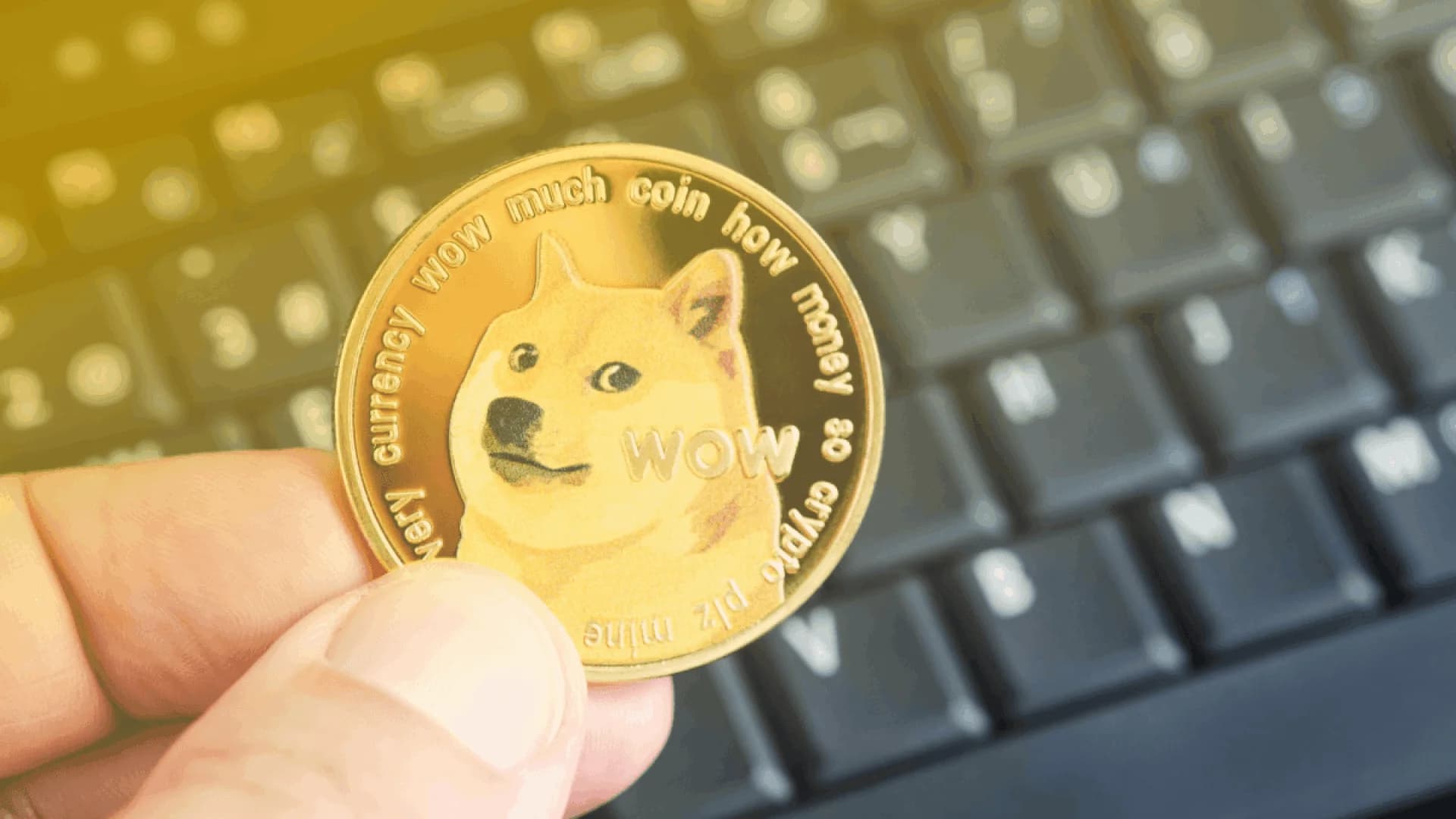
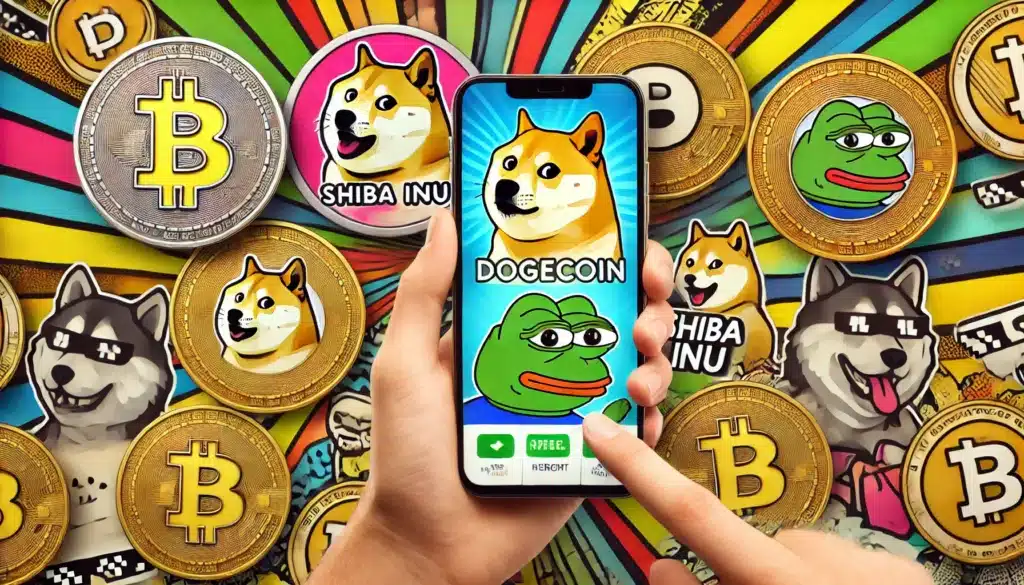
Dogecoin started in 2013 as a joke. Its creators took the “Doge” internet meme — a Shiba Inu dog with deliberately misspelt captions — and created a cryptocurrency around it. Nobody expected it to amount to anything. By early 2021, it had a market capitalisation exceeding $80 billion, driven almost entirely by social media hype and a series of endorsements from Elon Musk. People who had bought thousands of coins for a few dollars became millionaires. People who bought at the peak lost most of their money.
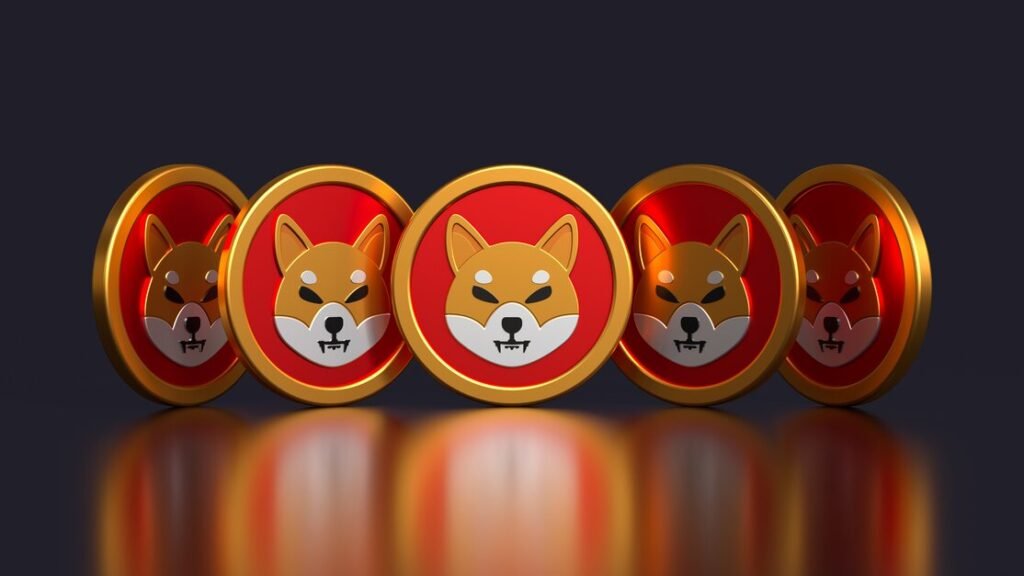
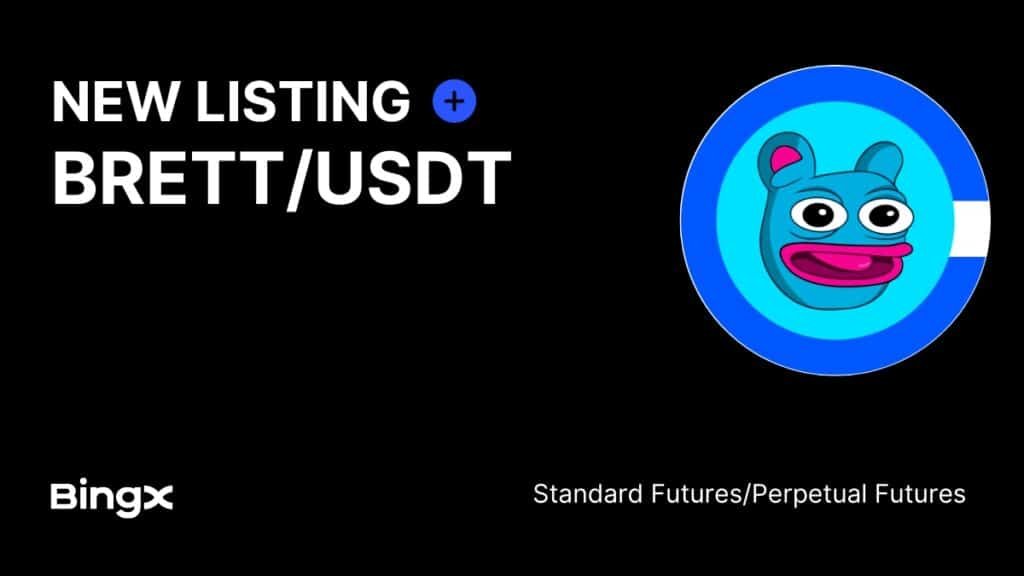
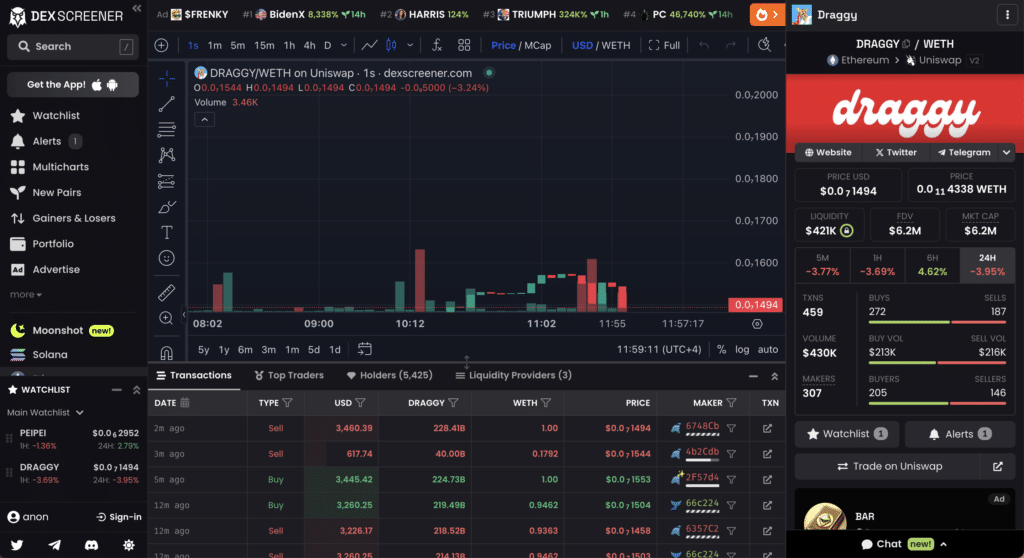
Shiba Inu (SHIB) followed a similar trajectory. Newer entrants like Brett, Pei Pei, and Draggy represent the latest wave: coins built around internet characters or themes, often launched with minimal technical infrastructure and relying entirely on community enthusiasm to generate value. Some of these projects produce extraordinary short-term returns. Most eventually collapse. The challenge is that it is almost impossible to distinguish between the two outcomes in advance.
The honest characterisation of meme coins is that they are closer to a community-driven speculation game than an investment. The price is not anchored to any underlying business, revenue, or utility — it is anchored to attention. When attention moves on, the price follows.
The UAE’s Position in the Global Crypto Market
The UAE has established itself as one of the world’s most crypto-forward jurisdictions, and that is not accidental. Dubai’s Virtual Assets Regulatory Authority (VARA), established in 2022, created a dedicated licensing framework for cryptocurrency businesses — one of the first of its kind in the world. Abu Dhabi’s ADGM has maintained a parallel regulatory framework through its Financial Services Regulatory Authority.
The results have been tangible. Major exchanges, Web3 startups, and blockchain infrastructure companies have relocated or expanded to Dubai, attracted by regulatory clarity, zero capital gains tax, and a government that treats digital assets as a strategic sector rather than a threat. For UAE residents, this means access to a relatively well-regulated local crypto ecosystem compared to many other markets.
That said, UAE residents should be aware that regulations continue to evolve, and compliance obligations — particularly around anti-money-laundering checks — apply to licenced platforms operating here. Using unregulated offshore exchanges carries both financial and legal risk.
How to Buy Cryptocurrency Safely
The process of buying cryptocurrency is now straightforward, but the choice of where to buy matters considerably.
A centralised exchange (CEX) such as Binance, Coinbase, or Kraken acts like a traditional brokerage: you create an account, verify your identity, deposit funds, and buy. In the UAE, locally licenced platforms operate under VARA oversight, which provides a degree of consumer protection. These are the most appropriate starting points for beginners.
Once purchased, cryptocurrency can be kept on the exchange (convenient, but you are trusting the platform with your assets) or moved to a personal wallet. Hardware wallets — physical devices that store your private keys offline — are the most secure option for anyone holding significant amounts.
The single most important concept for any new crypto holder: whoever controls the private key controls the cryptocurrency. If you lose your private key and have no backup, there is no customer service line to call. The assets are gone permanently. This is not a hypothetical — billions of dollars in Bitcoin have been permanently lost this way.
Understanding the Risks Clearly
Cryptocurrency carries risks that differ meaningfully from traditional investments, and they deserve plain-language explanation.
Volatility is extreme. Bitcoin has lost more than 80% of its value on multiple occasions. Altcoins and meme coins can lose 95% or more. Price swings of 20% in a single day are not unusual.
Regulatory risk is real. Governments around the world continue to develop crypto policy, and regulatory changes can dramatically affect asset values and access.
Fraud and scams are prevalent. The irreversibility of blockchain transactions makes cryptocurrency an attractive vehicle for fraud. Phishing attacks, fake exchanges, rug pulls (where project developers disappear with investor funds), and pump-and-dump schemes are all common. If something promises guaranteed returns or pressures you to act quickly, treat it as a scam until proven otherwise.
Liquidity risk affects smaller coins. A meme coin might appear to be worth a large sum on paper, but if there are few buyers when you try to sell, you may be unable to exit at anywhere near the quoted price.
The Future Outlook: Where Crypto Is Heading
The infrastructure around cryptocurrency continues to mature. Institutional adoption has moved from scepticism to active participation: Bitcoin exchange-traded funds (ETFs) were approved in the United States in early 2024, bringing crypto exposure to mainstream investment accounts for the first time. Central banks in numerous countries are developing their own digital currencies (CBDCs), which — while distinct from decentralised crypto — reflect the broader direction of travel toward digital finance.
Decentralised finance continues to expand the use cases for blockchain technology, enabling lending, borrowing, and trading without traditional financial intermediaries. Non-fungible tokens (NFTs), despite a dramatic cooling from their 2021 peak, represent an ongoing experiment in blockchain-based digital ownership that has genuine applications in art, gaming, and intellectual property.
The trajectory points toward crypto becoming a permanent fixture of the financial landscape — not a replacement for traditional systems, but an additional layer operating alongside them. For UAE residents in particular, understanding this space is increasingly relevant as the country cements its position as a global digital asset hub.
Frequently Asked Questions
Is cryptocurrency legal in the UAE? Yes. The UAE has a developed regulatory framework for virtual assets. Dubai’s VARA and Abu Dhabi’s FSRA both licence and regulate crypto businesses. Residents can legally buy, sell, and hold cryptocurrency, though they should use regulated platforms.
Do I pay tax on crypto gains in the UAE? The UAE has no personal income tax, and qualifying personal investment income is excluded from the natural-person business calculation for Corporate Tax. Business activity and obligations in another country require separate assessment. The FTA’s AED 1 million natural-person business-turnover test is different from taxable-profit bands.
What is the difference between a coin and a token? Coins (like Bitcoin or Ethereum) operate on their own blockchain. Tokens are built on top of an existing blockchain — most commonly Ethereum — and typically represent a specific project, service, or asset.
How much should a beginner invest in crypto? Only what you can afford to lose entirely. This is not a figure of speech. Crypto markets are volatile and the risk of loss — particularly with smaller coins — is substantial. Financial advisers commonly suggest keeping highly speculative assets to a small portion of a diversified portfolio.
What is a crypto wallet, and do I need one? A wallet stores the private keys that give you access to your cryptocurrency. Exchanges hold keys on your behalf, which is convenient but introduces counterparty risk. For larger holdings, a personal hardware wallet gives you direct control.
What is the difference between Bitcoin and a meme coin? Bitcoin has a fixed supply, a decade-long track record, significant institutional adoption, and a clear use case as a store of value and payment network. A meme coin typically has none of these characteristics. The comparison is roughly equivalent to asking what separates a blue-chip stock from a novelty lottery ticket.
This article is for informational purposes only and does not constitute financial or investment advice. Cryptocurrency investments carry significant risk. Always conduct your own research and consider consulting a qualified financial adviser before investing.
Related UAE Guides
- Why the UAE Has Become One of the World’s Best Places to Buy Bitcoin
- Crypto & NFT Investment Circles in the UAE: How They Work (2026)
- From Classrooms to Crypto: How UAE Schools are Teaching AI and Bitcoin for Global Leadership
- UAE Salary Protection Insurance: The Expat’s Ultimate Guide to Financial Resilience
Coins, Wallets and Providers Answer Different Questions
A coin is the asset; a wallet is a way to manage signing keys or an account; a provider may hold assets or execute transactions for you. A secure network does not prevent an account scam, and a licensed provider does not guarantee a coin’s value. Bitcoin.org’s guidance explains key loss, irreversibility and counterparty risk. Before your first transaction, understand which chain you are using, who controls the keys, which fees apply and whether you can withdraw. For the local route, read our UAE Bitcoin buying guide and provider comparison.