
I would rather know what a policy pays for one real appointment than be reassured by the word “comprehensive”. A health card identifies your cover; it does not tell you the network tier, remaining benefits, approval requirements or your share of the bill. Start with those details before deciding whether an upgrade is worth the premium.
Dubai’s minimum benefits include defined dental and outpatient mental-health cover; “basic” does not mean those categories are automatically absent. The AED320 Northern Emirates worker scheme is a different package, not a general fallback for an uninsured Dubai resident.
First establish which scheme and rules apply
Dubai and Abu Dhabi have their own health-insurance arrangements. The federal expansion for specified workers in five other emirates does not make every package interchangeable. A scheme name, a low premium and a UAE address are not enough to establish your eligibility.
MOHRE’s Basic Health Insurance Scheme guidance identifies private-sector employees and domestic workers in Sharjah, Ajman, Fujairah, Ras Al Khaimah and Umm Al Quwain as its target groups. It states AED320 per year and links employer purchase to residence issuance or renewal. Its published FAQ says pregnancy, childbirth and dental care are not covered, while chronic/pre-existing conditions have no waiting period. Those are that package’s terms—not Dubai’s Essential Benefits Plan.
My first question to HR or the insurer would be: “What is the exact policy and applicable scheme for me?” If your employer should provide cover but has not, ask for the applicable obligations and remedy; do not assume buying an unrelated cheap policy fixes the problem.
Read the documents together, not just the benefits grid
I would request the schedule, table of benefits, full wording, endorsements and current network list. The schedule identifies your cover; the benefit table summarises limits and conditions; exclusions and endorsements can change how a benefit operates. No defensible percentage of understanding comes from reading just one document for 15 minutes.
Write down the policy dates, insurer and administrator, membership number, network name, benefit used so far, claim deadlines and contact route. Keep the version that applies to the treatment date. A renewed policy or updated network can differ from the document saved on your phone last year.

The glossary graphic is decorative, not a policy extract. Its garbled text is not a definition or evidence of an insurer’s terms. Use the explanations below and your actual documents.
The terms I would translate into money
- Deductible or excess: the amount you pay under the specified rule. Check whether it applies per visit, claim, admission or policy year.
- Co-payment or co-insurance: the member’s share. UAE documents can use “co-payment” for a percentage, so read the formula rather than assume the label means a fixed AED amount.
- Annual aggregate and sublimit: the overall and category-specific boundaries. Establish whether the stated limit includes your share and how earlier claims have used it.
- Network: the actual facilities and services available under your particular tier. A hospital accepting the insurer does not establish that every department and doctor accepts your plan.
- Direct billing: an arrangement for settling an eligible bill with the provider; it does not mean every charge is free or approved.
- Prior authorisation: a required approval step for specified care. Ask what has actually been approved, for which service and period, and what conditions remain.
- Member-payment cap: a cap may apply only to a particular category. Do not import an assumption that one universal out-of-pocket maximum limits every cost on every UAE policy.
Dubai’s minimum table changes the exclusions story
The DHA updated Essential Benefits Plan table, effective 1 January 2025, provides these specific checks:
- Dental: AED500 benefit with listed treatments including fillings and root-canal treatment; 30% outpatient coinsurance, with no coinsurance for a follow-up within seven days.
- Mental health: AED800 outpatient counselling benefit, 30% coinsurance and the seven-day follow-up exemption. This is not unlimited psychiatric care.
- Pre-existing/chronic conditions: a possible six-month treatment exclusion is tied to the individual’s first UAE scheme; emergencies during that period are covered, and otherwise cover starts at enrolment.
- Physiotherapy: prior approval, up to six sessions yearly and 20% coinsurance per session.
- Medicines: AED2,500 annual limit including coinsurance, formulary conditions and 30% member share.
These are selected minimum-table provisions, not an assessment of your claim. The official regulations directory is the route to subsequent rules; obtain the applicable current policy and clarification for a disputed service. The English/Arabic discrepancy provision in the circular gives precedence to Arabic.
Why “covered” still needs a calculation
Limited cover is not no cover. But a small benefit may also be insufficient for the treatment you need. I would ask for the eligible treatment code, remaining sublimit, member share and any non-covered charges together. A category name alone does not supply the answer.
For a deliberately hypothetical illustration, assume an AED1,000 eligible bill, 20% member share and an insurer-payment sublimit with only AED300 remaining. If the terms apply the 20% share first and then cap insurer payment, the normal AED800 insurer portion is reduced to AED300; the member pays AED700. That is not a calculation under the DHA dental limit above. It shows why the actual limit definition and order of calculation matter.
“Including coinsurance” is not the same as an insurer-only allowance
I would ask whether the benefit counter tracks the whole eligible bill or only the insurer’s payment. The DHA EBP medicines provision above expressly includes coinsurance in its AED2,500 annual limit. Treating it as AED2,500 the insurer pays on top of your share would overstate the allowance.
For illustration, take an eligible AED1,000 medicine bill at the listed 30% member share, with the full category allowance still available and no other adjustments. The split is AED300 for the member and AED700 for the insurer, while AED1,000—not just AED700—counts towards a limit defined to include coinsurance. That leaves AED1,500 of the illustrative category allowance. It is not a quotation for your prescription or a rule for every policy’s sublimit.
I would ask for both numbers in a claim explanation: what I owe and how much benefit remains. If the statement only shows what the insurer paid, ask how the benefit balance was calculated. That makes an actual disagreement much easier to identify than arguing over the word “covered”.
The network check I would make before a planned visit
Ask the clinic and insurer about the exact doctor, branch, service and network tier. Confirm whether a referral or authorisation is needed, whether direct billing applies and what you must pay. Record the reference number and written response. Do not delay emergency care to complete a routine appointment checklist.
The original article included this broker quotation. Its interview/attribution record remains under editorial verification; it is preserved here, not presented as a newly conducted interview:
The biggest mistake I see is clients assuming their doctor is covered. Insurer networks can and do change. Always check the latest network list on your insurer’s website or app before any appointment, especially a specialist one. A five-minute check can save you thousands of dirhams.
UAE insurance broker
I would take the practical point without adopting the promised savings figure as measured evidence. A network enquiry helps establish arrangements; it does not guarantee that every bill will be accepted.
This “illusion of coverage” illustration is not an actual insurance card or evidence that insurers universally conceal exclusions. The relevant question is what your contract and applicable rules provide.
Seven coverage questions worth asking—not seven automatic exclusions
1. Existing conditions and continuity
Disclose requested information accurately and retain proof of earlier cover. Ask how the proposed policy treats your known condition and any interruption. Do not accept a generic “six months to two years” answer without the actual applicable basis. A blog cannot determine whether a diagnosis or claim meets an exclusion.
2. Dental and optical
Ask separately about the planned dental procedure, eyewear, eye treatment and any emergency exception. They are not one benefit. The correction above is a reason to query a blanket dental rejection, not a promise that every crown, brace or optical purchase is covered.
3. Cosmetic versus medically indicated treatment
Get the doctor’s description and the insurer’s decision for the actual procedure. The same broad procedure name can conceal different clinical purposes. I would not classify a proposed treatment as cosmetic from a magazine summary or tell someone to assume reimbursement.
4. Complementary therapies
Ask about the specific therapy, practitioner, referral, authorisation and any session or monetary limit. A wellness package and insured medical treatment are different purchases. A premium product label does not establish that every therapy is included.
5. Mental-health services
Separate counselling, psychiatric consultation, prescribed medicine, inpatient care and emergency care when enquiring. Ask which service and provider are authorised. I would not let the phrase “mental-health cover” do the work of identifying an actual appointment and its costs.
6. Medicines and ongoing treatment
Ask about the exact prescription, formulary, authorisation and remaining medicine benefit. Take a coverage problem back to the treating clinician and insurer; do not stop or switch prescribed treatment solely on this guide’s advice.
7. Prevention and screening
Distinguish a screening linked to applicable age/risk criteria, a clinician-requested investigation and a commercially packaged annual check-up. Ask about each item rather than assume the entire bundle is covered or all prevention is excluded.
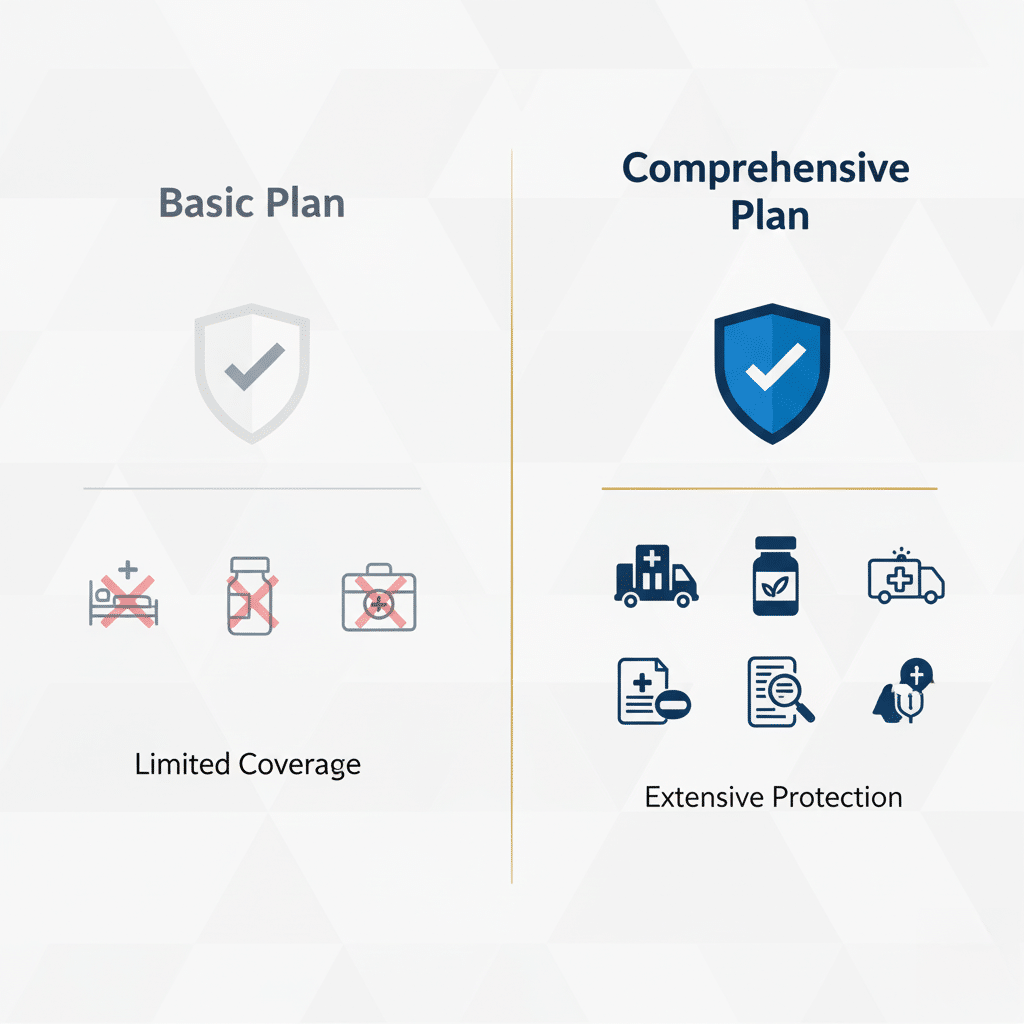
The basic-versus-comprehensive graphic is a general illustration, not a benefits comparison. Its crossed-out medical symbols do not establish that a particular basic plan excludes hospital care, medicines or other depicted services.
How I would compare a renewal or upgrade
Start with the services and places you need, then compare equivalent terms. I would favour usable access and clear answers over a longer brochure. An upgrade earns its higher premium by addressing an identified gap—not simply by being called premium.
| Record for each plan | What to establish |
|---|---|
| Premium and fees | Total payable, payment dates and renewal basis—not a monthly budgeting equivalent presented as instalments. |
| Facilities and approvals | Specific doctors/branches, referral rules, direct billing and pre-authorisation. |
| Services you expect to use | Actual benefit, member share, remaining sublimit and exclusions. |
| Existing treatment | Continuity, declarations and any treatment-specific conditions. |
| Travel | Routine versus emergency geography, reimbursement rules and any separate travel-insurance need. |
| Dependants | Who is enrolled, their dates and documents; your own card is not proof of everyone’s cover. |
I would also keep a small cash-flow calculation. With assumed figures only, an AED1,200 premium plus AED600 eligible cost shares and AED400 excluded charges means AED2,200 total personal spending. Another policy at AED1,800 plus AED200 cost shares and AED100 excluded charges totals AED2,100. The second is AED100 cheaper in that scenario, not a universally better policy or a forecast of your health.
A rejected claim: build an evidence file before escalating
I would ask for the specific decision, not accept “not covered” as a complete explanation. Record whether it is a denied pre-authorisation, rejected reimbursement, billing dispute or missing-document request; they need different responses. Ask for the reason, relevant clause, service code and next review step in writing.
- Match the decision to the policy and treatment dates, benefit, network and any approval reference.
- Ask the clinic to check factual or coding errors and provide appropriate supporting clinical documents.
- Submit a clear formal complaint or review request to the insurer/administrator through its stated process, keeping the acknowledgement and deadlines.
- Use the appropriate external channel if necessary, checking jurisdiction and eligibility. Do not assume one regulator is the final appeal for every dispute.
Official routes to check
- Dubai: ISAHD’s iPROMeS page provides health-insurance feedback and complaint access. HICAL is separately described for suspected fraud, waste or abuse; do not interchange the purposes.
- Abu Dhabi: the Department of Health contact page lists a health-insurance complaint request and 800555 for enquiries.
- Insurance-company complaints: Sanadak’s current eligibility check asks about a prior insurer complaint, 15 calendar days and the response, alongside other conditions. Confirm that your issue belongs there; the displayed period is not a promise of resolution.
A complaint request you can adapt
Please review decision [reference/date] for service [code/date/provider] under policy [number/dates]. The reason given is [reason]. Please identify the applicable clause, benefit calculation, network/approval record and any missing evidence. I attach [documents] and request a written response, complaint reference and the applicable next review route. Please distinguish a correctable administrative issue from a coverage exclusion.
Keep personal medical documents out of public comments and social posts. Use the official secure channel. This guide does not decide clinical necessity, legal entitlement or an individual claim.
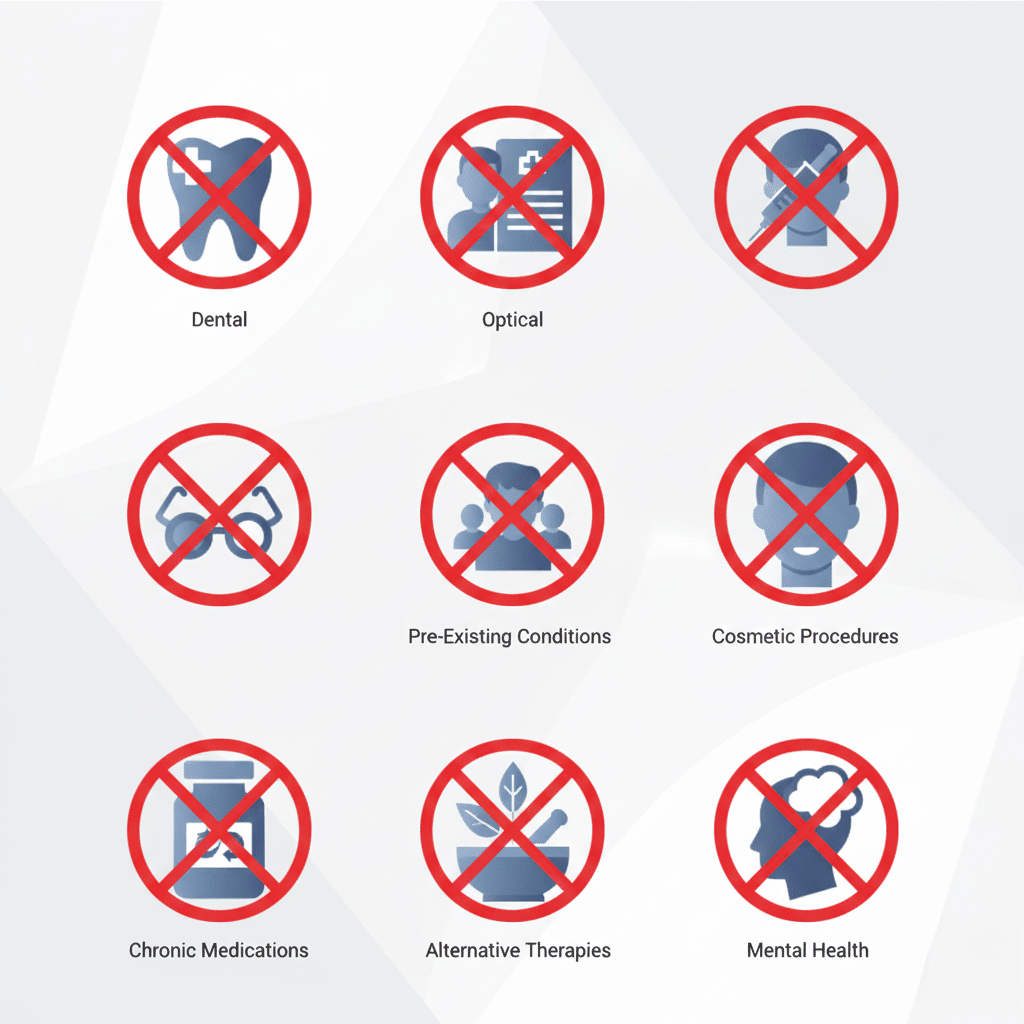
Graphic correction: the crossed-out categories above are not a valid list of blanket exclusions. In particular, they contradict the Dubai minimum-table provisions discussed earlier. Do not use this illustration to decide whether to seek care or submit a claim; its replacement is pending editorial approval.
My verdict: less fear, better questions
I would check one real service end to end before spending more on a vague promise of better cover. Get the applicable documents, ask precise questions and retain the answers. When a decision is disputed, the dates, wording, approvals and evidence matter—not dramatic language about invisible holes in your card.
Sources and review scope
Reviewed 19 October 2026 against the named MOHRE, DHA, Department of Health and Sanadak sources. Relevant DHA table text was read and its dental page visually checked. On 21 October, the medicines provision was visually rechecked for the worked limit calculation, and ISAHD’s complaint-channel distinction and Sanadak’s eligibility guidance were rechecked. Four body illustrations and the hero were viewed and preserved; their limitations are labelled. The original broker quotation is awaiting attribution confirmation, and a misleading graphic awaits a replacement decision. This is not a complete professional legal, medical or policy-wording review, a treatment recommendation or a claim-payment guarantee. Author, original publication date and selected indexing/canonical settings remain unchanged.