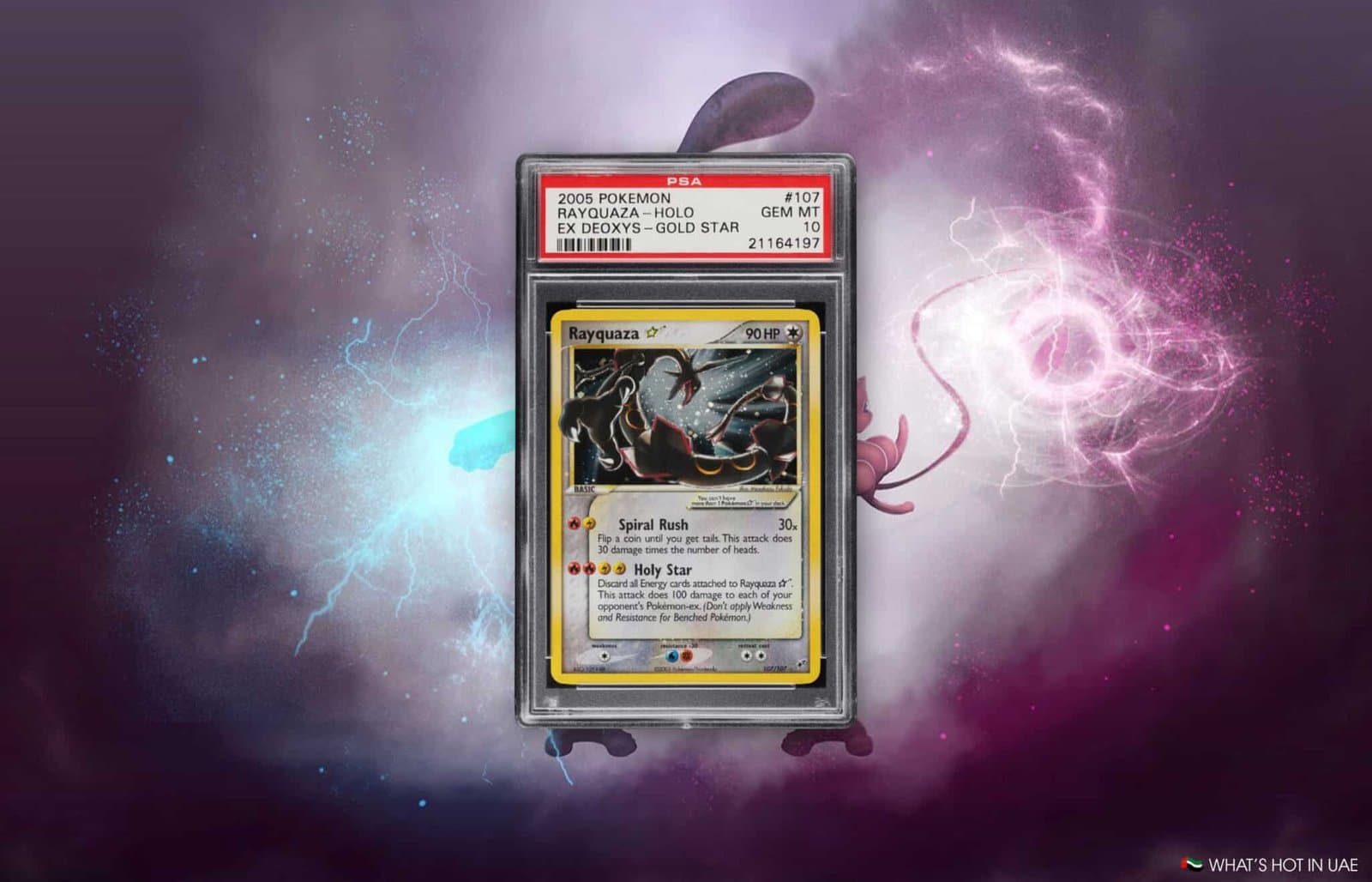
A 2005 Gold Star Rayquaza has become the first English Pokémon card to sell for over $1 million. Discover why this specific grade drove the record price.
A million dollars for Rayquaza is a spectacular headline. The detail I would not skip is the label: this was a CGC Pristine 10 copy of the English 2005 EX Deoxys Gold Star, not a price for every card with the same artwork. Fanatics Collect’s completed lot records US$1,020,000 including buyer’s premium on 28 August 2026, after 35 bids.
My view: enjoy the record, but do not let it become a shortcut to valuing another copy. Exact card, condition, certification and the basis of the price all matter. A record result is evidence of that transaction—not a promise about what a collector will get next.
Image note: the hero graphic shows a PSA Gem Mint 10 holder. It illustrates the card design, but it is not the CGC Pristine 10 auction lot. The original images are retained with that distinction made explicit.
The sale in one minute
| Question | Verified answer |
|---|---|
| Which card? | English 2005 Pokémon EX Deoxys Holo Rayquaza Gold Star #107. |
| Which grade? | CGC Pristine 10; not a generic “10” across grading companies. |
| When and where? | Fanatics Collect August Premier Auction, sold 28 August 2026. |
| What does US$1,020,000 include? | The buyer’s premium. It is not identified as the hammer price or the seller’s net proceeds. |
| What does the population of one mean? | The auction’s recorded Pristine-grade population, not that only one Rayquaza Gold Star card was printed. |

Why CGC Pristine 10 is not the same as Gem Mint 10
CGC’s card grading scale separates Pristine 10 from Gem Mint 10. Its Pristine standard calls for 50/50 centering and a virtually flawless appearance; Gem Mint is also an overall 10 but misses at least one Pristine criterion. I would read the full designation, not stop at the largest number on the holder.
CGC’s 12 August report records a Gem Mint 10 Rayquaza at US$168,000 on 19 July. It also describes factory edge wear as a grading difficulty and reports more than 250 graded copies, including 12 Gem Mint 10s and one Pristine 10. Those are dated report figures, not a freshly audited October population.
The August record is about 6.07 times the July result: US$1,020,000 divided by US$168,000, a difference of US$852,000. Both reported totals include buyer’s premium. That is our calculation across two different sales, not a controlled experiment proving that a grade change alone caused a sixfold price increase. Different copies, bidding and timing remain part of the comparison.
I would reject the conclusion that any Gem Mint copy is now worth the record divided by six. An arithmetic ratio is not a valuation model. Nor would I treat “population one” as permanent: the auction description and CGC’s September sale report describe the rarity at that time, including Fanatics’ statement about other grading-company populations.
What record did it actually set?
CGC described the August result as a new record for an English Pokémon card. Dropping “English” changes the story. It was not the first Pokémon card of any language to pass US$1 million, and this historical milestone is not a live ranking of every subsequent auction or private sale.
The earlier English benchmark discussed in the coverage was the PSA Gem Mint 10 First Edition Base Set Charizard at US$954,800. Goldin’s own later auction description confirms that February 2026 result and its connection to the 2021 Logan Paul and Ken Goldin break. Rayquaza’s US$1,020,000 total exceeds that figure by US$65,200—our subtraction, not a like-for-like judgment of the two cards.
For the broader comparison, Guinness World Records’ February report documents the Pikachu Illustrator auction at US$16,492,000, including buyer’s premium. Different language, issue and provenance mean it is context, not a direct price comparison for a Gold Star.
Rarity, artwork and the pull-rate problem
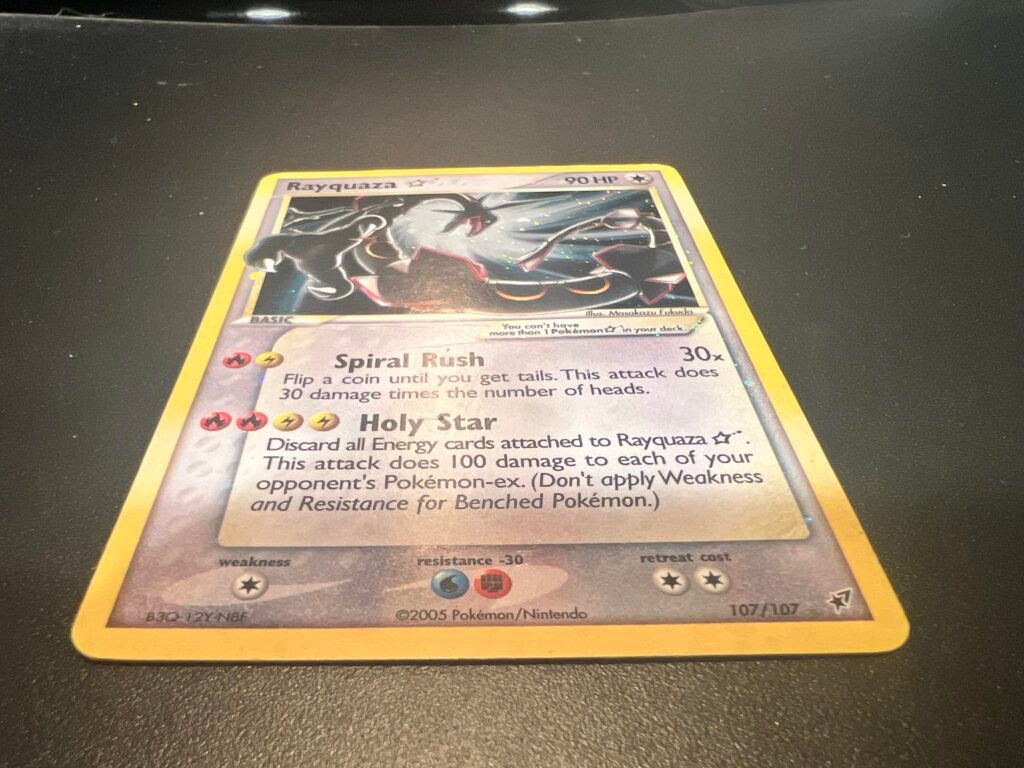
The appeal is easy to see in the black Rayquaza and the illustration spilling beyond its usual window. I like that the card looks dramatic without needing a price caption to tell me it is interesting. The set and card number still matter: the character’s name alone does not distinguish #107 from other Rayquaza printings.
Fanatics’ lot describes Gold Stars as roughly one per two boxes. CGC’s August report states one per 72 packs, while its September report gives 64 packs. Those published figures conflict, so I would not present one pack count as a guaranteed probability for finding this exact card. A general Gold Star insert rate would not establish the chance of pulling Rayquaza in Pristine condition anyway.
What I would check before comparing a UAE asking price
I would start with the seller’s exact card, not this headline. Ask for clear front, back and holder photographs; match the set, number, language, grading company and full grade. Follow the grader’s own certificate lookup and compare its details and images with the offered item. A matching number alone is not my authentication of a physical card.
- Completed result or asking price? A live listing is not proof that someone paid that amount.
- Same price basis? Keep hammer price, buyer-inclusive total and seller proceeds separate. Do not add another buyer’s premium to a figure already labelled inclusive.
- Same item and grade? An ungraded card, a PSA 10 and a CGC Pristine 10 are not interchangeable comparables.
- Actual acquisition cost? Get delivery, insurance, applicable import charges and the seller’s terms in writing before comparing the final cost in the UAE.
There is a documented Dubai connection to the wider collecting story: Guinness says Logan Paul acquired his Illustrator from Marwan Dubsy in Dubai. That is a specific piece of ownership history. It does not establish that this Rayquaza sold in Dubai, or that UAE collectors as a group treat cards like watches and cars.
My verdict: celebrate the card, do not buy the headline
The record is extraordinary. The buying lesson is much less glamorous and much more useful: identify the exact thing being sold. I would rather have a clearly documented, correctly described card I actually want than an impressive seller’s story built around someone else’s auction.
For a lighter Pokémon crossover, our Polaroid x Pokémon guide covers a different collecting idea. It is not a price comparable for this graded card.
Source and image checks
Reviewed on 20 October 2026 against the completed Fanatics lot, CGC’s August and September reports and grading scale, Goldin’s historical price reference and Guinness’ February auction report. The CGC certificate lookup returned an access error in this check; the auction’s dated certificate statement is not represented as a fresh independent lookup. All three existing images were visually inspected. No card was handled, authenticated, purchased or graded for this review.