
Most presidential palaces don’t let you in. Qasr Al Watan does — and it’s become one of Abu Dhabi’s most visited cultural sites precisely because of it. This is the UAE’s working presidential palace, opened to the public as a monument to Emirati governance, knowledge, and craftsmanship, and it’s a genuinely striking piece of architecture…
Key Takeaways
- Qasr Al Watan, Abu Dhabi’s presidential palace, offers a unique cultural experience as it combines official state functions with public access.
- Match the actual admission and show entitlement to the chosen date; the optional 30-minute guided tour requires a general-admission ticket too.
- The Palace in Motion light show captivates guests with stunning visuals and tells the story of UAE history after dark.
- To enjoy Qasr Al Watan best, visit in the late afternoon and adhere to the modest dress code, covering shoulders and knees.
- The palace features exquisite architecture, including a grand dome and hand-crafted details, along with a substantial library on Arab history.
Most presidential palaces don’t let you in. Qasr Al Watan does — and it’s become one of Abu Dhabi’s most visited cultural sites precisely because of it. This is the UAE’s working presidential palace, opened to the public as a monument to Emirati governance, knowledge, and craftsmanship, and it’s a genuinely striking piece of architecture regardless of your interest in politics.
What Is Qasr Al Watan?
Qasr Al Watan, meaning “Palace of the Nation,” is the official presidential palace of the United Arab Emirates in Abu Dhabi. While it still hosts state functions and official ceremonies, large sections are open to visitors as a cultural and educational attraction, showcasing Arabian hospitality, governance, and the arts and sciences that shaped the region. Rather than a straightforward palace tour, it’s designed as an immersive experience: halls dedicated to knowledge, diplomacy, and heritage sit alongside opulent state rooms, making it as much a museum as a palace.
Ticket Options
Separate the actual admission product from a guided-tour add-on. The operator’s 30-minute guided tour is valid only alongside a general-admission ticket, offers English and Arabic guidance and requires arrival at the Visitor Centre 30 minutes before the scheduled tour. Its slots are non-refundable and non-exchangeable. Do not infer a premium-library tier or afternoon-tea inclusion from a generic description: choose the named product and read its current price and terms.

The Palace in Motion Light Show
Palace in Motion is a light-and-sound experience distinct from browsing the interior exhibits. Use the operator’s selected-date timing information and confirm whether the purchased product includes the show. Its stated last-entry cutoff is 30 minutes before the start, so arriving only 15–20 minutes beforehand is not a reliable plan. Give the journey and security screening enough time, and do not assume a show runs at one permanent nightly hour.
Architecture Highlights
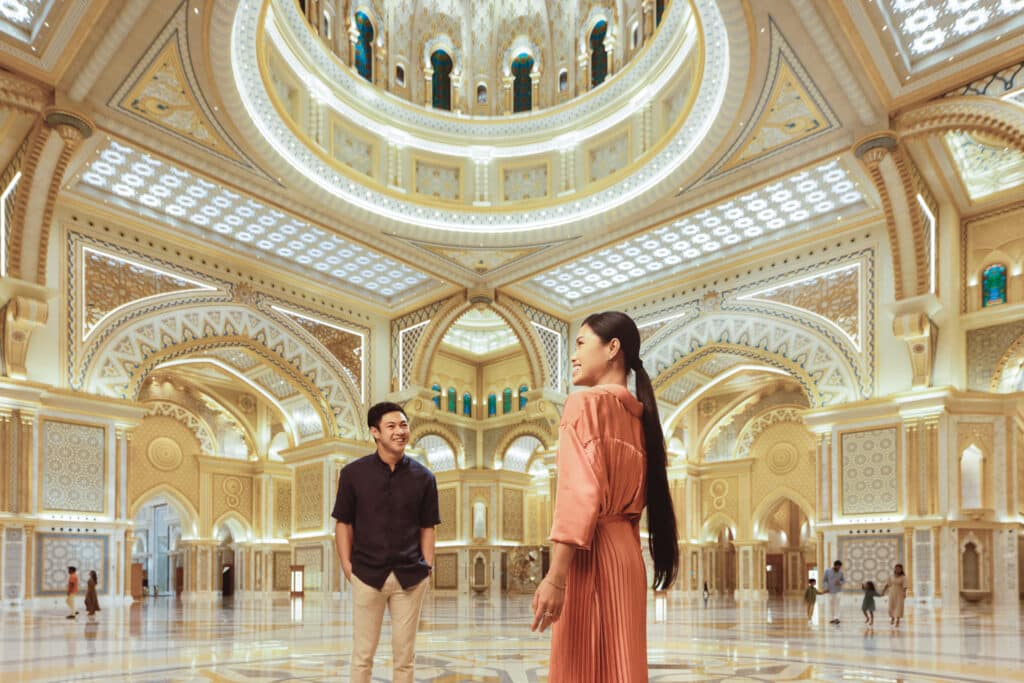
The architectural setting is a reason to visit, but the exhibits give the day more substance than a quick dome photograph. The operator’s palace overview describes Emirati governance and culture, the House of Knowledge and Qasr Al Watan Library. Our preference is to give the displays time alongside the Great Hall, rather than judge the visit only by its decorative scale. A route through public areas does not grant access to every space used for government business.
Best Time to Visit
A late-afternoon visit can combine interior time with an evening show when the actual admission and timetable allow it. Check that arrangement before reserving transport. Two to three hours is a planning allowance for the selected exhibits, not a guarantee of seeing every area or a required minimum. An outdoor evening in the cooler months is a different experience from air-conditioned interior browsing during summer.
Tips for Visiting
Wear clothing covering shoulders and knees, with comfortable footwear that meets the operator’s dress rules; flip-flops and overly casual shoes are prohibited. Plan to walk and pass security screening. Non-commercial photography is permitted subject to the published restrictions, while commercial work requires permission. Follow the actual site instructions and keep photography respectful of other visitors. A phone or small camera does not authorise filming security staff or systems.
How to Get There
Qasr Al Watan is in Al Ras Al Akhdar, near Abu Dhabi’s Corniche. Use the actual arrival point and current journey estimate from the place you are leaving, rather than a fixed drive time for all of Dubai or central Abu Dhabi. The visitor information lists free self-parking and a shuttle between the Visitor Centre and palace entrance. It also lists valet at AED 35. An internal shuttle is not transport from your hotel.
Dress Code and Visitor Etiquette
The published dress code prohibits shorts, sleeveless tops and see-through clothing, and requires knees and shoulders covered. Do not rely on staff supplying a wrap or admitting someone whose outfit does not meet the rules. Share the requirements with the group before leaving. The shoes also matter: choose comfortable permitted footwear for the walking involved, rather than assume any beach-style shoe is acceptable.
Bring a small bag: the operator says there are no cloakrooms or lockers, and oversized luggage can be refused at security. Store travel bags at the hotel or airport if visiting en route. The published policy allows bottled water as an exception to its outside-food-and-drink restriction. Confirm any particular equipment before carrying it into a working government site.
Food during the visit: the current visitor page lists Dhiyafat and Maqha Al Maktaba as temporarily closed and Legma as open. Plan the meal around the venue actually operating rather than an unverified afternoon-tea package. For the current booking or access question, the operator lists +971 600 544 442.
Frequently Asked Questions
Is Qasr Al Watan open to the public every day?
Qasr Al Watan is generally open daily, though hours and occasional closures for state events can vary. Check the official website for current opening times before planning your visit.
How much does it cost to visit Qasr Al Watan?
Use the current named ticket’s final price and inclusions. The 30-minute guided tour requires a general-admission ticket alongside it; it is not an admission replacement. Compare the actual products and selected date through the official site, and check show entitlement separately.
Is there a dress code?
Yes. Cover shoulders and knees. Shorts, sleeveless tops, see-through clothing, flip-flops and overly casual footwear do not meet the published rules. Plan the outfit before arrival instead of assuming a covering will be supplied.
Can I see the Palace in Motion show with a daytime ticket?
Confirm the selected-date show and the entitlement on the actual ticket. The operator states that last entry to Palace in Motion is 30 minutes before its start. A daytime route, guided tour and show should not be treated as interchangeable products.
Are Qasr Al Watan and Emirates Palace the same place?
No, and this trips up a lot of first-time visitors. Emirates Palace is the sand-coloured luxury hotel next door, sometimes nicknamed the “seven-star hotel,” while Qasr Al Watan is the white, domed presidential palace open for cultural tours. The two sit close enough together on Abu Dhabi’s Ras Al Akhdar peninsula that they’re easy to confuse from a distance, but they’re entirely separate venues with separate entrances and ticketing.
Does the President actually live at Qasr Al Watan?
Qasr Al Watan is a working seat of government used for official state functions, ceremonies, and hosting visiting dignitaries, rather than a private residence. It genuinely operates in that governing capacity alongside its role as a public attraction, which is part of what makes it unusual internationally, very few countries let visitors walk through halls still actively used for state business.
Is the Qasr Al Watan Library open to the public?
The operator includes Qasr Al Watan Library in its description of the palace’s visitor experience. Check current access and any requirements for the activity you want, particularly if research or reading is the main reason for going. The library and a guided-tour slot are different parts of the visit.