Headlines in July 2025 compared the estimated value of bitcoins attributed to Satoshi Nakamoto with the fortunes of prominent billionaires. The underlying calculation can be enormous, but “11th richest person” is not a permanent or officially established ranking. The amount attributed to Satoshi is an analytical estimate, the identity behind the pseudonym remains uncertain, and…
Key Takeaways
- In July 2025, headlines compared the estimated wealth of Satoshi Nakamoto to that of billionaires, but rankings remain speculative and not officially established.
- The calculation of Satoshi’s wealth, approximately $133.34 billion, relies on estimated Bitcoin holdings and fluctuating market prices.
- Satoshi Nakamoto’s identity is still a mystery, with various candidates proposed but none proven, leaving the wallets untouched.
- Understanding Bitcoin value requires careful attribution; market estimations do not equate to legal ownership or access to keys.
- Satoshi’s potential to become the world’s richest person depends on Bitcoin’s price increase and the stability of other billionaires’ fortunes.
Headlines in July 2025 compared the estimated value of bitcoins attributed to Satoshi Nakamoto with the fortunes of prominent billionaires. The underlying calculation can be enormous, but “11th richest person” is not a permanent or officially established ranking. The amount attributed to Satoshi is an analytical estimate, the identity behind the pseudonym remains uncertain, and market prices change. This guide explains how those wealth estimates are constructed, what early-wallet evidence can show and where it stops short of proving personal ownership or spendable wealth.
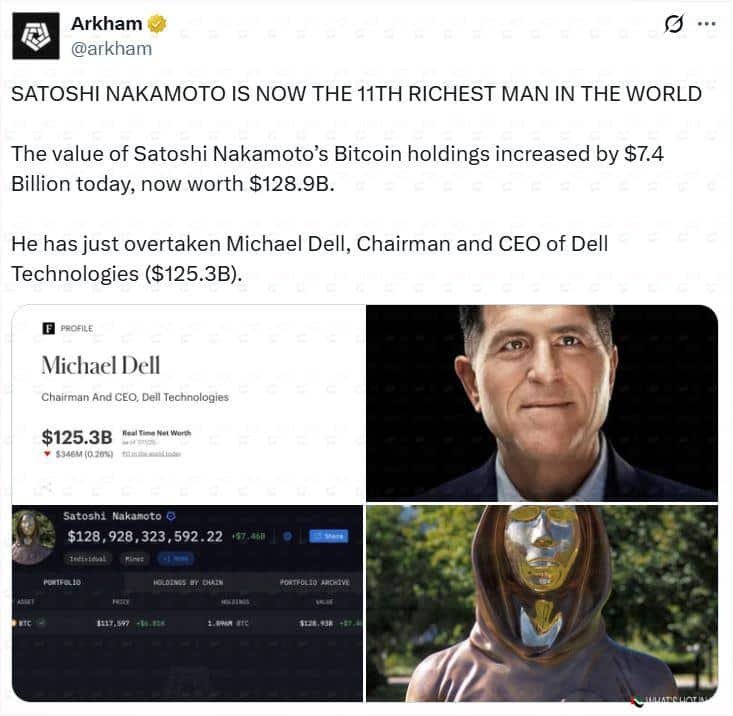
The original July 2025 comparison cited Arkham’s estimate of approximately 1.096 million BTC attributed to early mining. At an illustrative price of $121,659, multiplying that assumed balance gives about $133.34 billion. This is a dated, conditional calculation: the estimated attribution, the market quote and a person’s actual net worth are different things. It should not be read as today’s balance or an official wealth ranking.
Multiplying an assumed holding by a quoted Bitcoin price gives an estimated market value. It does not turn wallet attribution or a billionaire ranking into a blockchain-verified fact. The ledger records transactions and outputs; it does not identify a person’s entire assets, liabilities, access to keys or current legal ownership. Treat the result as conditional on the holding estimate and pricing date.
It is also too broad to say Satoshi never spent any bitcoin: the early history includes the test transaction to Hal Finney. That known event is different from whether particular blocks attributed by a clustering model remain unspent. A claim about the whole estimated wallet set needs the method, selected outputs and timestamp identified.
This isn’t just a story about wealth. It’s about anonymity, discipline, and the unstoppable momentum of an idea that changed the very definition of money.
Check out: UAE CRYPTO: THE FUTURE OF FINANCE
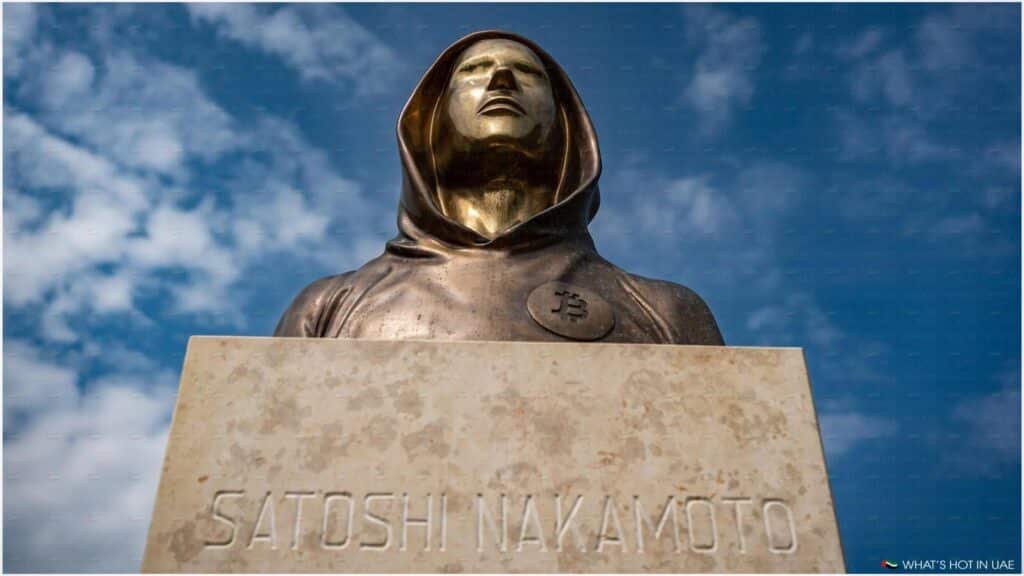
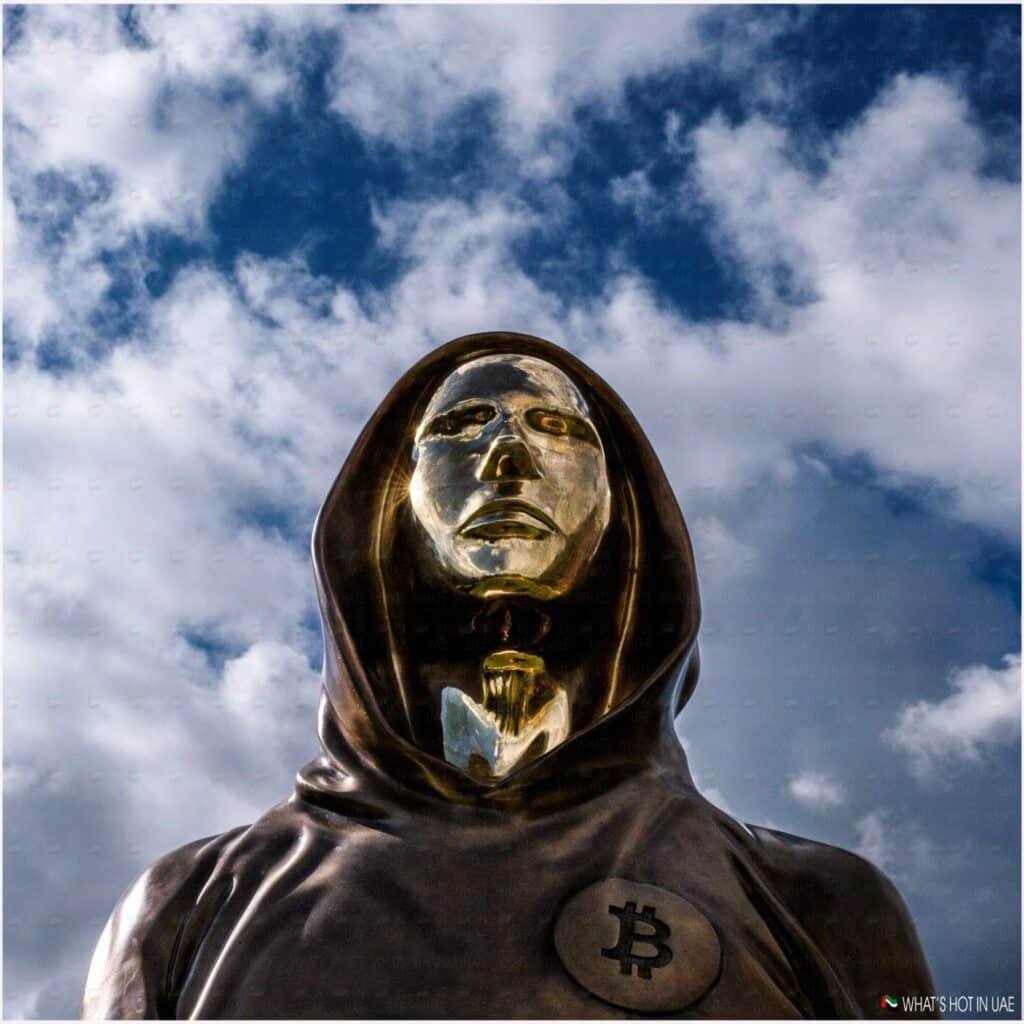
Who is Satoshi Nakamoto?
That question remains one of the internet’s greatest unsolved mysteries.
Satoshi Nakamoto is the pseudonymous author of the Bitcoin whitepaper, published in October 2008, and the original developer of the Bitcoin software, which launched the following January. Satoshi corresponded with early contributors on cryptographic forums and email, then quietly disappeared in 2010, handing over the GitHub repository and disappearing completely from public communication.
To this day, no one has ever been able to definitively identify Satoshi. The guesses have ranged from Hal Finney, the late cryptographer who received the first Bitcoin transaction, to Nick Szabo, an early smart contracts theorist, and even Dorian Nakamoto, a Californian engineer falsely outed by Newsweek.
While many have speculated, none have proven. The wallets remain untouched. The mystery remains intact.
Satoshi’s net worth by the numbers
The arithmetic below illustrates the assumptions used in the original July 2025 comparison. It is not a live valuation or an official Forbes position. At 1.096 million BTC and a hypothetical quoted price of $121,659 per coin, the product is approximately $133.34 billion. Change either input and the result changes; neither multiplication nor a chart establishes that one identified person owns and can spend every coin in the model.
- Total Bitcoin held: 1.096 million BTC
- Illustrative July 2025 BTC quote (as of Sunday): $121,659
- Total value: approx. USD 133.4 billion
- Original July 2025 comparison figure for (Michael Dell): $125.1 billion
- Original comparison, conditional on assumed holdings: Above Michael Dell, just behind Warren Buffett ($139B)
This calculation comes directly from wallet analysis tools like Arkham and Nansen. They use block history to identify addresses believed to be linked to early mining activity exclusive to Satoshi’s operation.
An address-cluster estimate is not the same as a signed demonstration of ownership. Its size and spending status depend on the methodology and snapshot. Check whether the provider is reporting mined rewards, current unspent outputs, a selected address set or an entity label. Those quantities may differ. A lack of movement in selected outputs cannot establish the holder’s motives, continued access to keys or all other transactions associated with the pseudonym.
Why this ranking matters
At a glance, it might seem like a novelty — a ghost with a billion-dollar stash. But in the world of financial rankings, it breaks every norm.
Forbes, Bloomberg Billionaires Index, and other wealth trackers typically measure fortune based on public, verifiable assets like stocks, company ownership, and property. They do not normally include anonymous crypto wallets, precisely because they can’t always attribute ownership.
The Patoshi analysis examines patterns in early mining data. Sergio Demian Lerner’s original research explicitly qualifies the ownership inference rather than claim certainty. A pattern can support an estimate of a dominant miner’s activity, but identifying that miner with Satoshi and defining which outputs belong in the set remain analytical assumptions. Different researchers and providers can classify blocks differently. Describe the method and uncertainty, rather than assert unanimous attribution or that no other miner could have created the relevant outputs.
If any wealth deserves acknowledgement, it’s this one. And it redefines what modern wealth even means — proof-of-work validated, publicly traceable, yet personally anonymous.
Could Satoshi become the world’s richest person?
That’s the big question. And the answer is: yes, but it depends on two things:
- Bitcoin’s price is climbing significantly
- Other billionaires’ fortunes remaining static
Let’s run the maths. As of mid-2025:
- Elon Musk leads the list with a net worth of $404 billion
- Larry Ellison and Mark Zuckerberg follow, each with approximately. $274 billion
- Satoshi, with $133B, needs Bitcoin to hit approximately $370,000 per coin to overtake Elon Musk
That represents a 208% increase from current BTC levels — ambitious, but not unimaginable in the context of past bull runs.
Crypto market veterans like Arthur Hayes predict $250K Bitcoin by the end of 2025. Matt Hougan, CIO of Bitwise, has publicly called for $200K Bitcoin by the end of next year, citing rising institutional demand and a “supply shock” following 2024’s halving event.
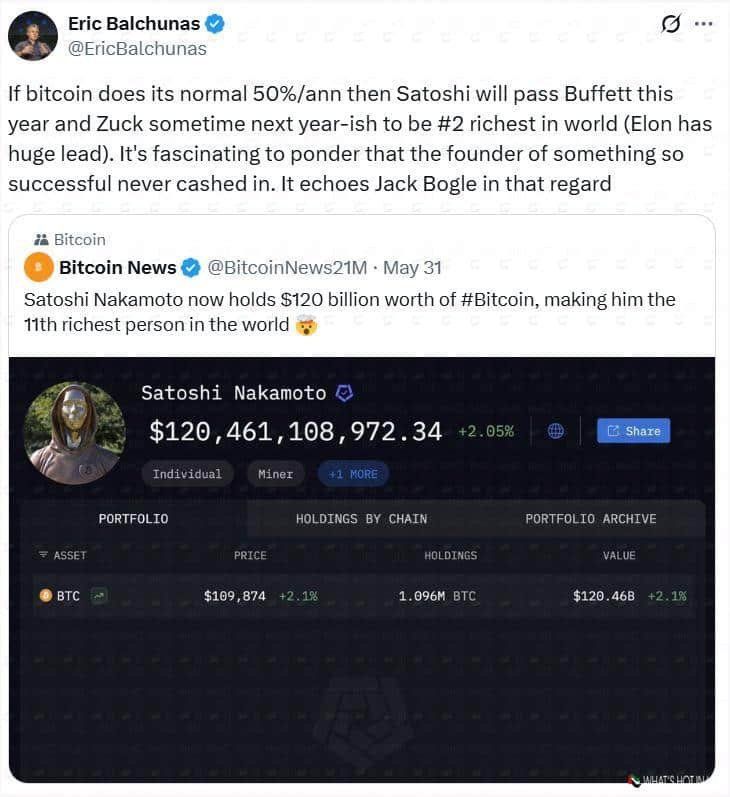
Bloomberg ETF analyst Eric Balchunas even projected that if Bitcoin continues its historic 50% annual growth, Satoshi could become the second-richest person by 2026.
What a Wealth Ranking Would Need to Establish
A credible comparison requires more than a list of large fortunes. The original July 2025 figures were a point-in-time comparison, not a live billionaire index. The following checks explain what needs to be established before assigning a rank.
- Identify the holding estimate and the outputs included.
- Distinguish a mining-pattern attribution from demonstrated personal ownership.
- Use the same valuation date for all assets being compared.
- Separate gross asset market value from net worth after liabilities.
- Consider custody, access to keys and whether assets can be sold.
- Read the wealth-index methodology rather than assign an official rank by analogy.
The unusual part of the estimate is the uncertainty about the person or group, the ownership attribution and access to the coins. Those uncertainties are not resolved by comparing a cluster’s market value with the disclosed shares of a named executive. The two estimates need compatible definitions before a ranking can be meaningful.
Could Satoshi ever spend it?
This is where things get philosophical. Even if Satoshi wanted to cash out, moving any of those coins would instantly trigger massive scrutiny — and possibly panic.
Movement from an address attributed to an early miner could attract attention, but it would not automatically prove Satoshi’s identity or guarantee a market crash. Attribution, the transaction’s purpose, destination and size would all need examination. Legal and tax implications would depend on the actual owner and relevant jurisdictions. Avoid predicting a particular outcome merely from the age of an output or an analytics label.
Some large sets of early outputs remain a focus of research because they are believed to be associated with the dominant early miner. That is separate from the documented early payments and from a claim about every coin Satoshi might ever have controlled. The historical evidence does not establish why a particular output has or has not moved.
It is tempting to interpret dormant coins as deliberate restraint, but lost keys, uncertain ownership or unknown circumstances are also possible explanations. An account of the mystery should distinguish those possibilities from facts that the ledger can demonstrate. The absence of a transaction does not prove an ideological motive.
The shadow of Jack Bogle
Eric Balchunas compared Satoshi to Jack Bogle, the founder of Vanguard and the inventor of the index fund. Despite creating trillions in value for the world, Bogle died in 2019 with a net worth of just $80 million.
He never chased profit. He didn’t exploit his invention, and he let it serve people.
Satoshi may be echoing that legacy, letting the network grow without touching the coins. It creates legitimacy, trust, and ideological purity. It also ensures that Bitcoin remains decentralised in spirit, not just in code.
What about other Bitcoin whales?
Other large Bitcoin holdings need similar care. A personal holding, a corporate treasury, an exchange wallet and assets held for customers are different categories. An address with many coins is not proof that one person owns them all. Likewise, a historical auction purchase or an executive’s old disclosure does not establish their present balance. Compare dated disclosures and custody arrangements instead of combine them into an unsupported current rich list.
- The Winklevoss twins: Approx. 70,000 BTC each (via Gemini)
- Tim Draper: Around 30,000 BTC (from a 2014 US Marshals auction)
- Michael Saylor: Holds 17,732 BTC personally (outside of MicroStrategy’s treasury)
- Public companies + custodians: Combined, they hold approx. 847,000 BTC (about 4% of total supply)
The estimated Satoshi-associated balance is significant, but comparisons need compatible definitions and dates. Use the same distinction between owned assets and customer custody, identify the supply denominator and acknowledge attribution uncertainty. A percentage of Bitcoin’s eventual maximum supply is not necessarily the same as a percentage of currently circulating or spendable coins.
Institutional fuel: Why the price could keep rising
Bitcoin’s current bull cycle is being powered not by retail traders but by some of the world’s largest institutions.
- BlackRock’s Bitcoin ETF was approved earlier this year
- Fidelity, Franklin Templeton, and VanEck have joined the party
- Goldman Sachs and JP Morgan are now offering crypto custody and exposure products to clients
- Sovereign wealth funds, including in the UAE and Singapore, are rumoured to be accumulating BTC
As supply becomes increasingly scarce and traditional institutions pour in, the case for Bitcoin hitting $200K–$300K in the next two years becomes more plausible, especially if global inflation and distrust in fiat currencies persist.
The ultimate paradox
The world’s most elusive inventor is on the cusp of becoming its richest. And he may never know — or care.
That’s the paradox of Satoshi Nakamoto. In a world obsessed with influence, visibility, and monetisation, Satoshi chose silence. In a world where billionaires tweet, launch rockets, and flaunt yachts, Satoshi’s only legacy is code — and the decentralised trust it created.
And that might be the most radical form of wealth we’ve ever seen.
On-Chain Questions
How many Bitcoins does Satoshi Nakamoto own?
Estimates commonly refer to a large set of early-mined outputs, often around a million coins. The exact set and its attribution are contested analytical questions; the blockchain alone does not establish an identified person’s full holdings.
Is Satoshi Nakamoto richer than Elon Musk?
A comparison requires an assumed Bitcoin holding, a dated price and a compatible estimate of another person’s net worth. It is not a fixed, verified ranking. Market value is different from realised proceeds or accessible wealth.
Why hasn’t Satoshi Nakamoto spent his Bitcoin?
The reasons for dormant outputs are unknown. The early record includes payments sent by Satoshi, including the test transaction to Hal Finney; do not generalise from an estimated cluster to a claim that Satoshi never spent any bitcoin.
Could Satoshi Nakamoto be more than one person?
Satoshi Nakamoto is a pseudonym, and the identity has not been conclusively established. Neither a group theory nor an individual candidate should be presented as proven by a mining-pattern estimate.
Market Value Is Not Cash You Can Necessarily Realise
A spot-price multiplication values every assumed coin at the same quoted price. Selling a very large holding can have fees, execution constraints and market impact, so the multiplication does not guarantee an equal cash receipt. It also says nothing about the availability of private keys. To compare a crypto estimate with a billionaire index, identify the valuation time, holdings methodology, ownership assumptions and liabilities. That distinction is the reason a spectacular headline should not be treated as an independently established personal net-worth record.