The age limit is the first thing I’d check—not the reassuring safety badge on an app. The UAE’s Child Digital Safety Law is Federal Decree-Law No. 26 of 2025. A later measure, Cabinet Resolution No. 106 of 2026, sets a minimum age of 15 for personal accounts on covered social-media platforms. That is different from the under-13 data-protection rule. Mixing the two gives parents the wrong answer.
This guide separates those rules, the implementation timetable and the checks I’d make before allowing an account. It was checked against official published and indexed legislative provisions on 19 October 2026. It does not establish that every platform has already implemented every required control, and it is not individual legal advice.
Understanding the UAE Child Digital Safety Law: Core Principles & Scope
The federal law covers digital platforms and internet service providers operating in, or targeting users in, the UAE when children use or encounter their services. It also sets responsibilities for caregivers. I would not treat an overseas company, a free account or a familiar brand as a reason to skip the safety checks.
What I would check before trusting a safety label
The useful distinction is between what a platform must build and what a family can check today. Privacy settings, age checks and reporting tools matter more than a promise that an app is “child friendly”. I’d open those settings with the child rather than assume the default account has done the job.
In its 27 January 2026 reporting, Khaleej Times interviewed solicitor Hesham Elrafei and legal adviser Hend Al Mehairi about prevention, age-appropriate design and caregivers’ responsibilities. Those were that publication’s interviews, not ours. The later social-media resolution adds a specific age restriction that an account of the January framework alone does not explain.

Look beyond the opening screen
I would not judge suitability only by whether a video contains explicit material. Look at the experience around it: who can contact the child, what personal details are requested, what follows in the recommendations and whether the child knows how to leave or report a conversation. A harmless-looking opening screen tells you very little about those settings.
For a practical check, ask the child to show you the next recommended video, the message-request inbox and the reporting button—not just the favourite game or creator. This is my suggested inspection routine, not a statutory checklist or a claim that a particular app is unlawful. It turns a broad safety conversation into things both of you can actually see.
The Mandate for Tech Platforms: Design by Default & Accountability
Article 10 sets platform duties including high-privacy defaults, age-related controls, filtering, parental tools and reporting channels. The required implementation also depends on the legal classification and implementing rules. For a parent, I’d translate that into a simple question: which protections are active on this account, on this device?
Implementing Age-Appropriate Protection by Design and Default
I would not assume two children using the same service have the same settings. Compare the account’s recorded date of birth, privacy level and supervision connection. Do that separately on a phone, a shared tablet and a console. A control enabled on one device is not proof that every other access route is covered.
Nor would I promise that a named app will display a particular new interface or automatically switch off every risky feature. That requires checking the service’s actual implementation. Treat Roblox, YouTube, TikTok and other services individually, including the difference between a supervised experience and an adult account handed to a child.
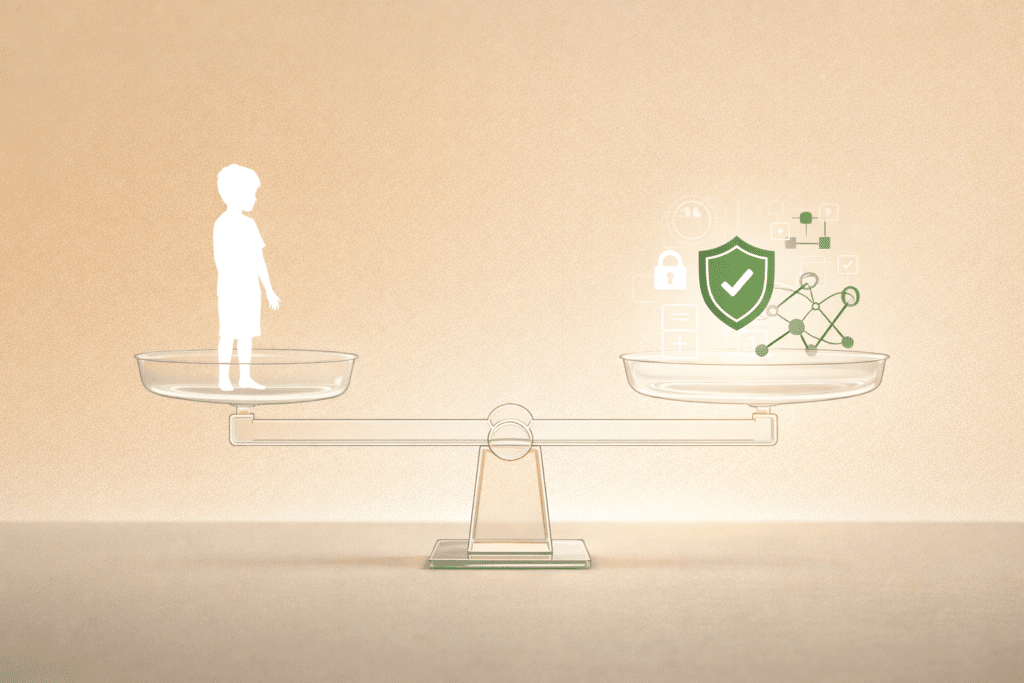
Data Privacy, Advertising Restrictions, and Limiting Stranger Contact
Article 7 gives under-13 personal data specific protections, including verifiable caregiver consent and withdrawal, clear disclosure and restricted access and use. It is not a general permission for a 13-year-old to open a social-media account. Read the government’s child digital-safety guidance alongside the later social-media rules.
My privacy check would start with permissions: does the service need the camera, microphone, location or contact list for the feature the child actually wants? Then find the account’s deletion and consent-withdrawal route. I’d ask the provider to explain an unclear request before supplying identity documents or a child’s personal details. An age-verification request is not a reason to trust an unsolicited link.
Enforcement & Penalties for Non-Compliance
Article 16 leaves the administrative-penalty framework to a Cabinet regulation; it is not a table of fine amounts. The social-media resolution separately describes regulators’ powers, including warnings and partial or total blocking. A possible sanction is not an enforcement decision against a particular service. Check the applicable regulation and any actual notice before relying on a quoted fine or a claim of compliance.
For a business, a reader’s checklist is no substitute for a compliance assessment. Map the actual account, messaging, recommendation, advertising and reporting features with qualified counsel. For a family, the next step is more immediate: identify which service has the account, where its controls are and how to contact its support team.
Empowering Parents: Responsibilities, Tools, and Support Under the New Law
I would not reassure a parent by saying “the law cannot penalise you”. Article 13 contains caregiver duties; Article 16 provides for administrative penalties to be set separately, and Article 17 preserves protections and penalties under other legislation. A particular incident needs its own legal assessment—not a blanket immunity claim in a lifestyle guide.
The practical priority is to supervise rather than wait for a perfect app. Article 13 includes monitoring, using controls, avoiding age-inappropriate accounts or shared content, protecting children’s privacy, educating them and reporting harmful material to the competent authorities. I’d keep the family’s account list and reporting routes somewhere accessible, not buried in a chat history.

Article 13: a practical family checklist
Here is the family routine I’d use to put those responsibilities into practice. It is an editorial checklist, not a verbatim reproduction of Article 13:
- Account list: List the apps, games and shared logins—not just the device names.
- Age and access: Check eligibility using the real birthday and the type of service.
- Controls: Open the privacy, contact, content and time settings together.
- Explanation: Agree how the child will leave a troubling interaction and ask for help.
- Reporting: Find the platform report function and the relevant authority’s official reporting channel before an incident.
Do not use an adult’s login as a workaround for an unsuitable account. I’d also review what adults post about the child: a public photograph, school detail or location deserves the same care as information entered into an app. The child’s digital privacy is not confined to the accounts they operate themselves.
Leveraging New Platform Features & Parental Controls
The best control is one you can find and use. I’d walk through the following four settings before discussing a daily time allowance. If the options are missing or unclear, ask support rather than assume that a hidden feature is protecting the account.
Set these together where the service allows it, and explain what each setting does. I’d rather have an understood boundary than a surprise restriction the child discovers halfway through a conversation:
- Time: Choose a schedule you can explain and review; this guide does not establish a universal legal daily-hour limit.
- Content: Check the account’s age profile and filtering rather than rely on the app-store label alone.
- Contact: Review messages, friend requests and public sharing separately.
- Supervision: Confirm which caregiver account is linked and what that link actually lets you see or change.
Recheck after changing devices, creating a new profile or installing a major app update. I’d also agree on a review date rather than treat initial permission as permanent. The point is not to inspect every moment of a child’s life; it is to know what access you have agreed to and whether the agreed limits still work.

Real-World Impact: What Changes for Children, Teens, and Online Experiences
There are different age thresholds, not one “children’s internet age”. The UAE government guidance distinguishes the under-13 data rule from the minimum age of 15 for personal social-media accounts. Turning 13 does not remove the later account restriction, and turning 16 does not turn a child into an adult under the broader framework.
The social-media resolution gives special restrictions to users aged 15 to under 16. Caregiver consent does not override its age prohibitions. I’d use the actual birthday and service category, not a loose label such as “teen account”, when deciding which rules to check.
Under 13: data protection is not account permission
For an under-13 child, I’d start with a service and experience suitable for that age, then check how consent, privacy and supervision work. The data rule does not require every app to adopt one identical interface, nor does parental consent override the social-media minimum age.
- Consent: Find the provider’s explanation of what is collected and how consent is withdrawn.
- Privacy: Check public visibility and unnecessary permissions before uploading details or photographs.
- Accounts: Do not confuse a data-consent process with permission for a personal social-media account.
- Access: Check the route through a shared adult login as well as the child’s own profile.
Ages 13–17: different rules, not one teen category
For teenagers, do not lump ages 13–17 together. The resolution bars personal social-media accounts for under-15s and provides restricted access for 15-year-olds. Sixteen- and seventeen-year-olds remain children under the broader law. I’d discuss both the applicable age rule and the actual features rather than promise “more freedom” automatically.
- At 13 or 14: Do not rely on a generic “13+” sign-up label as the answer to UAE social-media eligibility.
- At 15: Check the restricted-access protections, not just whether registration succeeds.
- At 16 or 17: Keep reviewing privacy, contact and content; the broader child-safety framework still matters.
- At every age: A working account is not a compliance certificate. Use current official guidance if the provider’s instructions conflict or remain unclear.
I would not describe the newer regime as an alternative to account bans: it contains one. Nor does an account that still opens establish legal permission. The legislation’s timetable and a platform’s technical rollout are different questions, which is why the dates below matter.

Effective dates and platform compliance deadlines
The federal law entered into force on 1 January 2026. Article 18 gives those covered at issuance up to one year from entry into force to regularise their position, with extension possible by Cabinet resolution. That transition is separate from the later social-media measure.
The social-media resolution took effect on 30 June 2026 and gives platforms a 12-month transition; the compliance deadline is 30 June 2027. Those are not interchangeable dates. I would not tell a family that every service completed its changes in June 2026, or that the resolution does not exist until June 2027. Check the current official instruments for amendments and extensions.
My recommendation: audit the accounts, not the marketing
My recommendation is to do the account audit now. Write down the service, the child’s real age, the account type and the controls you can actually demonstrate. Then resolve anything unsuitable or unclear. Waiting for a platform-wide change is not a useful substitute for knowing what is on the family’s devices today.
For a shared tablet, I’d ask three concrete questions: whose account is signed in, what content appears without another password and who receives message requests? For a console or game, check chat and payment access separately from the game’s age label. These are suggested household checks, not claims that every feature exists on every service.
My verdict: a safety label is not enough. The useful work is checking age eligibility, privacy, contact settings and reporting routes—and keeping them under review. Use the official law for the rules and qualified legal advice for an incident; use this guide to make the family conversation specific.
Sources and checks
Legal references: Federal Decree-Law 26/2025, particularly Articles 7, 10, 13 and 16–20; Cabinet Resolution 106/2026, particularly the age restrictions and transition; and the UAE government guidance. The legislative portal’s full downloads were unavailable to this check; specific provisions were checked in its indexed official text. The timetable was cross-checked against the published resolution and its implementation reporting. The household checklist is our editorial application, not a statutory quotation.
Disclaimer: This article provides general information and does not constitute legal advice. For specific legal guidance regarding the UAE Child Digital Safety Law, consult with a qualified legal professional.