The UAE introduced an official AI subject in its public-school curriculum from the 2025–2026 academic year, covering kindergarten through Grade 12. That is a confirmed Ministry of Education announcement. Claims that the same decision created a national Bitcoin curriculum require separate evidence: the AI announcement does not establish that every school teaches Bitcoin as a…
The UAE introduced an official AI subject in its public-school curriculum from the 2025–2026 academic year, covering kindergarten through Grade 12. That is a confirmed Ministry of Education announcement. Claims that the same decision created a national Bitcoin curriculum require separate evidence: the AI announcement does not establish that every school teaches Bitcoin as a dedicated subject. Financial literacy also features in the Ministry’s February 2026 National Education Charter, but a strategic priority is different from a compulsory cryptocurrency lesson plan. This guide separates those policies, explains the confirmed AI programme and the wider school reforms announced for 2025–2026, and gives parents practical questions to ask about what their own children are taught. It avoids turning a general digital-skills ambition into an unsupported claim about a national Bitcoin programme.
The UAE’s Bold Vision: Shaping Education for a Digital Future
The UAE Ministry of Education (MoE) stands at the forefront of a profound educational revolution, demonstrating an unwavering commitment to positioning the nation as a global leader in preparing its youth for the digital future. This forward-thinking approach is not just about adopting new technologies but about fundamentally restructuring the educational experience to foster innovation and critical thinking.
The relevant question is what the official documents actually require. The 4 May 2025 announcement confirms AI as a subject in public schools from kindergarten to Grade 12. It describes age-appropriate learning and responsible use of technology. That is a strong basis for explaining AI literacy. It is not evidence that Bitcoin was introduced as a separate national subject, nor that the same requirements apply identically to every private or international curriculum. Check the school and curriculum scope before translating a government announcement into a claim about a particular classroom.
Why Now? The Imperative for Future-Ready Skills
The rationale behind these sweeping UAE education reforms 2026 is clear: the rapid advancements in technology and the dynamic shifts in the global economy demand a new educational paradigm. Traditional educational systems often lag, creating a significant “gap in traditional education regarding future financial skills” and broader digital competencies. The imperative is to equip students with future skills UAE schools need to navigate a world increasingly shaped by AI, blockchain, and other emergent technologies. By fostering innovation in UAE education and prioritizing digital economy readiness UAE, the nation aims to ensure its graduates are not just employable, but capable of driving innovation and economic growth.
For a complete practical guide to life in the Emirates, explore our full Living in the UAE hub.
Digital Finance and Bitcoin: What Is Actually Confirmed?
The confirmed national AI curriculum and claims about Bitcoin lessons should be treated separately. The Ministry’s AI announcement covers public schools from KG to Grade 12; it does not announce a standalone national Bitcoin subject. The February 2026 National Education Charter includes financial literacy among future skills, alongside AI and other capabilities. Financial literacy is broader than cryptocurrency: it can cover budgeting, risk, saving and evaluating financial information. An individual school may cover digital-money topics, but that requires its own curriculum evidence. Do not infer nationwide Bitcoin teaching from a social-media claim, a technology strategy or the existence of a financial-literacy priority.
A useful financial-literacy lesson could explain the difference between cash, a bank balance, a digital payment and a crypto-asset. That would help students assess claims about money without encouraging speculative trading. This is an example of a possible teaching approach, not a description of an officially confirmed Bitcoin syllabus. Parents should ask which topics are included, for which age group and under which curriculum document. A practical blockchain example can teach record-keeping or verification, but it is not by itself evidence of a national crypto subject or an invitation for children to invest.
Beyond the Hype: What Students Will Actually Learn
Financial education should help a student distinguish a product claim from evidence, understand risk and recognise attempts to manipulate trust. An age-appropriate classroom exercise might compare a bank statement with a publicly visible ledger or discuss why an online investment promise needs verification. Those are illustrative ideas rather than confirmed requirements of the UAE AI curriculum. The education value lies in reasoning and safety, not in opening trading accounts or predicting token prices. If a school offers blockchain or digital-money lessons, ask how it protects student information, avoids promotional material and separates general financial concepts from endorsement of a particular platform or asset.
Empowering the Next Generation with AI Literacy: The National Curriculum
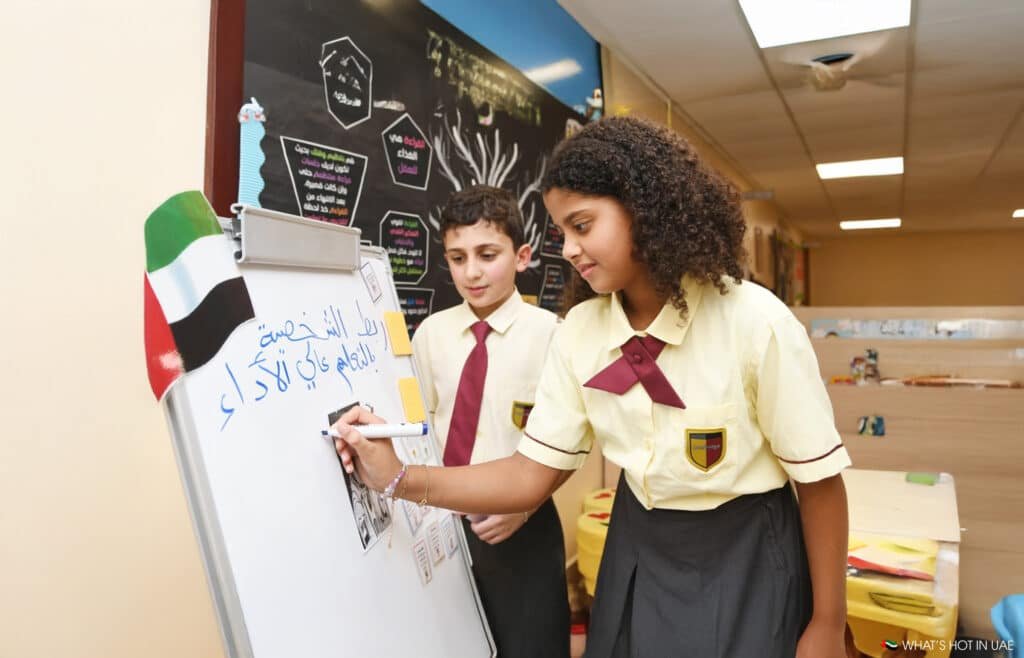
The confirmed national programme is the AI curriculum announced in May 2025 for public schools from the 2025–2026 academic year. Its purpose is to equip students with age-appropriate understanding and responsible use of AI. It should not be described as evidence that a separate Bitcoin subject was launched. Readers can use the Ministry’s National AI Literacy Curriculum Framework as a starting point for the actual AI content, then check their school’s implementation and any additional subjects separately.
This comprehensive program answers the question, “How will UAE schools teach AI?” by integrating AI concepts into various subjects, from foundational principles in early grades to advanced applications in higher education. Approximately 1,000 teachers are slated to deliver AI lessons across all grades[3], underscoring the scale and seriousness of this commitment. Mohammed Al Qassim, Under-Secretary of the MoE, highlighted the significance, stating that the program’s insights will help to “shape both UAE and global education policy on AI integration”[2]. This proactive AI curriculum UAE solidifies the nation’s commitment to building a future-ready workforce and society.
From Theory to Application: Responsible AI for Future Leaders
The AI in education UAE curriculum extends far beyond theoretical knowledge. It emphasizes practical application and, crucially, the ethical considerations of AI. Students will engage in project-based learning to understand how AI systems are built, how they function, and their potential societal impact. Discussions around data privacy, algorithmic bias, and the societal implications of automation will be integral. By focusing on responsible AI usage skills, the curriculum aims to cultivate critical thinkers who can leverage AI’s power while mitigating its risks. This proactive education directly addresses “How will AI impact future careers?“, by preparing students for roles that will require interaction with AI, development of AI, or critical analysis of AI’s outputs across almost every sector.

Holistic Reforms: Beyond Tech to Well-being and Skill-Based Learning
The UAE’s educational reforms for the 2025–2026 academic year extend far beyond the integration of AI and digital finance, encompassing a comprehensive overhaul designed to nurture well-rounded individuals. These UAE education reforms 2025–2026 reflect a holistic vision for education, addressing “What are the new education reforms in UAE for 2025–2026?” by implementing changes across assessment, pedagogy, national identity, student well-being, and community involvement.
Minister Sarah Al Amiri confirmed a “significant shift in assessment policies”[1], marking a pivotal change in how student progress is measured. Furthermore, the operational readiness for these reforms is robust, with 9 new schools accommodating more than 25,000 students and 800 new teachers, alongside the distribution of 47,000 laptops[3], ensuring adequate resources for the updated New UAE school curriculum and UAE school curriculum updates.
Modernizing Assessment: A Shift Towards Deeper Understanding
Responding to “What changes are happening in UAE school assessments?“, the MoE is moving towards a more nuanced and continuous evaluation system. Specifically, “centralised tests at the end of the second semester have been removed and replaced with school-based summative assessments,” with “Centralised exams now taking place only in the first and third semesters“[3]. This significant shift allows for more localized and diverse assessment methods.
Crucially, the “project-based learning and assessment (PBLA) system [is being expanded] to all Cycle 2 students“[3]. This empowers students to apply knowledge in real-world scenarios, fostering deeper understanding and practical skills over rote memorization. Additionally, new national standardized proficiency tests in Arabic, English, and mathematics will be introduced for Grades 4–11, ensuring consistent quality while allowing for more flexible, school-based assessments elsewhere. These changes in UAE school assessments and the expansion of project-based learning UAE underscore a commitment to developing critical thinking and applied skills.
Nurturing National Identity and Well-being
Beyond academics, the reforms place a strong emphasis on cultural and personal development. Al Amiri reiterated the Ministry’s focus on “strengthening national identity through Arabic language and Islamic education as the foundation of student character”[1]. This includes increased teaching time for Arabic language and Islamic education, along with daily literacy sessions for younger students, reinforcing a strong national identity UAE education.
Furthermore, student well-being is a key priority, with the rollout of a “new Physical Education, Sports and Health Programme to improve student wellbeing“[2], as stated by Mohammed Al Qassim. These initiatives aim to foster not only intellectual growth but also physical health and a deep connection to the UAE’s heritage, enhancing student wellbeing UAE schools provide.
Engaging the Community: Parents and Educators as Partners
Recognizing the vital role of community in education, the reforms also strengthen partnerships with parents and educators. Restructured Ta’aleem Councils and the expansion of Parents’ Councils will play a more significant role in shaping educational policy and fostering a collaborative learning environment. With “520 Parents’ Councils representing 6,140 members nationwide“[3], families and teachers will have greater participation and input into their children’s educational journey, creating a more inclusive and responsive system. This focus on Parents’ Councils UAE and educator participation UAE ensures that the educational ecosystem is truly collaborative.

The Impact: Preparing UAE Students for Global Leadership in the Digital Age
The comprehensive and ambitious reforms being implemented in the UAE’s education system represent more than just an update; they signify a strategic investment in the nation’s future. By integrating advanced technological literacy with a holistic development approach, these reforms are meticulously designed to equip students with the critical thinking, innovation, and ethical skills necessary not just to navigate, but to lead in a globalized, digitally-driven world. The UAE is consciously positioning itself as a global education innovator, offering a comprehensive and proactive approach that could serve as a model for other nations striving for global leadership education UAE.
Cultivating Innovators and Critical Thinkers
The confirmed AI programme and the broader skills priorities can support problem-solving, evaluating evidence and responsible use of technology. Project-based learning offers an opportunity to apply those capabilities, but its precise implementation depends on the school and curriculum. A student might investigate how a system reaches a recommendation, identify a biased example or explain why an apparently confident answer needs checking. These are useful learning goals regardless of whether a lesson includes cryptocurrency. The important distinction is between building digital and financial judgment and treating a particular asset, app or trend as educationally essential.
A Blueprint for Global Education?
The UAE’s integrated educational model—combining cutting-edge tech literacy with robust foundational education, national identity, and well-being initiatives—has the potential to profoundly influence and inspire education systems worldwide. As Mohammed Al Qassim noted, the AI program itself is expected to provide insights that help “shape both UAE and global education policy on AI integration”[2]. By demonstrating how a nation can proactively prepare its youth for the complexities of the 21st century, the UAE is not just adapting to the future; it is actively crafting a UAE education model that could serve as a global education policy AI blueprint, positioning the nation as a thought leader in future-proof education.
Conclusion
The documented picture is clearer when the policies are separated. The Ministry announced an AI subject for public schools from 2025–2026, alongside other reforms reported in August 2025. Its February 2026 National Education Charter includes financial literacy among the future skills it prioritises. Neither source, on its own, establishes a dedicated national Bitcoin curriculum. Parents should use the actual school syllabus to find out what their child will learn and how it is assessed. AI, financial literacy and blockchain can be related subjects, but they are not interchangeable. Keeping those distinctions clear gives families a reliable account of the policy and a practical way to check classroom delivery.
For a specific school, ask for the current curriculum outline, the age groups covered, examples of classroom activities and the rules for using outside AI tools. If a notice mentions Bitcoin, blockchain or digital finance, request the lesson’s purpose and source rather than assume it is a national requirement. Understanding technology does not require endorsing an investment product.
Disclaimer: This article is for informational and educational purposes only and does not constitute financial, investment, or legal advice. Readers should consult qualified professionals for specific guidance.
References
- Ministry of Education AI curriculum announcement, reported by Emirates News Agency, 4 May 2025: public-school scope, starting academic year and age-appropriate AI programme.
- Ministry of Education academic-year readiness briefing, reported by Emirates News Agency, 19 August 2025: assessment reforms, school readiness and teacher, equipment and council figures for 2025–2026.
- Ministry of Education explanation of the National Education Charter, 28 February 2026: national identity, learner attributes and future skills, including AI and financial literacy.
Related UAE Guides
- Why the UAE Has Become One of the World’s Best Places to Buy Bitcoin
- UAE Salary Protection Insurance: The Expat’s Ultimate Guide to Financial Resilience
- UAE Unveiled: The Definitive Guide to Lifestyle, Money & Tech for Thriving in the Emirates
- UAE History and Transformation: From Pearl Diving to Global Powerhouse
What Parents Can Ask Their School
- Which curriculum applies? A public-school AI announcement does not automatically describe every private or international programme.
- Which grades and lessons? Ask for the actual subject outline, not only a description of future-ready skills.
- Is financial literacy being confused with investment promotion? Budgeting and evaluating risk are different from encouraging children to buy a token.
- How is AI used responsibly? Ask about checking answers, privacy, age restrictions and rules for submitting AI-assisted work.
- How will learning be assessed? Confirm the current school policy and academic year rather than assume an old announcement describes today’s arrangements.
The August 2025 briefing discussed assessment changes for schools applying the MoE curriculum. Its school, teacher and equipment figures describe that announcement, not a fresh count for 2026–2027. Dates and scope matter as much as the policy headline. A parent can use these questions to establish what happens in the actual classroom without needing to infer it from a viral post or a general technology strategy.