
Verified 2026 UAE travel-insurance rules for tourist visas, visa on arrival and residents flying abroad, plus policy, proof and claim checks.
Travel insurance is required for many UAE visa applications, but there is no single rule that makes it compulsory for every person entering or leaving the UAE. The answer depends on whether you are applying for a UAE tourist visa, entering visa-free or with a visa on arrival, returning as a resident, or travelling from the UAE to a country that imposes its own insurance requirement.
That distinction matters. Search results currently mix inbound tourists, UAE residents and Schengen visa applicants, creating contradictory “yes” and “no” answers. This guide uses current UAE government and immigration sources to show who needs proof, where a policy is only recommended, and what to verify before paying.
UAE travel insurance: the verified 2026 answer
- Applying for a UAE tourist visa: yes, ICP lists health insurance and a travel ticket among the requirements for single- and multiple-entry tourist visas.
- Applying for the five-year UAE tourist visa: yes, valid health insurance applicable in the UAE is required.
- Eligible for UAE visa-free entry or visa on arrival: the official entry guidance does not state a blanket insurance document requirement, but nationality and route conditions must be checked before travel.
- UAE resident travelling abroad: there is no verified blanket 2026 UAE exit-insurance mandate; the destination’s visa and entry rules decide whether proof is compulsory.
- Schengen visa applicant: yes, EU law requires qualifying travel medical insurance with at least EUR 30,000 coverage.
- Last fact-check: 29 July 2026.
Is travel insurance mandatory for visiting the UAE?
It is mandatory when it is a required document for the visa you are applying for. The Federal Authority for Identity, Citizenship, Customs and Port Security (ICP) currently says tourist-visa applications require health insurance and a travel ticket. Its FAQ applies that statement to single- and multiple-entry tourist visas and also lists a passport valid for at least six months.
The UAE Government’s official tourist-visa page explains why some answers online differ: a tourist visa is for travellers who are not eligible for visa-free entry or a visa on arrival. In other words, “visiting the UAE” is not one immigration route.
| Traveller or route | Insurance position | What to verify |
|---|---|---|
| Pre-arranged single- or multiple-entry tourist visa | Required by ICP as part of the application | The policy accepted by the issuing authority, sponsor, airline, hotel or licensed travel agency |
| Five-year multiple-entry tourist visa | Required | Cover valid in the UAE; U.ae currently specifies a policy applicable for 180 days |
| Visa on arrival | No blanket insurance requirement is stated on the official visa-eligibility page | Passport nationality, permitted stay and any airline document checks |
| Visa-free entry or GCC citizen | No tourist-visa application is made | Current entry eligibility and passport or national-ID conditions |
| Medical-treatment entry permit | Health insurance is required for the patient route | Medical report, sponsor documents and emirate-specific process |
| Returning UAE resident | Tourist-visa rules do not apply | Residence validity, passport and any separate resident health-insurance obligations |
Check the official UAE visa-eligibility page first. If a pre-arranged visa is needed, follow the exact document list supplied during that application. Do not buy a generic worldwide policy and assume it will satisfy an immigration portal.
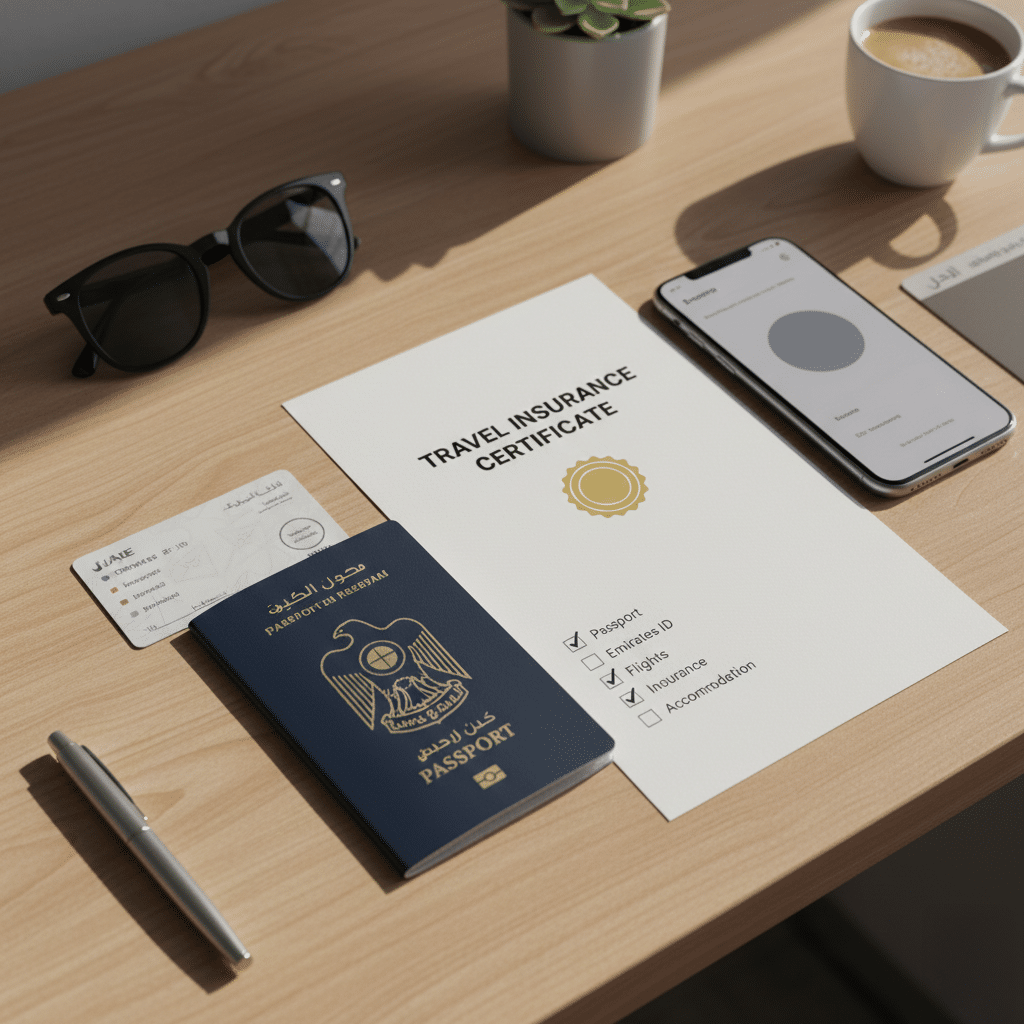
The five-year UAE tourist visa insurance rule
The self-sponsored five-year multiple-entry tourist visa has a clearly published insurance condition. U.ae lists:
- a bank balance of USD 4,000 or its equivalent during the previous six months;
- a valid health-insurance policy applicable in the UAE and valid for 180 days; and
- a ticket showing onward or return travel from the UAE.
GDRFA Dubai separately lists a passport valid for at least six months, bank statements, health insurance and a round-trip ticket for its five-year service. The visa can permit a stay of up to 90 days per visit, with the annual total subject to the published 180-day limit.
Do not confuse the insurance’s stated period with permission to remain continuously for that entire period. Visa validity, entry validity and allowed length of stay are different fields. Read the issued visa and use the authority’s travel-report service if the remaining-day calculation is uncertain.
Is insurance mandatory for UAE residents flying abroad?
There is no verified blanket UAE rule making travel insurance an exit document for every resident or citizen in 2026. We found no such universal mandate in the current U.ae, ICP or GDRFA material reviewed for this guide. The old version of this article incorrectly claimed that all expatriate residents would have to show a comprehensive policy and could face UAE fines or denied boarding. Those claims have been removed because they were not supported by a government directive.
Insurance can still be compulsory for a UAE resident because of the destination. A visa application, entry rule, cruise operator, organised tour or adventure provider may require a policy with named benefits and limits. Airlines may check documents required by the destination, but that is not evidence of a separate UAE-wide insurance law.
Check in this order:
- the immigration or foreign-ministry website of the destination;
- the official visa application centre or consulate instructions for your nationality and UAE residence status;
- transit-country requirements for separate tickets or airport changes;
- the operating airline’s travel-document checker; and
- the policy wording—not a comparison-site summary.
Schengen travel insurance from the UAE
Schengen is a useful example of a real, specific mandate. Article 15 of the EU Visa Code requires applicants for a uniform visa to prove they hold adequate travel medical insurance. It must cover medical repatriation, urgent medical attention, emergency hospital treatment and death, be valid throughout the member-state territory and cover the intended stay or transit. The legal minimum is EUR 30,000.
A multiple-entry visa applicant proves cover for the first intended visit during the application and acknowledges the need for insurance on later stays. That does not mean one annual policy automatically meets every future journey: territorial validity, maximum trip length, age limits and policy expiry still matter.
Visa-exempt travellers to the Schengen Area are not applying under the same insurance-document rule, although medical cover remains prudent. Always distinguish “required for my visa application” from “recommended for the trip”.
UAE health insurance is not automatically travel insurance
A UAE resident’s domestic health plan may include emergency treatment abroad, but many plans limit the territory, cap reimbursement, exclude elective care, require pre-authorisation or omit medical evacuation. An Emirates ID or insurance card alone does not prove comprehensive worldwide cover.
Before relying on an employer plan, ask the insurer in writing:
- Is the destination inside the covered territory?
- Are emergency outpatient and inpatient costs covered outside the provider network?
- Is payment direct to the hospital or reimbursement after return?
- Is medical evacuation or repatriation included, and who must approve it?
- Are pre-existing conditions covered, excluded or subject to a declaration?
- Does the insurer issue a certificate that meets the visa authority’s wording?
If the answer to the last question is no, buy the required travel policy even if the health plan has some overseas benefit. Immigration compliance and financial protection are related, but they are not the same test.
What a useful travel policy should cover
There is no honest universal “best” coverage limit. A visa authority may prescribe a minimum, while the financial risk changes dramatically between a weekend nearby and a long trip involving the United States, remote islands or winter sports. Start with the non-negotiable requirement, then insure the actual trip.
| Policy section | What to compare | Common trap |
|---|---|---|
| Emergency medical | Overall limit, excess, direct billing and outpatient restrictions | A high headline limit with low sub-limits |
| Evacuation and repatriation | Medical transport, return to the UAE and repatriation after death | Transport only when the insurer—not the treating doctor—approves |
| Pre-existing conditions | Declaration process, stability period and emergency-only cover | Assuming controlled medication means the condition is irrelevant |
| Cancellation and curtailment | Covered reasons and limit per traveller | “Change of mind”, known events and visa refusal often excluded |
| Activities | Skiing, diving, trekking altitude, motorsport and organised competition | Buying an add-on that still excludes the planned level or location |
| Baggage and electronics | Single-item limit, valuables cap and proof of ownership | Phone or laptop worth more than the per-item maximum |
| Trip length and territory | Each-trip maximum, annual-policy rules and sanctioned destinations | A worldwide label with a shorter permitted trip than the itinerary |
Credit-card travel insurance: verify activation
Some UAE cards include travel cover, but the benefit may activate only when all or part of the fare is paid with that card. Other conditions can include a maximum age, maximum trip length, limited family definition or a lower medical limit than a visa requires.
Download the current certificate and full wording before travel. A marketing page saying “complimentary insurance” is not proof that a named traveller is covered for a specific destination and date. If a visa certificate is needed, ask the card’s insurer—not the bank call centre alone—to issue it.
Proof to keep with you
- policy certificate showing every insured traveller’s name;
- policy number, insurer and 24-hour emergency-assistance contact;
- covered territory and exact travel dates;
- medical and repatriation limits where the visa authority requires them;
- schedule of benefits and excesses;
- receipts and confirmation of how the premium was paid; and
- digital and offline copies, shared with one trusted contact.
Match names to the passport. A missing middle name may be acceptable to an insurer but rejected by a visa-processing workflow; correct discrepancies before departure. If the policy came bundled with a UAE tourist visa, ask the sponsor or issuing agent how to retrieve the certificate and make a claim.
If you need medical help or must claim
- Call local emergency services first when there is immediate danger.
- Contact the policy’s assistance number as soon as reasonably possible.
- Ask whether treatment needs pre-authorisation and whether the hospital can bill the insurer directly.
- Keep medical reports, itemised invoices, prescriptions, police or airline reports and original receipts.
- Record claim numbers, call times and the names of representatives.
- Submit within the policy deadline and explain any unavoidable delay.
For baggage, theft or travel-delay claims, obtain the carrier or police report before leaving the airport or jurisdiction when possible. An insurer can reject an otherwise valid loss when the required contemporaneous report is missing.
If a UAE-regulated insurer rejects a complaint, complain to the insurer first and keep its written final response. The UAE Government says eligible consumers can then use Sanadak, the independent financial and insurance ombudsman established by the Central Bank. Sanadak generally requires the consumer to have raised the complaint with the insurer and waited 15 calendar days.
The bottom line
For an inbound traveller applying for a UAE tourist visa, health insurance is a real application requirement. For the five-year tourist visa, the official requirement is explicit. For a visa-free or visa-on-arrival traveller, do not transfer the pre-arranged visa rule to a different entry route. For a UAE resident flying elsewhere, the destination and visa type determine whether insurance is compulsory; there is no verified universal 2026 UAE exit mandate.
Even when not legally required, travel cover can prevent a medical or cancellation problem from becoming financially severe. Buy it because the wording fits the trip—not because an unsourced article says every traveller faces a made-up fine.
Continue with our indexed guides to applying for a UAE tourist visa, the UK ETA for UAE travellers and checking and resolving a UAE travel ban.
Sources and verification
This guide was checked against the ICP tourist-visa FAQ, the UAE Government’s pages for tourist visas and visa eligibility, GDRFA Dubai’s five-year tourist-visa service and Article 15 of the EU Visa Code. Immigration and insurance rules can change; reconfirm the exact route with the issuing authority before applying or travelling.