Dubai’s Sustainable City: what its solar and efficiency features mean, how to read the dated energy figures, and what residents should verify.
Key Takeaways
- Dubai’s Sustainable City integrates social, environmental, and economic pillars, prioritizing resilience over luxury.
- Solar power and efficient design are central to the project; annual energy figures are not proof of off-grid operation or zero emissions from every activity.
- Assess claimed savings against dated bills and the actual home; efficient infrastructure does not guarantee fixed costs or protection from a downturn.
- Plan a visit around a named destination or appointment; resident gardens, biodomes and other facilities are not automatically public attractions.
- The project offers a working example to examine, with reported performance that needs a clear year, boundary and comparison.
The question I’d ask about Dubai’s Sustainable City is not whether it looks green in photographs. It is whether the design makes the home cheaper in resources and easier to live in. The development offers a concrete place to examine that idea: solar generation, shared infrastructure and walkable residential clusters. The useful evidence is the dated performance record and the actual home, not a promise that every resident gets the same bill.
My verdict: inspect the everyday gains, not just the label
I’d judge a move here on recent bills, the home’s layout, the daily route and the full recurring cost. That gives sustainability something real to prove. The historical energy figures below are worth reading precisely because they separate common areas from homes. A promising community model becomes a convincing personal choice when those details work for the way you actually live.
For a smaller everyday sustainability action, see Dubai Media City’s recycling initiative. New residents can separately use the Emirates ID benefits guide to check benefits rather than assume residency brings every advertised perk.
My move-or-stay test: do the annual sums
The developer’s Dubai page, checked on 21 October 2026, advertises electricity-bill savings of up to 60% and zero service charges. Those are two different claims. “Up to” is not the saving every household receives, and a service-charge statement does not erase electricity, water, rent or transport costs. I would ask the landlord to identify the charges covered by the actual contract, then request a full year of the home’s bills—not the best-looking month.
A deliberately hypothetical comparison: suppose another home costs AED 1,000 a month in electricity and the proposed home costs AED 400. That would save AED 600 a month, or AED 7,200 a year. If the proposed home’s annual rent is AED 12,000 higher, it still costs AED 4,800 more before transport, moving and other differences. These are invented example figures, not rents, bills or a promised saving at The Sustainable City. The point is to test the complete household budget rather than let one impressive percentage make the decision.
I would still pay more for a layout and daily routine I genuinely prefer—but I would call that a lifestyle choice, not pretend the electricity saving funded it. Test the exact home-to-work and school journeys at the times you would use them, check the walk from parking to the front door, and ask how deliveries and access work for your household. Car-free residential clusters are an appealing design feature; they do not answer every journey outside the community.
The project’s own timeline traces the idea to research after the 2008 financial crisis, construction to 2014 and the first phase’s handover to November 2015. Its Dubai overview labels handover as 2016, and the timeline records grid connection in June 2016. Those are different milestones in a phased development, not a single date that proves every system was complete. The project began under Diamond Developers; SEE Holding is the current umbrella group.
I would judge the “green” claim by the infrastructure and dated operating results, not by the branding. The practical test is whether the solar, water and cooling systems deliver the reported benefit for the stated part of the community and period—not whether a development wears a sustainability badge.
This project moved from a proof-of-concept to a working blueprint over the last decade. It tests how people actually live when the environment and the economy are linked. It is a shift in how we think about urban planning in the UAE.
How does the community achieve environmental resilience?
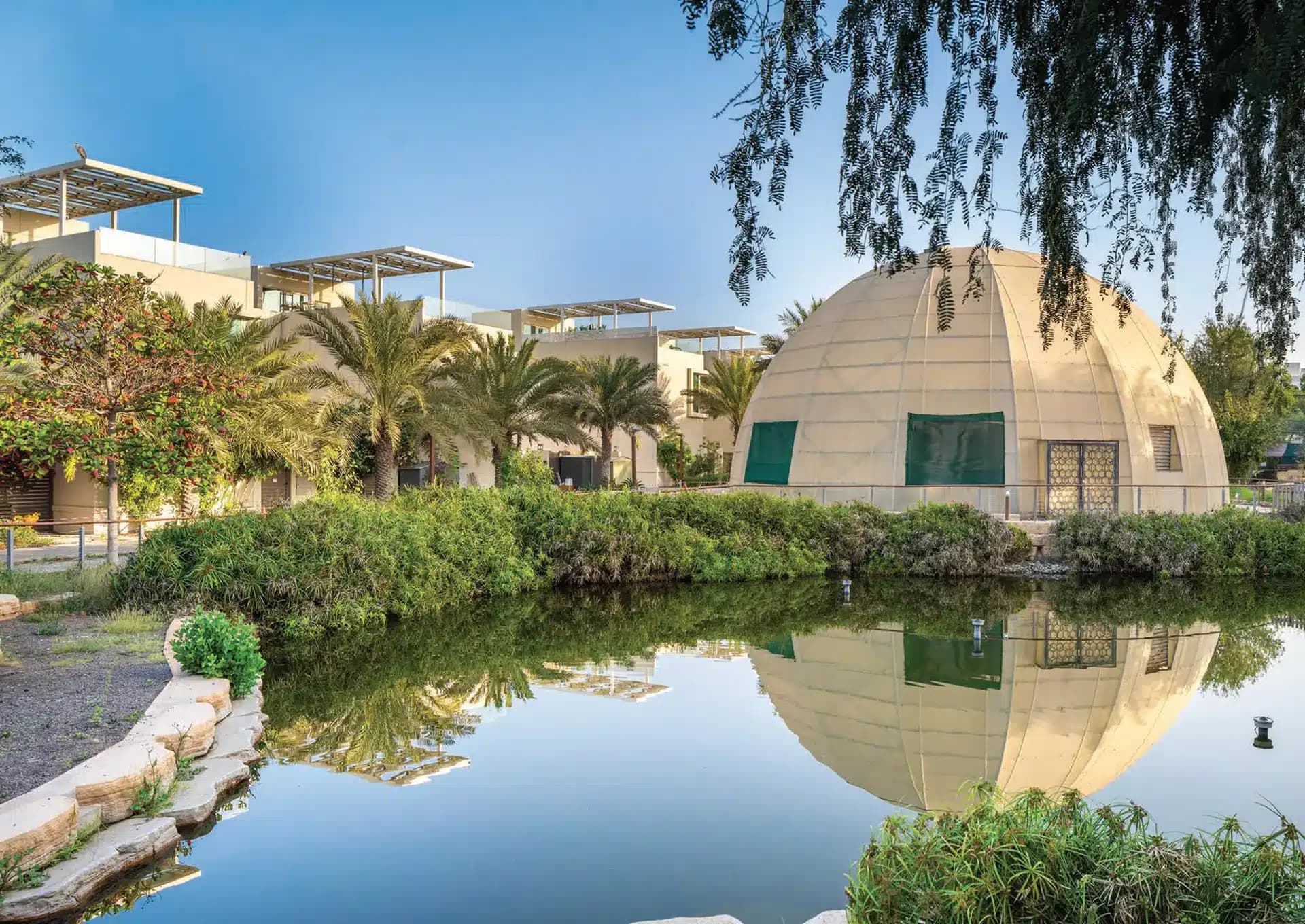
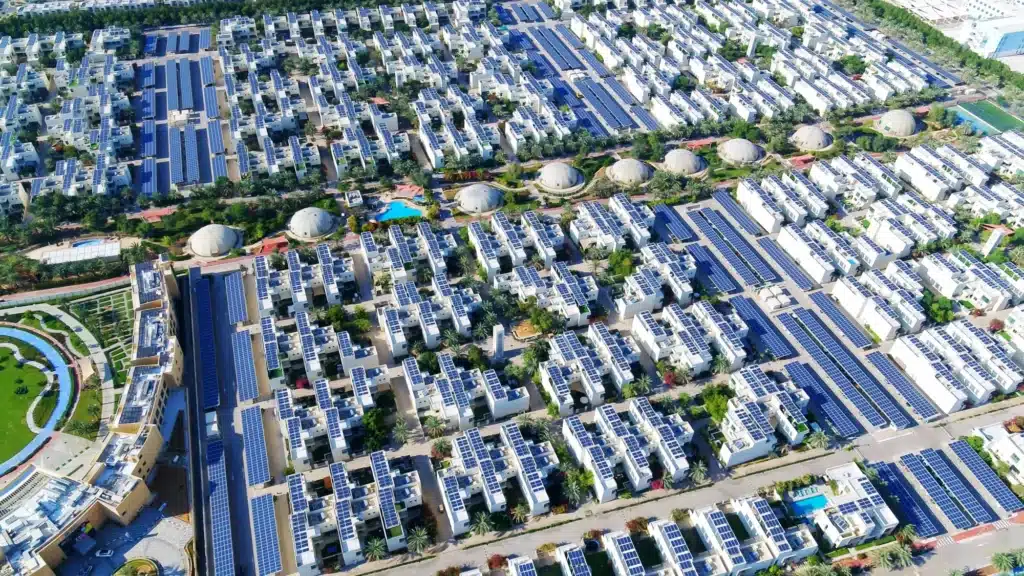
The official Dubai project page lists solar panels, efficient water systems and walkable residential clusters. These are physical features of a villa community, not evidence that high-density towers or every household achieve the same result. A net annual energy balance and a full carbon inventory also answer different questions: electricity generation alone does not account for every construction, travel or consumption emission.
Solar panels on homes and parking roofs generate electricity, but an annual total does not establish independence from the grid at every hour. The relevant questions are how much electricity is produced, how much is used directly and how much is imported or exported over the stated period. A roof photograph cannot answer those questions.
Reducing heat gain can lower cooling demand; it is not the only possible route to a net-zero target. The operator also lists accessibility across the community. Treat that as a feature to check against the specific home and route someone needs, not a guarantee that every user’s access requirements are met.
The useful lesson is to examine demand reduction alongside generation, rather than use “net zero” as a substitute for either. For a prospective resident, the actual unit’s consumption and the accounting period matter more than an undated community-wide slogan.
Reading the energy evidence: what the figures cover
The operator’s 2022 dashboard includes energy results labelled 2021. Its communal-energy section reports 5.3 GWh of annual solar generation and a 111% net-positive PV offset for common areas. A separate residential section reports 3.57 GWh of annual solar generation, with 73% self-consumption and 27% export. Do not combine the two scopes into a claim that every home runs entirely on solar, or relabel the figures as 2026 results.
The distinction changes how to read the claim: an annual surplus in common areas can coexist with grid imports at particular times. The dashboard is operator-reported historical evidence, not an independent audit commissioned by this magazine. Ask for the latest comparable period, the same measurement boundary and the accounting method before claiming present-day whole-community carbon neutrality.
The economic logic behind sustainable urbanism
The project’s stated economic idea is to lower resource demand and use shared infrastructure efficiently. That can be examined through costs, but does not establish immunity to inflation, vacancies or an economic downturn. Compare the complete cost of a particular home before drawing a conclusion about affordability.
The official timeline places the founders’ research in the post-2008-crisis years. This explains the model’s emphasis on resilience; it is not a stress test showing how every household or business will perform in the next downturn.
For a home, ask for recent electricity and water bills, occupancy assumptions and the treatment of solar credits. Check the lease or ownership documents for service charges and other recurring costs. A percentage saving measured against another building, tariff or occupancy level should not be presented as a guaranteed reduction in your own bill.
For a business, ask separately about rent, fit-out, utilities, customer access and trading conditions. I would request dated footfall and occupancy evidence for the relevant retail area, then compare it with the hours and customer trips the business needs. Efficient infrastructure is useful, but it is not a sales forecast or proof that a shop will outlast competing businesses.
Practical guide to visiting and experiencing the community
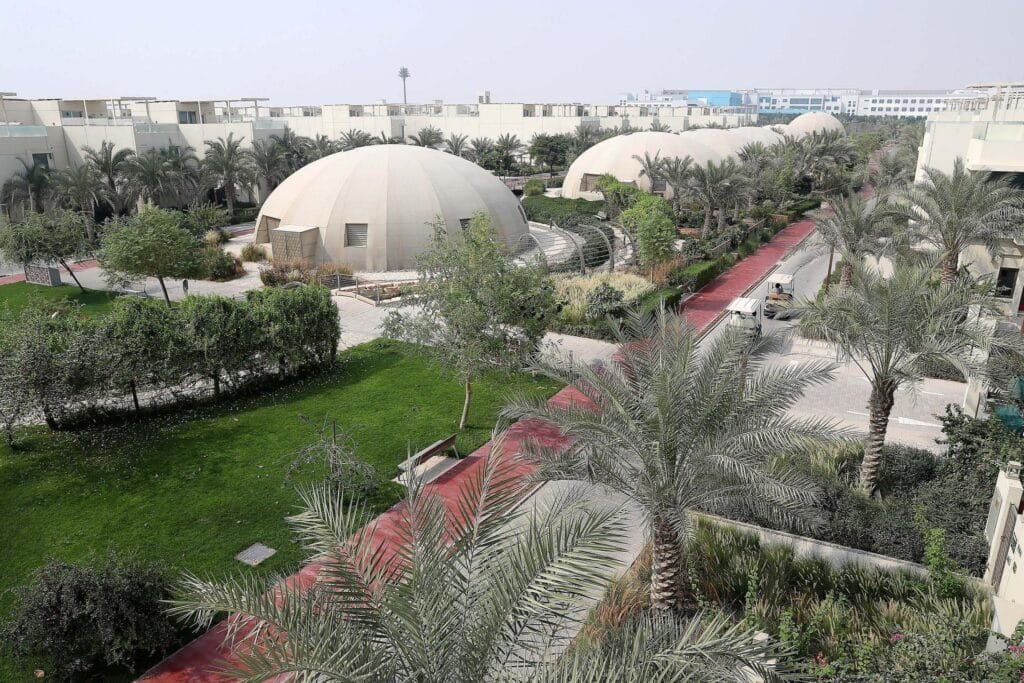
The Sustainable City is a residential community, not one attraction with a single admission ticket. Make the visit useful by choosing the place you want to assess: a school, a learning venue or an individual retail business. The developer’s Dubai overview lists retail and food outlets, SEE Institute and a school, but describes its 11 biodomes and community gardens specifically as facilities for residents.
Four practical starting points for a visit
Comparing schools for a move: Fairgreen International School’s campus page places the school inside The Sustainable City and gives access via Al Qudra Road or Emirates Road (E611). It invites prospective families to arrange an appointment and provides a location map. Start with that appointment rather than assume a walk through the community includes access to the school or its facilities.
Learning about sustainability or organising a professional visit: SEE Institute’s visit and contact page provides its map and separate enquiry routes for learning, research, partnerships and events. Choose the relevant enquiry before travelling and ask what can be arranged for your purpose. The contact page is a useful starting point, not confirmation that a particular tour or event is available.
A café or shopping stop: choose a currently operating outlet, confirm its hours and use its own entrance or parking instructions. A retail visit does not establish permission to enter residential gardens, pools or biodomes. If those are the reason for your journey, obtain access confirmation for that specific facility rather than rely on a community photograph.
A riding activity with a specific booking: The Sustainable City Equestrian Club’s lesson page lists adult and children’s classes, including a ten-lesson beginner children’s package of 30-minute sessions. Its own booking and location page places the club off Al Qudra Road next to Arabian Ranches 2 and asks visitors to call the office for bookings. Ask which class suits the rider and confirm availability before travelling; this is a named activity, not permission to roam the residential facilities.
Budget for the package, not an assumed drop-in lesson: checked on 29 October 2026, that beginner package is listed at AED 2,300 before VAT. New riders also pay a one-time AED 200 registration fee plus VAT. Those two listed charges total AED 2,625 including 5% VAT: (AED 2,300 + AED 200) × 1.05. This is the cost of ten lessons and registration at the published rates, not a single-session ticket. Confirm the current total and booking terms with the club; no lesson was booked or tested for this guide.
Visit-planning sources checked on 29 October 2026: the developer’s Dubai overview, Fairgreen’s campus page, SEE Institute’s contact page and the equestrian club’s lesson and booking pages. No appointment was booked and no site visit, riding lesson or accessibility test was carried out for this update. The historical energy evidence and household-cost example above remain separate from these access checks.
The Sustainable City is a working development rather than only a proposal. Its useful contribution to the debate is the opportunity to compare reported performance with daily needs. That is a stronger basis for judging the model than treating its existence as proof of every environmental or economic claim.
Follow our business and economy beat for more deep dives into the UAE’s evolving urban landscape.