
Key Takeaways
- Kaspa is a unique Layer-1 cryptocurrency, built on proof-of-work and the GHOSTDAG protocol, allowing for high transaction speeds without sacrificing decentralization.
- It processes up to 10 blocks per second, with future upgrades targeting 100 blocks per second, while maintaining security properties of proof-of-work.
- Kaspa launched without pre-mining or allocated tokens, prioritizing fair distribution and community governance.
- The Crescendo upgrade demonstrated that GHOSTDAG architecture can scale effectively, validating Kaspa’s protocol design at higher transaction rates.
- Kaspa employs a continuous emission schedule based on a chromatic scale, differing from Bitcoin’s halving approach, and aims to establish itself as a robust and decentralized cryptocurrency.
In a cryptocurrency market saturated with variations on a theme, Kaspa stands apart. It is not a fork of Bitcoin. It is not a rebranded proof-of-stake chain dressed up with governance tokens and a white paper full of promises. Kaspa is the product of years of academic computer science research, built on a consensus protocol that genuinely extends — rather than simply imitates — the architecture Satoshi Nakamoto introduced in 2008.
Kaspa is a fast, scalable Layer-1 cryptocurrency built on proof-of-work and powered by the GHOSTDAG protocol, a novel consensus mechanism that extends Nakamoto’s original design. Unlike traditional blockchains that discard competing blocks, GHOSTDAG allows parallel blocks to coexist and orders them within a Directed Acyclic Graph — a blockDAG — enabling high throughput while preserving decentralisation and security. CoinMarketCap
That technical distinction matters more than it might initially appear. It is the reason Kaspa can process transactions at speeds that Bitcoin cannot approach, without abandoning the security properties that made proof-of-work valuable in the first place. Understanding why requires a brief look at the problem Kaspa was designed to solve.

The Problem Kaspa Was Built to Fix: The Blockchain Trilemma
Bitcoin processes roughly seven transactions per second. Ethereum, before its shift to proof-of-stake, managed around fifteen. These speeds are not the result of lazy engineering — they are the consequence of a deliberate architectural choice. Traditional blockchains confirm one block at a time, in a strict linear sequence. Miners compete to add the next block; only one wins; the others are discarded. This design ensures security and decentralisation, but it creates an unavoidable ceiling on throughput.
For over a decade, the cryptocurrency industry treated this as an either-or problem: you could have speed, or you could have decentralisation and security, but not all three simultaneously. Layer-2 solutions, sidechains, and proof-of-stake all represent various attempts to work around this ceiling without confronting it directly.
Kaspa confronts it directly.
Unlike traditional blockchains, GHOSTDAG does not orphan blocks created in parallel but allows them to coexist and orders them in consensus. This makes Kaspa a blockDAG — a generalisation of Nakamoto consensus — which enables the network to operate safely while maintaining high block rates and minimal confirmation times. Coinbase In practical terms, where Bitcoin discards competing blocks as wasted effort, Kaspa incorporates them into the ledger. The result is a network that processes more transactions, confirms them faster, and still maintains the security guarantees of proof-of-work.
The Origins: Academic Research, Not a Marketing Campaign
Kaspa’s credibility begins with where it came from. Kaspa’s originator is Dr Yonatan Sompolinsky of Harvard University, whose research introduced scalable proof-of-work protocols that generalise Nakamoto Consensus. The project began through DAGLabs, a research company founded by Sompolinsky and funded by Polychain Capital. CoinMarketCap
Sompolinsky’s 2013 GHOST protocol paper was significant enough to be cited in the original Ethereum whitepaper — a notable credential in a field where most projects reference nothing but each other’s marketing materials. Kaspa was fair-launched in November 2021 with no pre-mine, zero pre-sale, and no coin allocations, and is 100 per cent community-managed. CoinGecko DAGLabs was subsequently dissolved, transitioning governance to the broader developer community.
This origin story — genuine research, fair launch, no insider allocation — is unusual enough in the cryptocurrency space to be worth emphasising. Most blockchains that claim decentralisation began with a token distribution that quietly concentrated supply among founders and early investors. Kaspa did not.

The Crescendo Upgrade: 10 Blocks Per Second and What It Means
In May 2025, Kaspa completed its most significant technical milestone to date. Kaspa currently processes 10 blocks per second, with a long-term goal of scaling to 100 blocks per second, offering confirmation times limited only by internet latency. This level of performance was made possible by the Crescendo upgrade — a hard fork that successfully increased Kaspa’s block rate to 10 BPS while maintaining network stability. CoinMarketCap
To put that in context: Bitcoin processes one block every ten minutes. Ethereum confirms blocks every twelve seconds. Kaspa, post-Crescendo, confirms ten blocks every second — and the roadmap targets 100 blocks per second in future upgrades. All of this occurs within a proof-of-work framework, without delegating security to validators, staking pools, or other mechanisms that reintroduce centralisation through the back door.
A shorter block interval can improve how quickly a transaction becomes visible in the ledger, but blocks per second, transactions per second and finality are different measures. A 10-BPS target does not mean that every payment is irreversible after 0.1 seconds or that every application achieves the same throughput. Confirmation confidence depends on the protocol, network conditions and the risk of the transaction. Use the network’s documentation and the recipient’s requirements rather than equate rapid block production with unconditional instant settlement.
The Crescendo upgrade also demonstrated something arguably more important than the speed itself: that the GHOSTDAG architecture can scale without the network breaking. Increasing block rates in a conventional blockchain causes security degradation — the orphan rate climbs, the network becomes vulnerable to attacks. In Kaspa’s blockDAG, the protocol absorbs that increased block volume structurally. The 10 BPS upgrade passed without incident, which validated the core technical thesis at scale.
Tokenomics: Supply, Emissions, and the Chromatic Halving Schedule
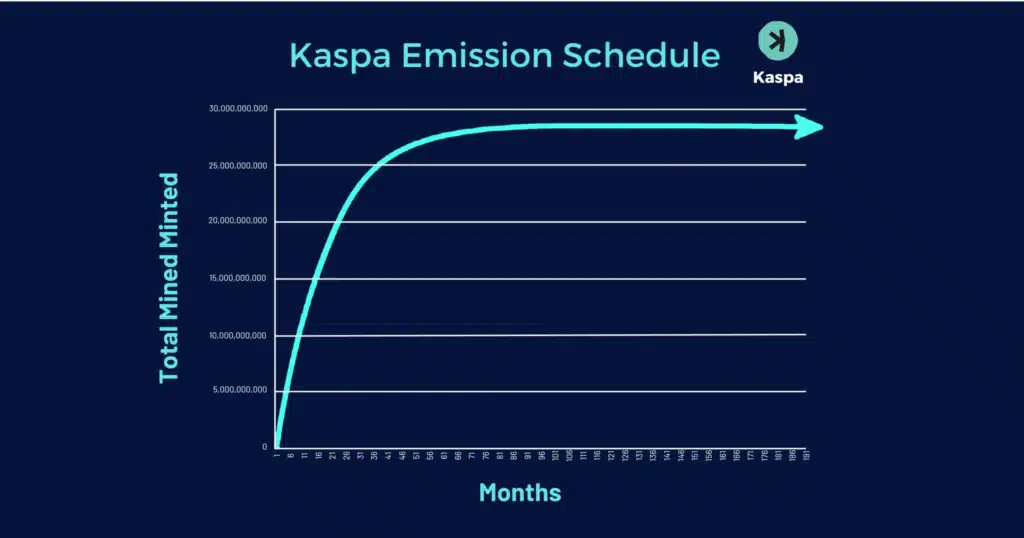
Kaspa’s unique monetary policy decreases emissions geometrically over time based on the 12-note scale of music, known as the chromatic phase. Coinbase This means Kaspa does not follow Bitcoin’s four-year halving cycle. Instead, mining rewards decrease smoothly and continuously, creating a predictable, graduated deflationary emission schedule rather than abrupt supply shocks.
KAS has a total maximum supply of 28.7 billion coins, with a circulating supply of approximately 26.78 billion KAS — the vast majority of the total supply already in circulation. Bybit The near-complete emission of the total supply means that Kaspa is approaching full circulation — a characteristic that typically reduces inflation pressure and shifts miner incentives towards transaction fees over time, mirroring the long-term dynamics of Bitcoin’s supply curve.
Kaspa network is secured by miners through proof of work and uses an algorithm known as k-Heavyhash. Heavyhash was chosen for forward-compatibility with Photonic miners when they become available. CoinMarketCap Photonic computing — using light rather than electricity for computation — represents a potential next generation of mining hardware. Building forward-compatibility into the mining algorithm now is a technical decision that reflects longer-term thinking than most cryptocurrency projects apply to infrastructure choices.apacity, and verifiable economic distribution — all of which the team is delivering in measurable strides.

Where Kaspa Stands in 2026: Market Position and Price Context
Kaspa’s price, circulating supply and market capitalisation change continually. A figure embedded in an article is a dated snapshot, not a live quote. Check the timestamp and methodology on the linked market-data provider before relying on a number. For understanding the network, the more durable facts are its proof-of-work model, GHOSTDAG ordering and the live block-rate target described in Kaspa’s own documentation. Those technical properties are separate from any forecast of the token’s market value.
The hashrate growth observed throughout 2024 to 2026 indicates sustained miner confidence, though this also increases network difficulty and potentially reduces individual mining margins. Bitget Rising network hashrate is generally a positive signal for a proof-of-work cryptocurrency — it means more computational resources are being committed to securing the chain, making attacks progressively more expensive to execute.
Kaspa is the only major proof-of-work blockchain that also uses DAGs for scalability. Cryptonews That structural uniqueness creates genuine differentiation in a market where most projects compete on narrative rather than technical substance.
It is worth stating clearly: cryptocurrency price predictions carry no reliable accuracy at any time horizon. The range of analyst forecasts for KAS in 2026 varies enormously — from modest appreciation to significantly higher targets — and none should be treated as guidance for investment decisions. What is observable and verifiable is the technology, the network growth, and the development activity. Everything beyond that is speculation.

The BLOCKS Mining Project: One Example of Ecosystem Development
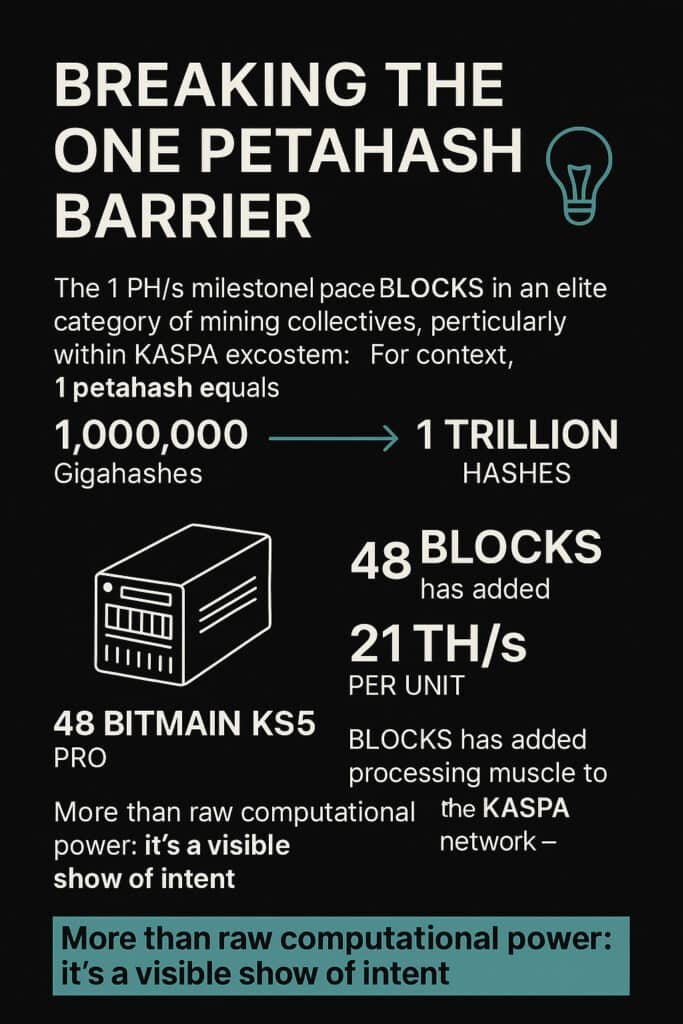
BLOCKS appeared in earlier coverage as a Kaspa-related mining operation. Claims about a named operation’s hashrate, equipment purchases, token sale or income need their own dated evidence. They should not be used as proof that the broader network is a good investment or that a particular mining business is profitable. Assess the operator separately from Kaspa: ownership, hardware, electricity costs, operating records and token-holder rights are business questions, while consensus design is a network question.
BLOCKS represents one example of a broader pattern in the Kaspa ecosystem: institutional and semi-institutional mining operations building infrastructure around the network as its technical credibility grows. The KS5 Pro miner, one of the most powerful ASIC units purpose-built for Kaspa’s k-Heavyhash algorithm, has a hashrate of 21 TH/s per unit — reflecting the fact that the commercial mining hardware market has now developed specific, high-performance equipment for this network, which did not exist two years ago.
The broader significance of projects like BLOCKS is less about any individual token launch and more about what their existence signals: that third-party developers and miners are treating Kaspa as stable enough infrastructure to build upon. That is a meaningful data point, distinct from price speculation.

Why Kaspa’s Design Philosophy Matters Beyond the Technology
There is an ideological dimension to Kaspa that its technical community tends to articulate clearly. The network was designed in conscious alignment with the original properties of Bitcoin: proof-of-work security, no pre-mine, no central governance, fair distribution. Kaspa aims to be the world’s global sequencer for traditional finance and decentralised crypto markets by utilising proof-of-work and its blockDAG consensus protocol. CoinGecko
Kaspa’s use of proof of work reflects a design choice about how the network orders blocks and allocates security resources. Proof of stake uses a different mechanism with different trade-offs. Neither model’s name alone proves that a particular implementation is harder to capture or less exposed to regulation. Compare actual concentration, node requirements, incentives and protocol assumptions rather than describe all staking systems as centralised or all mining systems as resistant to interference. The point is to explain Kaspa’s design accurately, not treat one consensus family as an automatic investment advantage.
Whether that position will matter to the broader market over the next decade remains an open question. But as a technical and ethical foundation, it represents one of the more coherent long-term bets available in the current landscape.
Frequently Asked Questions
What makes Kaspa different from Bitcoin technically? Bitcoin uses a linear blockchain where competing blocks are discarded, limiting throughput to roughly seven transactions per second. Kaspa uses the GHOSTDAG protocol within a blockDAG architecture, allowing parallel blocks to coexist and be incorporated into consensus. This enables 10 blocks per second currently, with a roadmap to 100 BPS, while maintaining the proof-of-work security model that makes Bitcoin reliable.
Was Kaspa fairly launched — did insiders get early tokens? Yes. Kaspa launched in November 2021 with no pre-mine, no pre-sale, and no founder allocations. All KAS in circulation has been mined since launch. The founding research entity, DAGLabs, was dissolved after the mainnet went live, transitioning the project to community governance.
What is the total supply of KAS and how does its emission schedule work? The maximum supply is 28.7 billion KAS. Unlike Bitcoin’s four-year halving cycle, Kaspa uses a continuous geometric emission reduction based on a 12-note chromatic scale — mining rewards decrease smoothly over time rather than in abrupt steps. As of early 2026, the vast majority of the total supply is already in circulation.
Is Kaspa available on major exchanges? Availability depends on the provider, legal entity, market and product. A derivatives listing is not necessarily a spot market, and a global listing does not establish availability for a UAE account. Check the current market and withdrawal network directly before acting.
What is the Crescendo upgrade and why does it matter? Crescendo was a hard fork completed in May 2025 that increased Kaspa’s block rate from 1 BPS to 10 BPS. It is the most significant technical upgrade in the network’s history and demonstrated that the GHOSTDAG architecture can scale in practice — not just in theory. The upgrade passed without security incidents, validating the core protocol design at a new scale.
Should I invest in Kaspa? This article does not provide investment advice. Kaspa is a technically distinctive proof-of-work cryptocurrency with a fair-launch history and a growing mining ecosystem. It is also a high-volatility, speculative asset that has declined significantly from its 2024 all-time high. Any investment decision should be made on the basis of your own research and risk tolerance, not on the basis of any single article or price prediction.
What Crescendo Confirms—and What It Does Not
The Kaspa developers’ Crescendo guide records the transition from 1 to 10 blocks per second and the May 2025 activation target. The project’s current feature page describes the live 10-BPS network. This supports an explanation of the upgrade, but not a universal “fastest blockchain” ranking: benchmarks depend on workload, transaction size, confirmation criteria and hardware. A roadmap target of 100 BPS is also different from the present deployed rate. Protocol development does not guarantee token returns or mining profitability.