

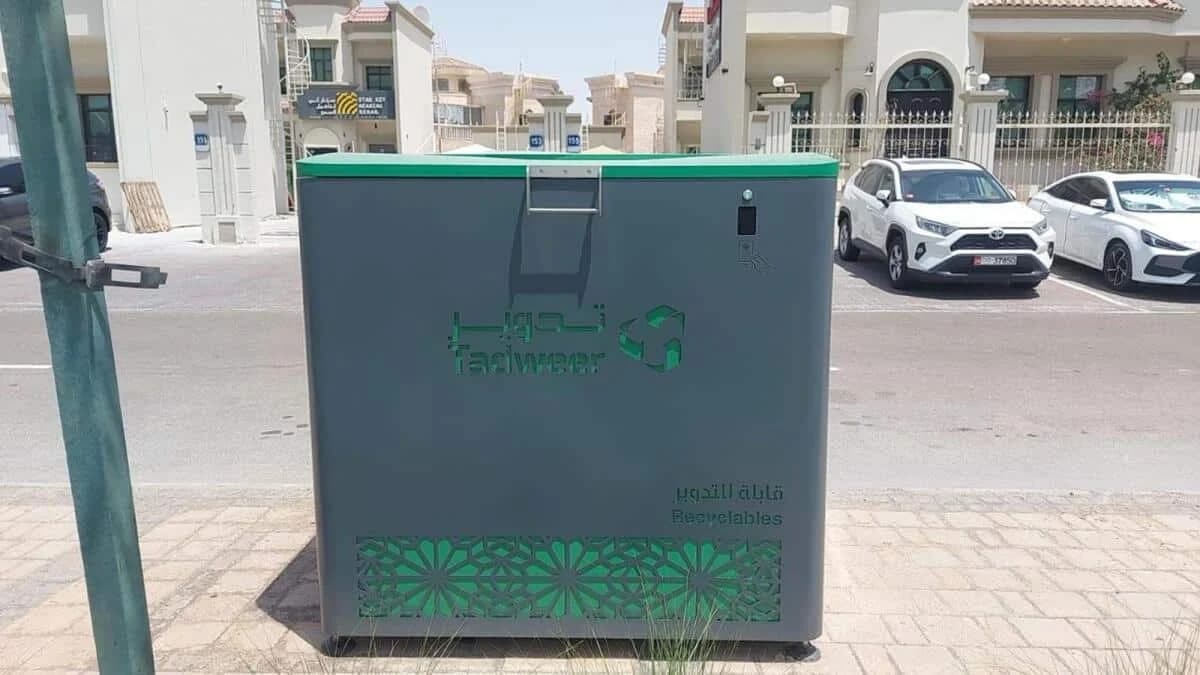
How Tadweer’s smart-bin trial used sensors and user identification, what the original reporting established, and what residents should check locally.
Abu Dhabi’s smart-bin story began as a 2024 trial, not a requirement for every resident to register household waste. There is now a separate development to know about: Tadweer’s Tajmee’e collection system expanded into named Abu Dhabi areas in May 2026. Collection-service coverage and the access rules for an individual smart bin are not the same thing.

What the original trial actually established
Khaleej Times reported on 18 July 2024 that the trial was taking place at selected Abu Dhabi locations. Tadweer’s spokesperson described sensors, information about the amount and type of waste, and identification of individual users. The reporting also discussed app integration and scanning a barcode or QR code.
Those details explain the pilot’s purpose. They do not establish universal availability, a compulsory registration portal for all households or a published saving achieved across the emirate. The date matters: repeating a 2024 trial announcement as a fresh citywide launch would give residents the wrong impression.

The May 2026 update: Tajmee’e collection coverage
On 4 May 2026, Abu Dhabi Media Office announced an expansion covering Khalifa City, Shakhbout City, Yas Island, Al Rahba, Al Shahama, Al Samha, Ghantoot and the Abu Dhabi Airport zone. The announcement described residential, commercial and bulky-waste collection, AI-supported routing and command-centre oversight. It reported service across 29 northern Abu Dhabi districts at that point—not completed coverage of the entire emirate or proof that every container uses the 2024 pilot’s QR access.
For a resident, I would turn that update into three checks:
- Confirm the building’s operator: a named district is a useful lead, not the collection schedule for your address.
- Separate bulky waste from daily rubbish: ask for the actual collection arrangement and accepted items before leaving furniture beside a bin.
- Verify any registration request: get the current operator’s instructions; neither an old trial article nor a wider service announcement establishes which portal your bin requires.
For household furniture or garden waste, start with TAMM’s Green Waste or Bulky Waste Removal from Households service, not a smart-bin registration page. Its public instructions require UAE PASS and photos of the waste, followed by a reference number and a call to agree when to place it outside. Wait for that agreed time rather than leave items beside a bin in advance.
The service’s published terms exclude real estate development areas, free zones, commercial and industrial areas, and investment facilities. A named Tajmee’e collection district therefore does not automatically qualify an address for this household service. Check its item and size limits before applying; batteries, tyres and construction waste are among the exclusions. These public instructions were checked on 2 November 2026; we did not submit a request or verify a completed pickup.
How a connected bin can change collection
A conventional collection schedule sends a vehicle to a location at planned intervals. A connected bin can add information about its fill level, helping an operator decide whether a visit is necessary. The advantage depends on whether the data actually changes routing and whether the equipment remains reliable.
Consider an illustrative route with ten bins. If only four need emptying, an operator might have an opportunity to avoid some unnecessary stops. That is an example of the decision the technology supports, not a measured result from Tadweer. Travel distance, vehicle capacity, hygiene requirements and neighbouring stops still affect whether a route can be shortened.

Smart bins, recycling centres and reverse-vending machines are different
| System | Main question it addresses | What to verify |
|---|---|---|
| Connected waste bin | When does this container need emptying? | Access method, accepted waste and who operates it. |
| Recycling collection point | Where should a material be separated? | The material labels on the actual containers. |
| Reverse-vending machine | Can this machine accept and record an eligible container? | Accepted items, account requirements and any reward terms. |
The collection-centre photographs in this article illustrate waste and recycling infrastructure. A photograph of a sorting centre does not establish that it is one of the bins in the pilot. Tadweer’s separate waste-recovery facility announcement should likewise not be confused with a neighbourhood-bin deployment.

What residents should do at their building
- Follow the labels on the bin you are using; a generic recycling symbol does not mean every material is accepted.
- If a bin requires a scan or account, ask building management for the operator’s official instructions.
- Check who collects registration information and read the relevant privacy notice before providing personal details.
- Report a full, blocked or damaged bin through the verified operator or building-management contact.
- Ask where batteries, electronics and other items unsuitable for an ordinary bin should go. Do not infer permission from the presence of a large opening.

What would demonstrate a successful rollout?
A useful update would specify the participating areas, launch date, working access method and accepted waste streams. An operator could then compare collection journeys, overflow incidents and equipment uptime before and after installation. A claim about emissions would also need its calculation method and scope.
For the person carrying a bag downstairs, the important outcome is simpler: a usable container, clear instructions and dependable collection. Until a location-specific deployment is confirmed, use Tadweer’s official channels or your building manager for instructions. Our Living in the UAE section covers other practical changes affecting residents.


