Key Takeaways
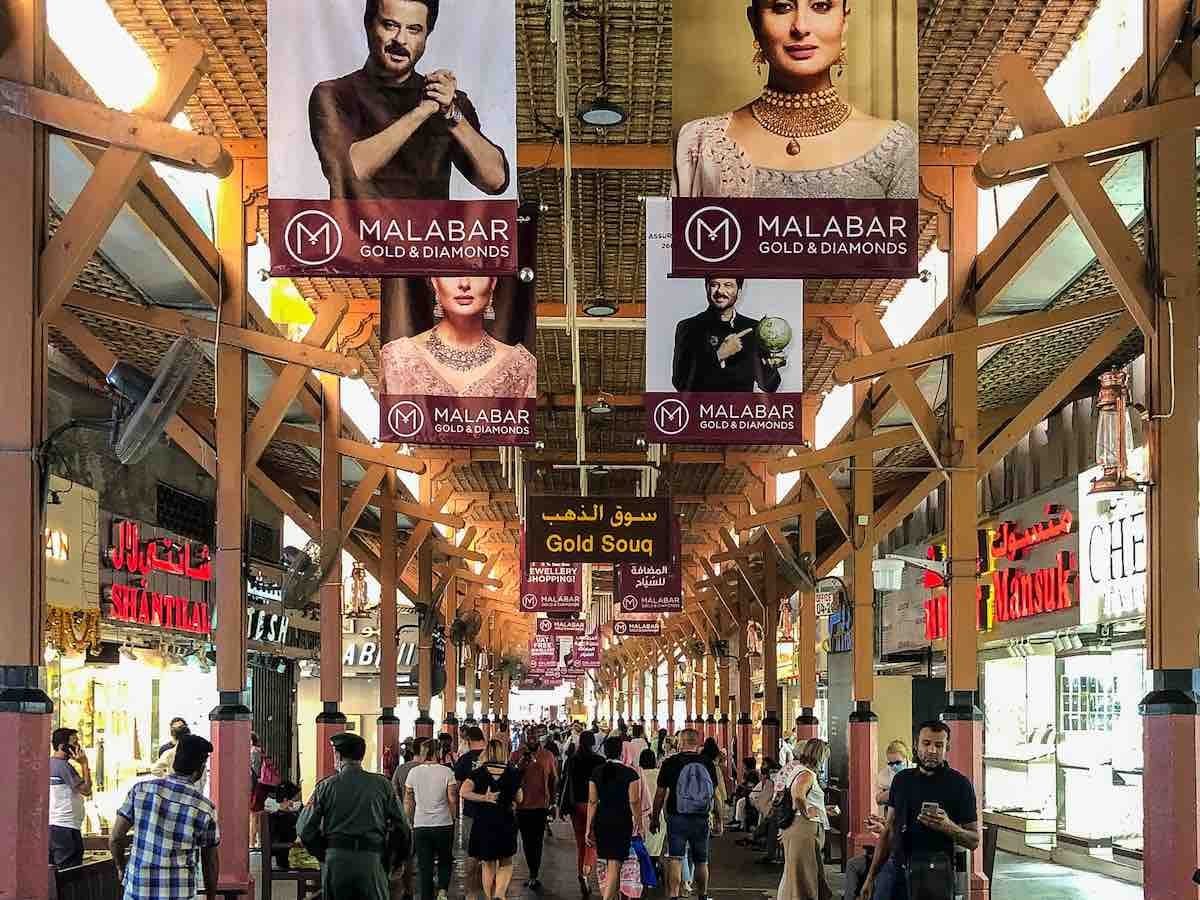
- The Deira Gold Souk is a dense, historic market filled with gold, diamonds, and precious stones, reflecting Dubai’s trading history.
- Compare the quoted karat rate, net gold weight, making charge and final bill; a displayed metal rate is not the complete jewellery price.
- Making charges may be negotiable; compare itemised final offers, keep the receipt and ask separately about any returns or buyback terms.
- The nearby Spice Souk is worth visiting for its aromatic spices and atmosphere, creating a complete market experience.
- Evenings are the best time to visit the souks, and they are easily accessible via the Dubai Metro or by traditional abra across the creek.
Deira Gold Souk is where I’d go for Dubai’s jewellery-market spectacle and a properly considered purchase—not a promise of automatic bargains. The windows are the fun part; comparing an itemised bill is the important part. I’d choose the design, ask for karat and net gold weight, then compare making charges and the final total before getting excited about a discount.
My recommendation: browse freely, buy deliberately
Go for the market experience even when you do not intend to buy. If you do, my rule is to compare equivalent pieces and the final written price, not a headline saving. A ten-gram plain piece and a stone-set design are different purchases. I would walk away from a rushed decision; a keepsake should not begin with a bill I did not understand. No investment or resale-value score is assigned here.
Keep the established souk separate from the plans described in Dubai Gold Street. For a completely different working-market outing in Abu Dhabi, compare Mina Zayed Fish Market.
Gold Souk, Gold District and Gold Street: which destination do you mean?
The names describe different scopes. Dubai Media Office’s 27 January 2026 announcement records Ithra Dubai’s launch of Dubai Gold District as a unified retail, bullion and wholesale destination. Its figure of more than 1,000 retailers includes jewellery, perfume, cosmetics and lifestyle businesses across the District; it is not a count of gold jewellers inside the old covered arcade.
| Name you see | What to use it for | Check before travelling |
|---|---|---|
| Historic Deira Gold Souk | The covered market lanes and individual jewellery shops discussed in this guide | Pin the intended market entrance or jeweller, not just the wider district |
| Dubai Gold District | The broader destination launched by Ithra Dubai, including several retail categories | Confirm the exact shop or experience and its own entrance and opening hours |
| Gold Street | A specific attraction described in future tense in the January launch announcement | That announcement is not an opening notice; obtain current operator confirmation if the street is the reason for your trip |
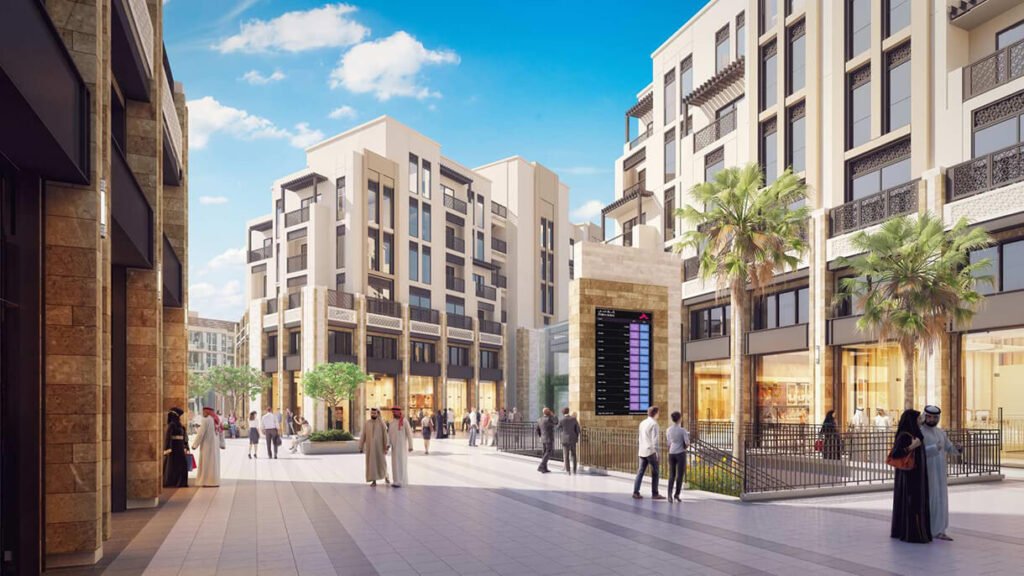
This is a distinction between published names and announcement scope, not a new site visit or a finding that Gold Street is open or closed today. Do not let a promotional rendering replace an actual location and operating-status check.
A market built on trade and history
Deira has been Dubai’s commercial heart since long before oil money reshaped the city, thanks to its position on the creek, which made it a natural hub for traders arriving by dhow from India, Persia, and beyond. The Gold Souk grew out of that trading tradition, and by the mid-20th century Dubai had already earned a reputation as a major gold trading centre in the region, helped along by comparatively low import duties that made it an attractive place to buy and sell.
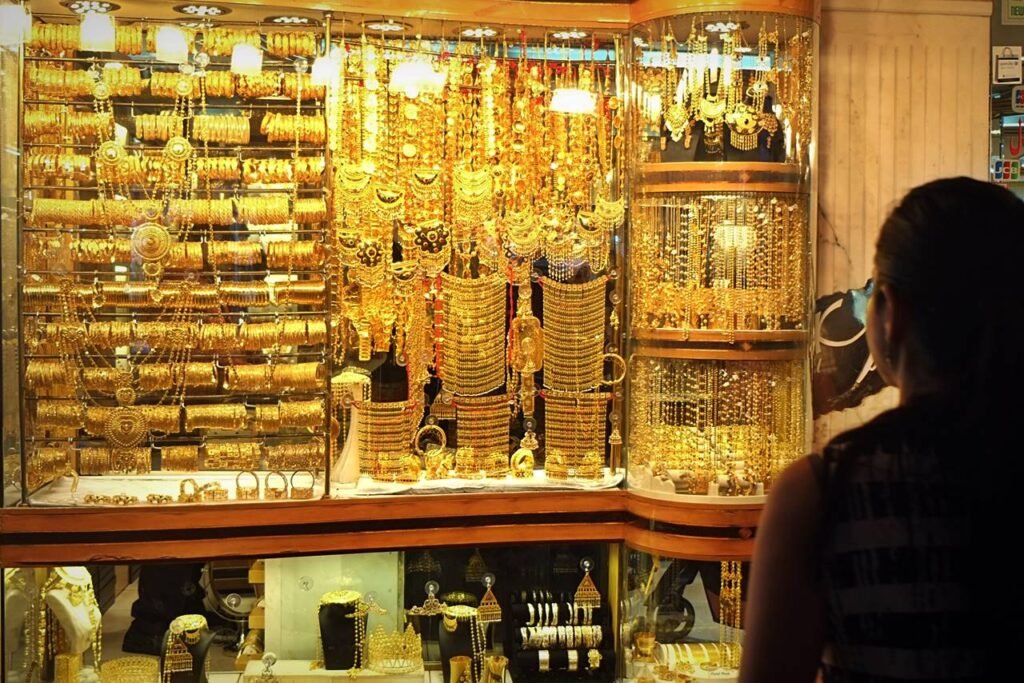
Today the souk is home to hundreds of retailers across the covered market lanes, their windows stacked with everything from delicate everyday pieces to elaborate statement jewellery, including some famously oversized showpiece rings and necklaces displayed purely for their spectacle value.
What to expect: gold and jewellery shopping
The appeal is the range: traditional Arabic and Indian jewellery sits alongside simpler contemporary pieces. For a purchase, separate that visual choice from the bill. The Dubai Jewellery Group’s own rate page publishes suggested retail gold-jewellery rates in AED per gram by karat. “Suggested” is not a guarantee that every item or shop has an identical final price. Ask which rate and net gold weight the shop is using, then identify the making charge, stones and other extras separately.
Check the timestamp and karat on the reference rate when you compare quotes. A 22K rate and an 18K rate are not interchangeable, and a piece’s total weight may include stones or other non-gold components. Ask for an itemised final quotation rather than multiply the weight of the whole piece by a gold rate and assume the result is the payable price.
Carat, metal weight and pure-gold content are different
Two 10 g items can contain different amounts of gold
Illustrative calculation — not observed data
At the same gross weight and 18K purity, 2 g of stones displaces 1.5 g of pure-gold content. Ask for metal weight, not just total weight.
Methodology
Pure gold = 75% of alloy weight. Fictional items; excludes making charges and is not a valuation.
Read chart data
| Comparison | Pure gold | Other metal | Stones |
|---|---|---|---|
| Alloy only | 7.50 | 2.50 | 0.00 |
| With 2 g stones | 6.00 | 2.00 | 2.00 |
The World Gold Council’s carat and purity guide explains that 18-carat gold contains 75% gold, with other metals making up the rest. Fineness expresses that proportion in parts per thousand: 750 corresponds to 18 carat. The gram weight of an 18K piece is therefore not all pure gold, and stones should not be treated as part of its metal weight.
A weight example, not a valuation: a hypothetical 10g of 18K metal alloy contains 10 × 75% = 7.5g of gold. If a different 10g item includes 2g of stones and the remaining 8g is all 18K metal, its calculated gold content is 8 × 75% = 6g. These are arithmetic assumptions, not an assay or a shop quotation. Ask the retailer to distinguish total item weight from metal weight excluding stones, then use the matching carat rate and compare the full bill.
Bargaining tips
Ask whether the making charge or another quoted component is negotiable, then compare the complete written offer with another shop. A discount percentage is not meaningful without its starting price, applicable pieces and final terms. Decide on the design and budget at your own pace; a retailer can decline a negotiation, and no particular saving is guaranteed.
Always ask for a certificate or receipt confirming the karat, weight, and price breakdown of anything you buy, both for peace of mind and for any future resale or insurance purposes. And if a deal feels rushed or pressured, it’s fine to take your time or come back later as reputable traders in the souk are used to unhurried customers weighing up their options.
Compare like with like before choosing a discount
Here is a deliberately simplified comparison, not a live gold quotation. For two plain pieces with the same 10g net gold weight, karat and quoted metal rate, making charges of AED 150 and AED 250 create an AED 100 difference before tax or other extras. If the weights, stones, rates or designs differ, that calculation no longer isolates the making charge.
| Ask the retailer to separate | Why it matters |
|---|---|
| Karat and net gold weight | The same total weight does not establish equal gold content. |
| Metal rate and its timestamp | Different quotes can use different rate observations. |
| Making charge and stone charges | A zero-making headline does not establish a zero-premium final price. |
| Tax, extras and final total | Compare what you actually pay, not only a rate-board number. |
| Returns, alterations and buyback terms | Ask separately; a sales price is not a guaranteed resale value. |
Tourist VAT refunds are not automatic
If a tourist refund matters to the budget, check the Federal Tax Authority’s current service rules before paying. The retailer must participate in the scheme, the purchase must qualify, and the tax-free transaction needs validation. A normal receipt alone is not a completed refund. The FTA says goods may need inspection and should be available before luggage check-in; deductions apply to the refund, so do not treat the full tax amount as guaranteed money back. Eligibility and fees should be checked against the current FTA/Planet instructions for your purchase and departure.
Before paying: check tourist-refund eligibility
The FTA’s service conditions, checked on 29 October 2026, require entry on a tourist visa, age 18 or above and non-resident status. They state a minimum eligible spend of AED 250 excluding VAT per refund transaction. Ask the participating retailer to confirm that your goods and transaction qualify before paying; an advertised refund is not automatic eligibility.
What a tourist refund actually returns
The scheme operator Planet’s current FAQ says an eligible refund returns 87% of the VAT paid, less AED 3.60 per tax-free transaction. The FTA’s service page gives the same deductions. Both were checked on 21 October 2026. That is not 87% of the jewellery price, and it is not the full VAT amount.
A hypothetical invoice example: if an eligible invoice records AED 50 of VAT, the calculation is AED 50 × 87% − AED 3.60 = AED 39.90. This is an arithmetic example, not a quote or a determination of the tax treatment of a particular piece. It assumes one qualifying tax-free transaction and successful validation. I would compare the shop’s full payable bill first; a possible later refund is not a reason to accept an inflated price today.
Before leaving the retailer, check that it has issued the tax-free transaction as well as the invoice. Keep the goods and original travel document available for the departure checks. Planet says validation is required within 90 days of the invoice date. A screenshot of a shop’s “tax-free” sign is no substitute for a correctly issued transaction.
Buying jewellery to take home: refunds and customs are separate
A tourist VAT refund does not settle customs requirements. The UAE Government’s customs guidance, checked on 29 October 2026, says passengers entering or leaving the UAE with more than AED 60,000 in cash or its equivalent in other currencies, financial instruments, precious metals or valuable stones must declare it to ICP. This is a disclosure threshold, not a promise of duty-free treatment.
Before buying for an overseas journey, check both the UAE declaration process and your destination country’s current gold and jewellery import rules. Keep the itemised invoice and distinguish a VAT-refund validation from a customs declaration; completing one does not complete the other.
The Spice Souk next door
Just a short walk from the Gold Souk sits Deira’s Spice Souk, a smaller but equally atmospheric market where sacks and barrels of saffron, frankincense, dried limes, cardamom, and countless other spices spill out onto the narrow lanes. It’s a fantastic contrast to the glitter of the Gold Souk, worth combining into the same visit for the smell alone. Vendors here are generally used to smaller, casual purchases and are often happy to let you sample or smell products before you buy.
Best time to visit
I would choose an evening for the lit shop windows and a more comfortable walk once the daytime heat eases. The cooler months, roughly November to March, suit a leisurely look around both souks. If you are travelling for a specific jeweller, confirm that shop’s opening and break times directly; a market-wide guide is not a promise that every counter will be open, on Friday or any other day.
How to get there
By Metro: use Al Ras on the Green Line as a starting point for the established Deira market. Open the Gold Souk map and choose the walking route to the market or your intended jeweller, rather than navigate only to the wider Deira district. Confirm an individual shop’s hours before making a special journey.
Across the Creek: from Bur Dubai, use the traditional CR1 crossing from Bur Dubai Abra Station to Deira Old Souq Abra Station, then continue on foot through the souk district. RTA lists AED 1 per passenger per trip, cash only, and a 6am-to-midnight operating window, checked on 29 October 2026. Other abra routes and vessel types can have different fares; check the linked timetable for changes.
Choose one sensible arrival: if you are already on the Deira side, the Metro-and-walk option avoids an unnecessary Creek crossing. If you are exploring Bur Dubai first, the CR1 crossing lets you continue into the Spice Souk and Gold Souk district. This is a suggested sequence, not a timed walking test or an accessibility guarantee.
Taxis and ride-hailing apps are also options. Use your chosen shop or the Gold Souk map as the destination, then check the final pedestrian approach rather than assume the vehicle can stop at the shop door.
Frequently Asked Questions
Is gold cheaper at the Deira Gold Souk?
Not automatically. Compare equivalent karat, net gold weight, design, stones and the final payable total. A lower making charge can be offset by another component of the quotation, and a low advertised starting price does not establish that a particular piece is cheaper than an equivalent elsewhere. Ask about any buyback policy separately; a purchase receipt does not guarantee a future resale price.
Can you bargain at the Gold Souk?
You can ask whether the making charge or another component is negotiable, but a retailer may decline. Compare the final itemised offer with an equivalent piece elsewhere; neither a discount percentage nor a zero-making headline guarantees the lowest total price.
How do I get from the Gold Souk to the Spice Souk?
They’re a short walk apart within the same Deira trading district, making it easy to visit both in a single trip.
What’s the best way to reach the Gold Souk?
For a Metro arrival, use Al Ras on the Green Line and follow the Gold Souk map to your destination. From Bur Dubai, the traditional CR1 abra runs to Deira Old Souq; RTA lists AED 1 per passenger per trip, paid in cash. Check the current timetable and your chosen jeweller’s hours.