

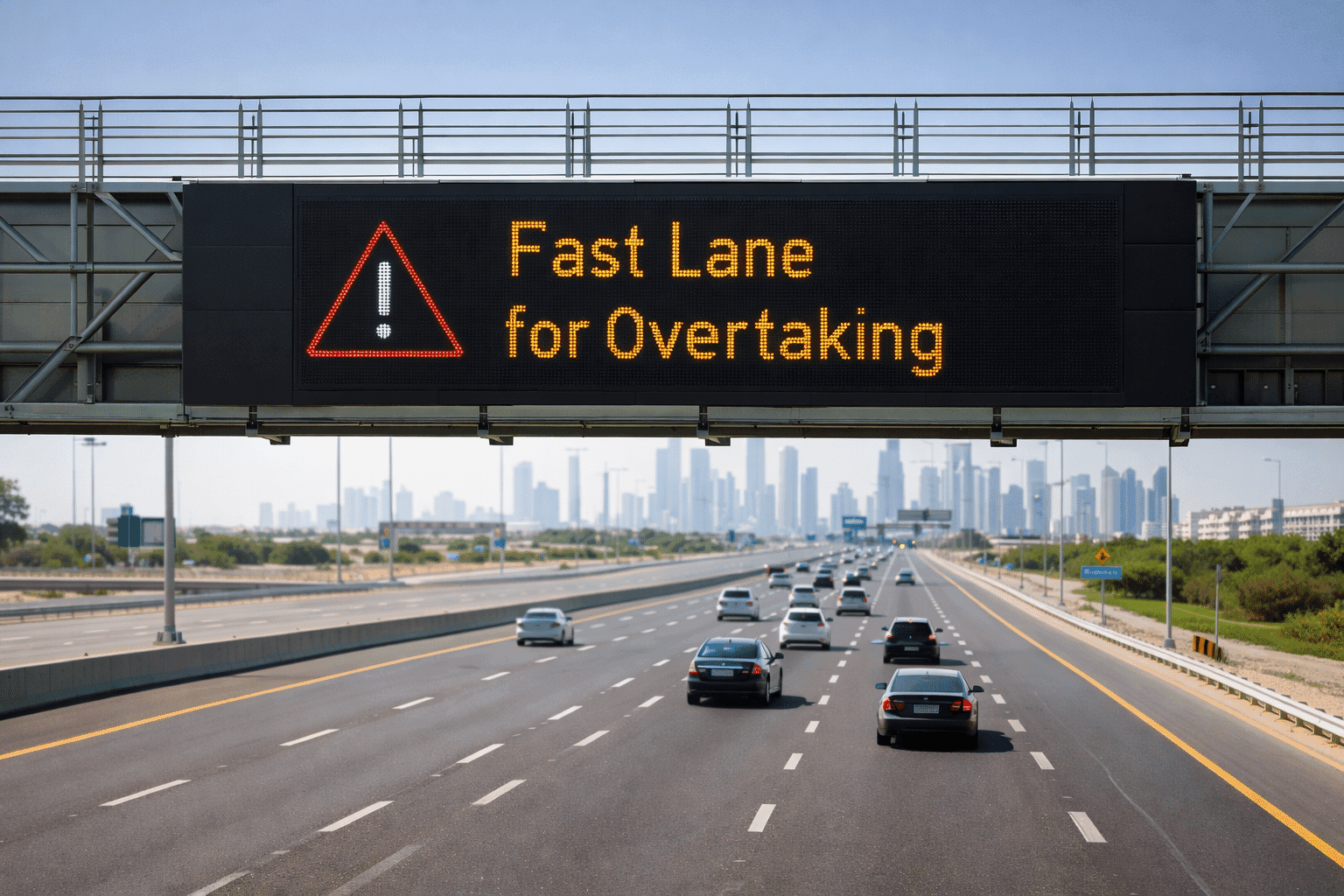
Dubai’s far-left lane is for overtaking. Learn when to move, why the AED 400 fine has no black points, tailgating penalties and delivery-bike rules.
Last checked: 29 July 2026. On a multi-lane Dubai road, the far-left lane is the overtaking lane. Use it to pass, then move right when it is safe. If a vehicle approaches from behind, you must not obstruct it simply because you are already travelling at the posted limit. Failing to give priority to a vehicle coming from behind or from the left carries an AED 400 fine under the UAE’s official traffic-violation schedule.
That does not give the driver behind permission to speed or tailgate. Each driver remains responsible for a separate offence: move over safely without exceeding the speed limit, while the faster driver can still be penalised for speeding, unsafe following distance or reckless behaviour.
Dubai fast-lane rule in 20 seconds
- Which lane? The far-left lane on a road travelling in your direction.
- What is it for? Overtaking, not continuous cruising.
- Fine for failing to give way? AED 400.
- Black points for that offence? The official schedule currently shows none.
- Can you stay there at the speed limit? Not if you are obstructing a vehicle behind and can move right safely.
- Should you speed up to get out of the way? No. Signal and change lane safely while obeying the limit.
What is Dubai’s official fast-lane rule?
The clearest primary source is the RTA Light Motor Vehicle Handbook. It describes slow driving in the fast lane as dangerous because it forces following drivers to brake or change lanes, and instructs motorists to use the fast lane only when overtaking.
Dubai’s road signs and lane markings still take priority in the specific location. A lane may be reserved, closed, merge, become an exit lane or carry a posted minimum speed. “Keep right unless overtaking” is not an excuse to cross a solid line or force into a gap.

What is the fine for blocking the fast lane?
The UAE’s published traffic-violation schedule lists AED 400 for “not giving priority to vehicles coming from the back or the left side of the road”. The schedule shows no black points and no vehicle impoundment for that specific violation.
| Relevant violation | Fine | Black points | Important distinction |
|---|---|---|---|
| Not giving priority to a vehicle coming from behind or the left | AED 400 | None shown | The rule most often associated with lane hogging |
| Driving below a posted minimum speed, where one exists | AED 400 | None shown | A separate offence; not every road has a minimum-speed sign |
| Failing to leave a safe following distance | AED 400 | 4 | Applies to the tailgating driver, not the vehicle being followed |
| Not giving way to emergency, ambulance, police or official-convoy vehicles | AED 1,000 | 6 | A separate and more serious priority offence |
You can verify the current federal schedule through the UAE Government traffic and patrol laws document. The UAE applies Federal Decree-Law No. 14 of 2024 on Traffic Regulation alongside its implementing rules and violation schedule.
Why do some articles claim four black points?
Some fast-lane explainers merge two different AED 400 offences. The published schedule shows no black points for failing to give priority to a vehicle coming from behind or the left. It separately assigns four black points for failing to keep a safe distance.
In other words, the front driver can be fined AED 400 for not giving way, while the following driver can receive AED 400 and four black points for tailgating. One driver’s lane misuse does not cancel the other driver’s unsafe following offence.
Do you have to move if you are already at the speed limit?
Yes—if a faster vehicle approaches and there is a safe opportunity to move right, give way. Do not police another driver’s speed by remaining in the lane. Equally, do not exceed the posted limit to complete the manoeuvre and do not make a sudden lane change.
Use this sequence:
- Check the interior and right-side mirrors.
- Check the blind spot.
- Signal before changing lanes.
- Wait for a sufficient gap; do not cut across another vehicle.
- Move one lane to the right smoothly while maintaining a legal, controlled speed.
If traffic is dense and there is no safe gap, maintain control and move when one opens. The obligation to give way is not an instruction to collide with the vehicle beside you, cross a prohibited marking or use the hard shoulder.
Does flashing headlights give the rear driver priority?
Headlight flashing may alert you that a vehicle wants to pass, but it does not make tailgating, speeding or aggressive driving lawful. Your response should be the same whether the driver flashes or not: check your surroundings and move right at the first safe opportunity.
Do not brake-check, retaliate, race the other vehicle or deliberately close a gap. If another motorist behaves dangerously, create distance rather than escalating the encounter. Call 999 only for an immediate emergency.
Is driving slowly in the fast lane a separate offence?
It can be. The official schedule sets an AED 400 fine for driving below the minimum speed limit established for a road, if a minimum is posted. This is not the same as merely travelling below the maximum speed.
A road’s maximum is the highest lawful speed in normal conditions. A minimum sign establishes a separate lowest permitted speed for the affected lane or road. Weather, congestion, an incident or police directions may require drivers to slow down, so the legal and safe speed always depends on the conditions as well as the signs.
| Situation | Correct response |
|---|---|
| You are overtaking and no vehicle is close behind | Complete the pass legally, then return right when safe |
| A faster vehicle approaches from behind | Signal and give way at the first safe gap |
| The right lane is occupied with no safe gap | Hold a predictable course; do not force the lane change |
| The vehicle behind is tailgating | Do not brake-check; move safely when possible and increase separation afterward |
| Traffic is slow across every lane | Follow lane markings, keep a safe distance and avoid weaving |
| An emergency vehicle approaches with warnings active | Give priority immediately and follow police or road instructions |

Special fast-lane rules for Dubai delivery bikes
Delivery motorcycles have additional Dubai-specific lane restrictions that took effect on 1 November 2025. The RTA and Dubai Police announcement sets the rule by the number of lanes on the road:
| Road width in one direction | Delivery-bike restriction |
|---|---|
| Five lanes or more | Delivery bikes may not use the two leftmost lanes |
| Three or four lanes | Delivery bikes may not use the leftmost lane |
| Two lanes or fewer | No lane restriction under this specific rule |
The official penalties are AED 500 for a first offence, AED 700 for a second, and permit suspension for a third. The same announcement sets separate escalating penalties for delivery riders who exceed 100km/h on roads with a limit of 100km/h or above: AED 200 for the first offence, AED 300 for the second and AED 400 for the third.
These delivery-bike penalties should not be confused with the AED 400 car-driver fine for failing to give way.
What not to do in the left lane
- Do not cruise indefinitely. Finish the overtake and return right when safe.
- Do not exceed the posted limit. Giving way does not authorise speeding.
- Do not tailgate. The safe-distance offence carries its own fine and black points.
- Do not pass on the hard shoulder. The shoulder is not an escape lane for impatient traffic.
- Do not weave across several lanes. Change one lane at a time unless markings and road layout clearly permit otherwise.
- Do not ignore emergency vehicles. Their priority is governed by a separate, more serious violation.
How to check or pay a Dubai traffic fine
Use an official channel rather than a link in an unsolicited message. The UAE Government’s road-safety page directs motorists to Dubai Police and RTA for Dubai fine enquiries and payment. RTA also provides an official vehicle-fines payment service.
Read the violation description, date, location and vehicle details before paying. “AED 400” alone does not identify the offence because several traffic violations carry the same amount. If the record appears incorrect, use the objection or support route shown by the issuing authority rather than relying on social-media advice.
The bottom line
Dubai’s fast lane is the far-left overtaking lane, not a place to hold position because you have reached the maximum speed. Overtake, then return right when safe. The current official schedule lists an AED 400 fine with no black points for failing to give priority to a vehicle coming from behind or the left.
Tailgating is a separate AED 400 offence carrying four black points, and driving below a posted minimum speed is another separate AED 400 offence. The rule is designed to prevent both lane blocking and aggressive driving: give way safely, obey the speed limit and leave enforcement of the other vehicle to the authorities.
This guide summarises official road-safety and penalty sources; it is not legal advice. Road signs, police directions and the current official violation record take precedence.


