
Understand Dubai’s controlled property-tokenisation pilot, the difference between property tokens and XRP, and the legal, cost and resale questions to ask.
A property token can make a holding divisible. It does not automatically make it easy to sell. Dubai’s real-estate tokenisation project is important because it tests how digital records and property rights can work together within a controlled framework—not because blockchain has abolished vacancy, maintenance costs or the need for a buyer.
Checked on 17 October 2026, this guide puts the DLD announcement and VARA’s accompanying alert together. The original article’s claims of unrestricted liquidity, superior safety and a global investment breakthrough are not established by those documents. This is general information, not an approved offering or personal investment/legal advice.

The 2026 announcements: Phase II is controlled testing
DLD’s 9 February 2026 announcement described resale activity starting 20 February and approximately 7.8 million property tokens within a controlled pilot. The VARA alert dated 19 February confirms Phase 1’s completion and describes Phase 2 as testing and evaluation, including secondary-market mechanisms and the conditions for future expansion.
Read these statements together. An operational milestone is not general permission for every promoter to sell property tokens. A historical announcement also does not establish that every offering is open, that you are eligible or that a buyer is waiting for a holding today. Use the current approved offering and relevant platform terms for an actual decision.

Five layers that a tokenisation headline can hide
| Layer | Question to answer |
|---|---|
| Underlying property | What is the actual asset, title, occupancy and condition? |
| Legal rights | What precisely does the holder own, through which documents and structure? |
| Token record | Which issuer, token identifier and ledger record correspond to those rights? |
| Administration/custody | Who handles records, rent, expenses, key control and disputes? |
| Exit | Which buyers, windows, approvals, costs and settlement steps apply? |
A correct record on one layer cannot answer every question on the others. For example, a visible token balance does not establish the building’s repair needs. A named custody provider does not promise rental income. A technically fast transfer does not show that the legal and cash parts of a sale complete at the same speed.

Fractional rights: read the documents, not just the percentage
A fraction tells you the size of the participation, not the complete right attached to it. Ask whether the documents establish a title-linked interest, an interest through a structure, a contractual claim or another arrangement. Check voting, income allocation, costs, administration, transfer restrictions and what happens on a sale of the underlying property.
Do not assume all property tokens represent identical rights, or that every fractional product is part of the DLD pilot. An issuer’s involvement in one approved activity does not authorise every other product it advertises. If the structure cannot be explained in plain language and supported by documents, the smaller entry amount is not enough reason to proceed.

XRP Ledger is not the same thing as owning XRP
The XRP Ledger is the network; XRP is its native asset; a property-related token can be a separate issued asset. Buying XRP is not, by itself, buying a fraction of a Dubai property. A token using the same ledger does not inherit the market liquidity, price behaviour or legal rights of XRP.
The XRPL documentation describes issuer-authorised trust lines and token-freezing controls. These show that issued assets can have technical transfer conditions. They do not establish which controls a particular property product uses or prove its legal compliance. Check that product’s actual configuration and approved terms.
Low network fees are only one component of an investment cost. Issuance, administration, custody, property management, transfer and cash-withdrawal charges can exist separately. An attractive ledger benchmark is not a complete fee schedule, and this guide does not claim a tested performance advantage over Ethereum, Solana or other networks.
Custody cannot eliminate the property risks
Custody concerns control and safeguarding of digital assets or records within the specific arrangement. It does not repair a building, eliminate a tenant default, settle every title dispute or guarantee an investor’s return. Ask which entity provides the service, its responsibilities and limitations, and what happens if a provider fails.
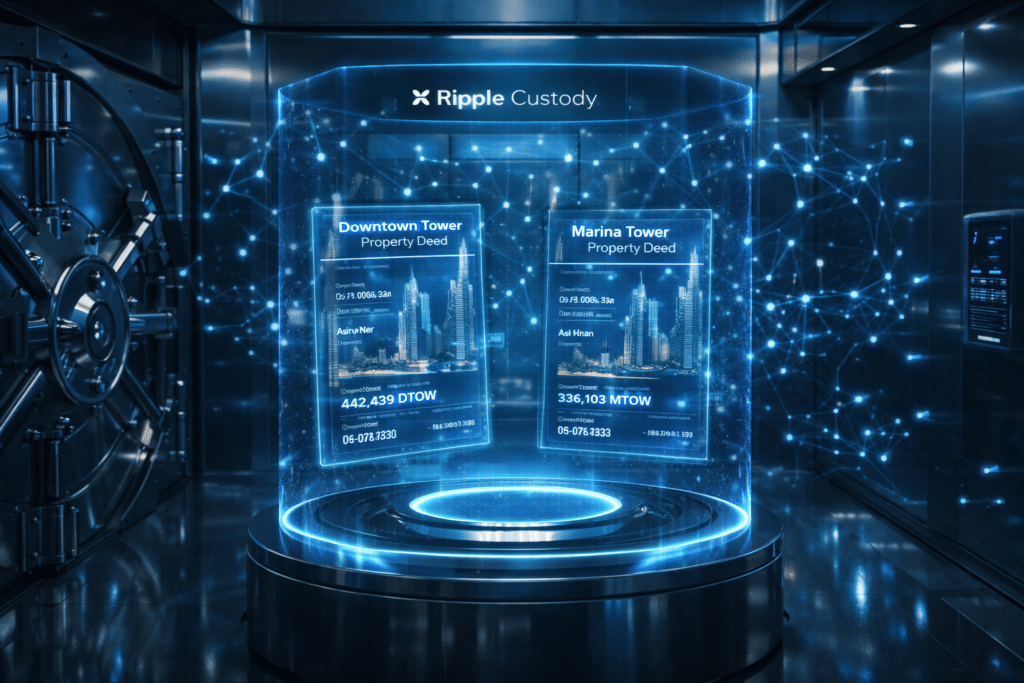
If a promoter cites Ripple Custody or another technology supplier, verify the claim for that product through actual provider documentation. Do not interpret a logo or the phrase institutional-grade as insurance against every loss. The retained custody image is a concept illustration, not a service contract.
Secondary market: an available mechanism is not guaranteed liquidity
| What a promoter says | Evidence to request |
|---|---|
| You can sell easily | Eligible buyers, sale windows, matching process, past executed trades and costs. |
| Instant transfer | Ledger confirmation versus legal update, cash settlement and withdrawal times. |
| Transparent value | Who sets or discovers price, valuations used and whether quotes are executable. |
| Low fees | All platform and property charges, including those deducted from rent or sale proceeds. |
| Regulated product | Exact legal entity, activity, approved offering and relevant restrictions. |
Even a functioning secondary market can have no buyer at your requested price. A quoted valuation is not necessarily a firm bid. A permitted sale request is not a completed sale. Work out whether you could hold longer if an exit is unavailable, instead of treating the token format as a substitute for a cash reserve.
Worked example: rent is not the net return
Hypothetical arithmetic, not a real offering: a 1% interest in a property earning AED 100,000 gross annual rent corresponds to AED 1,000 before allocated costs. If the relevant annual property costs are AED 20,000 and your share follows that same percentage, AED 200 would be deducted, leaving AED 800 before other platform, financing or tax effects. The actual allocation must come from the documents.
For an exit, suppose a holding was bought for AED 10,000 and the only executable bid is AED 9,000. That is a 10% capital loss before selling costs, even if rent was paid. A displayed underlying-property valuation of AED 10,000 for your fraction does not force a buyer to pay it. Calculate income and sale proceeds separately.
The due-diligence pack before a deposit
- Approved offering and the legal identity of every contracting party.
- Evidence of the property and the rights represented by the token.
- Customer eligibility and any restrictions on holding or transfer.
- A full schedule of property and platform costs, with worked allocations.
- Rent distribution, maintenance decisions, reserves and dispute arrangements.
- Actual exit procedure and the position if no buyer is found.
- Custody, record reconciliation and provider-failure provisions.
Get advice on any legal language you cannot resolve. The pilot’s existence does not validate an unrelated WhatsApp allocation or a request to send money to a personal wallet. VARA’s alert specifically warns about marketing that implies approval or participation beyond the authorised scope.
What would demonstrate success—not just an announcement?
Useful outcomes include accurate reconciliation of rights and records, functioning distribution processes, understandable costs, completed eligible resales and a workable response to disputes. Broader adoption and capital inflows are possible future outcomes, not facts established by a launch release.
Editorial scope: the DLD Phase II announcement, VARA alert and selected XRPL technical controls were checked. We did not buy a property token, audit the pilot, confirm a live exit price or inspect an underlying property. Unverified market-size totals, untraced quotations and ledger-versus-ledger superiority claims have been removed. All five original illustrations remain, accurately labelled.
Questions answered
Does buying XRP give me fractional ownership of Dubai property?
No. XRP is the ledger’s native asset. A property token is a separate product whose legal rights, issuer, eligibility and terms need checking.
Does tokenisation guarantee that I can sell immediately?
No. A transfer mechanism does not guarantee an eligible buyer, an acceptable price or immediate cash settlement. Read the actual secondary-market conditions.
Is every Dubai property-token project approved because DLD has a pilot?
No. VARA’s alert describes a controlled framework and warns against implying authorisation beyond the approved scope. Verify the actual entity, offering and activities.