How Brave Wallet’s NEAR Intents swaps work: compare the full quote, follow a hypothetical fee example, understand Zcash privacy and trace a stalled transfer.
Brave Wallet’s NEAR Intents integration brings cross-chain swaps into the browser’s built-in wallet. The appeal is straightforward: choose the asset you have and the asset you want, with less manual route management in between. The important details are just as practical—what arrives, which network receives it, what the quote includes and where a refund would go. Here is how to read that journey, compare costs and understand what shielded Zcash adds to the privacy picture.

What Brave announced—and when
Brave’s 11 March 2026 announcement introduced NEAR Intents with browser version 1.88, naming Bitcoin, Solana, Zcash, Cardano and EVM networks including Ethereum, Base and Arbitrum. That dates the integration; current availability depends on the installed platform and the route offered for the particular assets and amount. An asset appearing in the wallet and a quote for a specific cross-chain swap are different features to look for.
Start with the wallet on your own platform and the exact source and destination networks. A ticker alone can hide a different asset representation or network. The release history below explains how the features arrived; the quote and product documentation supply the conditions for the transfer you are considering.

What an intent-based swap changes
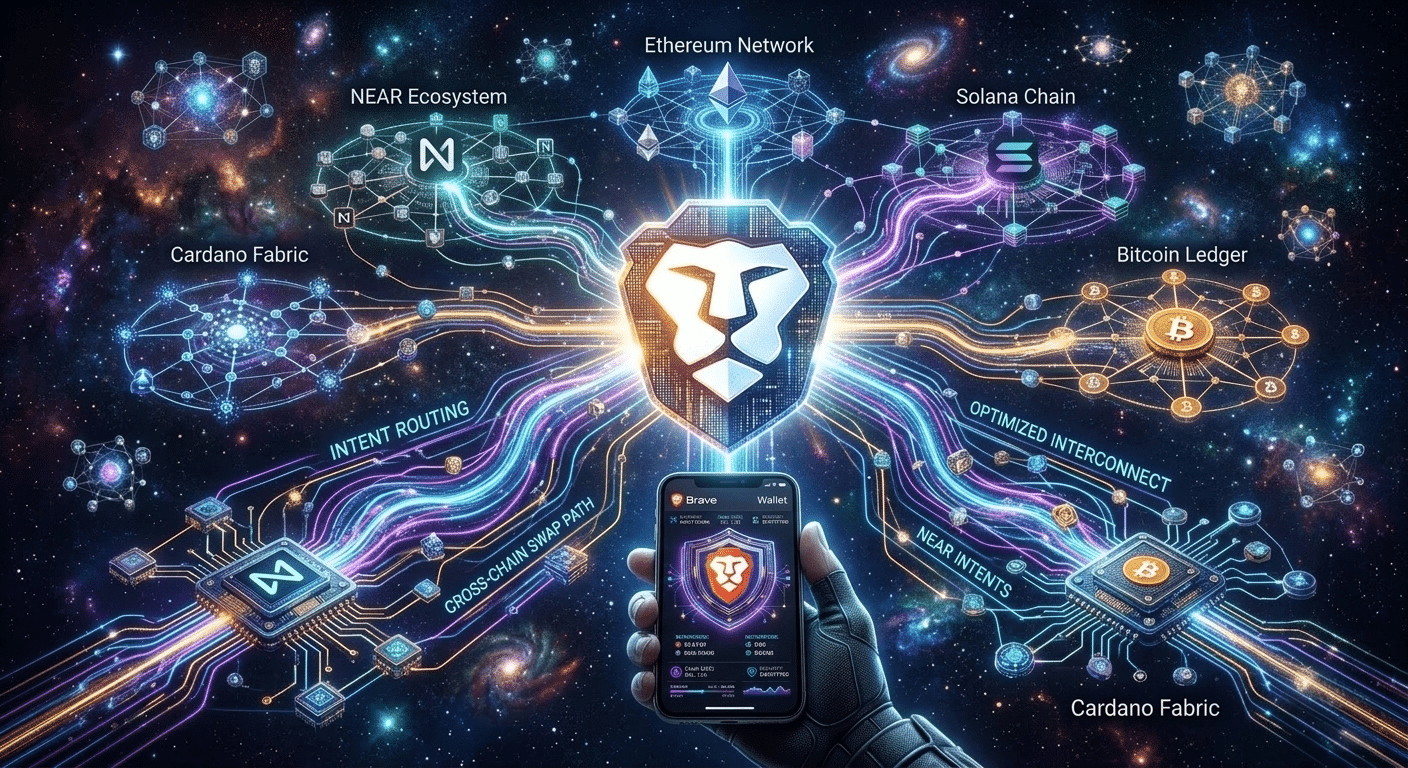
NEAR Intents’ cross-chain swap overview describes four stages: choose the source and destination assets, obtain the route, sign or deposit as required, and receive the destination asset. The overview also allows configurable per-swap fees for integrations. That is why a simpler route still needs a cost comparison using the actual wallet quote, rather than an assumption that one provider’s fee schedule applies to every integration.
The practical benefit is easier coordination between chains. Keep the source asset, destination asset, destination network and receiving address together as one set of instructions. For example, receiving a token on Base and receiving the same ticker on Ethereum are different outcomes. Resolve that choice before comparing the headline rate: a slightly better quote for the wrong destination does not complete the task you came to do.

A quote checklist before confirming anything
| Field to verify | The mistake it can prevent |
|---|---|
| Source asset and network | Sending the right ticker on the wrong chain, or a different token with a similar name. |
| Destination asset and network | Receiving a representation or network you did not intend to hold. |
| Recipient address | Sending to an address or destination account that does not support the selected asset and route. |
| Amount expected and minimum if shown | Confusing a headline rate with what the actual order is expected or permitted to deliver. |
| Fees and any separate balance needed | Assuming abstracted gas means no cost, or counting an included fee twice. |
| Quote deadline | Treating an expired quote as a current execution commitment. |
| Refund destination and conditions | Assuming a failed route automatically returns funds to whichever address you happen to prefer. |
| Transaction reference and status | Confusing a submitted deposit with a completed destination transfer. |
Use the table as a reading aid rather than a literal map of every wallet screen. If a quote or route leaves an important condition unclear, consult the product’s documentation or official support before confirming. Keep the quote and transaction reference so the same conditions can be checked later if execution stalls.

“No manual gas handling” does not mean no cost
Why a gas-abstracted swap can still cost you
Illustrative scenario — not observed data
Compare the value arriving at the destination, not whether the interface asks for gas separately.
Methodology
Illustrative WHIUAE calculation; source links explain the mechanism, not the assumed inputs. Both imagined routes start with AED1,000 equivalent. Delivered value is marked at the same reference price. No Brave quotes, execution tests or real fees were used.
Read chart data
| Scenario | Delivered value |
|---|---|
| Quote A | 995.00 |
| Quote B | 985.00 |
A service may abstract network charges while still reflecting them in a quote or another charge. Compare like with like: the same source amount, same source and destination assets, same destination chain and a quote taken at a comparable time. Then read whether each charge is included in the displayed amount or separate.
A worked cost comparison—entirely hypothetical: the chart illustrates two routes starting with an AED1,000-equivalent transfer, with destination values marked at the same reference price. Quote A delivers AED995 equivalent after all quoted charges. Suppose quote B advertises AED1,000 equivalent before a charge of AED15: its delivered value is AED985 equivalent, matching the chart. Under these assumptions, A leaves AED10 more at the destination. If B already displays the final AED985 amount, subtracting the fee again would be wrong. Also compare the minimum received and completion conditions. These are illustrative values, not live Brave quotes, real fees or token price predictions.
The best route for a particular transfer balances the destination, total cost and execution conditions. Compare the same source amount and route at comparable times; a different amount may produce a different quote or liquidity result. Keep convenience and price separate so fewer clicks do not hide a worse economic outcome.

Zcash: useful privacy, not universal anonymity
Brave’s April 2025 shielded-Zcash announcement explains that shielded transactions can conceal particular sender, receiver and amount information from the public Zcash ledger. It launched that functionality on desktop at the time. Do not assume a historical “coming soon” statement proves identical mobile availability today.
The March 2026 integration announcement describes routes into and out of transparent and shielded ZEC and says refunds from spending shielded ZEC return to the shielded pool. That statement concerns the described route, not a promise of complete anonymity across every source and destination chain.
Trace privacy through the journey rather than treating it as an on/off label. Shielding protects particular information on Zcash; an address or transaction on another public network has that network’s own visibility. A receiving exchange account can also link activity to its customer record. Check the specific stages you want to keep private, while meeting the legal requirements that apply to the transaction.

If a swap does not finish
If a swap stalls, gather the record before taking another action: the quote, source transaction reference, source and destination networks, receiving address and displayed status. These help distinguish a deposit that was submitted from a destination transfer that completed, or a refund that is being processed. Check the relevant network and token identifier before treating an apparently missing balance as a failed transfer.
- Use official wallet documentation and support reached from the product’s own site.
- Check the relevant network and asset identifier before concluding a destination balance is missing.
- Confirm the refund destination and conditions for the actual route, not a different product’s tutorial.
- Never disclose a recovery phrase, private key or one-time code to someone offering to unlock the transfer.
- Do not assume a claimed support agent in a direct message is associated with Brave or NEAR.
For a refund, use the conditions attached to that route and its designated destination. Brave’s March announcement specifically describes shielded-ZEC refunds returning to the shielded pool; it does not provide one refund deadline for every asset and route. Keep that distinction when asking support to trace an individual transfer.
Cardano support is a separate feature history
Brave’s October 2025 Cardano announcement described managing Cardano assets, token swaps and governance participation in its wallet. The later NEAR Intents integration adds another cross-chain element. Keep those milestones separate: support for storing an asset or participating in governance does not prove that every possible cross-chain swap for it is available.
There is also an earlier provider history to recognise: Brave’s August 2024 cross-chain announcement described LI.FI-powered bridging, while the March 2026 release introduced NEAR Intents. When reading an older tutorial or fee statement, identify which provider and route it covers. A historical statement about one integration is not the fee schedule or feature list for another.
What matters for UAE readers
A browser wallet, a swap route and a locally regulated financial-service provider are different things. A technical integration does not itself establish a UAE licence, eligibility for your account or protection against investment loss. If another provider supplies custody, funding or conversion services, identify the actual legal entity and applicable terms separately.
The useful comparison is the complete transfer: the amount committed, the asset and network received, the total charges and the recovery route. NEAR Intents reduces the manual routing work described in Brave’s integration announcement. A good wallet experience keeps those conditions visible while making the journey easier to manage.
Sources and Release History
This explainer draws on Brave’s dated NEAR Intents, Cardano and shielded-Zcash announcements, its earlier LI.FI release and NEAR’s official cross-chain overview, read on 15 November 2026. The fee calculation is a hypothetical example. We have not executed a swap or measured its completion time, cost or privacy in practice.
Questions answered
When did Brave announce NEAR Intents support?
Brave announced the integration on 11 March 2026 with browser version 1.88. That is a release milestone, not a claim that 1.88 remains the latest version.
Does abstracted gas handling mean Brave swaps are free?
No. Check the expected amount, included charges and any separate costs for the actual quote. Simpler route handling is not evidence of zero execution cost.
Does shielded Zcash make every cross-chain activity anonymous?
No universal anonymity is established. Shielding concerns particular Zcash transaction information; other chains, accounts and transaction stages need separate assessment.
What should I keep if a cross-chain swap stalls?
Keep the quote, source transaction reference, asset and network details, receiving address and displayed status. Use official support and the route’s refund terms to trace the transfer. Never disclose a recovery phrase, private key or one-time code to someone offering to unlock it.