Dubai’s Smart Municipality Eye is a drone-and-AI initiative for looking after green spaces—not an established airborne disease detector. The Municipality announced it on 10 November 2025. My interest is straightforward: can this help teams find a struggling tree or an irrigation problem and actually put it right? That matters more than another futuristic control-room image.
The useful distinction is between the green-space initiative, a separately reported public-health data agreement and results that have not been demonstrated in the sources reviewed. I would not combine them into a claim that drones are already predicting or preventing human outbreaks. This guide explains what was announced, what the evidence supports and the practical questions I would ask before calling the programme a success.
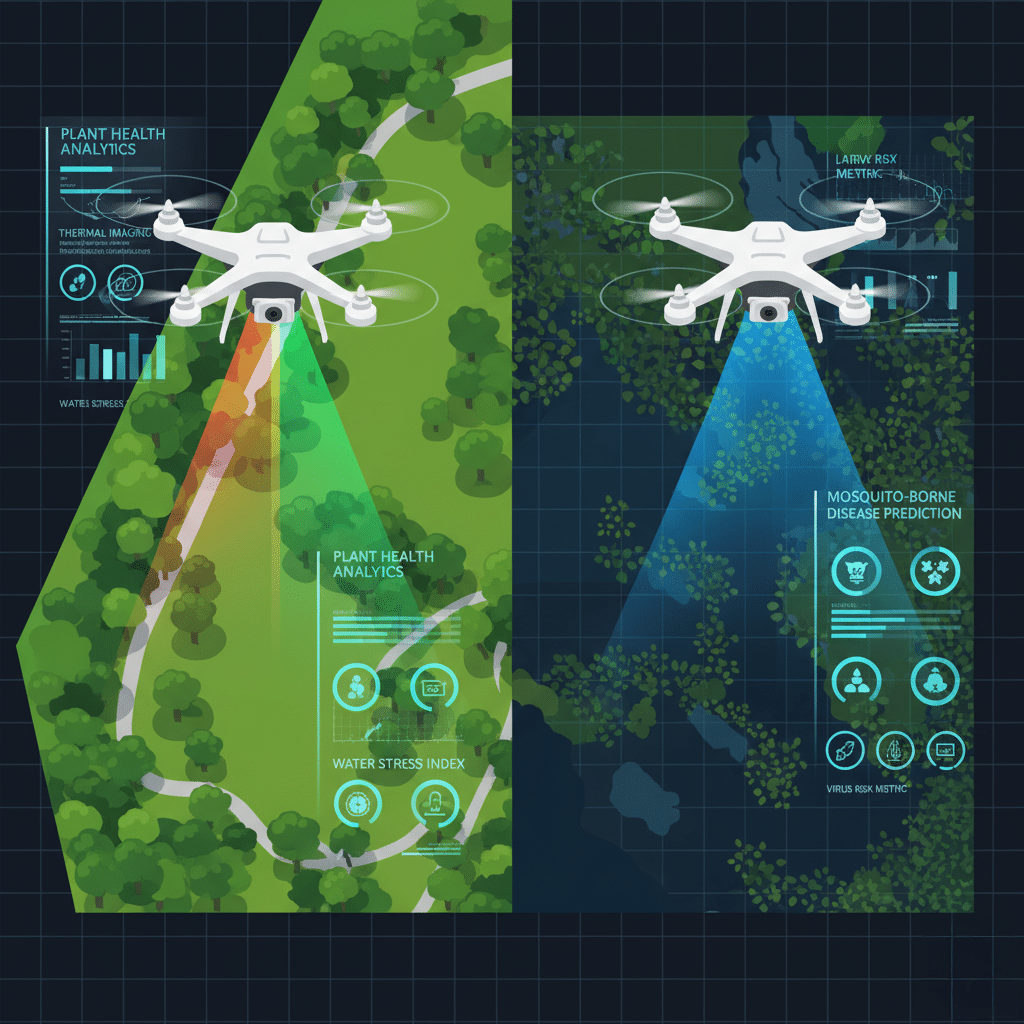
Image note: the retained hero is a concept illustration of a drone network over Dubai, not a documented deployment photograph. The body illustrations are also conceptual, not official equipment, monitoring screens or medical evidence.
Why I care about the maintenance, not the spectacle
For residents, the test is not whether a park appears on a digital map. It is whether someone acts on a problem that the map flags. I would judge this as a maintenance service: a useful alert, a sensible inspection and a repair or treatment that improves the place people actually use.
There is a broader policy ambition behind the launch. In Nasreen Abdulla’s 10 November 2025 Khaleej Times report, Marwan Ahmed bin Ghalita’s speech links forward planning, environmental renewal and new destinations. Those are reported priorities, not measured outcomes. A speech can explain why a project exists; it cannot tell us how reliably it works.
For related everyday questions rather than technology announcements, browse our Living in the UAE coverage.
What Smart Municipality Eye actually announced
The official Municipality announcement describes AI-supported aerial monitoring of vegetation, irrigation concerns and pests. It names 52 million square metres of green space as the mapping scope. That figure is not evidence that every square metre has already been surveyed or that every alert has been checked.
The launch names Eanan Al Samma as the drone-technology partner and describes an agreement covering development, expertise and pilot operational models. I would read that as an announced collaboration, not a published performance audit or proof of a fully established service everywhere in Dubai.
Abdulla also reported Khulood Mustafawi identifying plant monitoring and seed sowing as initial use cases, with wider deployment to be considered after feedback. The seeding detail is attributed reporting, not something we observed. Keeping that distinction matters: a planned activity, a completed flight and a successful planting are different claims.
The public-health agreement is a separate piece of reporting
The same newspaper report describes a Municipality–Dubai Health Authority agreement on early detection and analysis of shared and vector-borne disease data. It attributes the disease-prevention aim to Fidaa Alhammadi. We did not conduct those interviews, and the report’s description of that agreement does not establish a Smart Eye disease-surveillance flight.
Do not read “disease data” as “a drone can diagnose disease”. Nor does a public-health partnership prove that an airborne system has located an infected mosquito, predicted a human outbreak or prevented one. Those claims need their own evidence. I would want the method, validation and actual outcomes before recommending that interpretation to readers.
The official green-space release does not supply that evidence. It does not specify an outbreak model, publish its accuracy or demonstrate eradication before infection. We have therefore removed this article’s earlier claim that the partnership would use a Smart Eye fleet to do those things. The agreement remains relevant context, but it is not a licence to fill the gaps with impressive-sounding capabilities.
Plant monitoring: the announcement versus the result
Green-space maintenance is a much clearer fit for the announced initiative. Finding a possible irrigation fault gives a team a specific issue to investigate. But I would still separate “the system highlights a concern” from “the concern is confirmed” and “the repair worked”. A colourful image alone answers none of those questions.
The release does not identify the sensor configuration or publish a comparison against ground inspections. I would not assign particular thermal or multispectral equipment to these aircraft without a specification. These are the three evidence gaps I would look to close:
- Was the alert correct? Compare the flagged location with an inspection and record both confirmed problems and false alarms. An alert count is not the same as a count of sick plants.
- Did an intervention help? For a water-saving claim, show measured water use and plant condition against a stated baseline. Reduced watering alone does not prove better maintenance.
- Did the planting establish? For a seeding trial, I would ask how many plants survived and what follow-up was needed—not just how much ground an aircraft covered.
Those are my evaluation criteria, not results supplied by the project. The distinction makes the story more useful: readers can recognise an actual improvement when the evidence arrives, rather than being asked to applaud a promise twice.
The five-step test I would apply
For a hypothetical maintenance trial, I would follow one issue from detection to outcome: record the alert and its location; inspect it on the ground; choose an intervention; log the time and resources used; then check the result. This is a proposed assessment workflow, not a verified description of the Municipality’s operating procedure.
A comparison also needs comparable conditions. I would want the site, period, type of problem and method explained before treating a faster response as proof that drones caused it. A one-off success is interesting; a repeatable, documented service is much more convincing.
What would make this worth copying?
I would not call an announcement a ready-made blueprint for other cities. The useful idea is to connect observation with a maintenance decision. The hard questions come afterwards: who verifies an alert, who owns the action and how does the team know that action helped?
Keep the partnerships distinct. The Eanan arrangement concerns the announced drone initiative; the separately reported DHA agreement concerns public-health collaboration. Describing a single three-party system would go beyond the evidence. Cooperation is valuable, but it needs a clear account of what each agreement actually covers.
If I were assessing a similar proposal, I would ask for the following before signing off on claims of success:
- Name the problem first. “Find irrigation faults in this defined area” is a question a trial can answer. “Make the city smarter” is not an adequate success measure.
- Make responsibility visible. A technology supplier and a maintenance team need a clear handover. I would want to know who receives an alert and who checks that it is not lost between systems.
- Explain the information being used. A vegetation image and a public-health dataset are not interchangeable. Do not imply that one project has access to another’s information without evidence.
- Publish a meaningful denominator. Ten confirmed problems mean little without knowing how many alerts, inspections or sites were involved. I would ask for the misses and false alarms as well as the wins.
- Show the follow-through. A prediction that nobody acts on is not a repaired irrigation system. I would judge the completed maintenance and its outcome, not the number of dashboards.

My verdict: show me the healthier park
I am interested in this as a practical maintenance tool, not as proof that Dubai has solved outbreak prediction from the sky. Catching a problem early and making a park better is a worthwhile ambition on its own. It does not need an unsupported medical claim to make it interesting.
My recommendation is to read the launch for what it is: an announced green-space initiative with a technology partnership and a proposed direction. Before declaring it a model everyone should copy, I would want documented results, clear limitations and evidence that the alerts led to useful work. Better maintenance is the story worth following.
For residents, this announcement is not a health alert or proof that a particular park is disease-free. It also establishes no public flight schedule or permission for private drone use. If those are the answers you need, this launch release cannot provide them; do not infer them from the illustrations.
Sources
- Dubai Municipality, 10 November 2025: official Smart Municipality Eye launch. Nasreen Abdulla, Khaleej Times, 10 November 2025: attributed interviews, initial use cases and the separately reported DHA agreement. Source check: 19 October 2026. This is a review of those announcements, not an exhaustive 2026 operational-status audit, technical test, site visit or independent interview.