Learn the useful words before trying to sound like you have lived in Dubai forever. I’d start with a greeting, a thank-you and the phrases you actually hear, then keep the rental and admin vocabulary in a different mental drawer. “Yalla” helps a conversation along. “Chiller-free” can affect a bill, and needs a question about…
Learn the useful words before trying to sound like you have lived in Dubai forever. I’d start with a greeting, a thank-you and the phrases you actually hear, then keep the rental and admin vocabulary in a different mental drawer. “Yalla” helps a conversation along. “Chiller-free” can affect a bill, and needs a question about the contract rather than a quick translation.
My starting point: useful, polite and in context
A few expressions used naturally beat a whole glossary performed at someone. I’d follow the other person’s tone and preferred form of address, especially in a formal setting. For anything involving rent, cheques or registration, move beyond the slang definition to the actual document or service. The examples here illustrate usage; they are not interview quotations or a rule for every speaker.
For the administrative words in practice, use the DEWA bill guide and Emirates ID service checks rather than treating a glossary as a complete procedure.
We’ve expanded the classic list to over 30 essential words and phrases — from Arabic greetings you’ll hear every day to admin jargon that’ll stop you looking like a freshly landed expat.
Quick Reference: Dubai Words at a Glance
| Word / Phrase | Meaning | Category |
|---|---|---|
| Yalla | Let’s go / hurry up | Street slang |
| Habibi / Habibti | My dear / my love | Social |
| Inshallah | If God wills it | Arabic phrase |
| Khalas | Finished / done / enough | Street slang |
| Wallah | I swear / honestly | Arabic phrase |
| Yaani | Like / you know / means | Filler word |
| Wasta | Connections / influence | Culture |
| Mafi mushkila | No problem | Social |
| Shukran | Thank you | Arabic phrase |
| Tfaddal | Please / go ahead / here you go | Social |
| Mashallah | God willed it / praise God | Arabic phrase |
| Alhamdulillah | Praise be to God | Arabic phrase |
| Mabrook | Congratulations | Social |
| Yakhee | Bro / mate | Street slang |
| Arbab | Boss / landlord | Street slang |
| Khalli walli | Forget about it / ignore it | Street slang |
| Chammer / Chammak | Mall-hanging teen trying to be cool | Local slang |
| Tayeb | Okay / fine / good | Social |
| Yalla bye | Goodbye (very Dubai) | Street slang |
| Bukra | Tomorrow (sometimes “eventually”) | Street slang |
| Chiller-free | Air conditioning included in rent | Real estate |
| PDC / Post-dated cheques | Future-dated cheques for rent | Real estate |
| DEWA | Dubai Electricity & Water Authority | Admin |
| Ejari | Official tenancy registration system | Admin |
| RERA | Real Estate Regulatory Agency | Admin |
| Ahlan wa sahlan | Welcome / hello | Arabic phrase |
| Sabah al khayr | Good morning | Arabic phrase |
| Masaa al khayr | Good afternoon / evening | Arabic phrase |
| Aiwa | Yes | Arabic phrase |
| Mafi | No / there is no | Arabic phrase |
| Jid jid | Very serious / for real | Street slang |
| Boss | Casual address to any man | Street slang |
The Essential Arabic Phrases
Visit Dubai’s language guide describes the city’s multilingual mix and common phrases such as habibi, inshallah and yalla. Transliteration and pronunciation vary by speaker and dialect. The short conversations below are usage examples, not quotations from an interview or claims that everyone speaks the same way. When meeting someone formally, a neutral greeting and their preferred name are a safer starting point than copying a friend’s nickname.
Ahlan wa sahlan
Literally “welcome”, but used as a general warm greeting. You’ll hear it at hotel lobbies, shops, and from colleagues as you walk in. Reply with “ahlan bik” (to a man) or “ahlan biki” (to a woman).
“Ahlan wa sahlan! Come in, sit down.”
Sabah al khayr / Masaa al khayr
Good morning and good evening respectively. The standard reply to sabah al khayr is “sabah an-noor” (morning of light). These two phrases will get you far with Emirati colleagues and neighbours — the effort is always appreciated.
Shukran
Simply “thank you”. One of the easiest Arabic words to learn and one of the most useful. The reply is “afwan” (you’re welcome). Use it with taxi drivers, security guards, and anyone who holds a door — it lands better than you’d expect.
Inshallah
Arabic for “if God wills it” — used sincerely to acknowledge that outcomes are ultimately not in our hands. In Dubai, it’s also become a masterclass in ambiguity. “I’ll send that over today, inshallah” could mean genuinely today, or possibly never. Context is everything.
“Will the delivery arrive before 6pm?” “Inshallah, yes.”
Alhamdulillah
“Praise be to God” or “thank God”. Used to express gratitude for good fortune, health, or any positive outcome. It’s one of the most commonly heard phrases in daily conversation — asked “how are you?” in Arabic, “alhamdulillah” is the natural reply.
Mashallah
Used to express admiration or appreciation while attributing the credit to God. It’s a compliment wrapped in humility. Saying it when admiring someone’s home, child, or new car is good manners — it signals you’re not envious.
Wallah
“I swear by God” — used to add emphasis or assert that something is genuinely true. The Dubai equivalent of “honestly” or “no, seriously”. Stack it with “habibi” for full effect: “wallah habibi, this is the best shawarma in the city.”
Tfaddal
One of the most versatile words in Arabic. It can mean “please sit”, “go ahead”, “here you go”, or “after you” depending entirely on context. You’ll hear it constantly — at restaurants, in lifts, at checkouts. When in doubt, a slight hand gesture towards whatever you’re offering makes the meaning clear.
Aiwa / Mafi
“Yes” and “no” respectively. “Mafi” is particularly useful because it works as a standalone (“mafi!” = there isn’t any / no chance) and in compound phrases — “mafi mushkila” (no problem), “mafi floos” (no money).
Mabrook
“Congratulations.” Used for everything from new jobs to new cars to new babies. The reply is “allah yibarik feek” (may God bless you). Drop a “mabrook” on someone’s good news and you’ll make their day.
Everyday Dubai Street Slang
Yalla
Possibly the most-used word in Dubai. It means “let’s go” or “hurry up” and is deployed liberally: to kids dragging their feet at a mall, to colleagues before a meeting, to a group about to leave a brunch. “Yalla bye” — a smooth blend of Arabic and English — is the universally accepted Dubai farewell.
Habibi / Habibti
“My dear” or “my love” — habibi for males, habibti for females. It’s used warmly between friends, family, and colleagues. You’ll also hear it in slightly passive-aggressive contexts: “habibi, I’ve told you three times already.” The word does a lot of heavy lifting in Dubai conversations.
Yaani
Technically, “it means” in Arabic, but in daily Dubai usage it functions like “like”, “you know”, “kind of”, or an “um” while you gather your thoughts. It fills silences, softens statements, and has a way of appearing in places you wouldn’t expect. “Yaani, why are we even discussing this?”
Khalas
“Finished” or “done” or “enough”. One of the most satisfying words in the Dubai vocabulary. It closes arguments, ends conversations, and signals that a situation is resolved (or that you’re done with it regardless of whether it is). Khalas is final.
Khallis walli / Khalli walli
A more colourful relative of khalas. “Khalli walli” means forget about it, let it go, dismiss it entirely. It’s the verbal equivalent of waving something away. If someone’s asking you about something you don’t want to deal with: “Khalli walli, yalla.”
Wasta
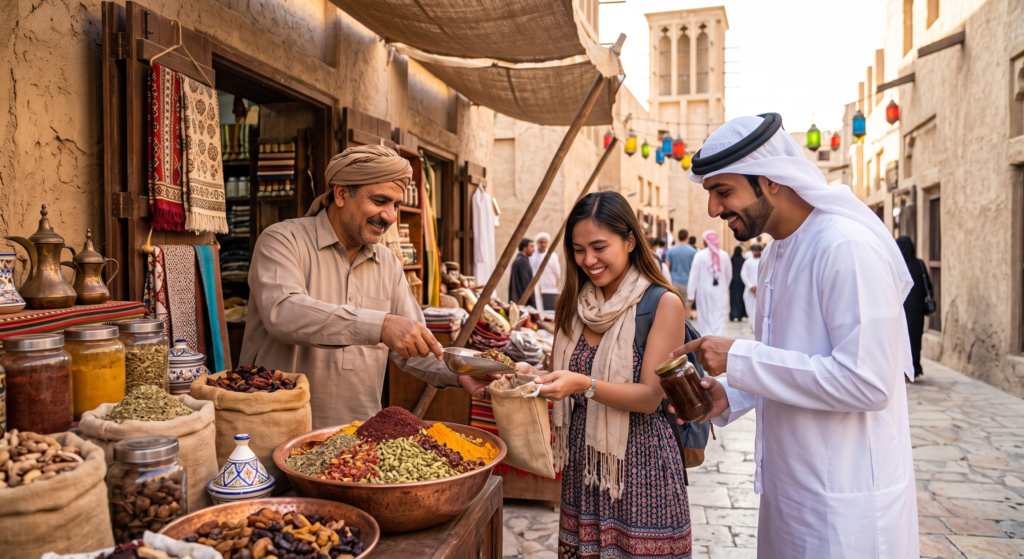
Perhaps the most culturally important word on this list. Wasta means connections, influence, or clout — the ability to get things done through who you know. It’s a real and widely acknowledged part of how business, administration, and social life operate across the Arab world. “He got that table because he has wasta.” Understanding wasta helps explain a lot about how Dubai works.
Yakhee
Casual for “bro” or “mate”. Used between male friends. Less formal than habibi but equally affectionate in the right context. “Yakhee, where have you been?”
Arbab
Originally Persian for “lord” or “master”, in Dubai it’s used to mean boss or the person in charge — whether that’s your employer, your landlord, or whoever is running things. Tone of voice does a lot of work with this one.
Boss
Ironically, the English word “boss” is used as a casual, friendly address to men in service jobs — delivery drivers, petrol station attendants, security guards, restaurant staff. It can sound friendly in one exchange and overly familiar in another; tone and the other person’s preference matter. “Thank you, boss” is one of the most frequently heard phrases at any Dubai drive-through.
Tayeb
“Okay” or “fine” or “good” — a soft affirmative used in conversation to signal agreement or acceptance. Less definitive than khalas, more relaxed than “yes”. “Tayeb, let’s do that.”
Bukra
“Tomorrow” in Arabic — but in Dubai, bukra has taken on a slightly flexible meaning that can range from “actually tomorrow” to “sometime soon” to “eventually” depending on who’s saying it. If someone promises something bukra and it doesn’t materialise, you have been officially bukra’d.
Jid jid
Repeated for emphasis, from the Arabic “jiddan” meaning “very” or “seriously”. “Jid jid?” used as a question means “seriously? for real?” It’s the Dubai equivalent of a raised eyebrow.
Chammak
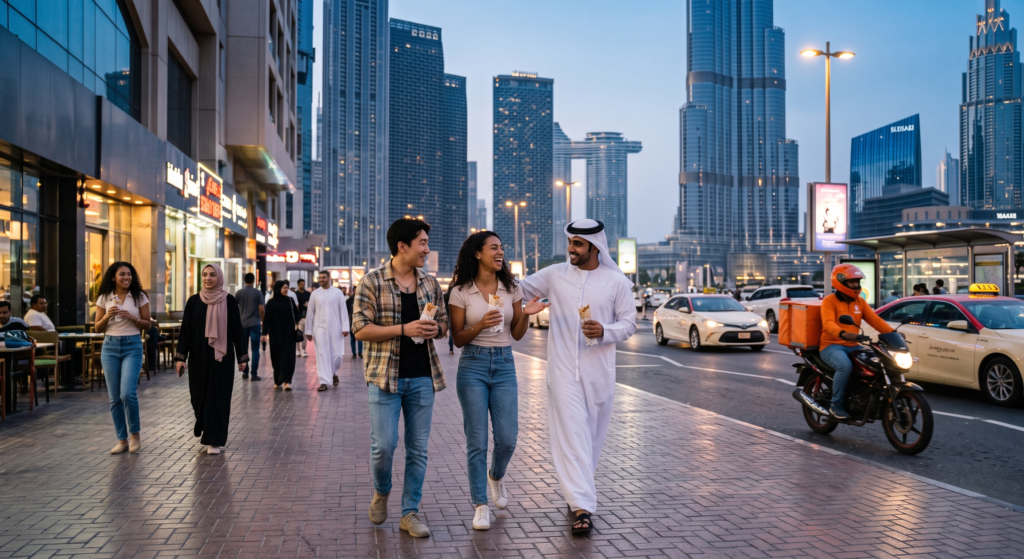
A very Dubai-specific term for teenagers who congregate at malls in the evenings, usually in groups, overdressed, and trying their hardest to look effortlessly cool. Not a compliment, but said with a certain affection. “The whole food court is full of chammaks on a Thursday night.”
Real Estate and Admin Lingo You Need to Know
Chiller-free
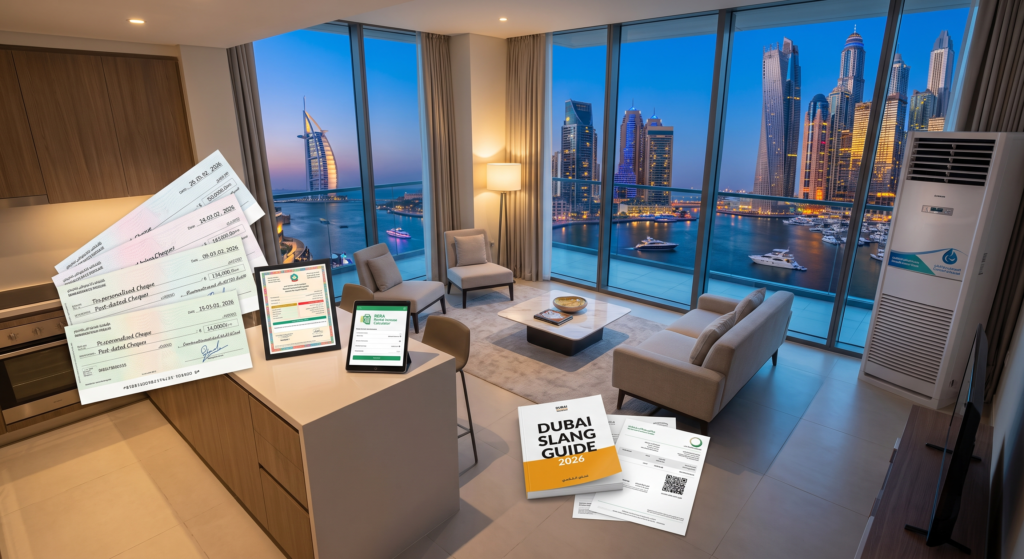
In a rental advert, “chiller-free” usually signals that the landlord covers an agreed cooling cost, but the phrase alone does not settle your bills. Ask what the signed lease and addendum cover: cooling consumption, any capacity charge, and electricity for equipment inside the flat. Do not infer that all DEWA electricity is included or that every building has district cooling. Get the applicable arrangement in writing before comparing two rents.
PDC / Post-dated cheques
PDC means a post-dated cheque: a cheque written with a future date, often used for agreed rent instalments. Four equal cheques for an illustrative AED 80,000 annual rent would be AED 20,000 each; the cheque count changes payment timing, not the total rent. The Central Bank’s explainer for amendments effective 2 January 2022 distinguishes insufficient-funds enforcement from retained cheque offences. It does not mean every returned cheque is consequence-free or only fraud matters: its examples include unlawful stop-payment instructions, closing or emptying an account and deliberately preventing encashment. This vocabulary guide is not a legal assessment of a particular cheque; seek current bank or qualified legal advice if a payment fails.
Ejari
Ejari is Dubai Land Department’s tenancy registration service. A registered contract produces an e-Contract Registration Certificate; creating an account or sending an application is not the same as receiving it. DLD lists approved registration routes including Dubai REST and real estate trustee centres, with eligibility and documents depending on the route. DLD’s FAQ also identifies Ejari for DEWA move-in. If you need proof of housing for a visa or another service, check that specific application’s requirements rather than assume every residency route requires the same document.
DEWA
Dubai Electricity and Water Authority — the government body that supplies electricity and water to homes and businesses in Dubai. You’ll register with DEWA when you move into a new property and receive a monthly bill. The DEWA app is worth downloading; it handles everything from bill payment to tracking your consumption.
RERA
The Real Estate Regulatory Agency regulates Dubai’s property sector. Do not confuse the regulator, a rental-index result and the forum that decides a dispute. The Rental Disputes Center has its own rental-claim service, with documents and procedures. If disputing an increase, check the applicable index, lease and notice requirements; a glossary definition cannot decide the outcome of your case.
When the phrase affects your money, ask a second question
| You hear | It tells you | It does not settle |
|---|---|---|
| Four PDCs | Four scheduled cheque payments | Total rent, exact dates or consequences of non-payment |
| Chiller-free | A claimed cooling-cost arrangement | Which charges your signed lease actually includes |
| Ejari submitted | A registration request may have been sent | Whether the certificate has been issued |
| Ask RERA | The property regulator is being referenced | Which dispute service, evidence or legal procedure you need |
The administrative references above were checked on 19 October 2026. These are definitions and comparison questions, not a legal opinion or a claim that every regional pronunciation and slang usage has been independently reviewed by a linguist.
Dubai Slang FAQs
What does “yalla” mean in Dubai?
Yalla is an Arabic word meaning “let’s go” or “come on” and is used to encourage people to move, hurry up, or get started. In Dubai, it’s used constantly — in casual conversation, by parents with children, and by friends heading out. “Yalla bye” is the quintessential Dubai farewell.
What does “habibi” mean?
Habibi (masculine) and habibti (feminine) translate as “my dear” or “my love” in Arabic. It’s an affectionate term used with friends, family, and colleagues. It can also be used with a slightly sarcastic edge depending on tone — context and delivery matter a lot.
What does “inshallah” actually mean in practice?
Literally “if God wills it”, inshallah is used sincerely to acknowledge uncertainty about future events. In everyday use, it ranges from a genuine expression of hope to a polite way of not committing. Most long-term Dubai residents develop a sense for which version they’re hearing.
What is wasta and why does it matter?
Wasta refers to social influence and connections — the ability to get things done through personal relationships rather than formal processes. It’s a widely acknowledged reality across the Arab world. Understanding wasta helps explain why personal introductions matter so much in UAE business and social culture.
What does “chiller-free” mean in a Dubai rental listing?
It usually means an agreed cooling cost is covered by the landlord or rent. Ask which consumption, capacity and in-flat electricity charges the signed lease includes. The advert alone does not prove that every cooling or DEWA charge is included.
Is Arabic necessary for living in Dubai?
English is widely used in Dubai, alongside Arabic and other languages. That does not mean it fits every interaction. A few polite Arabic greetings are useful; ask for the language or assistance you need when a conversation or official document is important.