Imagine soaring over the iconic skyline of Dubai, skipping the rush hour traffic on Sheikh Zayed Road, and traveling from Dubai International Airport to the Palm Jumeirah in just 10 minutes. This isn’t a scene from a futuristic movie; it’s the imminent reality of Dubai’s flying taxi service. With a whirlwind of news announcements and…
Imagine soaring over the iconic skyline of Dubai, skipping the rush hour traffic on Sheikh Zayed Road, and traveling from Dubai International Airport to the Palm Jumeirah in just 10 minutes. This isn’t a scene from a futuristic movie; it’s the imminent reality of Dubai’s flying taxi service. With a whirlwind of news announcements and exciting developments, it can be difficult to find consolidated, practical information. You’re likely asking: When can I actually ride one? Where will it go? How much will it cost, and how do I book it?
This is your ultimate passenger’s guide. We’ve cut through the noise to bring you the definitive resource on Dubai’s aerial taxi network. Here, you’ll find everything you need to know about the official launch date, the initial routes and vertiport locations, the projected price, the booking process, and the incredible in-flight experience that awaits.
Dubai’s Flying Taxi Service: When Can You Actually Ride One?
Dubai’s flying taxi service is an ambitious urban air mobility project designed to integrate a fleet of electric vertical take-off and landing (eVTOL) aircraft into the city’s public transport network. Spearheaded by Dubai’s Roads and Transport Authority (RTA), this initiative aims to provide fast, safe, and sustainable transportation, drastically cutting down travel times between key city locations.
The most pressing question on everyone’s mind is the launch date. Following a landmark agreement signed at the World Government Summit in February 2024, the RTA has officially set a target to begin commercial operations of the flying taxi service by early 2026.[1] This agreement solidified an exclusive partnership with Joby Aviation to operate the air taxis in Dubai for six years, marking a significant step from concept to concrete reality.
The vision extends far beyond simply launching a new mode of transport. According to Ahmed Bahrozyan, CEO of RTA’s Public Transport Agency, the goal is a seamless integration into the urban landscape. “The air taxi service is part of RTA’s wider strategy to develop and integrate innovative, sustainable transport modes that align with Dubai’s future mobility goals,” Bahrozyan stated, emphasizing the project’s role in creating a truly multi-modal transportation system.[1]
The Network Map: Where Will Dubai’s Flying Taxis Take You?
The success of the flying taxi service hinges on its physical infrastructure: a network of “vertiports.” A vertiport is essentially a mini-airport designed for eVTOL aircraft, facilitating take-off, landing, and passenger services. The RTA has announced an initial phase that will establish a core network, with an ambitious plan for rapid expansion across the emirate.
This expansion is powered by a groundbreaking regulatory framework from the UAE’s General Civil Aviation Authority (GCAA). The GCAA has developed the world’s first national regulations for vertiports, a crucial step that not only governs the construction of new sites but also allows for the conversion of over 120 existing helicopter pads across the UAE into operational vertiports.[2] This innovative approach is key to accelerating the network’s growth. The vertiports themselves are designed for urban integration, with Ahmed Bahrozyan noting their flexible and small footprint of just 30×30 metres, allowing them to be built on rooftops or at ground level with minimal disruption.[1]
The First Four Vertiports: Your Initial Stations
The service will launch with four strategically located vertiports, connecting some of Dubai’s most vital and popular areas. Based on official RTA announcements, these initial stations are:
- Near Dubai International Airport (DXB): Providing a rapid connection for arriving and departing travelers, turning a potentially long taxi ride into a short flight.
- Palm Jumeirah: Connecting the iconic island with the rest of the city, offering tourists and residents an unparalleled way to travel.
- Dubai Marina: Serving one of the city’s most densely populated residential and leisure hubs.
- Downtown Dubai: Located in the heart of the city, offering access to landmarks like the Burj Khalifa and The Dubai Mall.
These locations were chosen to create a powerful initial network that demonstrates the service’s ability to slash travel times. For instance, the journey from DXB to the Palm Jumeirah, which can take 45 minutes or more by car, is projected to take only 10 minutes by air taxi.
Future Expansion: How Heliports Are Key to Rooftop-to-Rooftop Travel
The initial four vertiports are just the beginning. The long-term vision is to create a comprehensive, city-wide network that offers true rooftop-to-rooftop travel. This will be achieved through a strategic, three-phase expansion plan.
According to Anthony Khoury, General Manager – UAE for Joby Aviation, the plan leverages the UAE’s existing infrastructure. The first phase involves building the initial dedicated vertiports. The second, and most crucial phase, focuses on converting the UAE’s extensive network of over 120 heliports into certified vertiports.[3] This will dramatically and quickly scale the number of available take-off and landing spots. The third phase will involve building more cost-effective “v-strips” or simpler landing pads to further densify the network, making urban air mobility accessible from nearly anywhere in the emirate. This phased rollout ensures the network can grow sustainably and efficiently, bringing the future of urban mobility to more people, faster.
The Passenger’s Guide: Price, Booking, and In-Flight Experience
While the technology and infrastructure are impressive, what truly matters to a future passenger are the practical details: How much will it cost? How do I book a ride? And what will the experience be like? This is your complete guide to the journey, from booking on an app to enjoying the incredible views from the sky.
How Much Will a Flying Taxi Ride Cost in Dubai?
While the RTA has not yet finalized an official price list, initial projections from project partners suggest the cost will be competitive with existing premium transportation options. The pricing is expected to be in a similar range to that of a high-end ride-hailing service like Uber Black or Careem, or potentially comparable to a short helicopter tour, but with the added utility of point-to-point transit.[1]
The final price will likely be influenced by factors such as distance, time of day, and demand. The overarching goal is to make the service accessible, and as the network expands and operations scale, the cost per ride is expected to decrease over time. For now, passengers should anticipate a premium price for a premium, time-saving service.
How to Book Your Flight: A Step-by-Step Preview
Booking your flying taxi is expected to be a simple, streamlined process integrated directly into Dubai’s digital ecosystem. The RTA has a proven history of creating user-friendly, integrated apps for its public transport services, and the air taxi service will be no different. While the final app is still in development, the booking process will likely follow these steps:
- Open the App: Passengers will use a dedicated smartphone application, which may be a standalone app or integrated into existing RTA platforms.
- Select Your Route: Enter your pickup and drop-off locations from the available network of vertiports.
- Schedule Your Flight: Choose your desired travel time, either for an immediate departure or scheduled in advance.
- Confirm and Pay: Review your flight details and fare, then confirm your booking using an integrated payment system.
- Receive Your Ticket: A digital ticket or QR code will be generated, providing all the necessary information for your journey.
What It’s Like Inside: The Passenger Experience
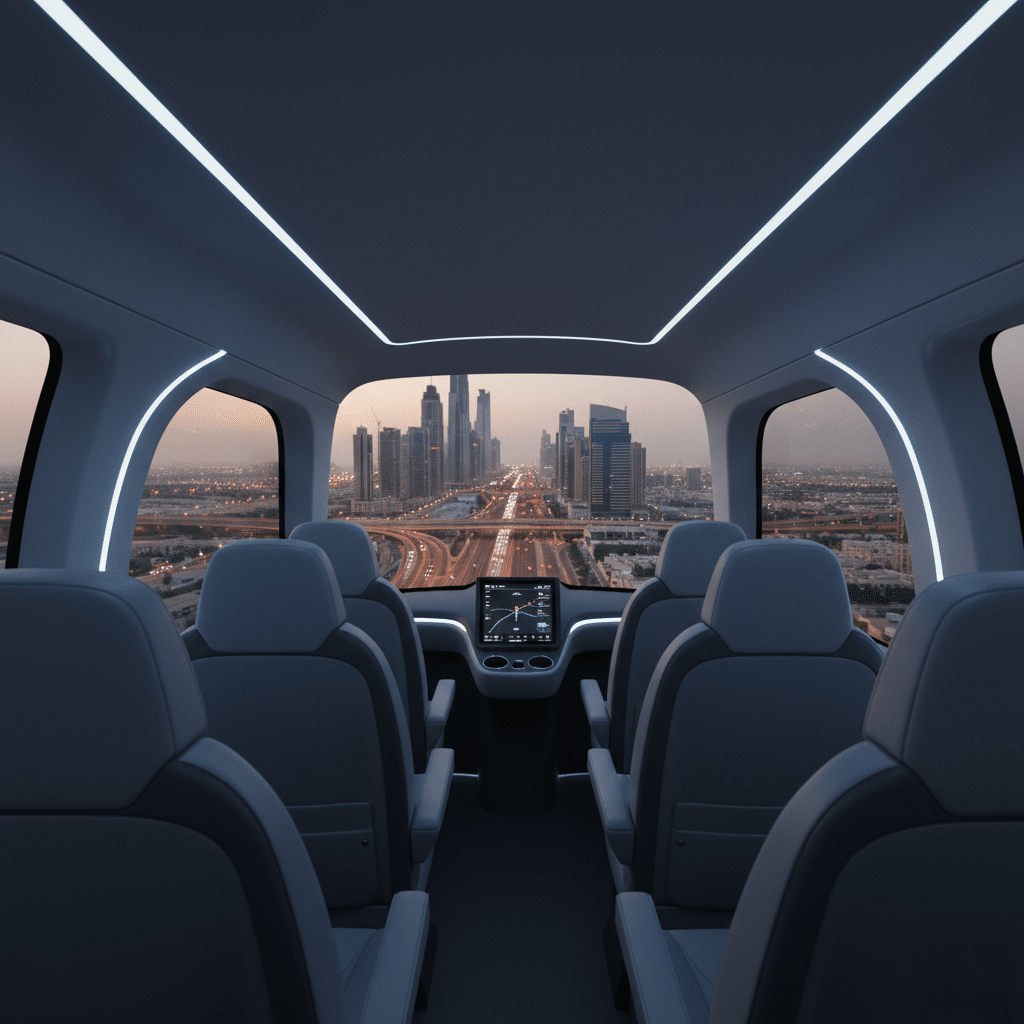
The passenger experience is designed to be as revolutionary as the technology itself. The aircraft selected for Dubai’s service is the Joby Aviation S4, a state-of-the-art eVTOL. Here’s what you can expect when you step inside:
- Capacity: The aircraft accommodates a certified pilot and up to four passengers, making it perfect for small groups or business travelers.
- Quiet Flight: Unlike a loud, vibrating helicopter, the Joby S4 is remarkably quiet. Its electric propulsion system means that its noise footprint is minimal, blending into the background of an urban environment. This also ensures a peaceful and serene journey for passengers.
- Zero Emissions: The all-electric design means your flight is entirely emission-free, contributing to Dubai’s sustainability goals.
- Speed and Views: With a top speed of up to 321 km/h (200 mph), you’ll reach your destination swiftly. The aircraft features large panoramic windows, offering breathtaking, unobstructed views of Dubai’s stunning landmarks.[4] There will also be dedicated space for luggage.

The Technology & Partners: Who is Making This Future a Reality?
Bringing the world’s first city-wide flying taxi service to life is a monumental task requiring a powerful collaboration between regulators, operators, and technology pioneers. The RTA is the master planner, leading the project and ensuring its seamless integration into Dubai’s public transport network.
The exclusive technology and operations partner is Joby Aviation, a California-based company at the forefront of the eVTOL industry. The agreement grants Joby the exclusive right to operate air taxis in Dubai for six years.[1] Their S4 aircraft is one of the most advanced in the world, having undergone years of rigorous testing.
Overseeing the safety and regulatory aspects is the UAE’s General Civil Aviation Authority (GCAA). The GCAA has been proactive in developing a comprehensive regulatory framework for air taxis and vertiports, establishing the UAE as a global leader in certifying this new form of aviation.[2] This collaborative effort ensures that the service will not only be innovative but also meet the highest international safety standards.
Frequently Asked Questions (FAQ) about Dubai’s Air Taxis
How are flying taxis different from helicopters?
While both fly, eVTOL air taxis and helicopters are fundamentally different. The key distinctions are:
- Noise: The Joby S4 is designed to be over 100 times quieter than a conventional helicopter during take-off and landing, and near-silent when flying overhead.[4]
- Emissions: Flying taxis are all-electric and produce zero operating emissions, unlike fuel-powered helicopters.
- Cost: While initial pricing is premium, the long-term operational costs of eVTOLs are projected to be significantly lower than helicopters, which should eventually translate to more affordable fares for passengers.
- Flexibility: Their smaller footprint and lower noise profile allow vertiports to be located in more urban areas where traditional heliports would not be feasible.
Are the flying taxis autonomous?
No, not at launch. For the initial operational phase, all flying taxis in Dubai will be operated by fully licensed and certified pilots.[1] The Joby S4 aircraft is designed with automation in mind, and the technology for autonomous flight is developing rapidly. However, the transition to a self-flying taxi service will only happen in the future, once the technology, regulations, and public acceptance have fully matured.
What safety regulations are in place?
Safety is the absolute top priority. The entire flying taxi ecosystem is subject to rigorous oversight from the GCAA, the UAE’s federal aviation authority.[2] This includes certifying the aircraft itself, which involves extensive testing of all its systems and components, as well as developing stringent standards for vertiport design and operation. Furthermore, all pilots will be required to meet commercial pilot licensing standards, ensuring the highest level of operational safety before the first passenger ever boards.
The future of Dubai’s commute is in the sky. As 2026 approaches, the vision of a cleaner, faster, and interconnected city is closer than ever. You are now fully prepared with all the practical information needed to be among the first to experience this transportation revolution.
The future of Dubai’s commute is in the sky. To get instant alerts on the official launch date and be the first to know when booking goes live, sign up for the What’s Hot in UAE newsletter!
Disclaimer: Information is based on the latest public announcements from the RTA and associated partners and is subject to change. This article is for informational purposes only.

Sources & References
- Dubai’s Roads and Transport Authority (RTA). (2024, February). RTA Signs Landmark Agreement with Joby Aviation to Launch Air Taxi Service by 2026. RTA Media Centre.
- General Civil Aviation Authority (GCAA), UAE. (n.d.). GCAA Unveils World-First Regulatory Framework for Vertiport Operations. GCAA Publications.
- Khoury, A. (2024). Comments on Phased Rollout and Heliport Conversion Strategy. As reported in various industry and media briefings following the World Government Summit.
- Joby Aviation, Inc. (n.d.). Aircraft Specifications for the Joby S4. Retrieved from the official Joby Aviation website.