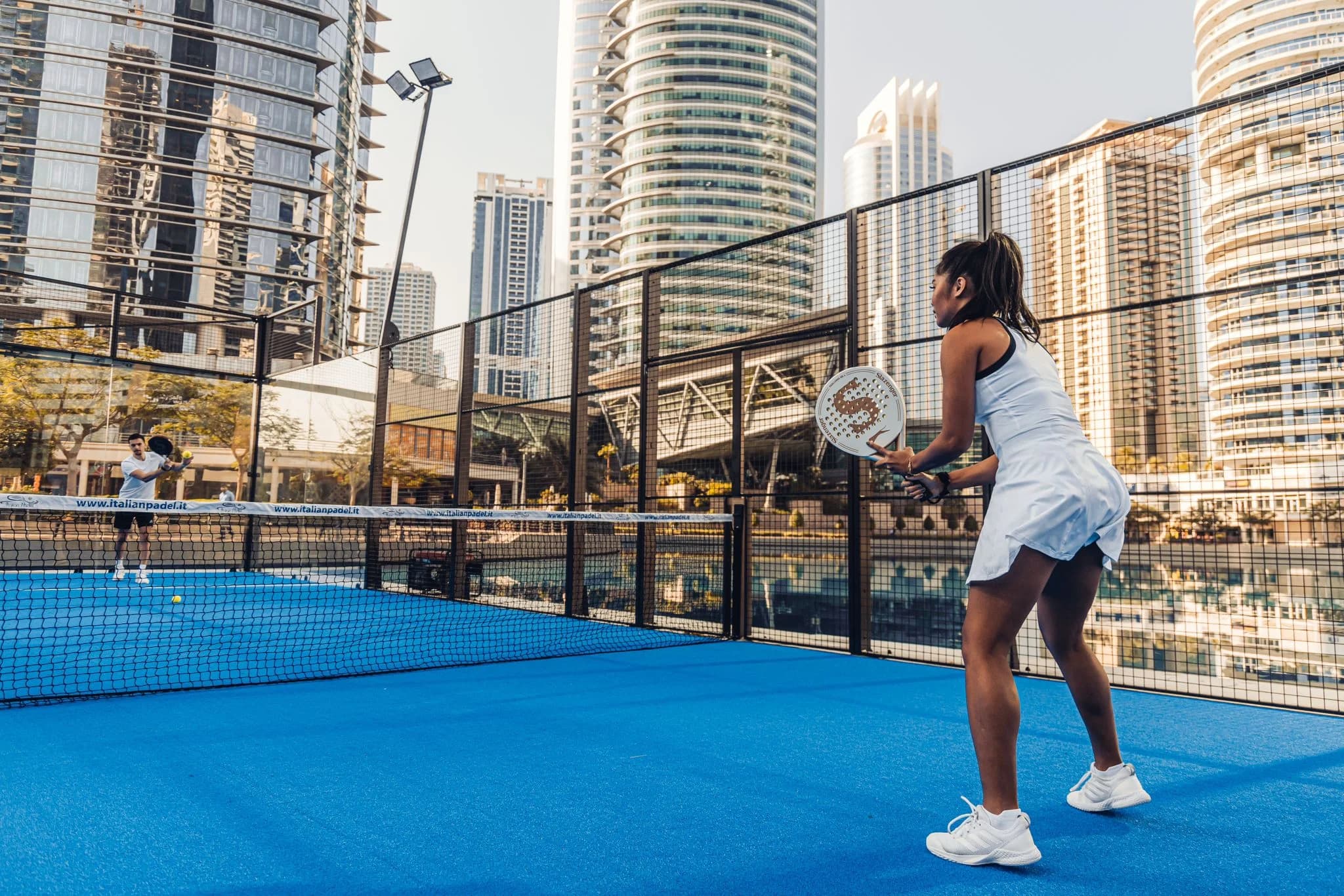
There is a sound that has become synonymous with early mornings and late evenings across Dubai’s residential districts and sports complexes: the distinctive hollow pop of a padel ball striking the back glass. It comes from rooftop courts in JLT, from indoor air-conditioned clubs in Business Bay, from floodlit courts behind hotels in Jumeirah, and from dedicated multi-court facilities that did not exist five years ago. Padel: The UAE’s New Favourite Sport has exploded in popularity, arriving in the UAE quietly and then, over the course of a few extraordinary years, becoming one of the most talked-about, booked-out, and invested-in sports in the country.
The numbers bear this out at every level. Globally, the sport now claims around 30 million players across more than 165 countries, with over 50,000 courts worldwide — a 17% increase in court numbers in 2024 alone, according to the Playtomic and PwC Global Padel Report 2025. The UAE, Qatar, Kuwait, Bahrain, and Saudi Arabia combined account for approximately 1,850 courts across 600 venues, according to Padel Court Quotes’ 2024 statistics report. Indoor air-conditioned facilities in Dubai consistently rank among the most expensive court-hire environments globally, with peak-time rates exceeding €100 per hour on some of the most sought-after courts — a pricing profile that reflects both the premium of climate-controlled infrastructure and the intensity of demand.
This is no longer a niche enthusiasm. It is a sport that has reshaped the UAE’s recreational landscape, generated a meaningful secondary economy in gear, coaching, and F&B, and placed the Emirates on the international professional calendar. Understanding how it happened, where it stands in 2026, and how to engage with it properly — as a new player, a competitive amateur, or a spectator — is the purpose of this guide.

How Padel Actually Works (For Those Who Haven’t Played Yet)
Before understanding why padel has exploded in the UAE, it helps to understand what it is — because the sport’s accessibility is the single most important factor in its growth, and that accessibility is not obvious from watching it.
Padel is played on an enclosed court approximately 20 metres by 10 metres — roughly one-third the size of a tennis court. The court is surrounded by glass and metal mesh walls, and the ball is permitted to bounce off these walls during play, introducing a strategic dimension absent from tennis. Scoring follows standard tennis conventions. The rackets — technically paddles, solid rather than strung — are smaller and lighter than tennis rackets, reducing the physical demands on the shoulder and arm. The ball is similar to a tennis ball but slightly depressurised, which slows its pace and produces longer, more rally-intensive points.
The game is played exclusively in doubles. Four players per court, all involved, all moving. Unlike tennis, where a doubles match can produce extended periods of inactivity for two of the four players, padel keeps everyone engaged throughout. The glass walls mean spectators can watch from all sides, giving the sport a visual appeal that closed squash courts lack. Points tend to be longer and more dynamic than in tennis, with wall play rewarding tactical creativity rather than raw power.
This combination — social by format, forgiving to beginners, technically rewarding for advanced players, visually engaging, playable in a climate-controlled environment at any time of year — explains its particular fit with the UAE. Every structural feature of padel maps onto something the Emirates values in its leisure culture.

The History: From Acapulco to Dubai, With a Spanish Detour
The sport’s origin story is well established: Enrique Corcuera, a Mexican businessman, built the first enclosed court at his home in Acapulco in 1969, improvising around the property’s limited space. Alfonso de Hohenlohe, a Spanish nobleman who visited and fell in love with the game, brought it to Marbella in 1974 and introduced it to Spain’s social elite. From Marbella it spread through the Spanish leisure class, eventually penetrating the country so deeply that padel overtook tennis in registered players in Spain — it is now the country’s second most popular sport behind football, with 15,300 courts and approximately 5.5 million players.
Italy, Sweden, Argentina, and much of Latin America followed Spain’s lead across the 1980s and 1990s. The sport then accelerated globally during the 2010s — partly because of social media, partly because of sustained Spanish economic growth, and dramatically because of the COVID-19 pandemic, which made an outdoor, enclosed, socially interactive sport with natural physical distancing one of the few recreational activities that could continue.
The UAE picked up the sport around 2013, initially through expats returning from Spain and through facilities at private clubs catering to the European professional community. For several years it remained confined to those early adopters. The turning point came around 2019, when a combination of returning holidaymakers from Spain, WhatsApp community building, and early investment in dedicated padel facilities created the critical mass needed for word-of-mouth acceleration.
By 2021, padel was visibly transforming the sports and leisure landscape in Dubai. By 2023, the backlog of court bookings at established facilities during evenings and weekends had become a recognisable inconvenience. By 2025, the UAE had been named as one of eight high-growth markets in the Playtomic and PwC Global Padel Report — alongside Portugal, the Netherlands, Mexico, India, Indonesia, the UK, and the US.

Why the UAE Is the Perfect Environment for Padel
The UAE’s padel boom is not coincidental. Several structural features of life in the Emirates align almost perfectly with what the sport requires.
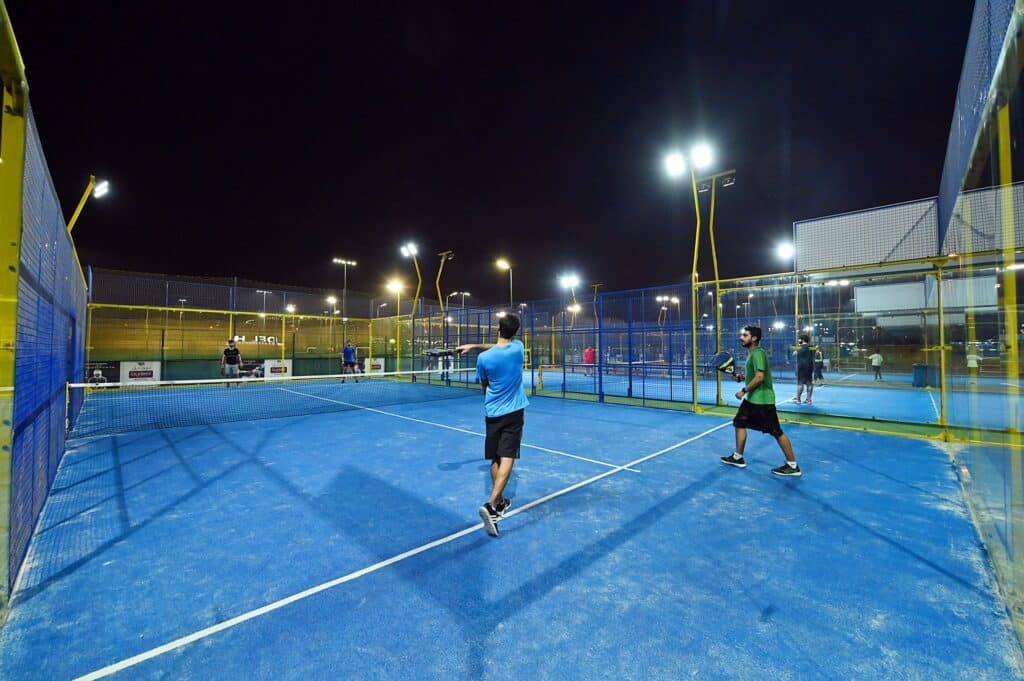
Climate and infrastructure. The UAE’s summer, which runs from May to September with temperatures regularly exceeding 40°C and humidity that makes outdoor exertion genuinely dangerous, has historically been the defining constraint on recreational sport. Padel’s willingness to move indoors — indeed, its enthusiasm for climate-controlled, air-conditioned facilities — solves this problem entirely. While outdoor courts are popular during the October-to-April window, the indoor padel club model has developed with particular energy in the UAE precisely because it offers year-round play without weather dependence. This is something cricket, football, and most other popular sports cannot match.
Demographics and the doubles format. The UAE’s population is unusually skewed toward working-age adults — the primary demographic for a sport that requires reasonable mobility but not elite athleticism. The doubles format is particularly effective as a social networking tool in an environment where building connections across national, professional, and cultural lines is part of daily life. Corporate leagues, building-specific WhatsApp groups, and professional community tournaments have all developed around padel’s natural format.
Court hire pricing and positioning. Dubai’s indoor padel courts consistently rank among the most premium in the world, with peak-time rates exceeding €100 per hour. This pricing positions padel firmly in the lifestyle premium segment rather than the mass-market sports category — which, counterintuitively, accelerates adoption in a market where premium positioning is a driver of desirability rather than a barrier. The social currency of being a regular at a well-regarded padel club is real and functions similarly to golf club membership in other markets.
The expat network effect. Spain and Latin America supply two of the UAE’s larger expat populations, and both come from cultures where padel is embedded rather than emergent. Spanish and Argentine residents brought not just familiarity with the sport but the cultural habits — the post-match dinner, the mixing of nationalities on court, the WhatsApp league coordination — that have helped padel embed itself socially rather than remaining a purely individual sport.
The Professional Scene: Premier Padel and Dubai’s Growing Role
The original article referenced the World Padel Tour as the sport’s governing professional body. This is no longer accurate. The professional padel landscape underwent its most significant structural change in 2023 and 2024.
Premier Padel was established in 2022 by the International Padel Federation (FIP), Qatar Sports Investments (QSI), and the Professional Padel Association (PPA) as an alternative to the existing World Padel Tour, which was owned by Setpoint Events (a subsidiary of the Spanish company Damm). Following a dispute over governance and market dominance — during which the FIP and players brought a complaint to the European Commission — QSI acquired World Padel Tour from Damm in August 2023. The World Padel Tour ceased operations after its final 2023 season, and from 2024 onwards, Premier Padel became the single unified global professional circuit.
The 2025 season — now branded as the Qatar Airways Premier Padel Tour — featured 24 tournaments across 16 countries. The circuit included four Majors (the sport’s equivalent of Grand Slams), a series of P1 events, and a season-ending Finals in Barcelona in December. Dubai featured on the 2025 calendar as a Premier Padel P1 event, held at Hamdan Sports Complex between 9 and 16 November 2025 — described by organisers as the UAE’s largest ever indoor padel venue for a professional event.
This is significant beyond mere scheduling. Hosting a Premier Padel P1 event brings the world’s top-ranked players to Dubai and generates television broadcast coverage that reaches padel audiences across Europe, Latin America, and increasingly the Middle East. It validates Dubai’s infrastructure, stimulates local participation through the visibility of professional play, and reinforces the UAE’s broader sports tourism positioning. The FIP’s push to include padel as a showcase sport at the Brisbane 2032 Olympic Games — currently in active discussions — would, if successful, further elevate the profile of markets that have already demonstrated sustained investment and player development.

Where to Play: UAE Venues Worth Knowing
The UAE’s padel infrastructure ranges from single courts attached to hotel sports centres to multi-court dedicated facilities with coaching programmes, food and beverage, retail, and leagues. For anyone moving to the UAE or looking to get started, understanding the landscape is useful before committing to a membership or booking pattern.
Dubai has the densest concentration of facilities. Padel Pro Dubai was among the earliest dedicated facilities and helped establish the category’s physical template. Zabeel Sports District offers a rooftop padel experience in a central location. The Hamdan Sports Complex — which hosted the 2025 Premier Padel P1 — represents the top tier of professional-standard infrastructure. Beyond these anchor venues, padel courts have been installed at JLT community facilities, in multiple hotel complexes, and at a growing number of standalone clubs across Jumeirah, Business Bay, DIFC, and Dubai Marina.
Abu Dhabi has developed strong padel infrastructure through facilities including the Abu Dhabi Padel Hub, which operates professional-level courts alongside regular competitive leagues. Government-backed sports investment in Abu Dhabi has supported padel’s growth specifically, with dedicated courts incorporated into major leisure district planning.
Sharjah and the Northern Emirates have seen court numbers grow as the sport spreads beyond the two major emirates. Sharjah in particular has developed a padel community among its large South Asian professional population, adapting what was initially a predominantly European sport.
Across all UAE markets, court booking operates primarily through apps. Playtomic — the global market leader for racquet sport booking with over nine million monthly users — is the dominant platform in the UAE and allows comparison of availability, pricing, and court quality across facilities. Booking a court for AED 300–500 per hour during peak evenings is standard at established Dubai venues, while off-peak morning and afternoon slots are generally available at AED 150–250.
Getting Started: What a New Player Needs to Know
One of padel’s most frequently cited advantages is the speed with which complete beginners become functional players. The court’s enclosed nature means the ball stays in play longer than in tennis, reducing the frustration of constant retrieval. The doubles format means no single player carries disproportionate responsibility for the point. The physical demands — while genuinely substantial at competitive levels — are manageable for casual participants without high cardiovascular fitness.
For someone coming to padel for the first time in the UAE, the practical starting points are:
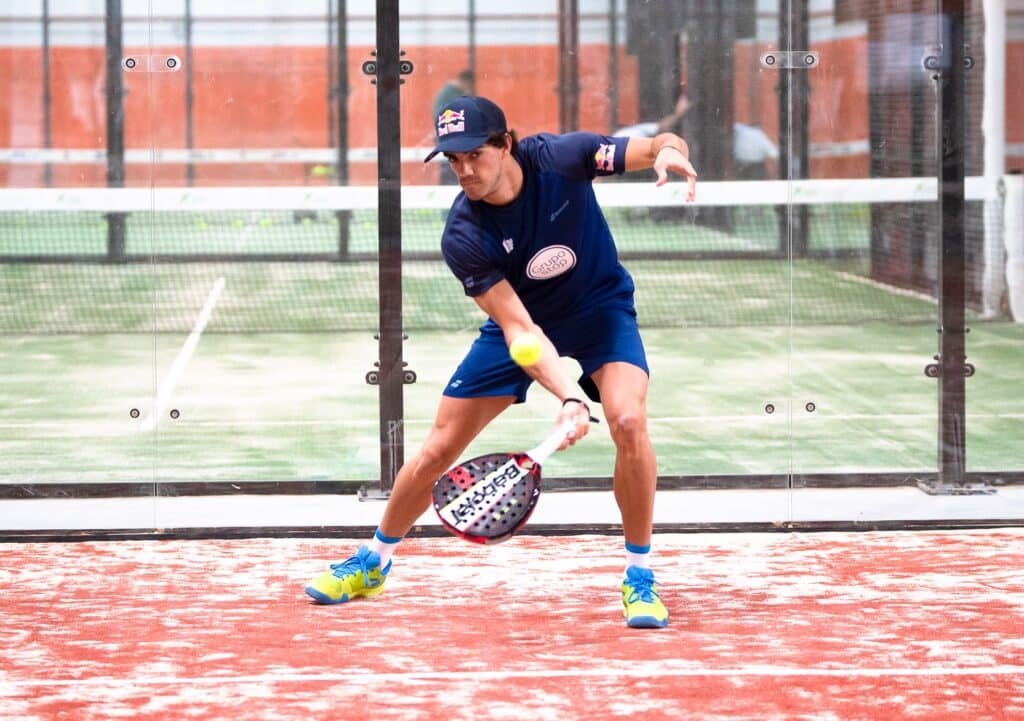
Equipment is minimal and relatively affordable. A padel racket costs AED 150 to AED 2,500 depending on quality level, with solid beginner options available around AED 250–400 from the major sporting goods retailers in Dubai. Balls are sold in tubes of three and consumed relatively quickly by regular players. Footwear should be court shoes with lateral support — dedicated padel shoes are available but not obligatory for beginners.
Take two or three beginner lessons before your first social game. Almost every established UAE padel facility offers individual or group coaching, with group beginner sessions typically running AED 100–200 per person. The basic positioning, wall-use, and service rules in padel differ enough from tennis that an untutored beginner will frustrate their partners and limit their own enjoyment. Two hours of instruction produces a functionally enjoyable level of play for most adults.
Use Playtomic or the facility’s app to find open sessions. Many clubs run “open padel” sessions — structured social play where individuals are matched with other players of similar level without needing to arrive with three friends. These sessions are one of the fastest routes into the UAE padel social ecosystem and are often where the best league and regular-game connections are made.
Consider the summer scheduling reality. Outdoor courts are genuinely unusable between June and September in most UAE locations. If you are investing in a club membership or regular booking pattern, confirm the facility’s indoor capacity before committing. The best indoor-only clubs experience heavy demand during summer months and may require advance booking of several days during this period.
The Business of Padel in the UAE
The sport has generated a meaningful secondary economy in the Emirates that is worth understanding for both participants and observers.
The global padel market was valued at approximately USD 327 million in 2022 and is forecast to grow at 9.6% annually through 2027. In the UAE specifically, the combination of premium pricing, high court utilisation, and strong tourist crossover creates unit economics that significantly exceed most European markets. A well-run UAE indoor padel facility with ten courts can generate revenue per court substantially higher than equivalent operations in France or Sweden, where pricing is lower and seasonality more constrained.
The equipment market has attracted serious brand investment. Wilson acquired Bullpadel — one of the established specialist padel brands — in January 2024, reflecting the major sporting goods companies’ recognition that padel has crossed the threshold from niche to mainstream. Head, Babolat, Adidas, and NOX all operate premium padel equipment lines, with authorised retailers and dedicated floor space in Dubai Mall Sports, Go Sport, and specialist padel stores.
The coaching market has professionalised significantly. Spanish and Argentine coaches dominate the UAE’s professional coaching ecosystem, bringing technical expertise developed in the world’s two most mature padel markets. Certified coaching programmes through the FIP’s affiliated national federation — the UAE Padel Federation — provide a quality framework for facilities and players.
The one regulatory note worth flagging: the Playtomic/PwC Global Padel Report 2025 specifically identified the UAE as a market where growth is “challenged by restrictions on large indoor clubs.” Planning and zoning constraints on large-scale indoor sports developments are a real factor in the UAE’s court expansion, and operators building multi-court facilities navigate a more complex approval process than in markets with fewer restrictions. This has slowed — though not stopped — the most ambitious infrastructure projects.

The Olympic Question and What Comes Next
The International Padel Federation’s push to include padel as a showcase sport at the Brisbane 2032 Olympic Games is the most consequential development in the sport’s near-term trajectory. Showcase sports at the Olympics attract television audiences and national federation investment that typically produce sharp acceleration in participation and infrastructure investment in the years following the Games.
The FIP’s case for inclusion is strong on several criteria: the sport is established in over 165 countries, it aligns with Olympic values of gender equality (mixed doubles is a natural tournament format), and participation numbers are genuinely global rather than concentrated in a handful of countries. The challenge, as the Playtomic report notes, is that elite competitive padel remains dominated by Spain and Argentina to a degree that raises questions about competitive breadth. The UAE’s continued hosting of Premier Padel events, and the development of national team programmes by the UAE Padel Federation, directly supports the FIP’s case that the sport has genuine global competitive depth beyond its traditional heartlands.
Whether or not the Olympic pathway advances on its current timeline, the UAE is positioned to be an increasingly central node in the global padel ecosystem — as a host of professional events, a high-value recreational market, and a hub for the regional spread of the sport across Saudi Arabia, Qatar, and Bahrain, where government support and infrastructure investment are creating the next wave of Gulf padel growth.
Frequently Asked Questions
What is padel and how is it different from tennis? Padel is a racquet sport played on an enclosed glass-and-mesh court roughly one-third the size of a tennis court, always in doubles. Unlike tennis, players can use the walls — the ball is permitted to bounce off the glass during rallies, adding a tactical layer absent from tennis. The paddles are solid rather than strung, and the ball is similar to a tennis ball but slightly depressurised for slower pace and longer rallies. Scoring follows standard tennis convention. The game is widely considered more immediately accessible than tennis because the smaller court, slower ball, and wall-play create longer, more forgiving rallies for beginners.
How much does it cost to play padel in Dubai? Court hire during peak evening hours at established Dubai facilities typically runs AED 300–500 per hour for a full court (four players, shared between the group). Off-peak daytime slots are generally available at AED 150–250 per hour. Dubai’s padel courts rank among the most expensive in the world by court-hour, with peak-time rates at premium indoor facilities exceeding €100 per hour — a reflection of climate-controlled infrastructure costs and high demand. Membership packages at dedicated clubs reduce the per-session cost significantly for regular players.
What happened to the World Padel Tour? The World Padel Tour ceased operations after its final 2023 season. Qatar Sports Investments (QSI) — the Qatari state-backed investment fund that also owns Paris Saint-Germain — acquired the World Padel Tour from its previous owner Damm in August 2023. QSI had already established Premier Padel in 2022 in partnership with the International Padel Federation (FIP). From 2024 onwards, Premier Padel became the single unified global professional circuit, branded as the Qatar Airways Premier Padel Tour. The 2025 season featured 24 tournaments in 16 countries, including a P1 event in Dubai in November 2025 at Hamdan Sports Complex.
Is padel going to be in the Olympics? The International Padel Federation is actively pursuing inclusion of padel as a showcase sport at the Brisbane 2032 Olympic Games. The sport meets several key criteria for Olympic inclusion: established presence in over 165 countries, alignment with gender equality principles through mixed doubles formats, and growing competitive depth internationally. The main challenge identified by analysts is that elite competitive padel is currently concentrated in Spain and Argentina. The FIP’s push to expand competitive depth globally — through events in the UAE, US, India, and other emerging markets — is directly aimed at strengthening the Olympic case.
Where are the best padel venues in Dubai? Dubai’s padel infrastructure is spread across the city, with notable options including: Hamdan Sports Complex (professional-standard multi-court facility, host of the 2025 Premier Padel P1); Padel Pro Dubai (one of the emirate’s original dedicated padel facilities); Zabeel Sports District (rooftop urban venue); and various hotel-based and community facilities across JLT, Jumeirah, Business Bay, and Dubai Marina. Court availability can be checked and booked through Playtomic, which covers the majority of UAE padel venues. and Italy.