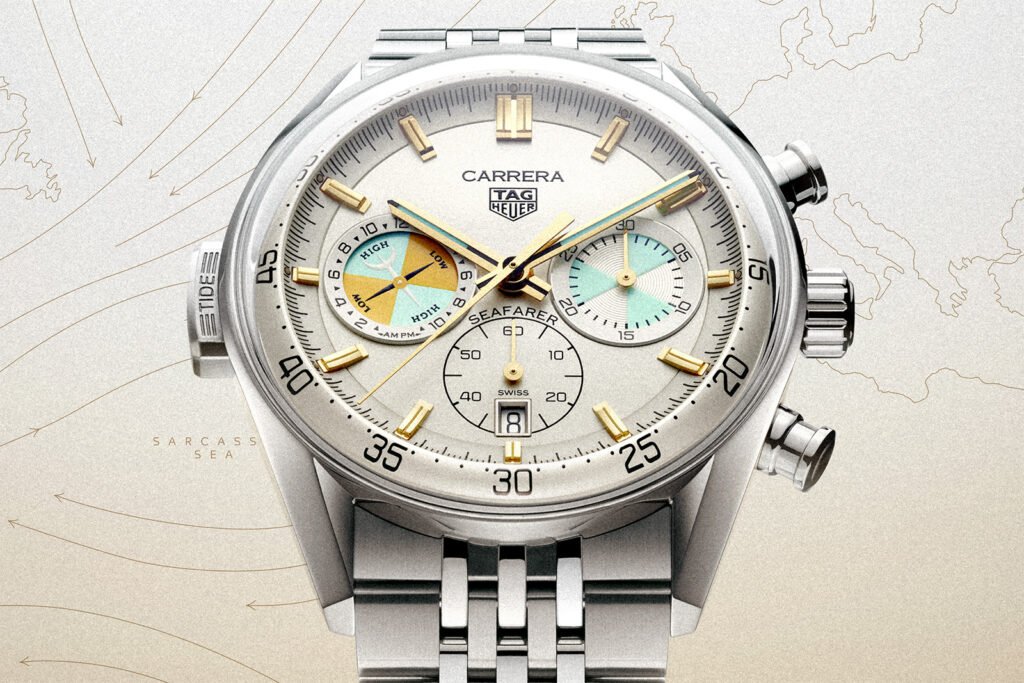
I’d choose the 2026 Carrera Seafarer for the tide display and the teal-and-yellow dial—not because I need a luxury watch to plan a safe day at sea. The 42mm steel CBS2016.EB0430 uses TAG Heuer’s TH20-04 automatic movement. The UAE brand page displays AED 36,500 and “out of stock online”, checked on 19 October 2026. I would enquire about a fitting and actual store availability before paying elsewhere. This is a product and buying guide, not our sailing or wear test.
The Historic Comeback: Tracing the TAG Heuer Seafarer’s Legacy
The unusual complication is what makes this Carrera interesting to me. The tide counter changes the conversation from another racing chronograph to a mechanical maritime idea. I like a revival more when there is a recognisable feature behind the story. Here, that feature is easy to point to at nine o’clock.
From Solunar to Seafarer: A Timeline of Innovation
TAG Heuer’s history traces Walter Haynes of Abercrombie & Fitch sharing a tide-watch patent with Charles-Edouard Heuer in 1947, followed by the Solunar in 1949 and Mareographe Seafarer chronograph in 1950. I’d keep those dates separate, rather than call every part of the story an original 1949 Seafarer. The modern Carrera takes the complication into a different case and buying context.
Jack Heuer’s Pioneering Role in Early Tide Complications
The teacher story is traceable rather than just watchmaking folklore. TAG Heuer’s account drawing on Jack Heuer’s memoir places him at school, around 15 in 1947 or 1948, consulting physics teacher Dr Heinz Schilt. That is different from the earlier claim that he was fresh from completing his studies. I find the specific development story more interesting than a general promise of inherited technical brilliance.
Navigating the Tides: How the Carrera Seafarer’s Unique Display Works
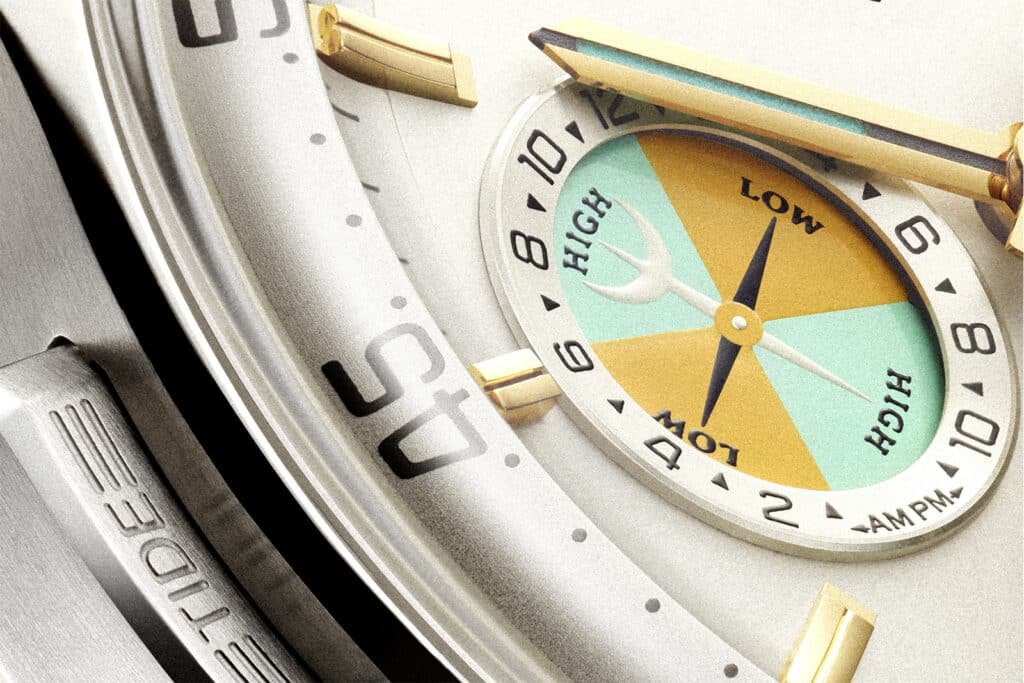
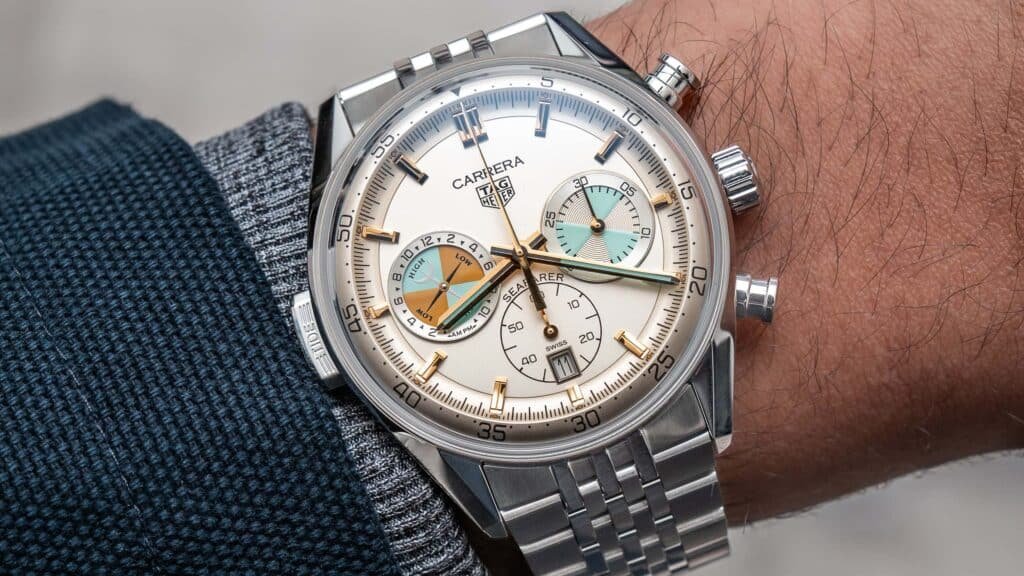
The tide subdial needs to be read as a mechanical indication, not a live sensor of the sea. TAG Heuer’s own explanation describes a disc rotating roughly once every 29.5 days, framed by a fixed 24-hour ring. Local high-tide information supplies the initial setting. That distinction is important: the watch is not measuring water depth, wave height or current speed at your location. We find the complication more interesting when its limits are understood than when it is advertised as an all-purpose coastal instrument.
Setting and Reading Your Tide Chronograph for UAE Coastal Activities
Setting the Carrera Seafarer’s tide display is a straightforward process, designed for quick reference when you’re by the water. The watch features a dedicated ‘TIDE’ pusher, conveniently located at nine o’clock on the case. To set it:
- Consult a local tide table or a reliable online resource for your specific coastal location (e.g., in the UAE, for Dubai or Abu Dhabi). Note the time of the next high tide.
- Use the TIDE pusher to align the white hand with that next high-tide time, following TAG Heuer’s reference-specific instructions.
- Once set, the display indicates approximate upcoming high and low tides. The disc’s roughly 29.5-day rotation is distinct from the 24-hour scale around it.
I’d enjoy it as a mechanical visual reference after setting it properly. I would not describe it as showing everything the water is doing: it does not measure depth, wave height or current strength. For an actual coastal plan, current local tide, weather and navigation information remain the starting point.
Is the Tide Complication Genuinely Useful for Adventurers?
My answer to “is it useful?” starts with why I want the watch. As a complication to understand and enjoy, it has a clear attraction. As a reason to leave proper tide or navigation information behind, it has none. I would buy the mechanical idea because I like it, not invent a safety need to justify the price.
These are the distinctions I’d make before using it around water:
- Tide timing: Set from a trusted local source and treat the watch as an approximate indication.
- Current and depth: Obtain these separately. The tide dial does not measure either.
- Weather and access: Check current forecasts, local notices and the requirements for the actual activity.
- Watch use: Follow the reference’s care and pusher instructions; the water-resistance number is not blanket approval.
For sailing or other water activities, use current local information for decisions. The mechanical display is a convenient visual reference, but it is not a substitute for a tide table, depth chart, current forecast or the conditions you can observe. A watch continuing to run without a phone signal does not establish that its approximation is sufficient for a safe route. We would choose the Seafarer for the enjoyment of an unusual complication and its maritime design, while keeping actual navigation and water-safety planning with the appropriate sources.
Horological Heartbeat: Deconstructing the TH20-04 Movement & Specifications
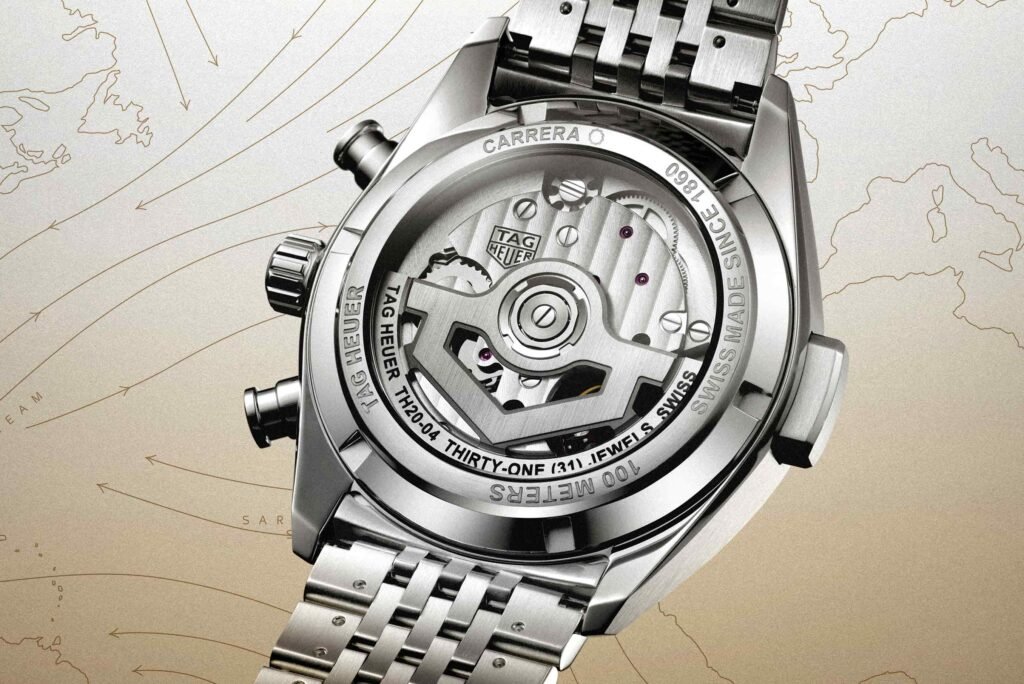
The movement specification gives the comparison some substance: TH20-04, automatic winding, an 80-hour reserve and a 4Hz frequency. I’d use those facts to identify the model, then ask a retailer to demonstrate the controls. They are not accuracy results measured by this magazine.
The Power Within: TH20-04 vs. TH20-01 Movements
The useful distinction is the function: the Seafarer’s TH20-04 includes the tide display, while the new 41mm Carrera Chronograph uses TH20-01. TAG Heuer lists an 80-hour reserve for the 41mm as well. I would not infer an exact modular construction or interchangeable gearing from those calibre names. For a buyer, the question is whether the tide complication earns the choice over the simpler chronograph.
Case, Crystal, and Construction: Built for the Elements
I like the way the Glassbox crystal gives the dial a raised, open presentation. The steel case is 42mm, but diameter alone would not settle the fit for me. I’d look at the watch from the side, check how it sits at the wrist and try it with a shirt cuff before choosing.
The stated water resistance is 100 metres. That is not a blanket approval for diving or operating the pushers underwater. Follow TAG Heuer’s instructions for the exact reference and have seals checked according to its service guidance. A used watch’s condition matters as much as the original rating. For coastal wear, also consider the strap and clasp, rinse and care instructions, and whether recent service records are available. The rating is a specification; it should not be expanded into a promise that the watch handles every marine activity.
Aesthetic Appeal: The ‘Glassbox’ Design and Retro-Sport Charm
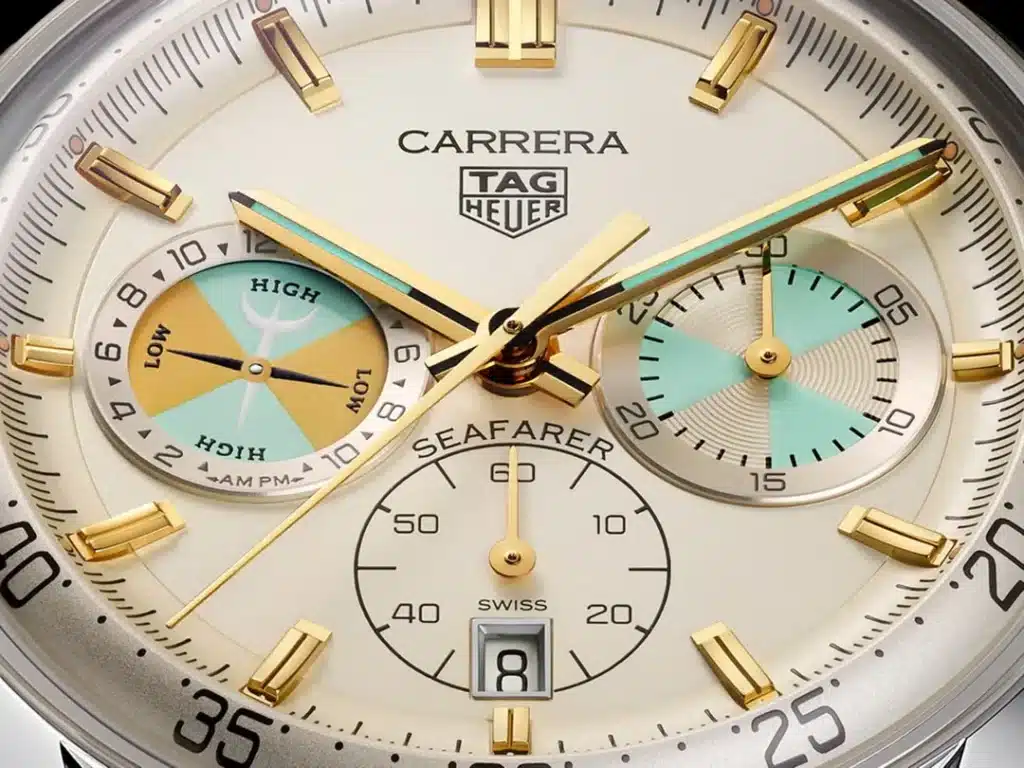
The colour is the other reason I’d shortlist it. The restrained base leaves room for the teal and yellow counters to make the watch distinctive. I prefer that to covering every part of a dial in a maritime motif. It reads as a specific design, not just another blue watch with a sea-related name.
Opalin Champagne Dial and Vibrant Accents
The brand calls the dial beige opalin. I like the warm base against the brighter counter colours and gold-toned details. My buying question would be whether those displays remain easy for me to read on the actual wrist, rather than assuming a large product photograph settles legibility.
Teal and yellow are the details I’d keep in view when trying it on. They give the watch enough personality that I would wear it with a quiet outfit rather than try to match every accent. The maritime history supplies context; I do not need a claim that each colour guarantees practical sailing usefulness.
The Iconic ‘Glassbox’ Carrera: Form Meets Function
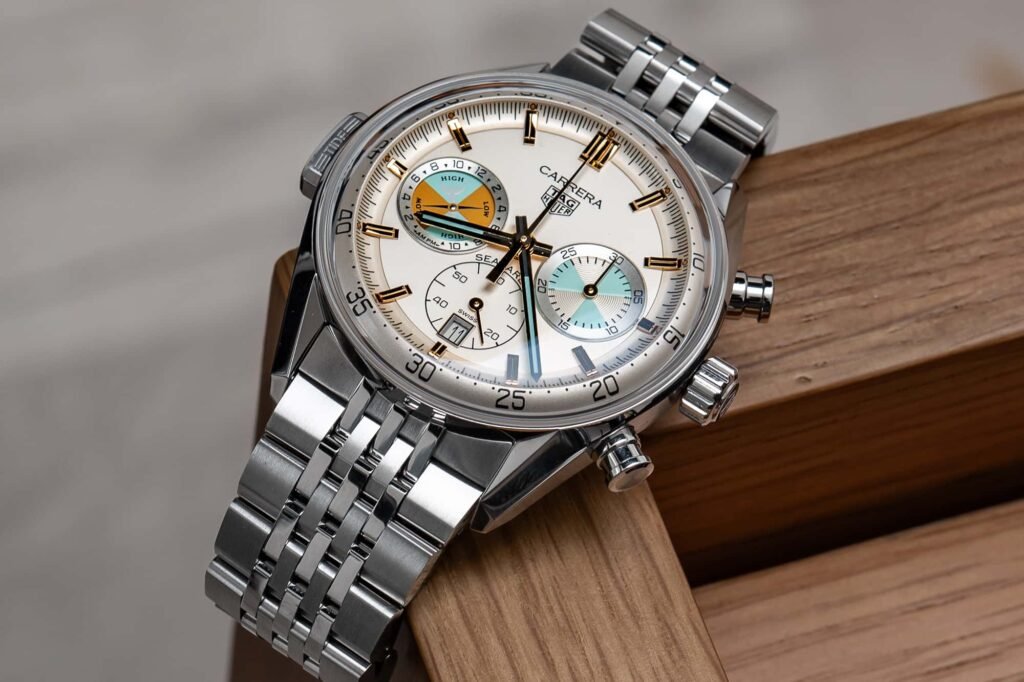
The official product page confirms the 42mm diameter. Retailer MOSSO’s specification lists 48.6mm lug-to-lug and 14.4mm thickness. Those dimensions are worth taking to a fitting; I would not turn them into a claim that it wears small on every wrist. The 100m water-resistance rating has its own use and care conditions.
I’d try both straight-on and angled views under ordinary light. The domed crystal is part of the appeal, but a fitting should show whether I enjoy that presentation in real use. No polished launch image can decide wrist comfort or everyday readability for the person buying it.
Strap Options: Versatility for Every Adventure
The seven-row beads-of-rice steel bracelet is the option I’d try first: I like how it connects the dial’s vintage references to the rest of the watch. I’d check the clasp, adjustment and required links in person rather than repeat a universal comfort claim.
The brand page includes an additional textile strap with blue stitching; MOSSO describes the beige strap and teal inner colour. I’d ask the seller to show the complete supplied package and demonstrate any strap change before assuming the accessories or mechanism. A fabric strap’s adventurous appearance is not proof it suits every water activity.
The demonstration I would ask for before buying
I’d ask the retailer to show the tide setting, chronograph operation, date adjustment, bracelet fit and the included strap. I’d also confirm the reference’s water-use instructions and the actual warranty paperwork. This is my proposed buying checklist, not a demonstration we have already completed or a replacement for the manual.
Beyond the Seafarer: The 2026 TAG Heuer Carrera Chronograph Collection
I’d compare the Seafarer with the other Carrera choices by what I want to own: a tide complication, a cleaner chronograph or a more complex split-seconds mechanism. Shared branding does not make them variants with the same purpose, case size or price.
The 41mm Glassbox Trio: New Core Models
The 2026 41mm Carrera announcement identifies blue, black and teal dial configurations with TH20-01. I’d look here first if I liked the Glassbox language but did not want the tide feature. The simpler dial might be the better choice for that buyer; more complication is not automatically more desirable.
Introducing the Carrera Split-Seconds Chronograph: A High-Complication Flex
TAG Heuer’s official January 2026 launch description identifies the first split-seconds complication in the Carrera collection. That is a different mechanism and buying proposition from a tide display. I’d investigate it for the interest of timing separate finishing intervals, not treat it as the natural upgrade everyone should want after a Seafarer.
TAG Heuer’s Chronograph Renaissance: A Strategic Vision
My reading of the range is straightforward: the appeal comes from choosing a function and design, not reciting a corporate “renaissance”. The Seafarer gives me a clear reason to look beyond the familiar Carrera outline. The ordinary chronograph and split-seconds alternatives give other buyers different reasons to choose.
Before comparing prices, I’d write down the exact reference and what I want from it. Then compare case fit, controls, package and ownership terms. That is more useful than a claim that a collection proves the brand’s leadership or guarantees long-term desirability.
My verdict: buy the Seafarer because the tide complication and colour make it the Carrera you want. I like its distinct identity, but I would not justify it as essential navigation equipment or predict a future resale gain. At this price, a proper fitting, a control demonstration and a clear offer matter more than the launch story.
For the current UAE reference, use CBS2016.EB0430 and the checked AED 36,500 listing. Its online out-of-stock notice does not establish every boutique’s inventory. I’d ask about the exact watch before travelling. For a pre-owned offer, compare condition, bracelet links, extra strap, warranty and service records; the earlier Hodinkee collaboration is a separate reference, not the same watch under another price.
Questions answered
Is there a modern Carrera Seafarer?
Yes. The 2026 CBS2016.EB0430 uses TH20-04 and is separate from the earlier Hodinkee collaboration.
What is the current UAE listing price?
The UAE brand page displays AED 36,500 and out of stock online, checked on 19 October 2026. Enquire separately about actual boutique availability.
How is the tide display set?
The brand says to find the next local high tide from a trusted source, then use the TIDE pusher to align the white hand with that time. Follow the reference instructions.
Does the tide indicator replace navigation information?
No. Use current local tide, weather, depth, current and navigation information for the actual water activity.
Does 100-metre water resistance mean a diving guarantee?
No. Follow the manufacturer’s instructions for the reference, including pusher use and seal maintenance.