Travel-advice check: 9 November 2026. Do not use historic interception rates, airport recovery figures or the graphics below as permission to travel. The US Mission’s 23 October update retains Level 3: Reconsider Travel, citing terrorism and armed conflict. The UK guidance, updated 27 October, warns of a high risk of sudden escalation and short-notice airspace closures. Read your own government’s advice, your insurer’s actual terms and your airline’s flight status for your itinerary. Economic figures below have stated reference years and release versions; the reported equipment overview is not a verified current deployment map.
I want a travel-safety guide to help me make a decision, not reassure me with an impressive interception statistic. My first check would be the current advisory and insurance position. The UAE’s infrastructure and past recovery record provide context; they cannot guarantee a flight, hotel stay or journey during a regional escalation.
If your plans change or an alert sounds
The current UK guidance distinguishes preparing to travel from responding to an alert. Keep departure plans under review and travel documents up to date. If instructed to shelter, stay indoors or find the nearest safe building or designated shelter; an interior stairwell or room with few external walls or windows may offer more protection. Do not approach or touch fragments or unusual objects. Follow the local instructions for your location rather than going outside to investigate an interception.
Before paying for a trip, keep a simple decision record: the advisory and its date, your insurer’s written answer for your dates and transit stops, the airline booking channel, and the hotel’s cancellation deadline. Ask separately about medical treatment, evacuation, cancellation and an enforced longer stay; one benefit being covered does not establish the others. This is a planning checklist, not a determination that any particular policy will pay a claim.
Before you leave for the airport: three checks I would make
| What you are deciding | The useful check |
|---|---|
| Whether to travel | Read your own government’s advisory and ask your insurer about armed-conflict exclusions, cancellation and medical evacuation. A general promise of cover is not confirmation for your itinerary. |
| Whether your flight is operating | Use your airline’s flight-status tool and check its messages to you. Emirates specifically says not to leave for the airport after a cancellation email, even if its website still shows the flight as planned. |
| How to recover money after disruption | Emirates directs direct-booking customers to its refund form and travel-agent customers to their agent. Paid extras, such as seats or upgrades, need separate refund requests; a ticket refund does not automatically include them. |
I would settle those checks before treating any recovery chart as reassurance. The airline’s disruption FAQs are the source for the Emirates instructions above, checked on 20 October 2026. Other airlines and individual tickets have their own conditions.
The better question is: how does the UAE actually perform when tested?
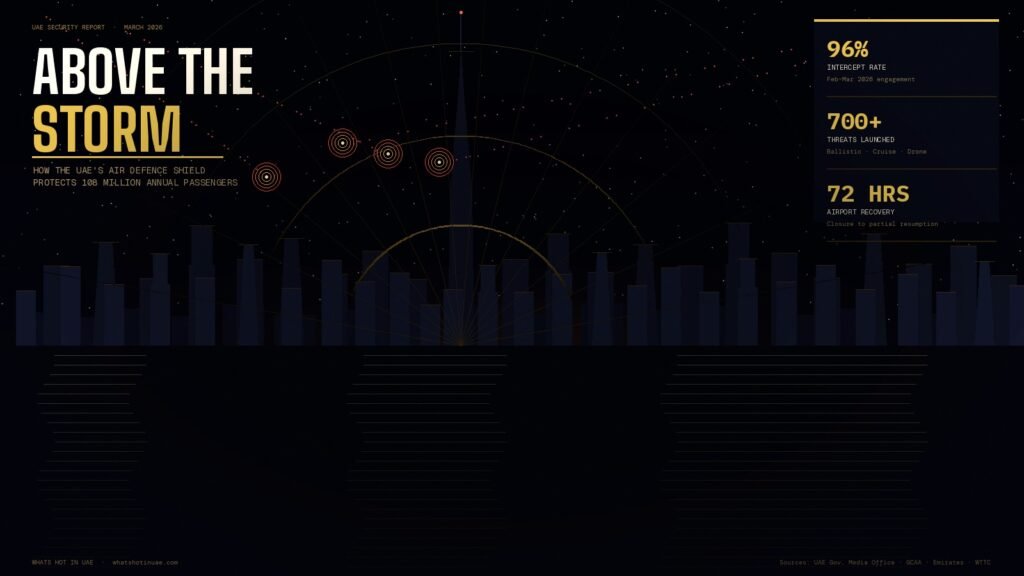
The February–March 2026 attacks are historical context, not the past ten days. Two source snapshots must be kept separate. WAM’s Ministry of Defence report, published at 02:04 UAE time on 1 March, recorded 137 ballistic missiles detected, 132 destroyed and five falling into the sea; of 209 drones, 195 were intercepted and 14 landed in UAE territory or waters. A later Semafor analysis on 2 March reported more than 700 aerial threats over two days and three deaths. Those are different reporting windows, not one dataset.
My conclusion is narrower than the original safety claim: the early figures demonstrate interceptions, but they also record threats that were not intercepted. They do not measure a visitor’s probability of harm, establish a safe route or prove that every category of weapon had the same success rate.
I would not turn military performance into a travel recommendation. Use the current advisory, airline and insurance checks above for that decision; use the dated figures below to understand the historical response.
Air Defence: Confirmed History Versus Reported Equipment
A layered defence combines systems designed for different threats. That does not establish a world ranking, a complete inventory or a guarantee that every incoming object will be intercepted. The historical evidence below distinguishes a manufacturer’s documented delivery and combat-use history from a commentator’s list of other systems. It is not a map of active batteries, coverage or command integration.
THAAD: Lockheed Martin’s December 2025 history identifies the UAE as its first international THAAD partner, dates the first battery’s arrival to October 2015 and describes successful engagements against medium-range ballistic missiles in January 2022. Those are specific historical claims from the manufacturer. They do not supply a current readiness assessment, a universal radar range in all conditions or a traveller’s probability of safety.
Patriot PAC-3: the same manufacturer history says the UAE was already operating Patriot PAC-3 when THAAD arrived. It describes layered missile defence and interoperability. That supports the relationship between the two systems, not the earlier assertion that Patriot is the world’s most combat-proven system or that this guide knows where every battery is deployed today.
Other reported systems: Tareq Alotaiba’s Semafor analysis of 2 March 2026 names Barak-8, Pantsir-S1, Cheongung II and SkyKnight alongside THAAD and Patriot. Treat that as an attributed analytical account, not an official inventory verified by this publication. A procurement announcement, system description and confirmed operational deployment are different evidence. The illustration therefore identifies reported names without promising that each forms a functioning, sequential wall of protection.
Using only that early WAM snapshot, the calculated interception shares are 132 ÷ 137 = 96.4% for ballistic missiles and 195 ÷ 209 = 93.3% for drones. Together, 327 of 346 detected threats in those two categories were intercepted: 94.5%, rounded. That is not a February–March overall rate. The report supplies no cruise-missile denominator for this calculation, and the five ballistic missiles that fell into the sea must not be labelled land impacts.
Training and operations: Lockheed Martin describes newly trained UAE operators conducting system tests with manufacturer and US-agency personnel after the first battery arrived, as well as a continuing training-and-operations partnership. That is meaningful history. It is not an independently measured assessment of every crew’s present proficiency, and this guide does not claim continuous readiness from a historical delivery date.
Historical source snapshot · UAE Security Analysis
THE UAE
AIR SHIELD
AIR SHIELD
1 March 2026 · 02:04 UAE
Reported equipment overview
Tally: WAM / Ministry of Defence · 1 March 2026. Equipment overview: separate sources.
Detected in this snapshot
346
137 ballistic missiles + 209 drones. This is one early report, not the later two-day total.
Two-category calculation
94.5%
327 intercepted out of 346 detected, using the two categories in this report.
Not intercepted
19
Five ballistic missiles fell into the sea; 14 drones landed in territory or waters. This is not a casualty count.
Intercept Performance
94.5%
Calculated from ballistic missiles and drones in the 1 March report only
Intercepted
Not intercepted
Reported systems · not a verified deployment map
1
Historical system · THAAD
THAAD
🇺🇸 United States
Manufacturer documents UAE delivery in October 2015 and January 2022 operational engagements; not a current coverage map.
2
Historical system · Patriot
Patriot PAC-3
🇺🇸 United States
Manufacturer says the UAE operated Patriot PAC-3 before the first THAAD battery arrived. No present battery locations are verified here.
3
Reported names · Semafor
Barak-8 / Cheongung II
🇮🇱 Israel · 🇰🇷 S. Korea
Named in the 2 March 2026 Semafor analysis. This guide does not independently confirm deployment, integration or interception performance.
4
Reported name · Semafor
Pantsir-S1
🇷🇺 Russia
Named in the 2 March 2026 Semafor analysis; not a guaranteed final interception layer or verified operational inventory.
5
Reported name · Semafor
SkyKnight
🇦🇪 UAE (Domestic)
Named in the 2 March 2026 Semafor analysis. A reported system name is not proof of present readiness at a particular site.
Investment Timeline
2011 — UAE signs for THAAD: world’s first international military sale of the system
2015 — First battery began arriving in October; manufacturer describes testing with newly trained UAE operators in the following months
Jan 2022 — THAAD’s first real-world combat engagement: Houthi ballistic missiles intercepted over Abu Dhabi
Feb–Mar 2026 — Reporting windows differ: use the dated WAM tally above, not an assumed whole-conflict percentage
Context & Significance
5
Countries associated with systems named in the earlier reporting. This illustration does not independently verify each deployment or command integration.
20+
Years of investment provide historical context, not a verified spending rank or an individual safety guarantee.
2 Mar
Date of the announced limited DXB/DWC resumption. Limited services are not full network recovery.
Aviation: How Dubai Manages One of the World’s Busiest Hubs Under Pressure
Dubai Airports reports 95.2 million DXB passengers for the full year 2025, up 3.1%. That corrects the earlier claim of 102.9 million in eight months. A large annual total describes the airport’s scale, not its status on a particular travel day. I would check the flight itself rather than infer present operations from historic traffic.
The UAE General Civil Aviation Authority’s response to the February 28 airspace closure illustrates how that system actually functions. On the afternoon of February 28, as Iranian strikes began, the GCAA enacted partial closure of UAE airspace as “an exceptional precautionary measure amid evolving regional security developments.” Flights already airborne were safely diverted to Abu Dhabi, Al Ain, Dubai World Central, and Muscat.
On 2 March, Dubai Airports announced a limited evening resumption at DXB and DWC. Limited service should not be read as every booked flight operating. Emirates later reported carrying about 30,000 passengers on 5 March.
In its 6 March statement to WAM, Emirates planned 106 daily return flights to 83 destinations for the following day, representing nearly 60% of its network. The statement anticipated further restoration subject to airspace and operational conditions. It was a plan, not confirmation that every service operated or that the network had fully recovered.
The dated announcements document a staged restart, with airlines and airports communicating operating restrictions and recovery plans. A restart announcement should be read for its actual scope and time: limited services, a planned schedule and a completed flight are not interchangeable. For a traveller, the actionable evidence is the status and message for their own booking, not an inferred comparison with other global hubs.
Past operational recovery can inform an analysis of resilience. It cannot promise the speed of a future reopening or guarantee that a particular passenger will be carried. Recheck the airline before leaving for the airport, particularly when a cancellation message conflicts with a timetable listing.
The Economic Stakes: Why Safety Is Not Optional for the UAE
Tourism’s scale explains why disruption matters economically. It does not establish that economic incentives can prevent an attack, keep airspace open or guarantee a visitor’s protection. The figures below describe different measures—GDP contribution, spending, employment and hotel inventory—and should not be combined into a single safety score.
WTTC’s release of 20 May 2025 estimated the UAE’s 2024 tourism GDP contribution at AED 257.3 billion, supported employment at 898,600 jobs and international visitor spending at AED 217.3 billion. These are that release’s historical estimates, not live 2026 results. Separately, Dubai DET’s 2024 annual visitor report records 18.72 million international overnight visitors, up 9% from 17.15 million in 2023. Dubai arrivals and UAE-wide economic contribution have different geographic and statistical scopes.
The UAE Tourism Strategy 2031 sets targets including AED 450 billion in tourism GDP contribution and 40 million hotel guests. Targets describe policy intentions, not achieved performance, protected bookings or an assured recovery path. Hotel guests are also not interchangeable with Dubai international overnight visitor arrivals.
The Ministry of Economy and Tourism’s 2024 indicator section, read on 9 November 2026, lists AED 44.8 billion in hotel revenue, 1,252 hotels and 217,000 hotel rooms for 2024. These replace the earlier undated “now” inventory in this article. The ministry page contains several historical-year sections, so its 2022 figures must not be read as 2024 totals or its page-update time as the year of the data.
The distinction between forecast and outcome matters. WTTC’s May 2025 release forecast AED 267.5 billion in UAE tourism GDP contribution and more than 925,000 supported jobs for 2025. Its April 2026 release later reported USD 68.5 billion in 2025 UAE tourism GDP and USD 56.9 billion in international visitor spending. WTTC explicitly warns that the releases use different real-price and exchange-rate bases and historical estimates can be revised. Do not subtract these headline values to calculate a supposed conflict loss or treat the old forecast as an actual result.
Economic Intelligence · UAE Tourism Analysis 2024–2026
UAE Tourism
Resilience
Resilience
Historical tourism indicators and recovery milestones. These figures are not a forecast for your trip or proof of the fastest recovery.
✦ ✦ ✦
Tourism GDP 2024
AED
257bn
257bn
Historical estimate from WTTC’s May 2025 release; not live 2026 GDP
Intl. Overnight Visitors 2024
18.7M
Dubai alone · New all-time record · +9% YoY
Jobs Supported
898k
2024 estimate of 898,600 supported jobs; May 2025 WTTC release
DXB passengers · Full-year 2025
95.2M
Dubai Airports’ annual total, not UAE-wide traffic or today’s flight status
Dubai International Overnight Visitors · 2019–2024 (Millions)
⚑ These annual totals do not isolate the effect of a particular attack or prove a recovery deadline. In this chart, 2022 remains below 2019; 2023 exceeds it.
Economic Stakes · Why the UAE Must Recover
AED 450bn
Tourism Strategy 2031 Target
Policy target, not an achieved result or recovery guarantee. Hotel guests differ from international overnight arrivals.
217,000
Hotel rooms · 2024 indicator
Ministry’s 2024 indicator section; not a current operational room count.
AED 44.8bn
UAE hotel revenue · 2024
Ministry’s 2024 indicator section also lists 1,252 hotels and 217,000 rooms.
AED 217bn
International Visitor Spending
In 2024. Historical estimate in WTTC’s May 2025 release, not a current spending measure.
Dubai visitor source markets · January–July 2024 only
20%
Western Europe
UK, Germany, France, Nordics
17%
South Asia
India, Pakistan, Sri Lanka
14%
CIS & E. Europe
CIS nations, Eastern bloc
14%
GCC Neighbours
KSA, Kuwait, Qatar, Bahrain
35%
All Other Markets
Americas, APAC, Africa, MENA
Feb–Mar 2026 Crisis · Dubai Airport Recovery Timeline
28 FEB
Airspace Closed
Iranian strikes begin. GCAA enacts precautionary closure. Flights diverted to AUH, Al Ain & Muscat.
02 MAR
Partial Resumption
DXB & Al Maktoum resume limited ops. The announcement concerned limited services, not normal operations.
05 MAR
30,000/day
Emirates reported about 30,000 passengers carried on 5 March.
07 MAR
60% Network Planned
On 6 March, Emirates planned 106 daily returns to 83 destinations for the next day; this was not proof of completed operations.
6 MAR PLAN
Restoration Target
Further restoration was anticipated subject to airspace and operational conditions. No actual completion date is established here.
Strategy 2031 Hotel Target
40M
Hotel-guest target in the national strategy; not international arrivals or a guarantee for any trip.
Post-COVID Recovery Speed
+2.5%
Using the chart’s listed visitor counts, 17.15 million in 2023 versus 16.73 million in 2019 is a 2.5% increase, not 12%. No fastest-recovery ranking is established.
2025 Sector Projection
AED 267bn
May 2025 forecast, not an actual result. WTTC’s 2026 release uses a different price basis; do not calculate a loss from the two headlines.
Information Management: How the UAE Communicates During a Crisis
One of the original article’s premises — that responsible communication is a pillar of UAE safety management — is correct, but it needs to be grounded in what that actually looks like in practice rather than described in abstract.
During the February–March 2026 disruption, the UAE’s official communication framework operated on several parallel tracks simultaneously.
For the historical airport sequence, the WAM announcements linked above distinguish the 2 March limited resumption from the 6 March Emirates plan. For a new disruption, use Dubai Airports and the operating airline’s current messages. A timestamped notice establishes what was announced then, not uninterrupted service since, a guaranteed hourly update or the status of another passenger’s flight.
Official local instructions and your own government’s advice answer different questions: local authorities direct the response where you are, while your foreign ministry publishes its travel-risk assessment and consular guidance. Do not infer that a venue being open overrides a warning or that one reassuring announcement establishes insurance cover. This guide does not evaluate the purpose or enforcement of the UAE’s information laws.
Keep the official airport and airline channels available, and sign up for your government’s travel updates if appropriate. The US Mission’s advisory recommends a departure plan that does not depend on US government assistance. The UK guidance likewise says to keep departure plans and documents under review. Neither is a promise of an evacuation seat or consular payment for extra expenses.
The Track Record: What History Actually Shows
The UAE’s resilience record predates the current conflict. Several historical stress tests are instructive.
The January 2022 missile-defence history is documented in the Lockheed Martin account linked above. It establishes a historical THAAD engagement, not the precise cause of every casualty in that attack series or a verified comparison of national crisis-management performance. A subsequent year’s visitor count cannot by itself measure how an attack affected tourism. The chart’s 2022 Dubai total remains below its 2019 benchmark.
COVID-19 and the later visitor recovery: the chart’s Dubai series records 16.73 million international overnight visitors in 2019, 17.15 million in 2023 and 18.72 million in 2024. The 2023 figure is 2.5% above 2019 using those listed values. This is an arrivals comparison, not a claim that UAE tourism GDP rose by the same percentage. It demonstrates a historical recovery in that measure, not the speed of recovery from a future conflict.
Regional-tension comparisons: annual visitor growth does not isolate the impact of attacks, airline capacity, new attractions, pricing or wider demand. A period of rising totals cannot prove there was no deterrent effect compared with what would otherwise have happened. This article does not establish that causal counterfactual, and should not use an unattributed market quotation as proof of it.
Source-market diversity: the DET January–July 2024 report gives Western Europe 20%, South Asia 17%, CIS and Eastern Europe 14% and the GCC 14% of Dubai’s international visitors; the remaining listed regions total 35%. Those are a dated part-year mix, not full-year 2024 shares. Diverse markets can spread commercial exposure, but they do not establish that the next disruption will follow a previous recovery trajectory.
The Diversity Advantage: Why the UAE Does Not Depend on Any Single Tourism Category
One of the UAE’s genuine structural advantages in sustaining tourism through volatility is the breadth and diversity of what it offers. A destination dependent on a single attraction type — beach tourism, cultural tourism, business travel — is exposed when that category faces disruption. The UAE is not that destination.
Existing attractions and future developments must be kept separate. Wynn’s own project information still describes Al Marjan Island as opening in 2027, not an operating resort today. I would check the operator’s opening and access information before planning any attraction into an itinerary. A development announcement does not establish a venue that can already receive visitors.
Business and leisure trips can respond differently to disruption, but corporate travellers are not insulated from airspace closures, postponed events or employer travel restrictions. If a trip depends on a conference or meeting, confirm that event as well as the flight and hotel. A financial-centre address or an exhibition calendar does not prove that travel continues regardless of regional tensions.
The tourism strategy’s emphasis on specialised products, capabilities and investment helps explain the range of planned tourism activity. It is not evidence that a security shock cannot affect several visitor segments at once. For the individual trip, current advice and enforceable booking conditions remain more useful than a national growth target.
Frequently Asked Questions
Is it safe to travel to the UAE right now? This article is not a safety clearance. Checked on 9 November 2026: the US Mission’s 23 October update retains Level 3: Reconsider Travel for terrorism and armed conflict; UK guidance updated 27 October warns of a high risk of sudden escalation and short-notice disruption. Read your own government’s current guidance, check your particular insurance and confirm the flight before deciding.
How does UAE air defence actually work? It uses different systems for different threats; the equipment overview is not a verified map of current deployments. The early WAM snapshot gives 132 of 137 ballistic missiles destroyed and 195 of 209 drones intercepted. The combined calculated share is 94.5% for those two categories in that report, not an overall conflict rate or a tourist-safety probability.
How resilient is UAE tourism historically? The Dubai totals shown here rise from 16.73 million international overnight visitors in 2019 to 17.15 million in 2023 and 18.72 million in 2024. The 2022 figure of 14.36 million was not a new record against 2019. This recovery history does not isolate the effect of regional attacks or establish a deadline for recovery from another disruption.
How quickly did Dubai airports recover after the February 2026 closure? A limited evening resumption at DXB and DWC was announced on 2 March. Emirates reported about 30,000 passengers carried on 5 March. Its 6 March statement planned 106 daily returns to 83 destinations for the following day. Those figures distinguish a limited restart and a published target from confirmed full recovery. Check your own flight rather than applying this historical timeline to a new disruption.
How significant is tourism to the UAE economy? WTTC’s May 2025 release estimated AED 257.3 billion in 2024 tourism GDP contribution, 898,600 supported jobs and AED 217.3 billion in international visitor spending. These are historical estimates from that release, not current 2026 performance. Newer EIR releases can use different price bases and revised data. The 2031 targets are policy goals, not a guarantee of safety or recovery.
This article draws on data from the World Travel and Tourism Council (WTTC) Economic Impact Research 2024–2025, UAE Ministry of Economy Tourism Indicators, Arabian Business, The National, Semafor, Middle East Eye, Lockheed Martin THAAD programme documentation, Emirates NBD Research, and Dubai Department of Economy and Tourism visitor data. Readers are encouraged to consult current official travel advisories from their home country’s foreign ministry before making any travel decisions.