
If I suspected a UAE travel ban, I would identify the issuing authority and case before booking a flight—not rely on a payment receipt or one clear app screen. Start with an official enquiry, save the case reference and establish what restriction is actually recorded. The authority responsible for that record must confirm the route to resolution. This guide explains the distinctions and the questions to ask; it cannot confirm anyone’s personal permission to travel.
Understanding UAE Travel Bans: Civil vs. Criminal
Civil debt and criminal proceedings are two important contexts, but they are not an exhaustive list of every possible restriction. Personal-status and immigration issues need separate checks. The Civil Procedure Code’s travel-ban provisions are in Articles 324–325; the Criminal Procedures Law addresses a prosecutor’s travel-ban power in Article 99. I would establish the actual legal basis rather than diagnose it from the amount on a bill.
Civil Travel Bans: Debts and Financial Liabilities
A civil debt dispute can lead to a court-ordered restriction when the relevant conditions are met. It is not a bank or telephone provider automatically switching off travel because an invoice is unpaid. My first question would be whether there is an actual order, which court issued it and what file it belongs to.
The indexed official text of Article 324 sets conditions for a creditor’s application. These are not a universal rule for every kind of travel restriction:
- Ordinary threshold: AED 10,000, with exceptions for established maintenance, obligations to act or refrain from acting, and work remuneration.
- Flight concern: Serious grounds for fearing the debtor will leave, assessed through the judicial process.
- Debt: Known, due and unconditional; where unquantified, the judge’s provisional estimate has written-evidence and guarantee conditions.
A prior final judgment is not the only route: Article 324 also allows an application before a substantive lawsuit in specified circumstances. I would take the actual order and supporting file to a UAE-qualified lawyer rather than assume “no final judgment” means no restriction can exist.
Criminal Travel Bans: Serious Offenses and Investigations
Article 99 of the Criminal Procedures Law gives the prosecutor power to issue a travel ban according to the circumstances and provides for circulation to the country’s ports. That is separate from civil debt enforcement. I would ask the responsible authority or a lawyer handling the file about the current order—not infer travel permission from being released from custody.
Examples of offenses that can lead to criminal travel bans include:
- Fraud and embezzlement
- Theft
- Assault
- Drug-related offenses
- Serious traffic offenses (discussed further below)
Gulf News’s interview with Dr Hassan Elhais explains the link between criminal restrictions and the proceedings. The interview is Gulf News’s, not one conducted by this magazine. I would use it for context, while checking the actual file and decision for a particular person.

Common Causes of a Travel Ban in the UAE
I would separate the underlying issue from the travel order. A debt, a returned cheque or a road incident is a reason to establish whether there is a case; it is not a substitute for checking whether a restriction has actually been issued. The following distinctions help frame that enquiry.
Bounced Cheques and Their Consequences
For a returned cheque, I would obtain the bank’s return information and any execution notice before making assumptions. A cheque issue can involve enforcement as well as other disputed facts. Do not ignore a notice because you believe the underlying transaction was unfair.
In the cited Gulf News interview, Elhais explains that a dishonoured cheque can support direct execution proceedings, with a travel-ban request following the relevant process. That is not a claim that every return automatically creates a ban or that every cheque-related offence has disappeared. I would get advice on the actual return reason, notice and case before deciding what to do.
Unpaid Debts and Financial Obligations
An unpaid financial obligation can become a legal dispute. I would check for notices and a case reference rather than assume the balance alone reveals the travel position. Examples of the underlying obligations include:
- Bank loans: Unpaid installments on personal loans, car loans, or mortgages.
- Credit card debt: Accumulating unpaid credit card balances.
- Rent arrears: Significant unpaid rent to landlords.
- Contractual obligations: Failure to fulfill financial terms agreed upon in contracts.
- Telecommunication bills: Large, outstanding bills with service providers.
The AED 10,000 condition is not a blanket exemption for smaller amounts or other legal matters: the Article 324 exceptions matter. Nor does crossing that figure automatically impose a ban. Ask which rule and order actually apply to the file.
Traffic Violations: When Fines Lead to Bans
I would not equate a routine administrative traffic fine with an existing travel-ban order. Gulf News’s interview with Ahmed Odeh distinguishes administrative violations from serious criminal traffic matters, but its discussion of later escalation is not a reason to invent an automatic amount or deadline. Check the actual notice and authority.
For a road-related concern, these are the questions I would ask:
- Is this an administrative fine only, or is there a separate police, prosecution or court file?
- Which authority issued any restriction, and what is its reference?
- What action and confirmation does that authority require? Do not guess from a total shown in a fines app.
A criminal road case needs its own legal review and status check. I would not promise that paying a traffic balance closes every linked case, removes a separate order or resolves a victim’s claim. Establish the specific restriction before treating the matter as finished.
How to Check Your Travel Ban Status in the UAE
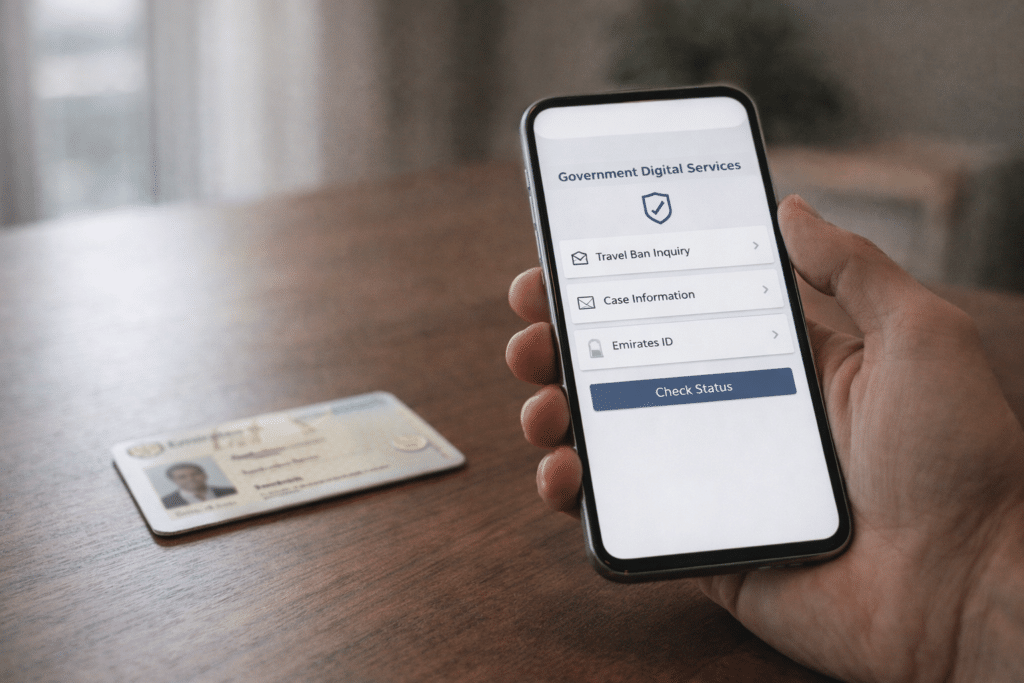
My first route would be the relevant official service, followed by the issuing authority when the result is unclear or incomplete. The UAE government’s preliminary-checks guidance recommends resolving matters that could prevent travel before reaching immigration counters. An online result is useful within that service’s scope; it is not this magazine issuing nationwide clearance.
Online Methods: Government Portals and Apps
Start from the actual official website or verified app. Use the identity method it requests; I would not promise that every portal accepts a passport number instead of Emirates ID or UAE Pass. Do not give an agent an OTP or login simply because they advertise a quick “ban removal”.
For Dubai Residents and Visitors:
- Dubai Police: Use the official Circulars and Travel Bans service. The services directory describes enquiry about financial-case circulars and travel bans issued by competent security authorities. Follow its current sign-in and displayed case instructions.
- If a result names a different issuing authority or an outstanding action, follow that record. Do not treat this service as a complete check of every UAE court, immigration or personal-status matter.
For Residents Across the UAE:
- Other or federal files: Start with the authority responsible for the case and the government’s preliminary-checks guidance. UAE Pass is an identity tool, not a standalone nationwide travel-clearance certificate.
For Abu Dhabi Residents and Cases:
- Abu Dhabi: Use the Abu Dhabi Judicial Department for a relevant judicial file. Its official app guide describes submitting and tracking enquiries on a selected case through My Page and Estafsarat. That is a case enquiry, not proof of every possible restriction.
- For help identifying the correct service, ADJD publishes 600 599 799. Ask which identity or case information is needed rather than use an unverified universal input list.
It is advisable to always use the official government websites or verified apps to ensure the accuracy and security of your information.
In-Person Inquiries and Legal Assistance
If the service does not cover the case, or you cannot use its identity route, ask the responsible authority about the appropriate enquiry. I would take the case number and documents to a qualified lawyer where representation is needed, rather than assume an empty result proves there are no other records.
- Authority enquiry: Ask the responsible police, prosecution, court or immigration authority what its record shows and what it covers.
- Representation: Where required, appoint a UAE-qualified lawyer through the applicable authorisation procedure. Ask for the file references, written scope and copies of relevant decisions; do not assume privileged access or guaranteed removal.

The case-information sheet I would prepare
| Save this | Why it matters |
|---|---|
| Issuing authority and emirate | Directs the enquiry to the record that needs action. |
| Case and restriction references | Avoids confusing a debt payment with a different file. |
| Order, notices and any settlement | Lets the authority or lawyer identify the actual requirements. |
| Payment and application receipts | Records actions taken without assuming the outcome. |
| Status confirmation and remaining records | Establishes what was updated and what still needs checking. |
I would keep this sheet privately, not post Emirates ID, case papers or login details in article comments. It is an organisational checklist, not a legal clearance document.
Legal Pathways to Lift a Travel Ban in the UAE
Identify the order before choosing a removal route. I would make a small file containing the issuing authority, case number, restriction reference and the authority’s current requirements. A civil settlement, criminal decision and immigration matter cannot be treated as the same transaction.
Lifting Civil Travel Bans: Debt Resolution
For a civil order, the legal basis and the court’s requirements matter. Article 325 provides grounds on which the judge may order the ban to lapse, including the end of the obligation, written creditor consent, an accepted guarantee or a court deposit in the stated circumstances. Ask which route applies; full payment is not the only possible legal ground.
This is the order in which I would organise the enquiry—not a promise that every case needs a new manual application:
- Identify the issuing court, order and execution reference.
- Confirm which legal ground and supporting documents apply to that file.
- Ask whether the file is covered by a digital closure process or needs an application; follow the actual service.
- Save the resulting decision or status confirmation and check whether any other restriction remains.
Do not use an old “couple of days” estimate as a departure guarantee. Official Dubai service information describes digital payment and case closure for covered records, while other files need their own procedure. I would obtain confirmation of the actual status update, not merely the payment, before relying on it for travel.
Lifting Criminal Travel Bans: Case Resolution
A criminal file must be checked with its responsible authority. The decision on custody, the underlying case and any travel restriction are separate things to establish. My instruction would be direct: do not treat bail, a paid fine or an apparent case conclusion as permission to leave without confirming the travel order’s status.
These are documents and decisions I would ask the authority or lawyer to check:
- The investigation or prosecution decision and what it says about the restriction.
- Any court judgment, sentence, fine or other obligation relevant to the file.
- Any bail or release terms: these must not be read as automatic travel permission.
- The actual record showing whether the travel order remains, has changed or has been lifted.
Ask for the restriction reference and the actual decision or status confirmation concerning it. If more than one case or authority is involved, identify each record. A result on one file should not be silently extended to another.
Digital services are not a universal removal promise. The official January 2026 Dubai Police announcement describes direct payment and case closure through covered enquiry services. I would follow the instructions on the actual record and verify the result. I would neither insist every case needs a new manual application nor claim every ban vanishes immediately after any payment.
Expediting the Process and Seeking Professional Help
I would not sell speed as certainty. Ask whether the file qualifies for a digital process, which action remains outstanding and how the result will be confirmed. Where an application is needed, obtain its reference and track it through the responsible service. A fixed “three-day” promise is not established by this guide.
A UAE-qualified lawyer acting with appropriate authority can help organise the file and represent the client within the applicable procedure. I would ask for the scope and fees in writing, rather than assume a named firm has special access or can guarantee an outcome.
- Verify all details: Confirm the exact nature, cause, and authority behind the ban.
- Streamline documentation: Ensure all necessary payments, court applications, and supporting documents are accurate and submitted promptly.
- Represent your interests: Liaise with courts, prosecution, and creditors on your behalf, navigating complex legal jargon and procedures.
- Provide strategic advice: Offer guidance on the most efficient path to resolution, whether through settlement, appeal, or other legal avenues.
The useful question for a lawyer is “what exactly remains to be done on this record?” Give them the notices and references, not only a summary of the debt. I would also establish how they will report the status and provide copies of relevant decisions.

Preventative Measures and Expert Legal Advice
I’d keep payment, contract and case records organised before a dispute turns into urgent travel planning. That will not guarantee that a restriction never arises, but it gives the authority or lawyer better material to work with. Respond to formal notices and investigate unfamiliar records early.
Financial Vigilance: Managing Debts and Cheques
For a financial dispute, I would keep the agreement, notices, bank return information and payments together. A receipt may prove one payment without proving that the entire obligation or case has been closed.
- Keep agreements, invoices, payment records and any settlement in one file.
- Respond to formal notices; ask about a disputed cheque or enforcement record rather than assume it has no consequences.
- Confirm what a settlement covers and how the record will be updated.
- Get advice on significant disputed obligations before signing new terms.
Traffic Law Compliance and Legal Awareness
For a traffic-related concern, check the official record and any case documents. Do not diagnose a restriction from an unpaid-fines total alone or ignore a serious incident because the vehicle-registration screen looks clear.
- Use official fines and case records and keep the reference for each.
- For a serious incident or prosecution matter, obtain advice on the actual proceedings and restriction.
- Do not assume a vehicle or licence service resolves a separate legal file.
The Value of Proactive Legal Consultation
Where a case, order or substantial disputed obligation is involved, I would get advice on that issue before committing to inflexible travel. Ask the professional to distinguish the legal question from an administrative status check.
- Ask which authority and legal basis apply.
- Provide the complete notices, order and payment record.
- Confirm whether representation or a specific application is needed.
- Ask how the resulting status will be checked, with the relevant reference in writing.

Illustrative situations: what I would check
The following are illustrative scenarios, not verified court reports or predictions of an outcome. They explain what I would check in different situations. This guide does not claim courtroom experience or a documented result for a named client.
Illustration 1: a credit-card execution file
- Illustrative situation: A person owes AED 25,000 on a card and receives a restriction linked to an execution file.
- What I would check: The actual order, full amount in the file and the terms of any proposed settlement.
- Next question: Which process applies to lifting that order and confirming the record? A settlement discussion is not itself clearance.
Illustration 2: a disputed business cheque
- Illustrative situation: A business cheque is disputed after a failed transaction and an execution notice arrives.
- What I would check: The bank return information, transaction documents, notice and restriction reference.
- Next question: What objection or application is legally available? I would not assume a fraud complaint or stop-payment instruction automatically suspends enforcement.
Illustration 3: a serious road incident
- Illustrative situation: A serious road incident results in a criminal file and a travel restriction.
- What I would check: The prosecution or court record, any custody decision and the separate travel order.
- Next question: Has the responsible authority changed the restriction’s status? A fine payment or release from custody alone is not the answer.
The lesson across the examples is the same: identify the record, establish the applicable procedure and verify the resulting status. The circumstances differ; no example supplies permission for another person to travel.

My recommendation
My recommendation: check the record, not the rumour. Identify the authority and case, follow the applicable route and confirm the status before making a travel decision. One payment, one portal result or a release from custody does not answer every legal and immigration question.
If there is an active restriction or an unclear result, take the actual documents to the responsible authority or a UAE-qualified lawyer. I would not buy a ticket as a way to test the answer at the airport.
This article is intended for general informational purposes only and does not constitute legal advice. While efforts have been made to ensure accuracy, UAE laws can be complex and are subject to change. Individuals facing a travel ban or concerned about one should seek immediate, personalized legal counsel from qualified professionals in the UAE for advice tailored to their specific circumstances.
References
- Civil Procedure Code, Federal Decree-Law 42 of 2022, Articles 324–325. Relevant indexed official text checked; full direct download was not available for this update.
- Criminal Procedures Law, Federal Decree-Law 38 of 2022, Article 99. Indexed official text on prosecutor-issued travel bans.
- Gulf News interview with Dr Hassan Elhais, updated 20 January 2026. Secondary explanation, not our interview or a case-specific legal opinion.
- Ahmed Odeh’s commentary in the same Gulf News report. Do not treat its broad traffic discussion as an automatic ban rule.
- Federal Decree-Law 14 of 2024 on Traffic Regulation. Consult the applicable official provisions and actual case; this update does not certify every traffic-law article.
- Dubai Police services directory and official January 2026 digital-services announcement.
- ADJD case-inquiry app guide; UAE government preliminary travel checks.