Cardano, a blockchain platform consistently ranked among the top ten cryptocurrencies by market capitalization, currently sits at a fascinating crossroads. Despite its formidable network and dedicated community, its decentralized finance (DeFi) activity has historically lagged behind its valuation, presenting a paradox for many in the crypto space. The question looms: when will Cardano’s solid foundational…
Cardano, a blockchain platform consistently ranked among the top ten cryptocurrencies by market capitalization, currently sits at a fascinating crossroads. Despite its formidable network and dedicated community, its decentralized finance (DeFi) activity has historically lagged behind its valuation, presenting a paradox for many in the crypto space. The question looms: when will Cardano’s solid foundational technology translate into a thriving DeFi ecosystem?
Cardano’s 2026 DeFi outlook combines implemented services with scaling research and application-specific tools. Those stages need to be distinguished before predicting adoption or ADA price performance. This guide examines Hydra, Ouroboros Leios, Midnight, stablecoins and oracle integrations, identifying documented deliveries and the limits of roadmap claims. USDCx and Pyth Pro have dated launch announcements; a throughput target or interoperability ambition is a different kind of evidence. Compare actual application use, liquidity and operating assumptions rather than assume that a technical roadmap establishes future DeFi dominance.
Cardano’s DeFi Today: A Landscape of Promise and Persistent Challenges
Cardano’s journey in the blockchain space has been marked by a meticulous, research-driven approach to development. While this strategy has garnered a loyal following and a significant market presence, it has also led to a slower rollout of certain functionalities, notably smart contracts. This historical context is crucial for understanding Cardano’s current position in the decentralized finance (DeFi) landscape. Many users grapple with the perceived mismatch between its high market capitalization and its relatively limited DeFi usage, wondering why activity has been constrained despite the network’s prominence.
The Mismatch: High Market Cap, Limited DeFi Activity
ADA’s market capitalisation, Cardano’s DeFi TVL and its transaction activity measure different things. Market capitalisation values the token’s circulating supply at a quoted price; TVL measures assets attributed to protocols under a provider’s methodology. Neither is a direct count of users, and a change in price can affect the figures without a matching change in activity. Use consistently dated data and comparable definitions before describing a mismatch or assigning a current ranking. An old market-cap figure should not be labelled “currently” without its timestamp and source.
Addressing the Roots: Smart Contract Delays and Integration Gaps
The primary reasons for Cardano’s slower DeFi growth can be traced to two significant factors: the late adoption of smart contracts and the current lack of essential integrations. As Charles Hoskinson has acknowledged, “late arrival to smart contracts slowed early adoption”. This measured approach, while prioritizing security and decentralization, meant that other Layer 1 blockchains had a head start in attracting developers and users to their DeFi offerings.
What’s more, Hoskinson emphasised a crucial integration gap: “Cardano is not yet integrated with a lot of the big bridges and oracles and stablecoins and these types of things. So it’s been able to build a nice kernel of a DeFi ecosystem, but it’s dormant”. This absence of established stablecoins, solid cross-chain bridges, and reliable oracle networks has been a major hurdle. These components are not just ‘nice-to-haves’; they are the very arteries and veins of a thriving DeFi ecosystem, enabling liquidity, interoperability, and secure data feeds. Addressing these foundational issues is paramount for answering “What are the main struggles for Cardano in decentralized finance?” and unlocking its dormant potential.

Catalysts for Change: Transformative Upgrades and Scalability Solutions
The roadmap to Cardano’s DeFi awakening is paved with significant technical advancements designed to fundamentally address its scalability challenges and enhance overall network performance. These upgrades are not mere incremental improvements; they represent a leap forward, enabling Cardano to handle the significantly higher transaction volumes crucial for a solid and thriving DeFi ecosystem.
Unpacking Hydra: Achieving 1 Million Transactions Per Second
At the forefront of Cardano’s scalability solutions is Hydra, a Layer 2 protocol designed to drastically increase transaction throughput without compromising the security of the main chain. Hydra operates by creating ‘heads’ – individual off-chain state channels – for groups of users or applications. Within these heads, transactions can occur instantaneously and with minimal fees, only settling back to the main Cardano blockchain when necessary.
Hydra scales activity through application-specific Heads, not by turning every Cardano Mainnet transaction into a universal million-TPS service. Throughput claims need the workload, hardware, number of participants or Heads and definition of a transaction. The developer documentation explains a Head as a state channel with a known participant set and off-chain activity. A demonstration can show what a particular setup achieved, but it does not establish that every user or DeFi protocol receives the same performance. Compare the application’s actual needs and deployment with the benchmark rather than present an aggregate testing result as general Mainnet capacity.
Ouroboros Leios: The Path to 60x Transaction Handling
Ouroboros Leios concerns changes to Cardano’s base-layer consensus and transaction-processing design, while Hydra addresses application-specific off-chain activity. They solve different problems and should not be combined into one headline throughput figure. An improvement target requires a defined benchmark and release status: a proposed multiplier is not proof that every Cardano transaction is processed that many times faster. Follow the project’s implementation work and distinguish research, prototypes, release candidates and activation on Mainnet. The realised benefit depends on deployment and workload, not only on the ambition described in a roadmap.
Leios is intended to improve base-layer processing, but the realised change depends on implementation and activation. Hydra Heads provide an application-specific off-chain approach with different participants and operating assumptions. They should be evaluated separately rather than added into one Mainnet throughput promise. A developer comparing designs needs the release, workload and actual deployment, including what happens when a Head closes or a participant is unavailable. A roadmap explains intended changes; measured production behaviour is the evidence needed to establish how a particular constraint has changed.

Expanding Horizons: Interoperability and Cross-Chain Innovation
For Cardano to truly flourish in the DeFi space, it must break free from the traditional blockchain silo. Interoperability – the ability to smoothly interact and transfer assets across different blockchain networks – is a critical pillar of its 2026 roadmap. Cardano’s strategy involves ambitious projects designed to expand its reach and user base far beyond its native holders, directly addressing a major pain point regarding lack of connections with major DeFi networks.
The Midnight Project: Connecting Blockchains with Privacy
Midnight is a privacy-oriented network associated with the wider Cardano ecosystem. Its own network, token and operating model should not be treated as identical to Cardano’s base chain or as proof of universal interoperability. Privacy capabilities depend on the application and deployment, while a claimed connection to another chain needs an actual implemented interface. A separate network’s progress can be relevant to developers without meaning that every Cardano application inherits its features or security assumptions.
Midnight’s 31 March 2026 network update reports that its genesis block was created on 17 March 2026. It describes a federated launch model and phased application rollout, with subsequent decentralisation as a roadmap objective. That is more precise than treating Kūkolu as only an internal testnet. A live network does not mean every proposed bridge or application is available. Its current environment documentation also separates Mainnet, Preview and Preprod; developers should use the relevant version and current access requirements.
Bridging Ecosystems: Bitcoin DeFi and XRP DeFi on Cardano
Beyond its native interoperability solutions, Cardano is also strategically pursuing direct decentralized finance links with other major cryptocurrencies. Charles Hoskinson has specifically highlighted that “Bitcoin DeFi coming, XRP DeFi coming”. These integrations are monumental because they are expected to expand participation beyond current Cardano users, bringing new liquidity and users to the ecosystem.
Bitcoin, with its unmatched market dominance and liquidity, represents an enormous potential source of capital for Cardano’s DeFi. By enabling Bitcoin holders to smoothly participate in Cardano-based lending, borrowing, and trading protocols, the ecosystem can tap into a vast, previously inaccessible user base. Similarly, integrating XRP DeFi brings another significant community and asset class into the fold. These strategic bridges will introduce greater asset diversity, enhance trading volumes, and foster a more dynamic and inclusive DeFi environment on Cardano. This directly addresses “How will Bitcoin DeFi and XRP DeFi impact Cardano?” by detailing the influx of new liquidity and users from these established blockchain communities.

Bolstering the Foundation: Key Integrations for DeFi Liquidity
While scalability and interoperability lay the technical groundwork, the real-world utility and adoption of Cardano DeFi hinge on the availability of fundamental financial primitives. This section explores the critical integrations that will enhance Cardano’s DeFi liquidity and broaden user interest, directly addressing a core pain point related to the absence of leading stablecoins and critical DeFi infrastructure.
Attracting Stablecoins: USDT, USDC, and Beyond
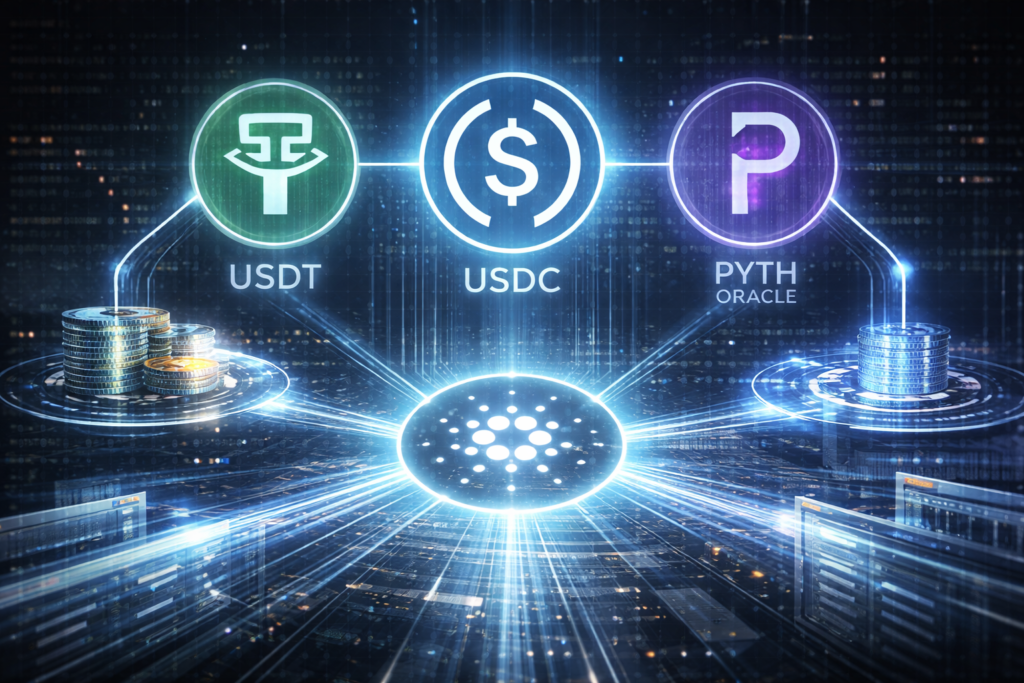
Stablecoins can provide dollar-denominated liquidity, but they differ in issuers, backing and transfer mechanisms. Cardano is not simply a network with no stablecoins. Circle’s 27 February 2026 announcement describes USDCx on Cardano, issued by a decentralised protocol and backed by USDC held in Circle xReserve. That is a specific delivered arrangement. It should not be conflated with every form of native USDC, a wrapped token or an unverified future USDT integration. Identify the actual asset, contract, backing and redemption process before making a liquidity or risk comparison.
USDCx and Pyth Pro are examples for which dated delivery announcements can be read. Other proposed integrations need their own evidence. A statement about attracting stablecoins is not confirmation that each named issuer has launched the same product on Cardano or that every application supports it. Readers should distinguish the issuer’s own token, a protocol-issued token backed by another asset and a bridge representation. Those structures can have different redemption, operational and counterparty risks even when they share a dollar target.
Real-Time Data: The Role of Pyth Oracle in Cardano DeFi
Decentralized oracles are indispensable for DeFi protocols, acting as crucial bridges that feed real-world data onto the blockchain. Accurate, reliable, and real-time market data is essential for the secure and fair functioning of various DeFi applications, including lending platforms (determining collateral value), decentralized exchanges (setting accurate prices), and derivatives markets.
Pyth’s 6 May 2026 announcement says Pyth Pro is live on Cardano and identifies Indigo as the first integration. This is more specific than describing the provider only as a future planned oracle. It does not establish that every Cardano protocol has integrated the service or that pricing infrastructure removes all contract, liquidity or oracle risks. Builders need to inspect the actual feed, integration and terms. A production announcement is evidence of a delivered component; its wider impact on activity and liquidity needs separate measurement.

Charles Hoskinson’s Vision: The ‘Make-or-Break’ Year of 2026
At the heart of Cardano’s ambitious DeFi trajectory is the unwavering vision of its co-founder, Charles Hoskinson. His forward-looking perspective frames 2026 as a pivotal year – a “do or die” moment – where the culmination of years of development, strategic partnerships, and community building is expected to catalyze exponential growth in Cardano’s decentralized finance sector.
Governance & Community: Fueling DeFi Growth with 1.5M ADA
A defining characteristic of the Cardano network is its commitment to robust, decentralized governance. Unlike many projects that rely on centralized decision-making, Cardano’s future is shaped by its community through mechanisms like Project Catalyst, a decentralized funding platform. This established governance system and decentralization structure are crucial for future DeFi expansion, ensuring that development aligns with community priorities and market needs.
Community funding can support application development, but the evidence needs to distinguish a proposal, an approved budget, a payment and a delivered result. An unlinked amount such as 1.5 million ADA should not be treated as proof of adoption merely because it appears in a roadmap summary. Identify the specific proposal, voting record, recipient and milestones, then compare those with actual delivery. Governance participation is relevant context; it is not by itself a measurement of DeFi liquidity, users or successful applications.
Cardano vs. Ethereum: A Realistic Outlook
In the competitive world of decentralized finance, comparisons with Ethereum are inevitable. As the undisputed leader in TVL and dApp activity, Ethereum casts a long shadow. Charles Hoskinson offers a realistic assessment of Cardano’s position relative to its larger competitor. While expressing immense confidence in Cardano’s significant growth, he tempered expectations regarding an immediate usurpation of Ethereum’s dominance, stating, “Do I think we’re going to eclipse Ethereum by the end of the year? No”.
This perspective indicates a pragmatic approach, focusing on sustainable growth and carving out Cardano’s unique niche rather than a direct, head-on challenge to Ethereum’s near-term leadership. Hoskinson’s confidence stems from Cardano’s distinct architectural advantages, its methodical development, and its burgeoning community. The goal is not necessarily to be “better” than Ethereum in every metric, but to offer a compelling, scalable, and secure alternative for the next wave of DeFi innovation. This addresses “Does Cardano aim to eclipse Ethereum in DeFi?” and “Will Cardano challenge Ethereum’s leadership in DeFi?” with a nuanced, realistic answer.
Charting the Future: Anticipated Milestones for DeFi Expansion
Hoskinson’s “2026 make-or-break” narrative is underpinned by a clear vision for anticipated milestones and strategic moves. He firmly believes, “I do think we’re going to see a huge growth in the DeFi side of the ecosystem”. This growth is not merely aspirational but is expected to be driven by the cumulative effect of the discussed upgrades and integrations.
The roadmap spans distinct stages. USDCx on Cardano and Pyth Pro have dated production announcements; Hydra is an application-specific scaling tool, while Leios and wider interoperability ambitions require release-specific assessment. Midnight’s own launch should not be described as a universal Cardano bridge. Proposed Bitcoin or XRP DeFi integrations need their own delivery evidence, supported assets and risk model. A collection of plans can show direction without establishing that every component is live or that liquidity and users will grow automatically.
Beyond the Horizon: Cardano’s Place in the Evolving DeFi Landscape
As Cardano progresses through its ambitious 2026 roadmap, it’s essential to contextualize its strategy within the broader, rapidly evolving blockchain ecosystem. Its approach to DeFi, characterized by deliberate development and a focus on long-term sustainability, positions it uniquely among Layer 1 blockchains.
Comparing Cardano’s DeFi Strategy with Other Layer 1s
Cardano’s DeFi strategy stands apart from many other Layer 1 blockchains. While some rivals prioritize speed-to-market or maximalist approaches, Cardano has consistently emphasised security, decentralization, and a peer-reviewed research methodology. This has resulted in a slower, more deliberate growth trajectory but aims for a more solid and resilient foundation.
Its competitive advantages lie in its Ouroboros consensus mechanism, which offers a highly energy-efficient and secure proof-of-stake model. The multi-layered architecture, separating the settlement layer from the computation layer, allows for greater flexibility and scalability (e.g., Hydra). The commitment to decentralized governance via Project Catalyst also differentiates it, fostering community ownership and a path for sustainable development. Challenges remain, particularly in overcoming the network effects established by earlier movers, but Cardano’s unique value proposition is appealing to users and developers seeking stability, rigorous engineering, and a truly decentralized future.
Getting Started with Cardano DeFi: A User’s Perspective
For users eager to explore and participate in Cardano’s expanding DeFi ecosystem, now is an opportune time to begin. The initial steps are straightforward and mirror those on other blockchain networks.
- Wallet Setup: The first step is to set up a compatible Cardano wallet. Popular options include Daedalus (a full-node wallet offering maximum security) and Yoroi (a light wallet for ease of use across devices). These wallets allow users to hold ADA, stake it to earn rewards, and interact with dApps.
- Acquiring ADA: To pay for transaction fees and participate in governance, users will need ADA, Cardano’s native cryptocurrency, available on most major exchanges.
- Exploring dApps: With a wallet and ADA, users can begin to explore emerging DeFi projects. These include decentralized exchanges (DEXs) like SundaeSwap or Minswap, lending and borrowing protocols, and NFT marketplaces. As the stablecoin integrations and cross-chain bridges come online, the variety and liquidity of these applications are expected to grow exponentially.
- Staying Informed: Given the rapid pace of development, engaging with the Cardano community through forums, social media, and official channels (like the Cardano Foundation or IOG blogs) is crucial for staying updated on new project launches, governance proposals, and ecosystem developments.
By providing a secure, scalable, and increasingly interoperable platform, Cardano is laying the groundwork for a rich and diverse DeFi environment. As 2026 approaches, the culmination of these efforts is poised to make Cardano a prominent and essential player in the global decentralized finance landscape.
Conclusion
Cardano’s DeFi development combines deployed components, application-level scaling and continuing research. Those categories should not be conflated. Hydra Heads do not prove a universal million-TPS Mainnet rate, and a Leios performance target is not evidence of an implemented 60-fold improvement across all transactions. Evaluate the exact release and benchmark, the applications using it and the observed effect. The useful question is which constraints have changed in practice, rather than whether a roadmap automatically guarantees massive growth or market dominance.
Delivered integrations can improve infrastructure, but their effect on liquidity, use and token value needs separate measurement. An approved grant is also different from a disbursed payment or a successful application: verify the proposal, approval and delivery records before using a budget amount as evidence of ecosystem growth. Do not turn management’s “make-or-break” framing into a prediction that Cardano will become dominant. The useful evidence is the actual component released, its limitations and the applications using it, alongside measured adoption and risk.
Explore current applications through official documentation and verify the network, asset identifier, fees and account requirements before connecting a wallet. Distinguish a test environment from production and an integration announcement from support in the application you intend to use. Development progress can improve functionality while token prices and investment outcomes still move independently.
Disclaimer: Readers should be aware that cryptocurrency investments are volatile and subject to market risks. This article is for informational purposes only and does not constitute financial advice. Always conduct your own research and consult with a qualified financial professional before making investment decisions.
Separate Delivered Features from Roadmap Targets
For each upgrade or integration, identify a dated release, the network and version, the applications actually using it and the limitations. A proposal, benchmark and production deployment are different milestones. Pyth Pro’s reported Indigo integration is evidence of a particular delivery; it is not proof that every oracle or stablecoin discussed in a roadmap is available everywhere. Hydra’s application-specific model also has participant and operational assumptions. A reader comparing DeFi networks should assess actual liquidity, use, costs and risks alongside technical plans, without inferring that developer progress guarantees ADA price gains.