I’d check the route before buying the scooter. A free permit is useful; it is not permission to ride on every pavement, road or cycling track in Dubai. Riders must be at least 16, and some driving-licence holders are exempt from applying. Here’s how I’d work through the permit, route and Metro checks without confusing one permission with another. Official guidance checked: 19 October 2026.
Understanding the Dubai E-Scooter Permit: Eligibility & Exemptions
Start with the RTA permit service, not a paid intermediary. The service is free and open to eligible residents and visitors. I’d settle the exemption question first: there is no point applying for a permit you do not need.
What is the Dubai E-Scooter Riding Permit?
The permit is a digital RTA authorisation for designated e-scooter use. Non-exempt applicants complete online theory lectures and a test. It does not make an unsuitable scooter legal or turn an unapproved route into an approved one.
Who Needs a Permit? Eligibility & Age Requirements
You must be 16 or older. If you do not hold an exempt driving licence, obtain the permit before riding on the designated routes. Being a tourist does not remove the requirement.
Permit Exemptions: When You Don’t Need to Apply
RTA exempts holders of UAE driving licences, valid international driving licences and driving licences from its listed exception countries. Check the linked country table on the official service page rather than assuming every overseas licence qualifies. Keep the relevant licence available; rental companies require a licence or permit.
Your Step-by-Step Guide to Applying for a Dubai E-Scooter Permit
I’d use the official website for a clear starting point. Have your Emirates ID or passport and a mobile number active in the UAE ready for identity verification. RTA Dubai and DubaiNow also offer the service, but their screens and login steps differ.
The Online Application Process via Official RTA Channels
The following sequence is for the RTA website. Follow the live service prompts if they change:
- Open the service: Select Apply for an Electrical Scooter Driving Permit on RTA’s website.
- Register if needed: Create the requested RTA account or traffic file.
- Verify your identity: Enter the requested Emirates ID or passport details and the OTP sent to your registered phone.
- Study first: Complete the online theory lectures, then take the test.
- Retake if necessary: RTA allows a failed test to be taken again.
- Finish the service: Follow the on-screen completion instructions after passing.
- Keep the permit accessible: Receive it through the website and SMS; RTA also lists My Docs in its smart app.
Mastering the Theoretical Test: What to Expect
The e-scooter theoretical test in Dubai is a crucial component of the permit application. It assesses your knowledge of key areas, including:
- E-scooter usage rules: Understanding where and how e-scooters can be operated.
- Safety requirements: Familiarity with essential safety gear and practices.
- Safe riding fundamentals: Knowledge of defensive riding, maintaining control, and interacting with other road users.
I’d pay particular attention to route signs and pedestrian crossings. Those are decisions you make during every journey, not just answers to get through a test. Read the official learning material rather than memorising an unofficial answer sheet.
Receiving and Accessing Your Digital Permit
Once you’ve successfully completed the application and theoretical test, your digital e-scooter permit will be issued electronically. This permit is accessible and verifiable via the RTA’s smart channels. Always ensure you have access to your digital permit while riding, as it may be requested by authorities.
Navigating Dubai’s E-Scooter Rules: Designated Zones, Restrictions & Safety
A neighbourhood name is not a route map. I’d check the exact path, junctions and last stretch to the destination against RTA’s e-scooter map and signs. A route that ends one road short of the office still needs a legal way to finish.
Where to Ride: RTA’s Permitted E-Scooter Zones
RTA’s current locations page identifies routes including Downtown–MBR, Jumeirah, Dubai Marina, Business Bay–Water Canal, Al Karama and the Greens. The important part is the designated track, not blanket permission throughout the district. I’d use these examples to find the map, not substitute this list for it:
- Downtown–MBR cycle track — designated routes only.
- Jumeirah cycle track — designated routes only.
- Al Mamzar cycle track — designated routes only.
- Dubai Marina cycle track — designated routes only.
- Al Khawaneej cycle track — designated routes only.
- Al Mankhool — designated routes only.
- Al Qusais 1 — designated routes only.
- Business Bay–Water Canal cycle track — designated routes only.
- JLT — designated routes only.
- City Walk cycle track — designated routes only.
- Internet City cycle track — designated routes only.
- Dubai Greens cycle track — designated routes only.
- MBR Library cycle track — designated routes only.
- Al Karama — designated routes only.
I would not follow another rider into an unsigned shortcut. Check the current signs and map; a cycle-only or pedestrian-only path is not automatically an e-scooter route.
Restricted Areas: Where E-Scooters are Prohibited
RTA’s December 2025 permit announcement excludes the following cycling tracks. There is no Al Qudra cycling-track exception in that guidance:
- Saih Al Salam
- Al Qudra cycling track
- Al Meydan
Riding in these forbidden zones can lead to fines and poses significant safety risks.
Essential E-Scooter Safety Advice for Riders
The RTA places a strong emphasis on e-scooter safety in Dubai. Adhering to these regulations protects not only the rider but also pedestrians and other commuters. RTA’s safety advice for riders includes :
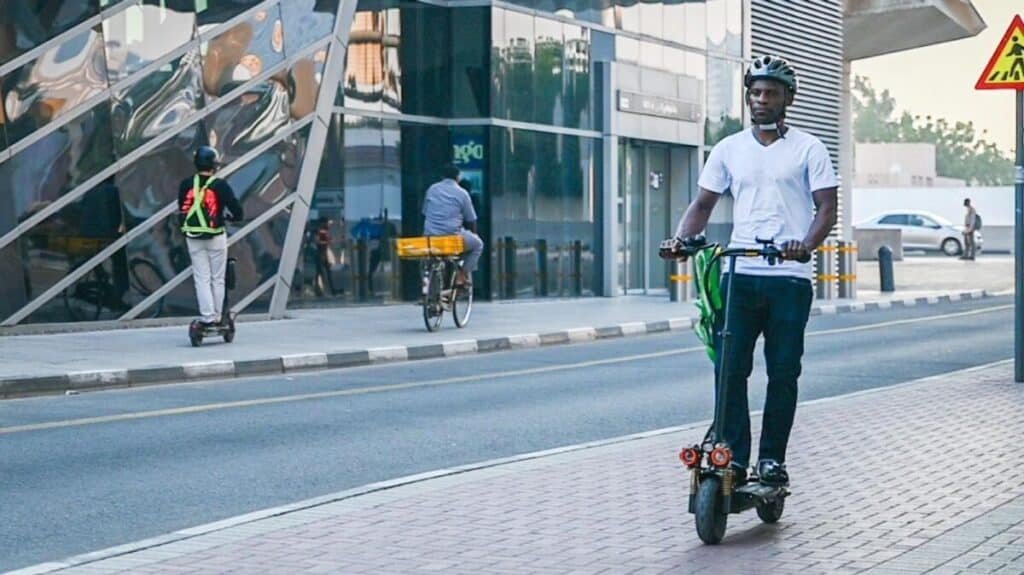
- Wear a Helmet: A helmet is mandatory for all e-scooter riders.
- Wear the required gear: Use a reflective vest as well as a protective helmet. Bright clothing does not replace the vest.
- Adhere to Speed Limits: Always respect and adhere to posted speed limits on designated tracks and shared paths.
- Maintain Safe Distances: Keep a safe distance from pedestrians, cyclists, and other vehicles to allow for adequate reaction time.
- No Dual Riding: E-scooters are designed for single riders only.
- Use Lights: Ensure your e-scooter’s front and rear lights are functional and used during evening or low-visibility rides.
- Avoid Distractions: Refrain from using mobile phones or wearing headphones that obstruct hearing.
General Riding Rules & Best Practices
My pre-ride check is simple: approved route, working brakes and lights, helmet, reflective vest and enough battery for the journey. Dismount at pedestrian crossings. Park in designated spaces without blocking the pavement; leaving a scooter across someone’s path is not a harmless shortcut.
E-Scooter Fines & Public Transport Regulations in Dubai
Compliance with Dubai’s e-scooter regulations is not optional; the RTA enforces these rules with clear penalties for violations. The core rules: stay within the 20 km/h speed limit, always wear a helmet, carry no passengers, and do not ride with earphones in both ears. Understanding e-scooter fines in Dubai and the specific guidelines for using public transport with your e-scooter is crucial for every rider. The RTA has issued strict warnings about enforcement to ensure public safety for all .
Common E-Scooter Violations and Their Penalties
The published cycle-regulation schedule distinguishes the offence and amount. A permit exemption matters for the permit row; it does not exempt a rider from route or safety rules.
- Riding without a valid permit: One of the most critical violations, incurring a substantial fine.
- Operating outside authorised areas: Riding in restricted zones or on main roads where e-scooters are prohibited.
- Not wearing a helmet: A mandatory safety requirement; non-compliance results in a fine.
- Riding against the direction of traffic: A dangerous violation that can lead to severe accidents and penalties.
- Exceeding posted speed limits: Endangering oneself and others.
- Carrying passengers: E-scooters are single-rider vehicles.
- Failing to comply with RTA safety regulations: This broad category includes not using lights at night, distracted riding, or reckless behaviour.
- Parking in non-designated areas: Obstructing pedestrian flow or vehicle traffic.
| Violation under the cycle-regulation schedule | Fine |
|---|---|
| Riding without the required permit, unless exempt | AED 200 |
| Failure to meet prescribed safety requirements | AED 200 |
| Carrying an e-scooter passenger | AED 300 |
| Failure to use RTA-designated cycle lanes | AED 200 |
| Exceeding the prescribed cycle-lane speed limit | AED 100 |
RTA’s Personal Mobility Monitoring Unit began operating on 1 May 2026. Its launch notice describes checks on riding, equipment and designated routes. I would not treat the table as an exhaustive account of every penalty or impoundment circumstance.
Carrying E-Scooters on Public Transport: What You Need to Know
Metro and Tram carriage is a separate check from permission to ride outdoors. I’d measure the folded scooter before planning a rail connection. For a bus leg, ask RTA about the specific service rather than transferring Metro rules to every vehicle.
Size, Condition, and Quantity Requirements
The RTA carriage poster specifies:
- Folded size: Within 120cm × 70cm × 40cm.
- Type and condition: Foldable, without a seat, clean and dry.
- Weight: No more than 20kg.
- Other services: Confirm bus and intercity-coach carriage separately. These rail requirements are not a promise that your scooter can board every bus.
My buying check: all three measurements and the weight must fit
I would ask for the folded measurements before buying for a Metro connection. These invented examples compare only size and weight with the poster’s limits; they are not tested products or boarding approvals.
| Hypothetical folded scooter | Size and weight check | Decision before purchase |
|---|---|---|
| 110 × 65 × 39cm; 19kg | Within all three listed dimensions and the weight limit | Still check the seat, battery, condition and remaining carriage rules |
| 110 × 65 × 41cm; 19kg | The 41cm measurement exceeds 40cm | Lower weight does not compensate for an oversized dimension |
| 110 × 65 × 39cm; 21kg | Within the dimensions, but above 20kg | A compact fold does not compensate for excess weight |
Measure the actual folded device and check any protruding parts; the poster requires potentially harmful projections to be covered or retracted. Do not judge compatibility by wheel size, a product photograph or the word “foldable” alone. If a source link changes, find “Requirements for carrying E-Scooters” under Metro or Tram in RTA’s brochure directory.
Boarding, Storage, and Safety Rules
The RTA has outlined clear boarding and storage rules to ensure the safety and comfort of all passengers:
- Station access: Fold the scooter and use the wide fare gate. Use the lift rather than the escalator.
- Designated Storage: E-scooters should only be stored in designated areas, often marked for luggage or mobility devices.
- Keep it clear: Do not obstruct doors, seats, aisles or emergency equipment.
- Maintain Control: Riders are responsible for their e-scooter at all times.
Prohibited Actions Within Public Transport Areas
Several actions are strictly prohibited to maintain safety and operational efficiency:
- Riding Inside Stations: E-scooters must not be ridden inside Dubai Metro or Tram stations, on pedestrian bridges, or any other public transport facility. They must be walked or carried.
- Charging at Stations: Charging e-scooters at Dubai Metro or Tram stations is strictly forbidden due to safety concerns.
- Obstruction: Ensuring the e-scooter does not obstruct emergency exits or pedestrian pathways comes first.
The poster also excludes damaged batteries, dual batteries and modified scooters, and requires batteries meeting recognised international standards. Keep the power off and do not charge the scooter in Metro or Tram premises.
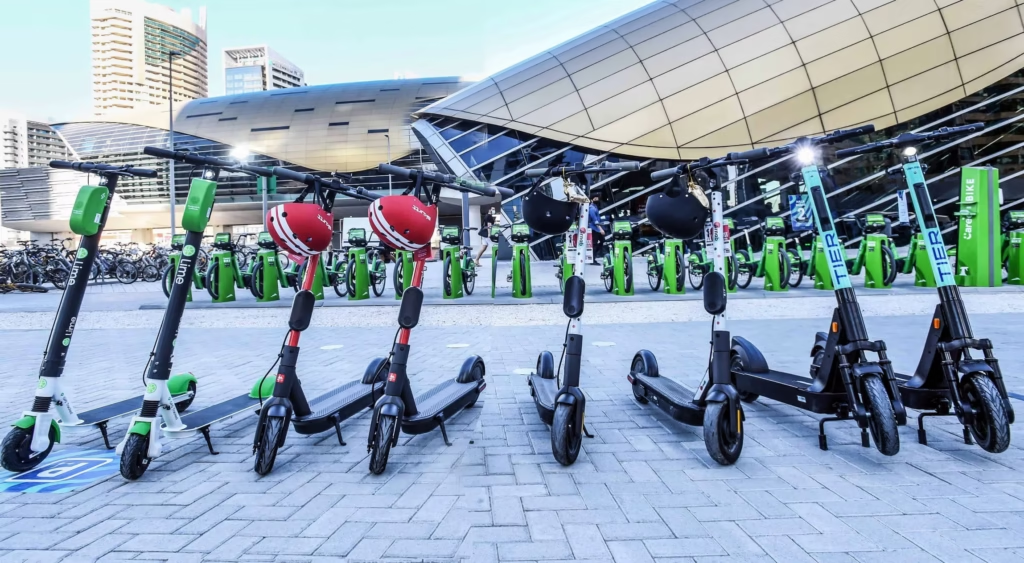
How I’d decide whether a scooter suits the journey
A scooter earns its place in a commute when the whole trip works. I’d check the legal last mile, storage at both ends and the folded weight I would actually have to carry. The cheapest model is a poor buy if it cannot make the connection you need.
Tips for Confident and Compliant Riding in Dubai
These are the practical checks I’d make before setting off:
- Route Planning: Before heading out, plan your route using RTA-approved maps that highlight designated e-scooter paths. This helps avoid accidentally entering restricted zones.
- Weather Awareness: Be mindful of weather conditions. Extreme heat can affect battery life and rider comfort, while rain can make paths slippery.
- Regular Maintenance: Keep your e-scooter in optimal condition. Regularly check tyres, brakes, and lights.
- Battery Management: Always ensure your e-scooter is sufficiently charged for your intended journey to avoid being stranded.
- Be Predictable: Signal turns and stops clearly. Eye contact with pedestrians and other riders can prevent misunderstandings.
- Respect Private Property: Do not ride or park e-scooters on private property unless explicitly permitted.
A permit is not a route guarantee
I would rather have an approved ten-minute route than a theoretically faster trip through prohibited space. That is the useful comparison—not an unsupported claim that one city’s permit system is the world’s best. Check the route itself and keep the broader UAE traffic-law guidance separate from the scooter-specific rules.
What I’d check when the rules change
I would look for a dated RTA notice before relying on a promised new route or rule. These are checks for future announcements, not claims that unannounced changes have been approved:
- New routes: Has RTA actually opened the track and added it to the map?
- Equipment: Does the current guidance still permit your device’s dimensions, weight and battery arrangement?
- Rental boundaries: Does the operator’s live map allow the full journey and a legal end-of-ride parking location?
- Instructions: Have new signs or a dated official notice changed the rules on your route?
- Connections: Does the transport operator accept your folded scooter on the service you intend to use?
I’d save the relevant official pages, but recheck them when planning a different route or buying a different scooter. Yesterday’s successful journey does not prove tomorrow’s shortcut is permitted.
Conclusion
My verdict: get the permit if you need it, but spend just as much care on the route and the device. Free authorisation is no bargain if the scooter is too heavy for the Metro or the journey depends on a prohibited cycling track.
I’d buy for the commute I can legally complete, not the top speed on the box. That means a usable approved route, compliant equipment and a realistic plan for the station connection.
Disclaimer: This guide provides general information based on official RTA regulations available at the time of publication. Always refer to the official Roads and Transport Authority (RTA) website or apps for the most current and authoritative guidelines. E-scooter riders are responsible for understanding and complying with all local laws and safety protocols.