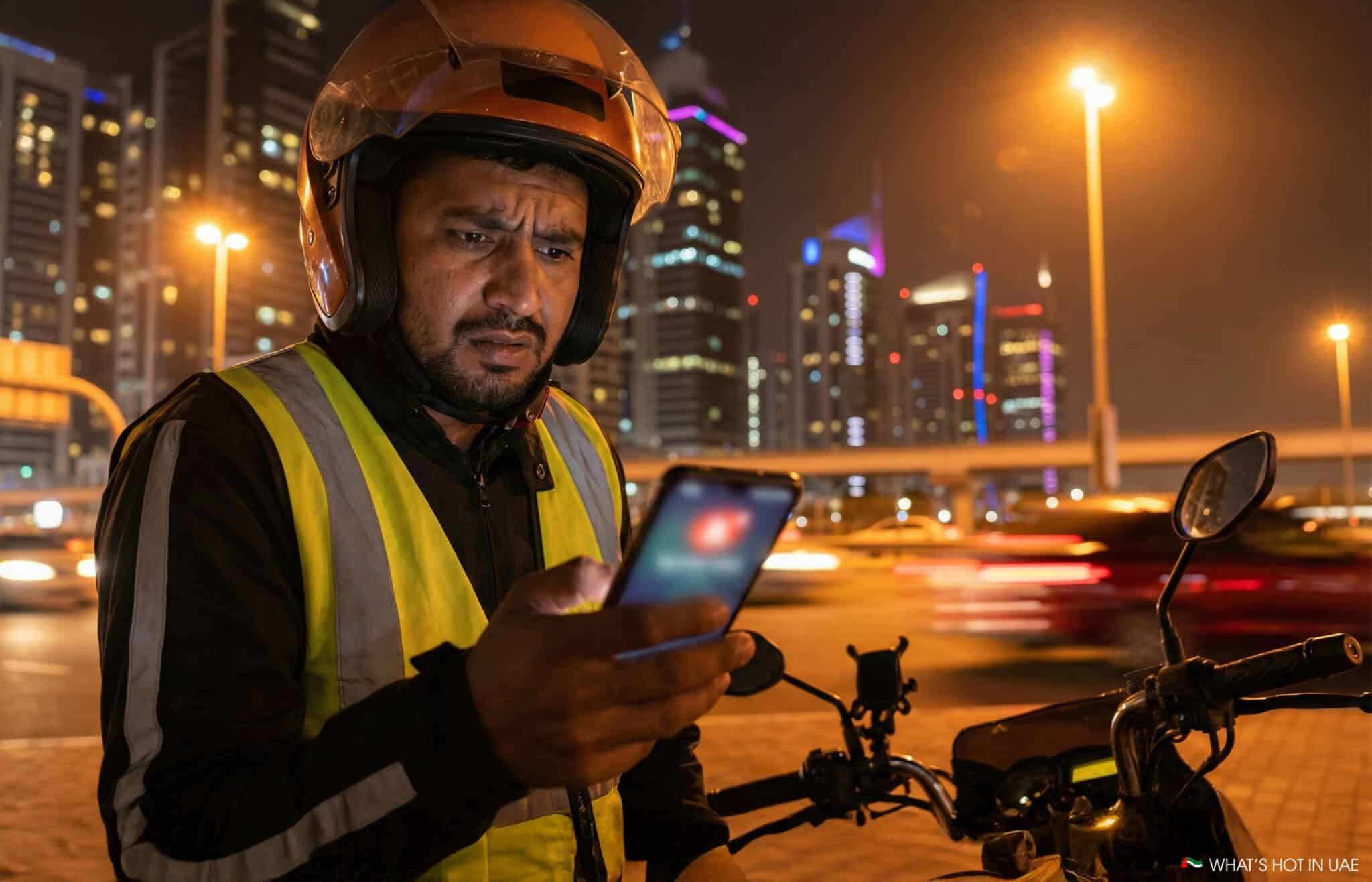
Count the lanes in your direction—not the lanes across the whole road. Dubai’s delivery-bike measure bars the two leftmost lanes where there are five or more, and the leftmost lane where there are three or four. On two lanes or fewer, this particular measure adds no lane restriction; other signs and rules still apply.
My practical recommendation is to keep three checks separate: the permitted lane, the speed requirement and the actual violation record. A delivery deadline cannot change any of them. The rule took effect on 1 November 2025, and its lane penalties are not a flat AED500 for every repeat offence.
The lane rule, with the arithmetic made clear
The RTA and Dubai Police announcement concerns delivery bikes and identifies restricted lanes by road width. Do not use it to declare every private motorcycle subject to an identical rule, or to infer permission to ignore another posted restriction.
| Lanes in your direction | Restricted by this delivery-bike measure | Lane-count result |
|---|---|---|
| 6 | Two leftmost | Four remain outside this particular restriction. |
| 5 | Two leftmost | Three remain. |
| 4 | Leftmost | Three remain. |
| 3 | Leftmost | Two remain. |
| 2 or fewer | No added lane ban under this measure | Follow all other applicable signs and traffic rules. |
The remaining-lane column is arithmetic, not a statement that every remaining lane is usable in every situation. Lane designations, closures and route-specific restrictions still matter. In particular, the five-lane illustration does not mean that a six-lane road also leaves only three lanes.
I would review the route and employer’s current briefing before a shift, not try to resolve an unfamiliar rule through a phone while riding. If the route is unclear, get a safe, lawful stopping place and clarification rather than improvise a manoeuvre from a diagram.
Diagram warning: the retained image below is not an official traffic plan. Its authority-style header is unverified and its divider markings should not be used as road-marking instructions. Use the sourced table and the signs on the actual road.

Lane offences and speed offences have different schedules
RTA’s announcement sets the following separate sequences. Match the category on the individual record rather than decide what happened from the amount alone.
| Published category | First | Second | Third |
|---|---|---|---|
| Delivery-bike lane-rule offence | AED500 | AED700 | Permit suspension |
| Exceeding 100km/h on roads whose limits are 100km/h or above, under this delivery-bike announcement | AED200 | AED300 | AED400 |
A road carrying a higher limit is not permission for a delivery bike to exceed its applicable maximum. On a road with a lower limit, that lower limit still matters. The linked RTA delivery-services manual also states a maximum 100km/h for a delivery bike. This guide does not determine a particular charge or replace other traffic-law provisions.
The first two lane amounts total AED1,200. Permit suspension is a different consequence, not just a third identical cash fine. I would take a repeat-offence notice straight to the employer and issuing authority for an explanation of the record and permit implications.
The payment-service total can differ from the headline fine
RTA’s Pay Vehicle Fines service page, showing an update dated 14 October 2026, lists the fine amount plus AED20 Knowledge and Innovation fees per fine. For a payment to which that schedule applies, AED500 plus AED20 would be AED520. Two fines of AED500 and AED700 plus that fee on each would total AED1,240.
Those are transparent calculations using the published service fee, not a quotation for every authority or violation. Read the actual official payment breakdown and do not add the same fee twice. A mismatch is a reason to ask about the specific record, not assume that an article has the final payable balance.
Check the record before deciding whether to pay or query it
I would start with the issuing authority, violation reference, date, location, category and amount. A screenshot shared in a riders’ chat is not your own record. If a vehicle is company-managed, agree with the employer how the relevant information will be checked and documented.
Use RTA’s linked official fine-enquiry service or the appropriate Dubai Police service reached through the UAE Government road-safety portal. RTA’s service information lists fine number, plate details, licence number or traffic-file number as enquiry details. Supply only what the actual service requests.
Avoid unsolicited payment links and keep personal documents private. I would navigate to the verified service myself rather than assume a convincing message or logo proves who sent it. Do not share account passwords or one-time codes with a person offering to clear the fine.
If the official service will not let you pay
I would establish the reason before making another payment attempt. RTA’s published payment steps distinguish an ordinary vehicle fine from a record involving black points or impoundment. Where the black-points workflow applies, it asks who was driving; if another person was driving, that person must complete the declaration process. This does not mean every delivery-bike lane offence carries black points.
For a company-managed bike, I would ask the fleet contact to identify the record and the responsible driver through the official process—not ask a colleague to accept a declaration merely to clear the screen. Keep authentication codes private. If RTA marks the fine unpayable through its channels, its instructions direct you to the issuing authority.
I would also check the channel before travelling to a counter. The same service page restricts payment at Customer Happiness Centre and Vehicle Registration Inspection Centre counters to customers applying for another service, such as renewal or registration. A screenshot saying “unpayable” is not a reason to assume every counter can resolve it.
A short record that makes a query easier
| Save | Purpose |
|---|---|
| Issuing authority and violation number | Identifies the record and the body that can explain it. |
| Date, time, location and offence wording | Separates a lane issue from speed or another category. |
| Official amount and payment breakdown | Distinguishes the penalty from separately listed service charges. |
| Relevant lawful records and employer reference | Supports a specific query without claiming the evidence guarantees cancellation. |
| Authority response, case number and stated deadline | Keeps the next step traceable. |
This is a suggested personal record, not an official form. My query would be: “Please confirm the category and issuing authority for violation [number], whether it is recorded as a first or repeat offence, the full payable breakdown and the applicable objection route and deadline.”
Do not copy an unrelated appeal process
Contact the issuing authority for the current objection procedure and required evidence. Simply disagreeing with the rule is not evidence that the recorded violation is wrong. A location record or other relevant information may support a query, but this guide cannot decide an individual case.
The RTA payment page includes an objection process specifically described for illegal-transport fines. I would not copy its document list or decision times into a promise about every delivery-bike lane offence. Ask which process applies to the exact notice, and retain the answer.
If a fine cannot be paid through RTA’s service, that service page directs users to the issuing authority. Paying a balance and resolving a permit issue are not necessarily the same administrative action. Establish both rather than assume one receipt settles everything.

The delivery box needs a real check, not an “approved” appearance
The RTA technical manual specifies a maximum 50cm length, width and height for the box, without obstructing the rider’s side/mirror view. It calls for secure attachment, rounded edges, materials other than wood or metal, and reflective tape at all corners. The relevant illustrated spread is printed pages 15–16.
It also addresses rear alignment, company identification, cleanliness and food-safety requirements where relevant. This is a selected summary, not a complete installation approval. The PDF’s file metadata dates to 2023; retrieving it today does not establish a newly issued 2026 consolidated specification.
I would ask the employer to show the applicable equipment specification and inspection arrangement for the actual bike. Measure and inspect the installation through the responsible qualified process. A neat grey box or reflective strip in a photograph cannot certify its material, dimensions or mounting.

My pre-shift priority: fix a defect before accepting the problem
RTA’s manual calls for regular maintenance, checks of the horn, signals, tyres and lights, appropriate protective equipment, attention to road conditions and no phone use while driving. I would use the employer’s inspection process and the motorcycle manufacturer’s maintenance guidance rather than treat this article as a mechanical inspection.
- Check that the required inspection and maintenance issues have been dealt with, and report defects through the employer’s procedure.
- Confirm the delivery box and load are secured and do not obstruct required views or equipment.
- Use the specified protective equipment and keep the visor suitable for visibility.
- Set the route before moving; stop safely and lawfully before interacting with the phone.
- Know the applicable lane and speed requirements and account for conditions, signs and closures.
I would not make up time through a restricted lane or use a delivery target as a safety argument. None of these checks guarantees an accident-free journey. The practical value is identifying a preventable problem before it becomes the rider’s burden on the road.
Keep the historical enforcement number in its year
Khaleej Times’ 27 November 2025 report said police took action against 8,152 motorcyclists that month. It is not an October-2026 enforcement total. Its simplified AED500 wording should not replace the primary announcement’s repeat-offence schedule.
Likewise, an account of Dubai’s rule is not a verified lane or penalty schedule for Abu Dhabi or Sharjah. A cross-emirate route requires current local guidance and the actual road signs. Our Dubai fast-lane guide discusses the separate car-driver context; it is not an exemption from delivery-bike restrictions.
My conclusion: the exact rule beats a reassuring shortcut
I would keep the lane-count table, the separate penalty categories and the official enquiry route together. That is more useful than a memorable but incomplete “AED500 fine” headline. Know what the road permits, check what the notice actually says and ask the responsible authority when the two do not make sense together.
Research scope
Reviewed 19 October 2026 against RTA’s announcement and current fine-service information, selected relevant sections of its downloaded technical manual, and dated enforcement reporting. Three retained body images plus hero were viewed; the box-requirements PDF spread was read, rendered and inspected. On 21 October, the primary lane announcement, payment-service steps and fee information were rechecked; the delivery-box spread was downloaded and visually rechecked. The added payment guidance is not a determination of the points or permit status on an individual record. No on-road test, equipment approval, individual fine determination, live payment/dispute submission, professional legal opinion or complete 2026 legislative consolidation is claimed.
FAQs for Dubai delivery riders
Do these rules apply only to a particular delivery platform?
The announcement concerns commercial delivery bikes, not an exemption for a named platform. Check the applicable permit and operating requirements with the employer and authority.
Are all private motorcycles covered by the same lane table?
The cited announcement is about delivery bikes. It does not establish an identical rule for every private motorcycle or permission to ignore other posted restrictions.
Does this guide establish the rules in other emirates?
No. It addresses the Dubai announcement. Check current local authority guidance and road signs for a route in Abu Dhabi, Sharjah or another emirate.