


Compare Dubai taxi starting fares and minimum charges, peak periods and Careem Plus at AED 29 a month, with worked examples rather than guaranteed savings.
Start with the pickup method, not the taxi’s roof colour. That is where I’d look for a cheaper Dubai ride. Street pickup can have a lower starting fare than an app booking, but the minimum charge, waiting and any usable subscription credit decide the real difference. The useful saving is the one on your whole journey—not a percentage attached to every ride in the city.
Quick fare check: for an ordinary daytime trip, street pickup starts at AED 5, with an AED 12 minimum bill. If you need an app and can choose your time, 10am–4pm is a common daily window for the lowest scheduled AED 9 e-hail start, with an AED 13 minimum bill. These are the RTA schedule and regular-taxi conditions, checked on 29 October 2026—not a guarantee of the lowest total fare or shortest wait.
My verdict: compare the bill you will actually pay
For a simple trip, compare the street and app options without assuming the starting-fare gap is the final saving. For a subscription, count only credit you will use after its fee and conditions. I would not make an unsafe pickup or risk a flight for a theoretical discount. The worked examples below show why a small, reliable saving is more useful than an impressive but unsupported taxi hack.
For another transport option, see the autonomous-taxi booking guide. For separate resident-service claims that also need setup and eligibility, use Emirates ID service checks.
Related: explore our full JLT area guide for the best value restaurants and bars, lakeside things to do and how to get around Jumeirah Lakes Towers.
Related: explore our full Business Bay area guide for canal-side dining, rooftop bars and things to do.
Fare starts, DTC’s minimum-charge conditions and the public Careem/Hala benefits were rechecked on 21 October 2026. The examples are calculations under stated assumptions, not measured journeys. Account-specific caps and live quotes still control your booking; the July roof-colour and S’hail references remain dated background.
Dubai Taxi Base Fares at a Glance
Use the RTA starting-fare schedule alongside the regular taxi service conditions. A starting fare is the initial meter amount, not the minimum bill or an all-in quote.
| Booking Method | Base Fare | Notes |
|---|---|---|
| Ordinary street pickup | AED 5 / 5.50 | Day / night starting fare; AED 12 minimum trip charge |
| Booked via authorised e-hail app | Dhs9 / 10 / 13 | Starting fare varies by time and day; AED 13 minimum trip charge |
| Dubai International Airport pickup | Dhs20 / 25 | Dhs20 normal taxi; Dhs25 van |
| Day and night changeover (street pickup) | Dhs5 / 5.50 | Dhs5 (6am–10pm); Dhs5.50 (10pm–6am) |
Do not subtract the two starting fares and assume that is your final saving. If both otherwise comparable ordinary trips finish below their minimum, the published AED 12 street minimum versus AED 13 app minimum means a difference of AED 1, not AED 4 or AED 8. A longer trip, different route or extra waiting changes that comparison. Airports, ports and special-event locations have separate conditions.
Distance, tolls and crossing charges: compare the full route
DTC’s regular-taxi fee table, checked on 29 October 2026, lists AED 2.45 per kilometre for street and app trips, AED 0.50 per minute of metered waiting, Salik charges where applicable and an extra AED 20 when passing through Sharjah. The Sharjah charge is separate from a toll; do not assume that exact surcharge applies to every other emirate. These are regular DTC service conditions, not an airport-van or limousine quotation.
A toll-free detour can cost more: suppose avoiding a hypothetical AED 6 toll adds 2km and three minutes of metered waiting. At those regular-taxi rates, the extra meter cost is (2 × AED 2.45) + (3 × AED 0.50) = AED 6.40. You would spend AED 0.40 more, not save AED 6. This compares only the changed charges, holds everything else equal and assumes both trips remain above their minimum fare. The toll amount and detour are invented examples, not a live Salik quotation, tested route or traffic forecast. Check the proposed route before treating “no tolls” as “cheaper”.
1. Hail It on the Street When You Can
When a licensed taxi is available at a safe permitted pickup point, compare a street pickup with the app option. The usual street start is AED 5 by day or AED 5.50 at night; authorised app starts vary by time. Do not walk into traffic or leave an authorised airport queue to chase a lower headline number.
A lower starting fare is not evidence that every short ride costs 30–40% less. For example, assume two daytime journeys have the same AED 25 of other metered charges, no extra fees and no minimum-fare adjustment. Starts of AED 5 and AED 9 produce totals of AED 30 and AED 34: AED 4, or about 11.8%, less than the app total. This is an arithmetic illustration, not a route quote or a measured average saving.

When a cheaper start stops being cheaper
RTA’s regular-taxi conditions list metered waiting at AED 0.50 per minute. In the hypothetical AED 30 street versus AED 34 app example above, eight extra minutes of metered waiting on the street option would use up its AED 4 starting-fare advantage: AED 4 ÷ AED 0.50 = 8 minutes.
Nine extra metered waiting minutes would make that street example AED 34.50, compared with AED 34 for the app example. This holds the other journey charges equal and assumes both trips are above their minimum charge; it excludes promotions and subscription credit. It is not a measured journey or an app pickup-time estimate. Compare the route and likely metered delays, not just the flag-fall number.
2. Check Current Hala Promotions Before Subscribing
Hala promotions and subscription offers change. Before paying for any plan, check the current offer inside the Careem app and confirm the monthly price, eligible ride types, discount cap and expiry date.
Do not rely on old screenshots or archived campaign pages: offers may be targeted, time-limited or withdrawn.
Hala’s own subscription terms rule out combining a ride promotion with cashback. I would compare the two benefits before choosing, not add them together. On a hypothetical AED 34 eligible fare, 10% would be AED 3.40 of wallet credit. An applicable AED 5 promotion would be the larger face-value benefit; it is not AED 8.40 off. That comparison assumes the promotion really applies and the credit would be usable.
If you combine Metro and taxi travel, compare the full door-to-door cost with using the Metro plus a regular street pickup.
3. Get Cashback with Careem Plus
Careem’s current help page lists AED 29 a month, while its UAE benefit page advertises 10% back on ten rides, including Hala, into the Careem Pay wallet. That is credit, not necessarily cash withdrawn or a lower meter total. A first-month or annual-plan price is a different commitment; verify the price, eligible rides, credit cap and expiry shown in your account.
For a taxi-only decision, calculate usable ride credit minus the subscription fee. With a hypothetical AED 29 monthly fee and 10% credit on fully eligible rides, four AED 40 rides return AED 16, leaving you AED 13 below break-even; eight return AED 32, only AED 3 above it. Those examples assume no lower cap, exclusion or unused credit. They do not value food benefits or prove the app is cheaper than street pickup.
An older Careem campaign specified an AED 7 Hala cap, but the current public benefit summary reviewed here does not establish every account’s cap. Do not apply historical campaign terms as a universal current entitlement. Use your actual subscription and ride terms before calculating a saving.
My taxi-only test: earning back the fee is not the same as winning the comparison
Take the same hypothetical AED 30 street trip and AED 34 off-peak app trip used above, and repeat each eight times in a month. Assume every app ride qualifies for the full 10%, no promotion is used, all credit is spent, and the whole AED 29 subscription is charged to these taxis. Keep routes, waiting and other charges equal. Here is the comparison I would actually use:
| Eight comparable trips | Calculation | Effective monthly cost |
|---|---|---|
| Street pickup | 8 × AED 30 | AED 240 |
| App, without a subscription | 8 × AED 34 | AED 272 |
| App, with the assumed subscription | AED 272 + AED 29 − AED 27.20 usable credit | AED 273.80 |
In that example, the subscription leaves the app journeys AED 1.80 more expensive than taking the same app rides without it, and AED 33.80 more than street pickup. Even if other benefits already justify the entire subscription fee, these eight app rides net AED 244.80 after the assumed credit—still AED 4.80 above the street total. I would pay for the app’s convenience when I need it, not call that difference a saving. Change the inputs for your own journeys; this is not a claim that street pickup wins every trip.
4. Know the Best Times to Book
Separate the published peak-fare window from actual congestion and taxi availability. The following windows come from RTA’s regular-taxi conditions; they are not measurements of every Dubai road or promises of shorter waits.
| Day | Published peak periods | Planning consequence |
|---|---|---|
| Monday–Thursday | 8–10am; 4–8pm | 7:30pm is still inside the evening peak |
| Friday | 8–10am; 4pm–midnight | After 7pm does not mean off-peak |
| Saturday–Sunday | 4pm–midnight | Weekend evening bookings remain in the published peak window |
If your plans are flexible, compare the quote on either side of a published fare boundary. Do not delay a flight transfer or an essential journey for a theoretical saving. The app’s current arrival estimate, road conditions and required arrival time matter more than a claim that one hour is always best.
5. Use the S’hail App for Seamless RTA Integration
S’hail is RTA’s multimodal journey app, combining public-transport planning and taxi-booking options. Use it to compare the whole journey: a Metro fare plus the last-mile taxi, walking distance and time may suit you better than one taxi across the city. An integrated app does not, by itself, give a cheaper taxi tariff.
RTA’s July 2026 app update describes nol card management, top-ups and travel-pass services alongside journey information. Check the current interface and the quoted journey before booking; app features alone do not establish a discount.
6. Know the Taxi Roof Colours
Dubai taxis aren’t all the same — different roof colours indicate different operators and service types. Knowing which is which can help you choose the right ride for your situation:
| Roof colour | Operator or service | Useful distinction |
|---|---|---|
| Red | Dubai Taxi Company (DTC) | Regular DTC taxi |
| Yellow | National Taxi | Not Cars Taxi |
| Blue / purple | Kabi, formerly Cars Taxi | Operator identity, not a discount category |
| Green | Arabia Taxi | Not Metro Taxi |
| Orange | Metro Taxi | Not Arabia Taxi |
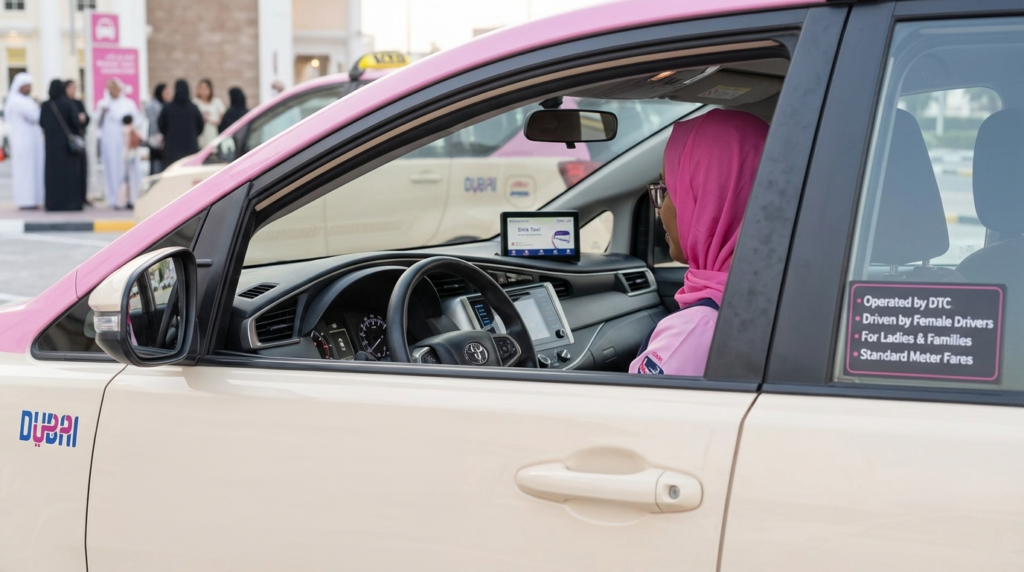
| Pink | Ladies and Family Taxi | Female-driver service for women and families |
The July 2026 operator-colour guide identifies the non-DTC fleets above; DTC confirms its own red-roof service and pink-roof Ladies and Family service. Colour is not a bargain-fare code. Compare the vehicle category, pickup location and booking method, and keep the receipt and plate details if there is a problem.
7. Use the Pink Taxi Service
DTC’s Ladies and Family Taxi is a female-driver service for women and families, identifiable by its pink roof. The operator lists app booking and pickups at airports, hospitals and shopping malls, subject to availability. Confirm the required vehicle and pickup channel for your party.
This is a service-choice check, not an extra saving. Ordinary street and app starting fares follow the published schedules, while the location and vehicle still matter: the operator’s page separately lists an exclusive-location base fare. Do not assume a pink-roof airport van has the same start as an ordinary daytime street pickup.
Dubai Taxi Hacks: FAQs
What is the cheapest way to get a taxi in Dubai?
For an ordinary trip, street pickup usually has the lower starting fare, but the minimum charge is AED 12 versus AED 13 for app booking. That can mean only AED 1 difference on a minimum-fare ride. Compare the full trip and any usable subscription credit, and use a safe authorised pickup point.
How much does a taxi from Dubai Airport cost?
RTA lists airport starts of AED 20 for a normal taxi and AED 25 for a van. Those are starting fares, not the complete journey price. Distance, waiting, tolls and other applicable charges determine the total; confirm the actual vehicle and pickup conditions.
How can I check current Hala promotions?
Check the offer in your own Careem account, including its subscription price, eligible rides, cap, expiry and renewal terms. A price printed in an old graphic or a dated campaign is not confirmation of a current offer.
What are the busiest times for Dubai taxis?
RTA’s published peak periods are Monday–Thursday 8–10am and 4–8pm, Friday 8–10am and 4pm–midnight, and Saturday–Sunday 4pm–midnight. These fare windows are not a live congestion forecast. After 7pm can still be peak time.
What do the different taxi roof colours mean in Dubai?
Red identifies DTC; yellow National Taxi; blue or purple Kabi, formerly Cars Taxi; green Arabia Taxi; orange Metro Taxi; and pink the Ladies and Family service. Roof colour does not establish a cheaper tariff. Check the actual service, pickup method and location.
Is Careem Plus worth it for taxi rides in Dubai?
Careem currently lists AED 29 a month and advertises 10% back on ten rides, including Hala, as wallet credit. It pays for itself from rides only if your usable eligible credit exceeds your fee. Check current account-specific caps and compare the app trip with the street alternative.
Compare the complete journey, not just a headline saving
Sharing a taxi can reduce the cost per person, but extra stops are not free. DTC’s regular-taxi FAQs, checked on 29 October 2026, allow friends or family with different destinations to share one taxi on one fare, and say the meter must not be restarted for multiple pickups and drop-offs during the trip. One fare means a continuing metered journey, not a fixed total: added distance, metered waiting and applicable tolls can still increase it. Confirm that the vehicle accommodates your party and luggage before choosing this option.
Compare the combined cost before splitting it. Suppose two separate taxis would each cost AED 20, while one shared journey costs AED 30 including both stops. The group pays AED 30 instead of AED 40; an equal split is AED 15 each, saving AED 5 per person. If the extra stop instead takes the shared total to AED 40, that saving disappears. These are hypothetical final bills, not measured routes or live quotes. Agree the stops and split beforehand; do not assume that sharing automatically makes every itinerary cheaper.
Hala’s FAQ says the pre-booking estimate excludes Salik; tolls are added separately if the route uses them. I would leave room for that in the budget rather than treat the displayed estimate as the final bill. For a toll-free alternative, ask before departure and compare extra distance or waiting: avoiding a toll does not automatically make the journey cheaper.
Keep the receipt. For a Dubai Hala lost-item report, the operator directs passengers to RTA on 8009090 with the trip time, pickup and drop-off, plate or side number, and driver details. Those specifics are much more useful than remembering only the roof colour.


