Prada expands its circularity strategy with Re-Cashmere and Re-Wool for FW26. Discover how the Italian house turns production offcuts into luxury knitwear.
Key Takeaways
- Prada launches Re-Cashmere and Re-Wool initiatives, expanding its circularity strategy to natural fibres.
- These lines transform production scraps and offcuts into luxury knitwear and ready-to-wear pieces, emphasizing that luxury need not be new.
- Prada incorporates blockchain for transparency, allowing consumers to trace the origins of their garments through embedded NFC tags.
- Re-Cashmere uses 100% recycled cashmere. Re-Wool yarn is 50% virgin wool, 40% recycled wool and 10% recycled cashmere—not wholly recycled.
- Because of the natural scarcity model, limited quantities and potential colour inconsistency exist in the Re-Cashmere and Re-Wool collections.
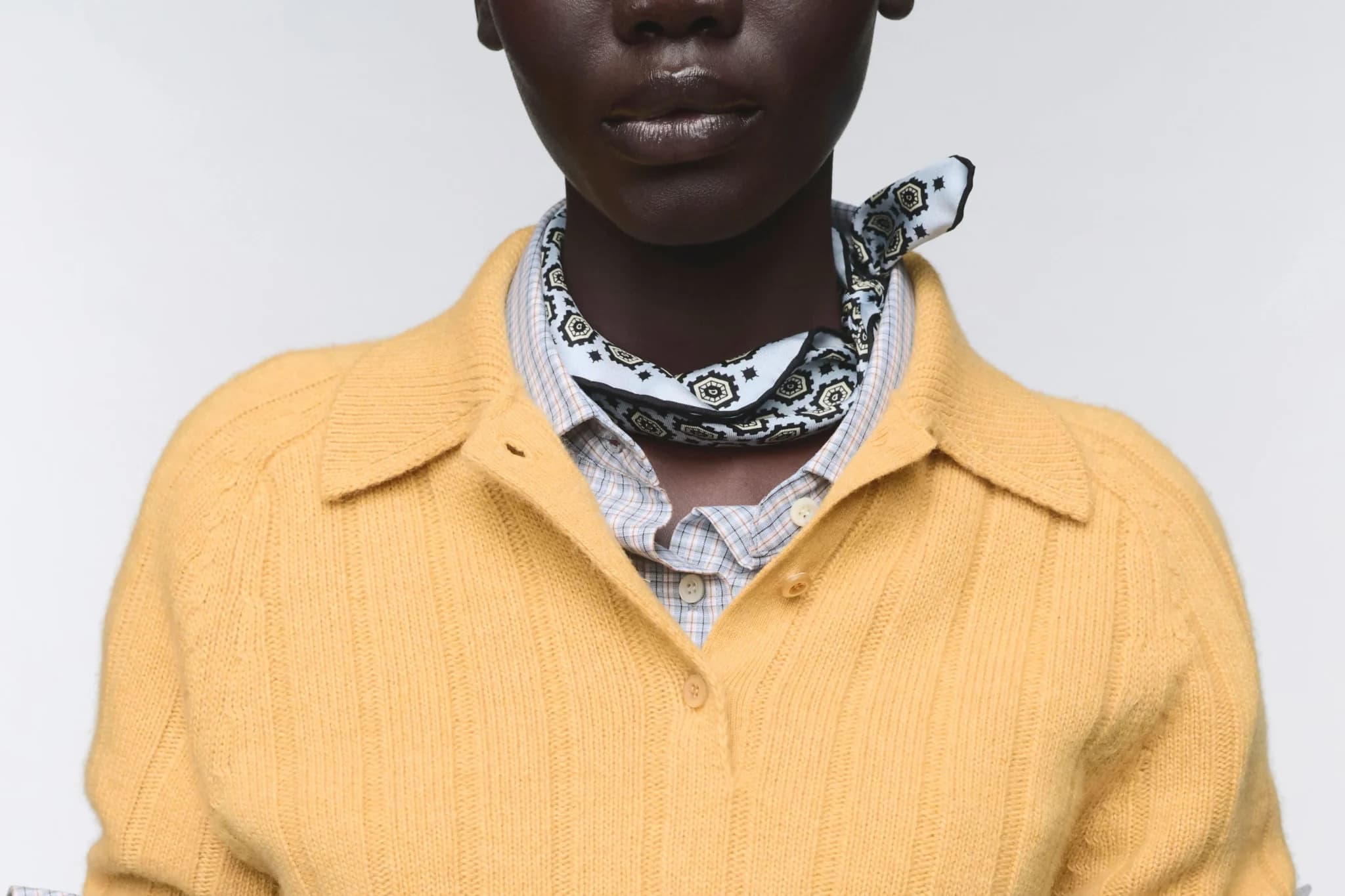
Prada is expanding its circularity strategy beyond synthetic materials, moving into the realm of natural fibres with the launch of its Re-Cashmere and Re-Wool initiatives. Integrated into the Autumn-Winter 2026 collection, these lines transform production scraps, spinning residues, and factory surplus into high-end knitwear and ready-to-wear pieces. Unlike previous efforts focused on nylon, this move targets two of fashion’s most storied materials, aiming to prove that luxury does not have to be “new” to feel premium.
The Shift from Re-Nylon to Natural Fibres
For years, Prada has been a leader in the circular economy through its Re-Nylon programme, which utilises regenerated nylon from waste like fishing nets. The new Re-Cashmere and Re-Wool projects represent a logical evolution, applying that same circular logic to animal fibres. However, the starting point is different: while Re-Nylon often deals with post-consumer waste, these new initiatives focus on “upstream” circularity, capturing material at the very moment of making.
Prada describes the use of pre-consumer offcuts, spinning residues and cutting-room remainders, with production in Tuscany and Umbria. Its official Re-Cashmere and Re-Wool collection page sets out the material composition and traceability. Reusing these inputs is the documented process; it does not, on its own, quantify the finished garment’s environmental footprint or prove what would otherwise have happened to every scrap.
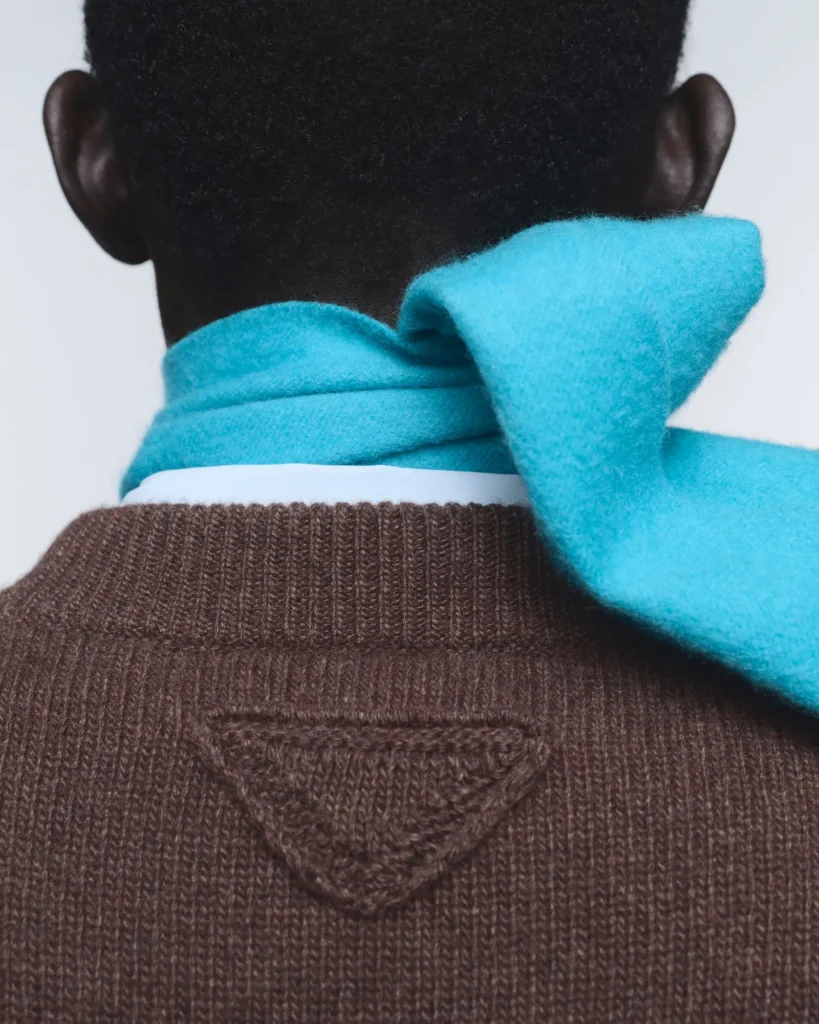
How It Works: From Production Scraps to Luxury Knitwear
The technical processes for these two lines differ based on the composition of the materials being reclaimed. Prada is using specific industrial techniques to ensure the resulting yarns meet luxury standards.
Re-Cashmere: 100% Recycled
Re-Cashmere is crafted from fine cashmere spinning residues and offcuts, including material sourced from the Prada Group’s own Torgiano facility in Umbria. To maintain the integrity of the fibre and avoid the environmental impact of new dyeing processes, the material is sorted by colour before being carded and spun into new yarn. The source cashmere is certified by the Sustainable Fibre Alliance (SFA), and the final recycled yarn carries the Global Recycled Standard (GRS) certification.
Re-Wool: A Precision Blend
The Re-Wool line draws from a wider pool of wool and cashmere offcuts, defective fabrics, and cutting-room remnants gathered across the Prada Group. The process involves:
- Removal: Non-wool components are stripped from the scraps.
- Sorting: Materials are sorted by colour to eliminate the need for dyeing.
- Wet Shredding: The fabric is reduced to filament through a fragmentation process carried out in a liquid medium.
- Blending: The final yarn is a specific blend consisting of 50% RWS-certified (Responsible Wool Standard) virgin wool, 40% recycled wool, and 10% recycled cashmere. The recycled elements are GRS-certified.
This blend is used for structured ready-to-wear items, such as trousers, jackets, skirts, and dresses.
Digital Traceability: The NFC and Aura Connection
To combat skepticism regarding recycled luxury, Prada has integrated blockchain technology to provide transparency. Every garment in the Re-Cashmere and Re-Wool collections features an embedded NFC tag.
Prada says the NFC tag connects to the Aura Consortium platform to trace materials, suppliers and successive production stages. That is useful provenance information, but it is not the same as an independent comparison of the garment’s climate impact. For a purchase, I would separate three questions: what proportion is recycled, what certification covers the yarn, and what the exact product’s care label requires. The Re-Wool blend still contains 50% virgin wool even though the range uses recovered material.
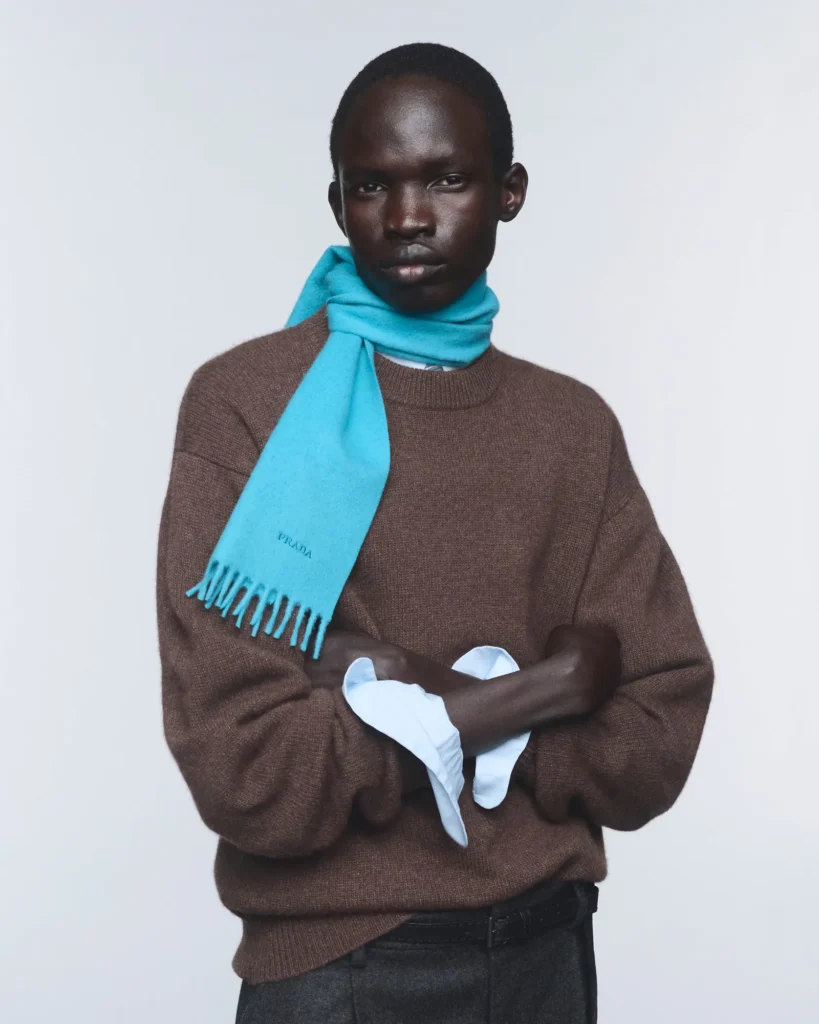
The Scarcity Factor: Why You Might Not Find Every Colour
Consumers should note that these collections operate on a model of natural scarcity. Unlike traditional luxury production, which can be scaled to meet demand, the volume of Re-Cashmere and Re-Wool is dictated by the physical availability of scraps and residues at any given moment.
This creates two practical implications for buyers:
- Limited Quantities: Production cannot be simply replicated on demand because the supply of specific offcuts is finite.
- Colour Inconsistency: Because the process relies on colour-sorting existing scraps to avoid new dyeing, a particular shade may return in a future season, but it may never be an exact match to a previous edition.
This unpredictability is a direct consequence of a supply chain that relies on what is actually available from the production floor.