A data-led 2026 guide to buying luxury watches in Dubai, covering market recovery, retail versus resale, tourist VAT refunds, authenticity checks and the costs hype leaves out.
The luxury-watch market in 2026 is recovering, but it is not a return to the anything-goes boom. WatchCharts’ broad secondary-market index was up 8.9% over one year on 13 July 2026, yet remained 2.9% lower over five years. Swiss watch exports then jumped 11.2% in June, while the first half of 2026 was still down 0.7%. For a buyer in Dubai, that mixed picture rewards patience: compare the exact reference, condition and full set; distinguish an asking price from a price someone will actually pay; and budget for the spread, service and insurance before calling any watch an “investment”.
Dubai is one of the world’s most enjoyable places to buy a serious watch. There are brand boutiques, authorised retailers, established pre-owned specialists and a deep community gathered around events such as Dubai Watch Week. That choice is an advantage only when the buyer knows what each sales route does—and does not—protect.
This guide turns the latest available evidence into a practical Dubai buying plan. It does not predict which reference will “moon”, and no brand paid to appear here. Market figures and official rules were checked on 29 July 2026.
The 2026 market in four numbers
| Signal | Latest figure checked | What it actually tells a buyer |
|---|---|---|
| WatchCharts Overall Market Index | +8.9% over one year; -2.9% over five years | A transaction-value-weighted basket of 300 watches from ten major brands has recovered recently, but the basket is still below its five-year level. |
| Swiss watch exports | June 2026 +11.2%; H1 2026 -0.7% | June was strong, but one month did not erase the softer first half. Export declarations are not retail sell-through. |
| Swiss exports to the UAE | 2025 +3.5%; Jan–Feb 2026 +7.1% | The UAE remained an important, growing destination in those official periods. It does not prove that every brand or model rose. |
| Chrono24 marketplace trend | Gen Z share of Cartier purchases rose from 1.7% to 6.8% across seven years | Design-led, dressier watches are finding younger buyers on a large marketplace; this is not a promise of future returns. |

Why headlines about “the watch market” can mislead
Three datasets dominate watch-market coverage, and each answers a different question.
- FH export statistics record watches crossing the Swiss border at export value. The federation explicitly warns that these are not sales to end consumers and cannot be used to infer one brand’s performance.
- Marketplace reports describe activity within a platform’s own audience and inventory. Chrono24 says it attracts nine million monthly users and carries more than 560,000 listings, making its signals useful—but not identical to the entire global market.
- Secondary-market indices estimate changing values for a defined basket. WatchCharts uses 300 watches from ten brands and weights them by transaction value. A basket gain does not mean the watch on your wrist rose by the same amount.
That is the first filter for any dramatic forecast. Ask what was measured, over which period, in which currency, and whether the number represents an advertised price, an estimated market price, an auction result or an executable dealer bid.
Is a luxury watch a good investment in 2026?
For most people, a luxury watch is better treated as a collectible that can retain some value than as a conventional investment. A few scarce references have historically appreciated, but the winner lists that circulate online usually ignore the watches that fell, the years spent waiting and the costs between purchase and resale.
The visible chart is only the start. A buyer may pay a dealer’s retail or asking price, then later receive a lower cash offer because the next dealer needs margin, warranty provision and room for market movement. Add insurance, servicing, possible parts, currency changes and opportunity cost. Polishing, damage, missing links, an incomplete set or an undocumented service can also change the bid.
A more honest test is simple: would you still want the watch if its resale value fell 20%? If the answer is no, you are taking a speculative position, not merely choosing something to wear. Never borrow at costly rates to chase a watch premium, and never regard an online estimate as a guaranteed exit price.
What is moving now—and what is not proven
The recovery is broad enough to take seriously. On 13 July, WatchCharts showed positive one-year brand indices for Rolex (+6.4%), Patek Philippe (+18.3%), Audemars Piguet (+6.8%), Omega (+6.0%), Cartier (+8.8%), Breitling (+7.7%) and Tudor (+15.2%). Those are brand-level baskets, not a shopping list. A common reference, a damaged example and a scarce full-set piece can move very differently under the same logo.
The more interesting change is aesthetic. Chrono24’s H1 2025 analysis found that Gen Z’s share of dress-watch purchases had risen 44% since 2018, compared with 29% among other age groups. Twelve per cent of Gen Z purchases on the platform were dress watches, while Cartier’s share of their purchases rose from 1.7% to 6.8%. Smaller cases, shaped designs and watches with a point of view are no longer side stories to the steel-sports conversation.
At the same time, product launches such as the 2026 Breitling Chronomat and the revived TAG Heuer Carrera Seafarer show how brands are mixing recognisable heritage with new colours, sizes and complications. Cultural relevance may support demand; it does not determine the second-hand bid.
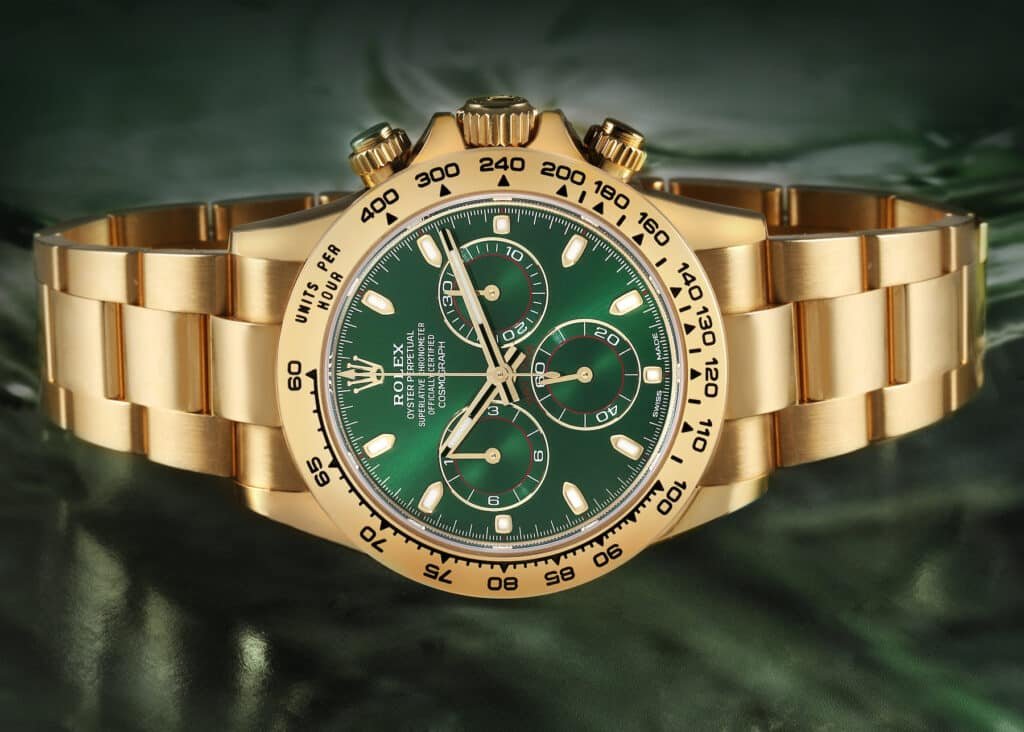
Where to buy a luxury watch in Dubai
| Buying route | Main advantage | Trade-off to understand |
|---|---|---|
| Brand boutique or authorised retailer | Clear provenance, manufacturer warranty and direct brand support | The most sought-after references may not be available on demand; do not assume a display or “wish” guarantees allocation. |
| Manufacturer certified pre-owned | Brand-backed authentication and a defined CPO warranty | The extra assurance can be reflected in the price, and programmes differ by brand. |
| Established independent pre-owned dealer | Immediate access to more references, ages and price points | Authentication standard, return window and dealer warranty must be confirmed in writing. |
| Private seller | Potentially less dealer margin | Highest due-diligence burden, weakest recourse and greater payment, title and authenticity risk. |
For one concrete example, Rolex says new watches are sold through Official Retailers and carry a five-year international guarantee when its conditions are met. That is a manufacturer fact—not a reason to assume every brand, retailer or pre-owned watch carries the same protection. Check the applicable brand’s own website and retailer locator on the day you buy.
How to compare two prices properly
“Same model” is rarely specific enough. Use the exact reference and, where relevant, dial, metal, bracelet and case size. Then normalise the comparison:
- Match the configuration. A dial variant, discontinued production run or original bracelet can change the market.
- Record age and condition. Look for case geometry, bracelet stretch, replacement parts, scratches, damage and the quality of any polishing.
- Check completeness. Original invoice, dated warranty card, service documents, box, booklets and spare links matter—but papers alone do not authenticate a watch.
- Separate price types. A dealer’s advertisement, a marketplace estimate, an auction hammer price and a cash purchase offer are not interchangeable.
- Add ownership costs. Include tax treatment, insurance, immediate repairs, expected service and the likely resale spread.
Before paying, ask the seller to put the reference, serial, condition, included items, warranty, return period and authenticity undertaking on the invoice. Do not post an unobscured serial number online.
Dubai tourist VAT refunds: the rule buyers miss
UAE residents do not qualify for the tourist VAT refund. For eligible visitors, the Federal Tax Authority says the buyer must be at least 18, have entered on a tourist visa and buy from a retailer registered with the Planet tourist scheme. The minimum eligible spend is AED250 excluding VAT.
The transaction must be validated within 90 days of the invoice. At departure, keep the goods accessible because they may need to be presented before checked baggage is handed over. Bring the original passport—or GCC national ID where applicable—the goods and proof of departure. The FTA says the refund is reduced by 13% of the VAT amount plus AED3.60 per tax-free transaction, so “tax free” does not mean receiving the entire VAT amount back.
Airport validation should be completed within six hours of departure where a staffed desk is involved. Different timing applies to the shopping-mall and hotel-kiosk process, which requires an online boarding pass within 24 hours. Rules and locations can change, so verify the current process on the FTA tourist-refund page before a large purchase.
The authenticity and provenance checklist
- Verify that the case, movement, dial and bracelet correspond to the exact reference and period.
- Match the watch to its invoice, warranty card and service trail; inconsistencies require an explanation.
- Ask whether any component is aftermarket, replaced, refinished or modified, and record the answer on the sale document.
- For a high-value independent or private purchase, arrange inspection by a qualified watchmaker who is not financially tied to the seller.
- Check loss or theft databases where available, while understanding that no database can prove clean title with absolute certainty.
- Use a traceable payment method and verify the legal seller named on the invoice.
- Read the return and warranty terms before money moves, including who pays if authenticity is disputed.
A convincing box and card can be copied or assembled from another watch. Conversely, a watch without its original packaging is not automatically fake; it is simply harder to value and document. Authentication is a judgement about the physical watch and its history, not a single accessory.

Owning a mechanical watch in the UAE
Dubai’s heat is not an invitation to leave a watch on a car dashboard, and humidity makes water-resistance discipline important. Water resistance is a tested condition, not a permanent property: seals age, crowns can be left open and impact can compromise a case. Have resistance pressure-tested after case work or at the interval recommended by the manufacturer. Avoid operating pushers or setting the watch in water unless the maker explicitly permits it.
A watch rated for water exposure still does not belong in a steam room or sauna; rapid heat changes can stress seals. Leather straps will usually show sweat and moisture sooner than metal or rubber. Strong magnetic fields can affect some mechanical movements, while an unworn automatic watch stopping after its power reserve is exhausted is normal—not necessarily a fault.
For insurance, document the serial privately, retain invoices and photograph the condition. Ask whether the policy covers accidental damage, theft outside the home, travel and an agreed value or only a depreciated/replacement value. A bank safe-deposit box, home safe and wearable access each solve a different problem; choose deliberately rather than storing the box, papers and watch together by habit.
A 30-minute decision plan before you pay
- Write down why you want this exact watch: design, complication, history, daily wear or speculation.
- Compare at least three like-for-like examples and label every number as asking, sold or bid.
- Calculate the all-in three-year cost, including likely service, insurance and resale spread.
- Verify seller identity, provenance, condition, authenticity process, warranty and return rights.
- Walk away for a day unless the loss of that exact example would genuinely matter. Scarcity language is not evidence.
The best 2026 purchase is not necessarily the watch with the loudest premium. It is the one whose price you understand, whose condition and history you can defend, whose ongoing costs you can absorb and which you would be happy to wear through the next market decline.
Sources and methodology
- WatchCharts Overall Market Index, last updated 13 July 2026. The index covers 300 watches from ten brands and is transaction-value weighted.
- Federation of the Swiss Watch Industry FH statistics, including 2025 annual, January–February and June 2026 releases. FH figures are export declarations, not retail sales.
- Chrono24 Secondary Watch Market Report H1 2025. Platform data should not be assumed to represent all transactions worldwide.
- UAE Federal Tax Authority: VAT refunds for tourists, page updated 17 July 2026.
- Rolex international guarantee. Other manufacturers’ terms differ.
Editorial note: This article is for consumer information and does not provide investment, tax, legal or insurance advice. Market prices and official procedures can change. Verify the exact watch, seller terms and current government rules before committing funds.