


The day you land in Dubai is exhilarating. If you’re moving to Dubai, it’s also the start of a to-do list that nobody fully prepares you for. Between navigating a new city, setting up a home, and figuring out which apps actually work here, the admin can feel overwhelming if you don’t know where to begin.
This guide covers 15 practical steps to take as soon as you arrive in Dubai — organised by urgency, with real timelines, actual costs, and no vague advice.
Your Moving to Dubai Timeline
| When | What to Do |
|---|---|
| Day 1 (at the airport) | Pick up a local SIM card |
| Day 1–2 | Get a nol card; download essential apps |
| Week 1 | Chase Emirates ID, medical insurance, and visa stamp confirmation |
| Week 1–2 | Open a bank account; set up DEWA if moving into a permanent home |
| Week 2–4 | Sort Ejari registration, driving licence transfer, vehicle registration |
| First month | Register with your embassy; notify your home country; explore your neighbourhood |
1. Pick Up a Local SIM Card at the Airport
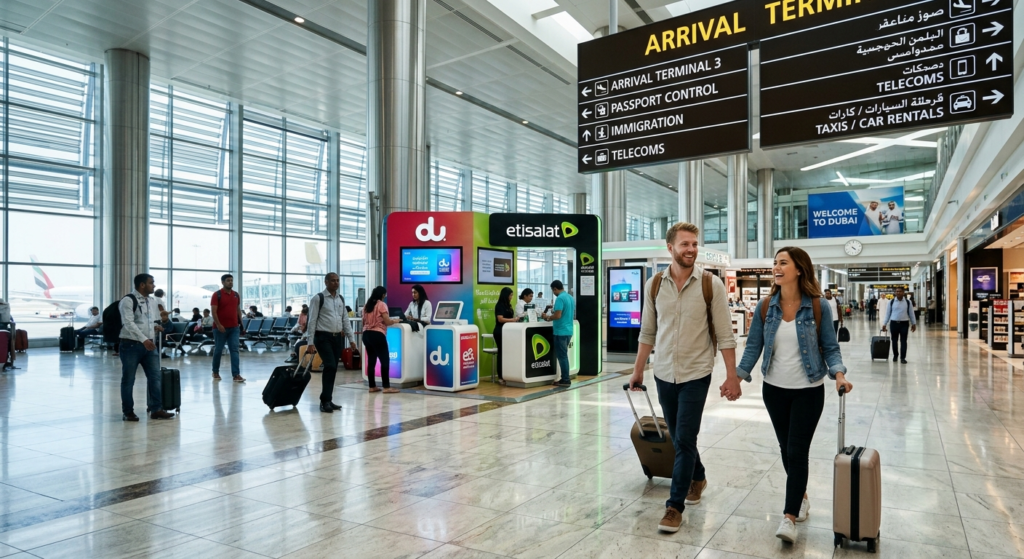
Do this before you leave the arrivals hall. Roaming charges in Dubai can be painfully expensive, and you’ll need a working local number almost immediately — for Uber and Careem, for WhatsApp groups, and for any government portals that require SMS verification.
There are only two main telecoms providers in the UAE: du and Etisalat (e&). Both have kiosks inside Dubai International Airport (DXB), and both offer tourist SIMs and monthly plans. Virgin Mobile UAE operates on the du network. Here’s a quick comparison:
| Provider | Starting Monthly Plan | Notes |
|---|---|---|
| du | From ~Dhs55/month | Tourist SIM available at DXB; strong for data packages |
| Etisalat (e&) | From ~Dhs60/month | Wider coverage in remote areas; popular for families |
| Virgin Mobile UAE | From ~Dhs45/month | Runs on du network; app-based management; flexible plans |
A tourist SIM is fine for the first few days, but switch to a monthly resident plan as soon as possible — the data allowances are far more generous, and the per-call rates are lower.
2. Get a nol Card
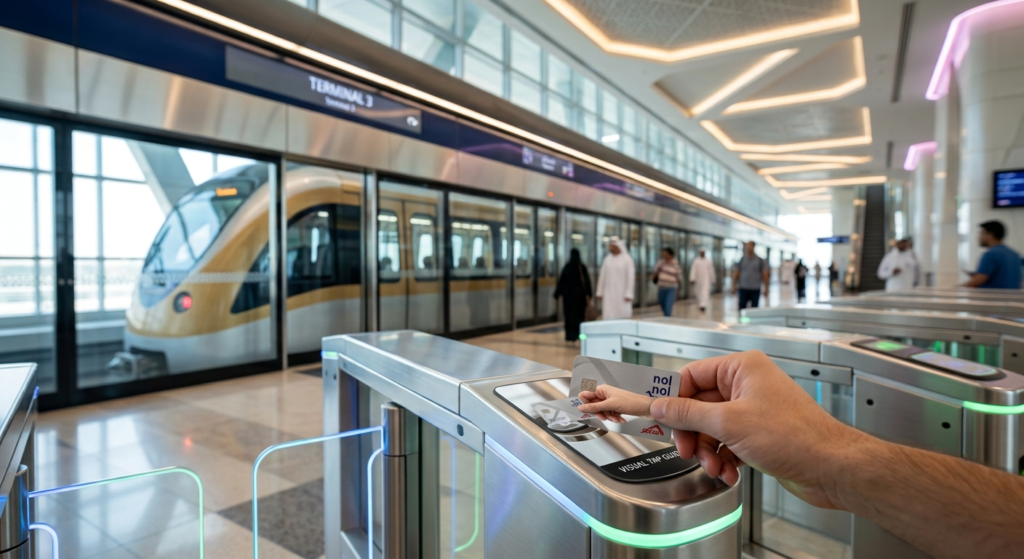
The nol card is Dubai’s equivalent of London’s Oyster or New York’s MetroCard. It works across the Dubai Metro, tram, bus network, water buses, and the Palm Monorail. You can also use it to pay at select supermarkets, parking meters, and some retail outlets.
There are four card types:
| Card Colour | Cost | Best For |
|---|---|---|
| Red | Dhs2 (non-refundable) | Tourists and occasional users; no registration needed |
| Silver | Dhs25 (Dhs19 refundable deposit) | Most residents; standard access to all transit zones |
| Gold | Dhs25 (Dhs19 refundable) | Access to Gold Class carriages on the Metro |
| Blue | Free | Registered workers and students with a specific employer or institution |
For most new residents, the Silver nol card is the right choice. Pick one up from any Metro station or the RTA kiosks at DXB. Top it up via the RTA app, nol Pay app, or at Metro stations.
3. Download These Apps Immediately
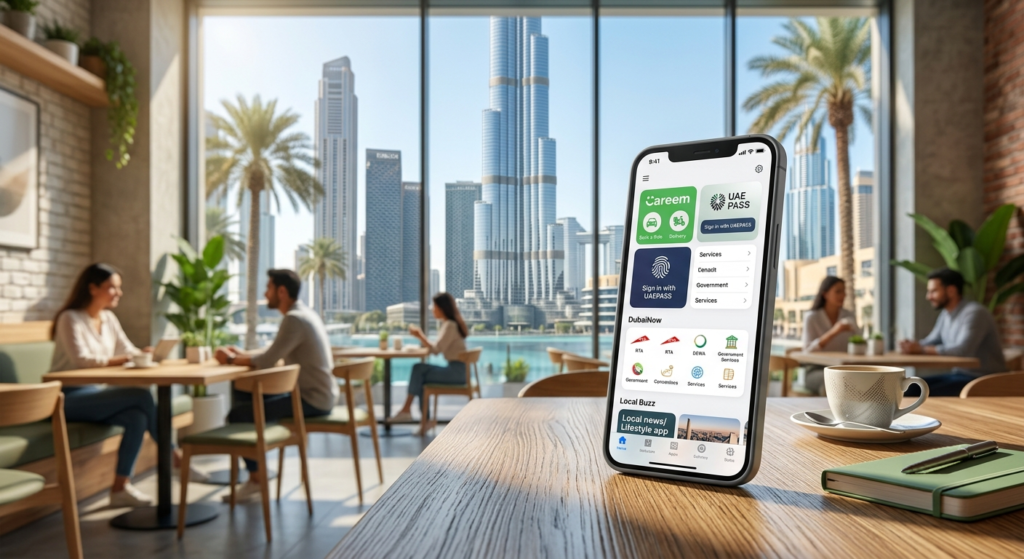
Dubai runs on apps. The gap between knowing which ones to download and not can genuinely affect your quality of life in the first few weeks. Here are the ones that matter:
| App | What It Does | Priority |
|---|---|---|
| Careem | Taxis, car rental, delivery | Essential |
| Uber | Taxis (good competitor pricing to Careem) | Essential |
| Talabat | Food delivery — widest restaurant selection in UAE | Essential |
| Noon | Shopping (UAE’s Amazon equivalent) | Essential |
| RTA Dubai | Public transport, nol top-up, parking | Essential |
| DEWA | Electricity and water bill management | Essential (when you move in) |
| ICA UAE | Emirates ID and visa application tracking | Essential |
| myID (ICP) | Official Federal Identity Authority app | High |
| UAE PASS | Digital identity for government services | High |
| Darbi | Salik (toll) account management | High (if driving) |
| Fetchr | Parcel delivery and address management | Medium |
| Dubizzle | Classifieds: furniture, cars, apartments | Medium |
4. Track Your Emirates ID Application
The Emirates ID is not optional — it’s a legal requirement for all UAE residents and the key that unlocks almost everything: a bank account, a lease agreement, a driving licence transfer, a Salik account, and more. If you’re entering on an employment visa, your employer’s PRO (Public Relations Officer) or HR department will typically handle the application, but you need to stay on top of it.
The ID is issued by the ICP (Federal Authority for Identity, Citizenship, Customs and Port Security). You can track your application status via the ICA UAE app or the ICP website using your application reference number. Processing typically takes 3- 15 working days. Chase your HR department early — delays often happen when passport photos or fingerprints need to be redone.
5. Get Your Visa Stamped
If you’re arriving on an employment visa, your residence visa needs to be stamped in your passport. This usually happens after your medical fitness test (blood test + chest X-ray at an approved MOHAP centre) and your Emirates ID biometrics (fingerprints). The sequence is typically:
- Entry permit issued by your employer
- Medical fitness test
- Emirates ID application and biometrics
- Residence visa stamped in passport
Until your visa is stamped, you technically cannot add dependants to your visa or be added to your employer’s medical insurance. Push HR to get this done in your first week.
6. Confirm Your Medical Insurance
Employers in Dubai are legally required to provide health insurance to their employees under the Dubai Health Authority’s mandatory scheme. However, the coverage varies enormously between policies — some cover only basic outpatient care, others include dental, optical, and specialist referrals. Ask your HR team specifically:
- Which insurance provider you are with (e.g. Daman, AXA/GIG Gulf, Oman Insurance, MetLife)
- Which hospitals and clinics are in-network
- Whether the card covers your family members (if applicable)
- What the claims process is for reimbursement
- The renewal date
Keep a digital photo of your insurance card on your phone at all times. If you need to visit a clinic before your physical card arrives, most providers have an app or online portal where you can retrieve your policy number.
7. Open a Bank Account
You’ll need a UAE bank account quickly — for receiving your salary, paying rent by cheque (yes, still cheques in most cases), and setting up utility payments. Most accounts can be opened within 1–3 working days once you have the right documents. Here’s what you’ll typically need:
- Original passport + copies
- UAE residence visa (or entry permit if visa isn’t stamped yet)
- Emirates ID (or application receipt if ID hasn’t arrived)
- Salary certificate or NOC letter from your employer
- Minimum opening deposit (varies by bank and account type)
| Bank | Min. Salary (typical) | Notable Feature |
|---|---|---|
| Emirates NBD | Dhs5,000 | Largest UAE network; strong app; Skywards partnership |
| ADCB | Dhs5,000 | Popular for expats; good credit card options |
| Mashreq Bank | Dhs3,000 | Fast digital account opening; Neo app for lower earners |
| HSBC | Dhs10,000 | Good for international transfers and existing HSBC clients |
| FAB (First Abu Dhabi Bank) | Dhs5,000 | Strong in both Dubai and Abu Dhabi |
| Liv. (Emirates NBD) | No minimum | App-only; great for under-30s; instant account opening |
8. Set Up DEWA for Your Home
You cannot receive electricity or water in your Dubai apartment without an active DEWA account. If you’re moving into a permanent home (rather than a hotel or short-stay), setting up DEWA is one of your first priorities. The process requires your Ejari certificate (which your landlord or agent should arrange), your Emirates ID, and a refundable security deposit (typically Dhs2,000 for an apartment, Dhs4,000 for a villa).
Apply online at dewa.gov.ae or via the DEWA app. Connections are usually activated within 24 hours of a successful application. Your monthly DEWA bill will depend on your usage and whether your building has district cooling — a separate utility not covered by DEWA.

9. Understand How Renting Works in Dubai
Dubai’s rental market has specific rules that differ significantly from most other countries. Knowing them before you sign anything will save you considerable stress:
- Post-dated cheques (PDCs): Most landlords require 1–4 cheques upfront covering your annual rent. A one-cheque deal is convenient but usually commands a premium. Four cheques (quarterly) is common and more manageable.
- Ejari registration: Your tenancy contract must be registered on the Ejari government system. Without it, you can’t set up DEWA or apply for certain government services.
- 90-day notice for rent increases: Landlords must give 90 days’ written notice before increasing your rent, and any increase must comply with the RERA rental index for your area.
- Security deposit: Typically 5% of annual rent for unfurnished properties and 10% for furnished. This is refundable at the end of your tenancy, subject to any deductions for damage.
- Agent commission: Usually 5% of annual rent, paid once. It’s typically the tenant’s responsibility.
10. Transfer Your Driving Licence
If you hold a driving licence from an eligible country, you can exchange it for a UAE licence without taking a driving test. Eligible countries include the UK, USA, Canada, Australia, most EU nations, and around 30 others. The process is done through the RTA (Roads and Transport Authority) and you’ll need:
- Your original foreign driving licence
- Emirates ID
- UAE residence visa
- Eye test (available at RTA-approved opticians, or in some cases at the RTA centre itself)
- Passport copy and NOC from your employer (for some nationalities)
The fee is around Dhs200–400 depending on nationality and licence class. Processing takes the same day at most RTA driving licence centres. If your country is not on the eligible list, you’ll need to go through the full UAE driving test process — typically 6–12 lessons minimum plus theory and practical tests.
11. Set Up Your Salik Account
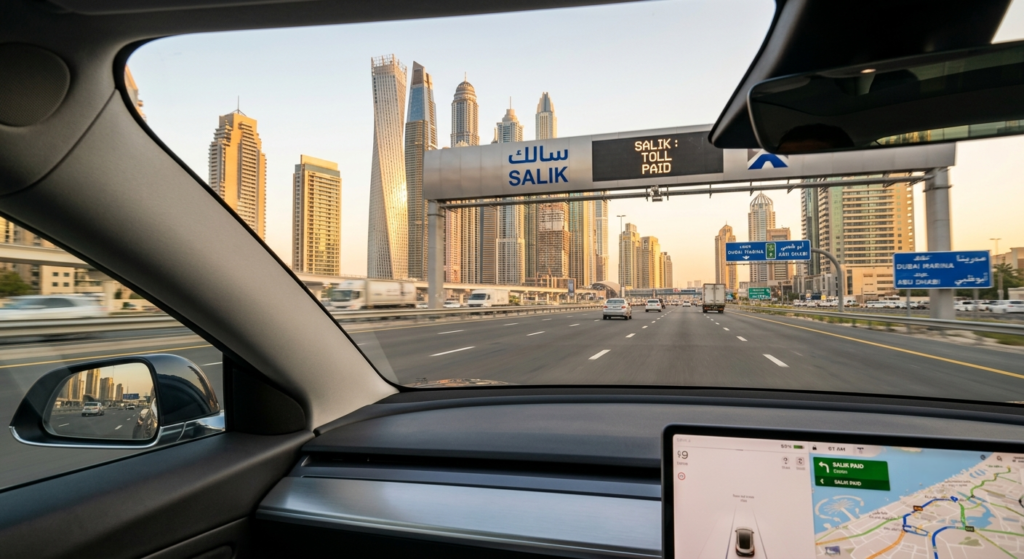
If you’ll be driving in Dubai, you need a Salik account. Salik is Dubai’s electronic toll system — a tag attached to your windscreen that automatically deducts charges as you pass through toll gates. There are currently eight toll gates across Dubai, including key routes like Sheikh Zayed Road and Al Safa.
You can buy a Salik tag at petrol stations, supermarkets, and RTA centres for Dhs50 (includes Dhs18 credit). Manage your account and top up via the Darbi app or at petrol stations. Each toll gate crossing costs Dhs4. There’s no upper daily cap, so commuters on routes with multiple gates can accumulate charges quickly.
12. Register With Your Embassy or Consulate
Many countries offer an overseas registration service that records your presence abroad with your government. It’s not mandatory in most cases, but it’s worth doing — it ensures you receive emergency notifications and travel advisories. It makes things like emergency repatriation or consular assistance much smoother if something goes wrong.
UK citizens register via the FCDO’s “Register your travel or stay abroad” service. US citizens use STEP (Smart Traveller Enrollment Program) at step.state.gov. Most embassies in Dubai also hold regular community events and can be useful contacts for document authentication and notarisation services.
13. Notify Your Home Country
This step is overlooked surprisingly often. Failing to notify relevant authorities when you leave your home country can result in tax complications, student loan overpayments, or benefit overclaims. Requirements vary by country:
| Country | Who to Notify | Why It Matters |
|---|---|---|
| UK | HMRC (tax); Student Finance England/Wales/Scotland (if applicable); DWP (benefits) | Tax residency status; student loan repayment threshold changes abroad; benefit eligibility stops |
| Australia | ATO (Australian Tax Office); Centrelink (if receiving benefits) | Tax residency and potential Medicare levy exemption |
| USA | IRS (still required to file taxes as a US citizen abroad) | US citizens are taxed on worldwide income regardless of residency |
| Canada | CRA (Canada Revenue Agency); provincial health coverage provider | Non-resident status affects tax obligations; provincial health coverage typically lapses after 7+ months abroad |
| EU countries | Local municipality / Einwohnermeldeamt (Germany) / Mairie (France) etc. | Deregistration affects tax residency and EU benefit eligibility |
14. Sort Your Children’s Schooling
If you’re moving with children, school places in Dubai can be competitive — especially at popular British and American curriculum schools. Many have waiting lists. The Knowledge and Human Development Authority (KHDA) regulates and inspects all private schools in Dubai, publishing annual ratings (Outstanding, Good, Acceptable, Weak, Very Weak) that are widely used by parents to compare options.
School fees in Dubai range from approximately Dhs15,000 per year at budget schools to over Dhs100,000 at premium international schools. If your employer offers a school fee allowance as part of your package, confirm the exact amount and which schools it covers before committing. Registration typically requires the child’s birth certificate, previous school reports, passport copies, and Emirates IDs for both parents.
15. Explore Your Neighbourhood — Early
Dubai is enormous and not particularly walkable outside of specific areas. Getting your bearings early makes a meaningful difference to how settled you feel. Spend the first few weekends exploring different neighbourhoods — not just the tourist areas, but the parts of the city you might actually live your life in. Find your local supermarket, your nearest metro station, your go-to breakfast spot. These small anchors matter more than you’d expect in the first few months.
Moving to Dubai FAQs
Typically 3 to 15 working days from the time your biometrics are submitted, depending on ICP processing times. You can track the status via the ICA UAE or myID app using your application reference number. Many services accept the Emirates ID application receipt in the interim.
Yes. Most UAE banks will accept an Emirates ID registration form (the receipt you receive when your biometrics are taken) in place of the physical card. Some banks may require additional documentation in this case. Check with your chosen bank beforehand.
The UAE has no personal income tax. However, your home country’s tax obligations may still apply — particularly for US citizens (taxed on worldwide income) and UK citizens who need to properly establish non-resident status with HMRC. VAT at 5% applies to most goods and services in the UAE. Corporate tax was introduced in 2023 for businesses with profits above Dhs375,000.
Genuinely, yes. Dubai’s population is over 90% expatriates, which means almost everyone has been the “new person” at some point. Fitness communities (running clubs, gyms, CrossFit boxes) are particularly easy entry points. Expat Facebook groups and WhatsApp communities for specific nationalities are active and welcoming. Most people you’ll meet have been through exactly what you’re going through.
Dubai is more expensive than many people expect, particularly for rent. A one-bedroom apartment in a central location (Downtown, DIFC, JBR) typically starts from Dhs80,000–120,000 per year. More affordable options in areas like Deira, Al Nahda, or Al Quoz start from around Dhs40,000. Groceries, dining out, and transport are generally comparable to major European cities, though alcohol (available only at licensed venues) is significantly more expensive.
Visitors can use an international driving permit or a licence from most countries for up to one year. Once you have a UAE residence visa, you’ll need to either transfer your existing licence (if your country is on the eligibility list) or go through the full UAE driving test process. Transfers can usually be done the same day at an RTA driving licence centre.
