


Do not turn a rain journey into a test of nerve. Slow down, leave more room and keep the phone out of your hands. I would postpone a non-essential trip before trust a familiar road covered by water. Getting through once is not evidence that the next driver—or the next minute—will be safe.
For Dubai drivers, rain-related traffic fines are not a single special penalty. The actual offence matters: distracted driving, speeding, failing to give way or ignoring official instructions. This guide separates those categories, corrects several figures in our previous version and explains how to check a recorded fine through official channels. It is general guidance, not a live weather alert or a legal ruling on a particular notice.
The first distinction: headlights are not hazard lights
For normal movement in poor visibility, use appropriate vehicle lighting and follow the current authority instructions. Do not use hazard lights simply to announce that it is raining. They obscure the usual directional signal and do not replace headlights.
Abu Dhabi Police’s published warning about hazard-light misuse distinguishes a genuine road hazard or breakdown from normal driving in fog. It identifies AED 500 and four traffic points for driving in fog contrary to the competent authority’s instructions, and separately for driving in fog without lights.
That distinction matters: our earlier wording presented AED 500 and four points as a universal Dubai rain-hazard-light tariff. The authority source supports the specific fog offences, not that blanket description. Follow the offence named on an actual notice rather than assume every weather-related situation has the same code.
I would keep the decision simple: normal rain driving calls for appropriate lights, extra space and lower speed—not a wall of flashing indicators. A genuine emergency is a different situation and must be handled safely under police instructions.

Phone use and emergency vehicles: the penalties are different
The published government road-safety schedule lists handheld phone use while driving at AED 800 and four points. Photographing the rain is not an exception. Set the route before departure, let a passenger handle updates or check them after stopping somewhere safe and permitted.
For failing to give road priority to emergency, ambulance, police vehicles or official processions, Abu Dhabi Police’s published penalty notice gives AED 3,000, six points and 30 days’ vehicle impoundment. That corrects our earlier AED 1,000, four points and 60-day statement. An older general schedule can retain a superseded entry, so the later specific authority notice is important.
Give emergency crews room without making a sudden unsafe manoeuvre. Do not gather to watch an incident or block access while trying to record it. The objective is to let responders reach people, not merely avoid the fine.
Speeding bands: do not borrow an invented rain table
The Sharjah Driving Institute’s published handbook sets out the following speeding schedule on printed page 136. The figures correct our previous mismatched bands and points. These are published schedule references, not a calculation of anyone’s actual Dubai notice or a statement that a camera tolerance is permission to exceed a sign.
| Excess over the applicable maximum speed | Published fine | Points | Light-vehicle impound period shown |
|---|---|---|---|
| Not more than 20 km/h | AED 300 | None shown | None shown |
| More than 20, not more than 30 km/h | AED 600 | None shown | None shown |
| More than 30, not more than 40 km/h | AED 700 | None shown | None shown |
| More than 40, not more than 50 km/h | AED 1,000 | None shown | None shown |
| More than 50, not more than 60 km/h | AED 1,500 | 6 | 15 days |
| More than 60, not more than 80 km/h | AED 2,000 | 12 | 30 days |
| More than 80 km/h | AED 3,000 | 23 | 60 days |
The table reads the handbook’s overlapping “not more than” entries as consecutive bands. It is not a complete consolidated statement of every later traffic amendment, impound-release charge or court consequence. The current authority record and applicable law determine a specific case.
Follow the live sign and police direction, not yesterday’s familiar limit. Do not add a supposed universal buffer to a temporary weather restriction or transfer another emirate’s enforcement practice to Dubai. A posted maximum is also not a recommendation to maintain that speed when visibility or grip makes it unsafe.
Lane changes need a clear signal and a safe gap; sudden swerving is a different offence from failing to signal. Do not collapse those categories into one generic rain fine. The practical answer is to leave room and plan the manoeuvre early, rather than cut across a queue because the exit arrived sooner than expected.
Floodwater: choose another route, not a slower crossing
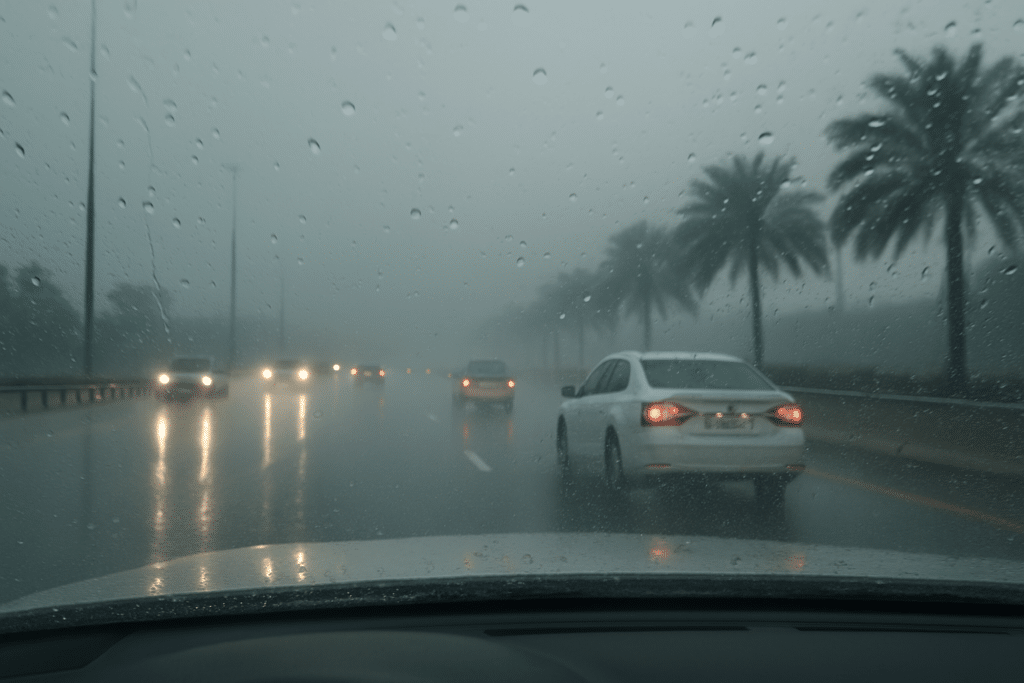
The old advice to drive slowly through standing water was too broad. Dubai’s official emergency-response account records police advice to avoid waterlogged, low-lying areas and valleys during adverse weather. A familiar underpass is not an exception.
I would not use another car as a depth gauge. Its clearance, path and timing can differ from yours. Do not enter a flooded route to find out whether it is passable, and do not move past a closure because a navigation app still draws a line through it.
If conditions deteriorate, prioritise a safe, permitted stopping place and current instructions rather than stopping abruptly in a live lane. For immediate danger in Dubai, call 999; 901 is for non-emergency Dubai Police enquiries. The current police website confirms those contacts.
My before-you-leave check
A two-minute check before setting off is more useful than scrolling through warnings while driving. Use the National Center of Meteorology, Dubai Police and RTA’s current channels for the relevant place and time. An old screenshot without a timestamp is not a live road instruction.
- Decide whether the trip is necessary: a flexible plan is better than a commitment to reach a flooded destination.
- Check the route and return: closures can affect the journey back as well as the outbound road.
- Check the car: tyres, pressures, lights, wipers and demisting must be ready. Have faults assessed before driving.
- Set navigation before moving: share changes with a passenger, not a phone held at the wheel.
- Leave more time and space: reduce speed smoothly and avoid abrupt braking or acceleration. No fixed following-time figure guarantees safety in every downpour.
Police wet-weather guidance supports slower driving, greater separation, gradual braking and maintenance of tyres, brakes and wipers. Its dated weather description is historical; the safety principles are not evidence that a storm is happening today.

Black points, impoundment and release charges are separate
Paying a monetary fine does not by itself prove that every associated restriction has been resolved. Check the recorded points, any impound requirement and the status of the licence or vehicle through the responsible authority. Do not assume that every serious offence has the same period or that a payment screen settles a court matter.
Dubai Police’s explanation of the 2023 impound amendments distinguishes release charges from the federal traffic-violation fine. That is why a high figure in a headline should not be substituted for the base fine—or ignored because a different figure appears in a general list.
If you are close to a points restriction, have an impounded vehicle or face an injury-related case, obtain the current position from the authority and qualified legal help where needed. This article does not give a personalised suspension timetable.
How to check and pay a Dubai traffic fine
Start at Dubai Police or the official RTA website and navigate to the relevant fine enquiry/payment service. RTA’s published enquiry supports plate details, licence number, fine number or traffic code. Some pages require JavaScript or authentication; an inaccessible result in a search preview is not proof that you have no fines.
- Match the record: issuing authority, fine number, date, location, vehicle details and offence.
- Read the full consequences: amount, points, impound or any restriction shown—not only the headline total.
- Resolve a discrepancy before paying blindly: ask the authority about the appropriate objection process if the record is wrong.
- Use the official payment journey: check the details and final total before authorising anything.
- Keep the receipt: retain the reference and verify the updated status. A successful card debit is not a substitute for an official payment record.
I would not wait for a promised “rain discount.” This review did not establish a universal early-payment discount or grace period for Dubai weather-related offences. A campaign elsewhere—or an unsolicited message offering a reduction—does not establish eligibility here.
Illustrative administrative scene, not a screenshot of the Dubai Police, RTA or prosecution service. Use the official links for the actual process.
If you believe the fine is wrong
Record the factual disagreement first. Is the plate wrong, the location inconsistent, the offence misidentified or the vehicle not yours? Keep the notice, registration information and any relevant original evidence. Do not create or alter evidence to fit an explanation.
For a Dubai Police fine, ask 901 or the issuing authority to confirm the current objection route and requirements. Dubai Public Prosecution has an official website, but its service page could not be retrieved during this check. We therefore do not promise an exact button sequence, submission language, deadline or guaranteed decision time.
Do not transfer an RTA public-transport grievance process or another emirate’s appeal route to a Dubai driving offence. Ask whether payment affects the available objection procedure before acting. A request for review is not a guaranteed cancellation or reduction.
For a useful enquiry, prepare the fine number, issuing authority, vehicle details and a short factual account of the error, with supporting records. If an agent acts for you, ask what authority to act is required. Share identity documents only through the verified service or adviser’s agreed secure process.
When I would seek professional help
A serious collision, injury, prosecution, disputed impoundment or licence restriction is not something to solve with a generic online template. Choose a properly licensed UAE legal professional with relevant experience, confirm the scope and fees, and provide the original documents. Do not pay someone who guarantees a fine will disappear.
For an ordinary record query, start with the authority. For a legal case, get advice on that case. Those are different levels of help and neither should be sold as a shortcut around the rules.
The practical verdict
The best rain-driving decision is often to make the journey less ambitious. Slow down, keep the lighting and signals clear, avoid floodwater and leave emergency crews room. If a fine arrives, identify the actual offence and use the official record—not a viral table—to decide the next step.
Verification scope: published authority penalty notices, the government road-safety schedule, the driving-school handbook’s relevant table, official Dubai safety communications and public service entry points, checked on 19 October 2026. No live weather, personal fine, logged-in appeal submission or complete consolidation of all current traffic legislation was reviewed. This is general information, not legal advice.


