


I would choose a crypto provider by checking how I can get money out, not by how quickly its app lets me buy. For a UAE beginner, the useful starting points are the exact licensed entity, the service it can offer your customer category, the full cost and the withdrawal route. A polished app and a local flag do not answer those questions.
This guide compares three checkable Dubai records: Binance FZE, OKX Middle East Fintech FZE and BitOasis Technologies FZE. All three showed active VASP licences in VARA’s register on 19 October 2026. Their permissions are not identical. This is a researched comparison, not a hands-on app test, a recommendation to invest or an award for the “safest” exchange. Virtual assets can lose their entire value.
My starting point: verify the entity before comparing the app
Use VARA’s live public register to match the legal name, licence reference, linked website, status and conditions to the account agreement. An in-principle approval is not a full licence: VARA expressly prohibits IPA holders from starting operations or servicing clients before obtaining it.
VARA covers Dubai’s mainland and free zones except DIFC. DIFC’s DFSA framework and ADGM’s FSRA framework are separate. Do not treat a familiar brand or an approval in one jurisdiction as permission for every product offered globally.
I would close a promotional page that could not tell me which entity takes my money. I would also check the conditions, not just the green “Active” label. A provider’s permission to offer a product to qualified investors is not permission to offer it to every retail customer.
Three records, three questions worth asking
| Legal entity and current record | What matters in the conditions | The question I would ask |
|---|---|---|
| Binance FZE, VL/24/04/001, Active | Exchange, broker-dealer, management/investment and lending/borrowing activities. The record permits retail service generally, but its margin and derivatives conditions specify institutional and qualified investors. | Which products are available under my actual entity and customer classification? |
| OKX Middle East Fintech FZE, VL/23/12/003, Active | Exchange, broker-dealer, management/investment and lending/borrowing activities. Margin and derivatives conditions include retail; collateral optimisation is restricted to institutional and qualified investors. | Which permissions apply to this product, and why would I need it rather than a simple spot transaction? |
| BitOasis Technologies FZE, VL/2024/11/001, Active | Broker-dealer activity, with institutional, qualified and retail clients permitted. Do not relabel that as an exchange-services licence. | How is my quote determined, what will settle, and what will it cost to withdraw? |
These are selected examples with verifiable records, not the entire UAE market. A licence supplies oversight of permitted activity; it does not promise returns, eliminate fraud or custody risk, or prove that an app’s interface is easy to use. I would not give a five-star safety score without evidence capable of supporting it.
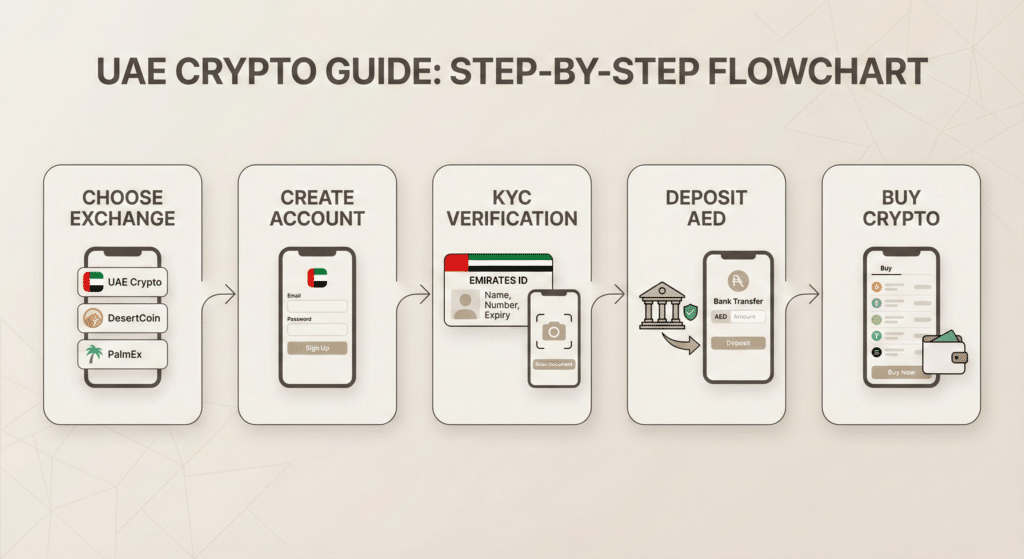
Illustration warning: the retained flowchart below contains example-looking provider names that are not verified recommendations in this guide. Its screens and ID drawing are not official onboarding instructions. Use the real entities and register links above, not the names inside the graphic.
AED funding: “easy deposits” is only half the story
I would check funding and withdrawal as a pair. Before transferring anything, establish whether the account supports AED, whether the bank account must be in your name, what references or deposit instructions are required, and whether withdrawals have a minimum. A platform-level claim is not confirmation that your own account is eligible.
OKX: the bank verification step matters
OKX’s UAE withdrawal guidance, updated 2 September 2026, states a minimum AED200 cash withdrawal and no OKX withdrawal-process fee. It requires a verified receiving bank account; first-time verification can require a cash deposit from that same account.
The published processing estimate is up to three business days for AED50,000 or less and up to five above that, with delays possible. Read the payment-method screen for account-specific limits and charges. A free withdrawal process is not proof that trading, conversion, your bank or crypto-network transfers are free.
That verification dependency is the detail I would settle before buying. Discovering it only when you want cash back is an avoidable problem. The help page does not establish that this magazine has completed a withdrawal or measured its actual speed.
BitOasis: resolve the fee inconsistency before funding
BitOasis’s wire-deposit instructions list UAE AED wire and card deposits as operational. They say the platform does not charge for wire deposits, while your bank may charge separately. Follow the current in-account details and create the required deposit voucher before transferring; do not reuse bank details from an old screenshot.
Its cash-withdrawal guide requires a personal bank account and gives a minimum AED200 excluding fees. But the page is internally inconsistent: its fee table says AED25 up to AED25,000 and AED65 at AED25,000 and above, while a later example still uses an AED10 fee. The two bands also overlap at exactly AED25,000.
I would get the live withdrawal quote or written clarification before relying on either figure. I will not silently choose the most attractive number and call it verified. Ask for the fee, total balance needed, expected settlement and the rule at the boundary amount for your actual withdrawal.
Binance: distinguish the FZE bank route from the discontinued ROMA channel
Binance’s AED withdrawal FAQ publishes an ADCB bank-transfer route for customers onboarded to Binance FZE: an AED10 withdrawal fee and AED11 minimum. The receiving account must be in your own name; the guide allows adding a new own-name account even without a previous deposit. Eligibility and the actual payment screen still matter.
Do not confuse that route with the ROMA buy/sell channel that ended on 12 September 2026. The notice covers that AED channel for USDT and USDC, not a blanket closure of every AED bank transfer. It directs eligible users towards Binance Dubai FZE for AED deposits and withdrawals. I would identify the entity and channel before following an old tutorial.
The cash-out comparison I would save before opening an account
| Provider and published AED cash-out route | Minimum and provider withdrawal fee | What I would resolve first |
|---|---|---|
| Binance FZE, ADCB bank transfer | AED11 minimum; AED10 fee | FZE onboarding, own-name receiving account and the current payment screen. |
| OKX, UAE bank transfer | AED200 minimum; no OKX withdrawal-process fee | Receiving-bank ownership verification, including any first deposit required from that account. |
| BitOasis, personal bank account | AED200 minimum excluding fees; published fee figures conflict | A written fee or live quote, total balance needed and the exact AED25,000 boundary. |
For a small balance, I would compare the exit minimum before the trading percentage. A low trading charge is no help if your intended cash withdrawal falls below the published minimum. These are provider cash-withdrawal terms checked on 21 October 2026, not an all-in trading-cost or safety ranking. Bank charges, conversion costs, account restrictions and changes to the terms can still affect the result.
Illustration warning: the shield below is decorative, not a government badge, insurance certificate or proof of “ultimate protection”. Licensing and account security do not remove investment losses.

Compare the amount received, not just the trading fee
A small advertised trading percentage does not settle the total cost. Compare the same asset, payment route, order amount and destination at approximately the same time. Record the executable quote, separately charged fees, net asset quantity and any cost of moving it to the intended destination.
Here is a hypothetical comparison, not a provider quote: with a total budget of AED1,000, Offer A leaves AED990 available for the asset and quotes AED300,000 per unit. That buys 0.0033 units before any further withdrawal deduction. Offer B leaves AED995 but quotes AED305,000 per unit, buying about 0.0032623 units. The smaller explicit fee did not produce more asset.
The amounts and prices above are invented to demonstrate the method, not market forecasts or tax rates. Use the final quoted amount for an instant-buy product and the actual fill for a trade. Never add a fee twice if it is already included in the displayed total.
| Record before confirming | What it answers |
|---|---|
| Total AED leaving your bank or card | What the purchase really costs, including separately imposed payment charges. |
| Asset quantity credited | What remains after the purchase quote and trading charges. |
| Cash-out or crypto-withdrawal minimum and fee | Whether the intended exit is possible and proportionate to the amount. |
| Network and receiving requirements | Whether a transfer can reach the intended destination without a network or memo mismatch. |
| Quote time and validity | Whether two comparisons are contemporaneous or reflect a changed market. |
I would prefer a plainly explained total to a page full of “zero fee” headlines. If support cannot explain the charge or the amount you receive, do not rush into a transfer to find out.
If you have already narrowed the question to Bitcoin, use our BTC buying workflow to compare the net quantity at the same destination and separate the order from the custody choice. If the asset, network and wallet are still getting mixed together, start with the crypto concepts guide before comparing accounts. Neither route requires you to make a purchase.
Illustration warning: CoinFlow Pro, Emirates Crypto Hub and GulfChain Secure in the graphic below are not verified licensed providers in this comparison. Its regulatory and security badges must not be used as evidence. The sourced table above names the real records checked.
Buying is not the same as understanding the order
I would choose an order type by what it controls, not label one automatically “ideal for beginners”. A market order prioritises execution against available liquidity, not a guaranteed displayed price. A limit order controls the price boundary but may not fill. Coinbase’s order-management explanation describes slippage; this is an explanation of mechanics, not a recommendation to use Coinbase in the UAE.
For a buy limit order, state the maximum acceptable price and read the order’s duration and execution settings. Do not assume seeing the market touch a number guarantees your complete order fills. A simple instant-buy quote is a different product again: read the amount, expiry and charges before accepting it.
I would leave leverage, derivatives, borrowing and yield products out of a beginner’s first comparison. Availability is not suitability. Nor would I recommend buying several tokens as an automatic diversification solution: different crypto assets can still expose you to shared market and platform risks.
Security: protect the account without inventing a guarantee
Use a unique password and enable strong additional authentication supported by the provider. The UK National Cyber Security Centre recommends two-step verification because it makes unauthorised access harder even if a password is known. Protect the email account used for recovery too.
Reach support through the verified app or website, not a stranger’s message. Do not give another person recovery phrases, passwords or one-time codes. If a purported support agent insists on a transfer to “unlock” funds, stop and verify through the provider’s official channel.
I would also ask who controls the keys, which entity holds the assets, what withdrawal restrictions apply and what happens during an outage or insolvency. Self-custody changes responsibility; it does not remove the risk of lost keys or an incorrect transfer. “Cold storage” and a proof-of-reserves claim are not, by themselves, a guarantee that every liability is covered or that your loss is insured.
For any claimed insurance or protection fund, ask for the named cover, beneficiary, limits, exclusions and claim route. Do not assume a platform’s fund reimburses price losses or every customer incident. A security audit also needs a date, scope and named assessor before it is useful evidence.
Illustration warning: the following ecosystem diagram overstates “protected assets”, low fees and easy local transfers. Those depend on actual provider and account terms; KYC and 2FA do not guarantee asset safety.
A first-account checklist that includes the way out
- Identify the entity: save the relevant register entry and account agreement, including customer-category and product restrictions.
- Check eligibility: read the current identity, residency, source-of-funds and bank-account requirements. Do not upload documents to an unverified link.
- Secure access: configure authentication and recovery before funding, and record the official complaint route.
- Price the whole process: note deposit, purchase, custody where applicable, sale and intended withdrawal costs and minimums.
- Understand the transaction: confirm asset, amount, order type and final quote. Do not assume a buy button implies an appropriate investment.
- Plan the exit: establish bank verification or receiving-wallet requirements before committing money.
- Keep records: retain quotations, statements, fees, transaction references and support replies. If you choose to transact, use only money you can afford to lose; a small test can check a process but cannot prove future safety.
My preferred support enquiry is: “I am a UAE retail customer under [entity]. Please confirm the permitted service, AED funding method, full purchase cost and quantity, cash-withdrawal minimum and fee, receiving-bank verification, and complaint process. Is any relevant restriction specific to my account?”
If Sharia compliance matters to you, obtain a current, attributable assessment covering the particular asset, service and transaction structure. A logo on an illustration does not establish it, and this magazine has not carried out a religious certification.
Illustration warning: the two phone screens below are not verified app screenshots or a Sharia certificate. Their rising graph is not evidence of returns.
If a deposit or withdrawal goes wrong
First save the details: account entity, amount, date, transaction reference or hash, destination or beneficiary, quoted processing time and support case number. Raise a clear complaint with the provider rather than send repeated transfers to solve the first one.
VARA’s complaint page says complaints about licensed VASPs should first be raised with the company. It accepts reports of potential regulatory breaches and unauthorised activity within its remit; fraud may also require a consumer complaint or police report. A submission is not a promise of reimbursement or a guaranteed resolution time.
My verdict: the exit route beats the slickest buy button
The provider I would investigate first is the one that can clearly document the entity, complete cost and withdrawal route for the account I can actually open. Not the one with the largest menu of tokens or the loudest reassurance about safety. An unresolved withdrawal fee is a reason to ask another question, not a detail to ignore.
Binance, OKX and BitOasis have distinct checkable permissions. The practical comparison still needs your live quote and account terms. There is no evidence in this review for declaring one universally safest, and no need to pretend otherwise to give readers a useful decision process.
Continue with our UAE crypto tax guide, staking explanation and cryptocurrency coverage for separate issues that an exchange licence does not settle.
Scope and risk: researched on 19 October 2026 using regulator records, published funding and withdrawal terms and order/security guidance. The three regulator records and selected payment terms were rechecked on 21 October; the cash-out comparison adds Binance’s published FZE route and distinguishes the discontinued ROMA channel. Five retained body graphics and the hero were viewed; they are not verified product evidence. No account opening, app usability test, executed trade, withdrawal-speed measurement, audit or professional financial/legal advice is claimed. Virtual assets are highly volatile and can result in total loss. This is information, not an invitation to invest.
Frequently asked questions
How do I check whether a crypto provider is licensed in Dubai?
Match its exact legal entity to VARA’s public register, confirm the status and permitted activities, and distinguish a full VASP licence from in-principle approval. DIFC has a separate regulator.
Does a licence make buying crypto safe?
Licensing provides oversight of permitted services. It does not guarantee investment returns, prevent price losses or eliminate custody, fraud and platform risks.
Which providers are examples in this guide?
The guide compares the register entries for Binance FZE, OKX Middle East Fintech FZE and BitOasis Technologies FZE. Their permitted activities differ; verify the live records and your account terms.


