
A lower regulatory barrier is not a promise that a bank will lend you money. UAE reporting in November 2025 described the removal of the former AED 5,000 salary floor, while banks retained their own criteria. The useful question now is which specific product matches your salary, nationality and employer—and whether its repayments leave you enough to live on.
I would start with the eligibility conditions, not the maximum loan in the advertisement. The October 2026 check still finds a starting AED 3,000 salary on DIB’s page and AED 5,000 on Emirates NBD’s. Mashreq now lists AED 5,000 for approved companies and AED 8,000 for unapproved companies, correcting the older AED 10,000 figure in this guide. None of those thresholds is an approval decision.
Bank criteria rechecked: 19 October 2026, with retrieval limitations recorded below. This independent guide is general information, not individual financial advice or a promise of approval. It has no bank referral links.
What changed — and what did not
| Question | Answer in 2026 |
|---|---|
| Is there a single CBUAE minimum salary? | No. The former AED5,000 universal floor was removed in November 2025. |
| Can banks still set a minimum salary? | Yes. Each lender sets product and risk criteria. |
| Does AED3,000 guarantee a personal loan? | No. Some official pages advertise products starting at AED3,000, but nationality, employer, service, credit and affordability rules still apply. |
| What is the regulatory maximum loan? | Up to 20 times verified salary or regular income; this is a ceiling, not an entitlement. |
| What is the usual maximum term? | 48 months is the standard Article 2 personal-loan limit; specific exemptions and product categories need separate checking. |
| What is the maximum debt-burden ratio? | Total monthly repayments across relevant debts must not exceed 50% of gross salary and verified regular income. |
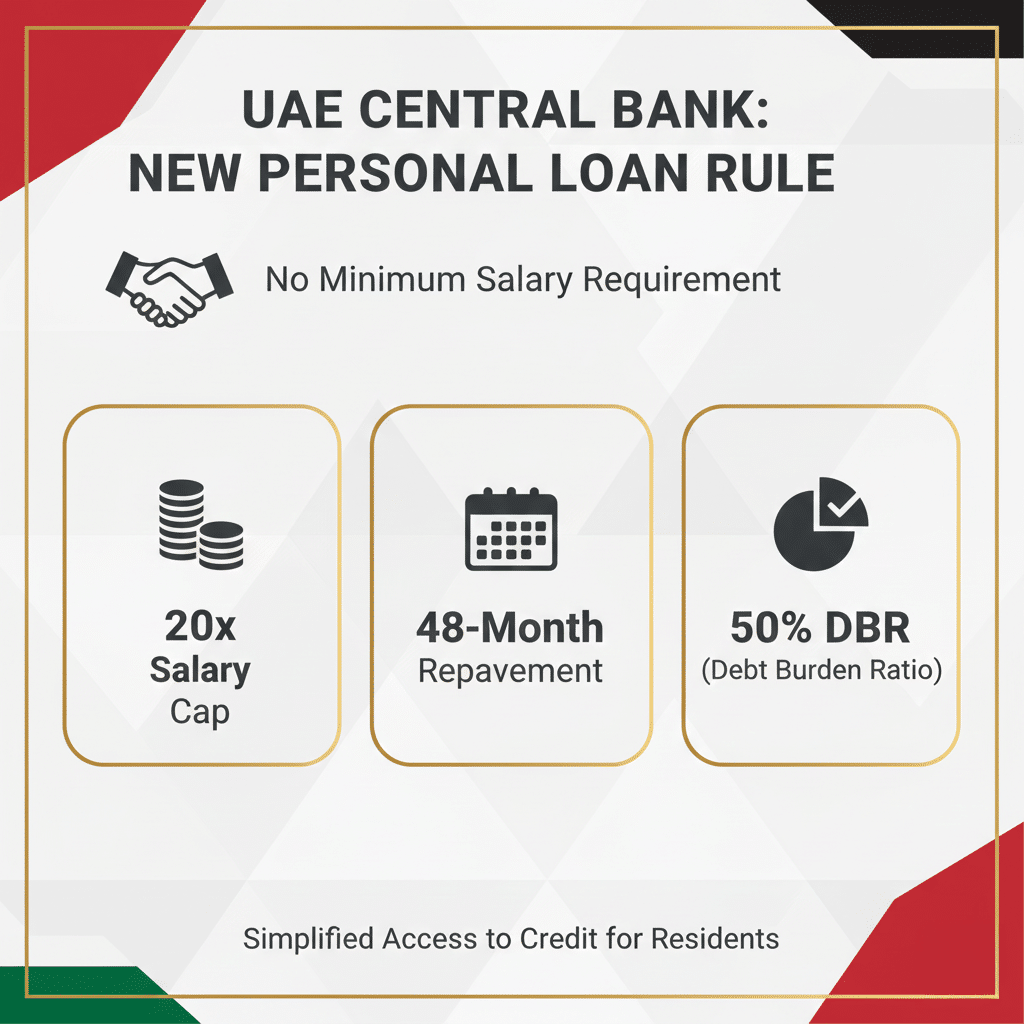
The change was reported in November 2025 by UAE media including Gulf News and Khaleej Times, which also quoted the UAE Banks Federation chairman stressing that not every worker would qualify. The public CBUAE rulebook confirms the enduring 20-times-income, 48-month and affordability limits; it does not publish a promise that lower-salary applicants must be approved.
Current UAE personal-loan salary requirements by bank
This is a sample of product criteria, not a recommendation to borrow or a ranking of the best bank. I would eliminate products whose nationality or employer conditions do not fit before comparing rates. Otherwise the lowest salary number can send you towards an offer you cannot use. Dates and retrieval limitations are recorded separately rather than presenting every row as equally current.
| Bank / product | Salary position checked | What I would establish before applying |
|---|---|---|
| Dubai Islamic Bank personal finance | 19 October: starting minimum AED 3,000. | The page also retains an AED 15,000 transferred-salary footnote. Ask which offer and conditions apply to your profile rather than assume every benefit is available at the starting salary. |
| RAKBANK UAE National personal loan | Previous 29 July check recorded AED 3,000; current eligibility text was not retrievable. | This is a UAE-national product, not an expatriate offer. Reconfirm the current salary, employer and service conditions with the bank; the older figure is not presented as newly verified. |
| Mashreq personal loan | 19 October: AED 5,000 approved company; AED 8,000 unapproved company. | The page requires confirmed employment or at least six months with the current employer. Confirm the exact offer, transfer conditions and charges. |
| Emirates NBD personal loan | 19 October: AED 5,000. | The support page specifies an approved employer. Salary alone does not satisfy that requirement; check the documents and product terms. |
| FAB selected products | 19 October: AED 10,000 for non-listed-company and new-to-country/employment products; AED 7,000 for the landlord product. | These are distinct products. A rental-income offer is not the same as an ordinary salary loan, and an advertised maximum is not your assessed limit. |
What this comparison shows: the lowest published starting point in this sample is AED3,000, not zero. Even that figure is tied to a specific lender and product. There is no credible basis for telling every person earning AED2,000 or AED3,000 that a loan is now available.
Can you get a UAE loan on AED2,000, AED3,000 or AED5,000?
On an AED2,000 salary
The regulatory floor no longer blocks consideration, but this review did not find a mainstream UAE personal-loan page promising eligibility at AED2,000. Do not pay an agent an advance fee based on “guaranteed approval.” Ask a licensed bank or finance company for a written product link and Key Facts Statement.
On an AED3,000 salary
DIB’s page advertises a starting salary of AED 3,000. RAKBANK’s earlier UAE-national threshold is preserved in the table as a dated reference, not a newly retrieved October criterion. I would ask the bank to identify the exact product and requirements in writing before treating either headline as a route to credit. Salary, employer classification, service, existing commitments and the lender’s assessment still matter.
On an AED5,000 salary
More public options appear at this level, including Emirates NBD and Mashreq’s approved-company criterion. The lender may still reject an application because of employer classification, short service, an adverse credit record, existing repayments or an internal affordability assessment.
The three Central Bank limits, correctly understood
1. Up to 20 times income
Article 2 of the CBUAE rulebook caps a personal consumer loan at 20 times salary or verified regular income. On AED5,000 gross income, that creates a regulatory ceiling of AED100,000. It does not say the bank must lend AED100,000. Interest, age, term, other debts and bank policy can reduce the approved principal substantially.
2. Up to 48 months
The standard Article 2 personal-loan limit is 48 months; do not turn that into a claim that every specialised financing arrangement has an identical term. Mashreq and FAB, for example, describe separate Ministry of Defense employee terms on their pages. Ask which product and applicable rules govern the proposed offer. A longer term can reduce an instalment while increasing total cost.
3. A 50% debt-burden ceiling
Article 7 says deductions for all relevant bank and finance-company debts, including credit-card commitments, cannot exceed 50% of gross salary and verified regular income. On AED5,000, the ceiling is AED2,500 across the covered repayments—not AED2,500 available for one new loan.
Retirement changes the calculation. The regulations’ repayment provisions describe reducing deductions to 30% of income or pension when repayment extends into retirement. I would have the lender explain the retirement-date treatment before accepting a schedule that crosses it, rather than apply the general 50% illustration blindly.
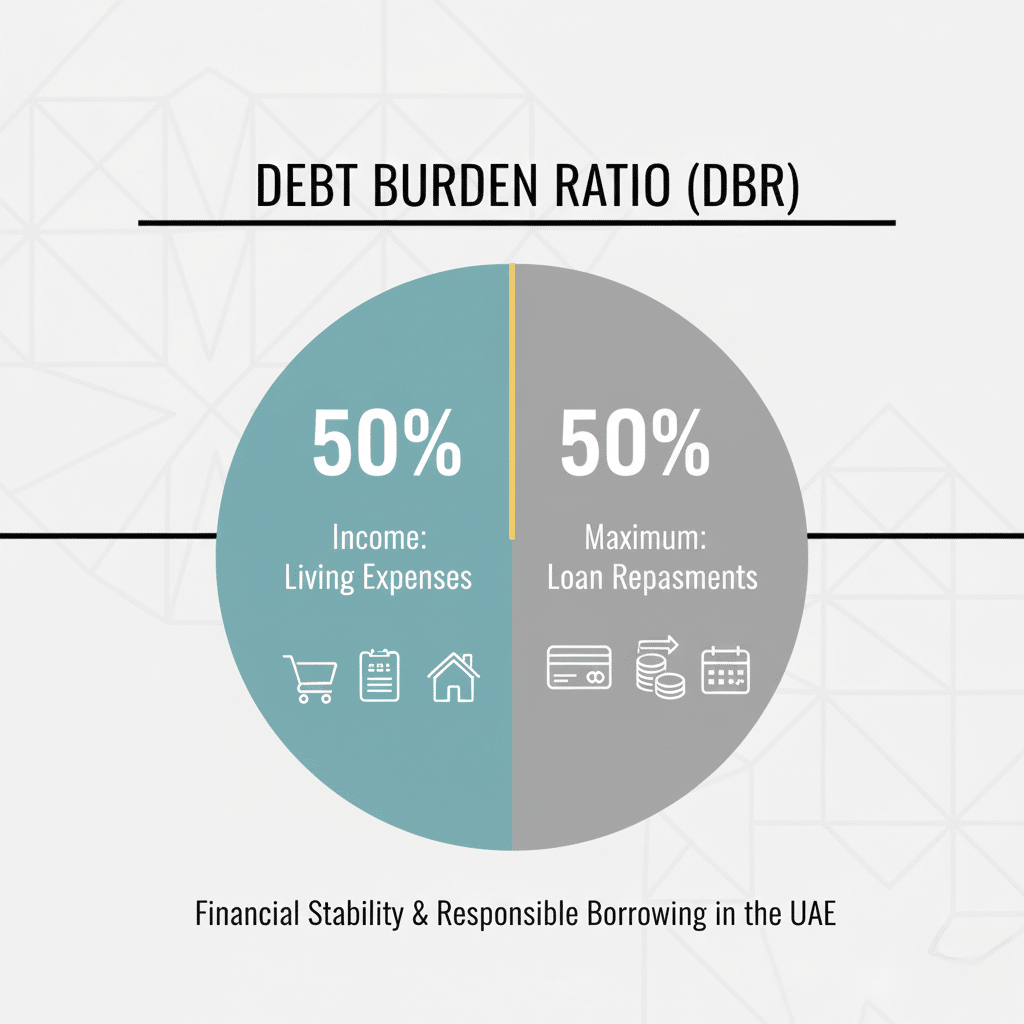
The CBUAE’s Consumer Protection Standards, sections 7.1.1 and 7.1.5, require ability-to-pay assessment, credit-risk controls and buffers for expenses and contingencies. I would treat that distinction seriously: fitting beneath a regulatory ceiling is not the same as being able to repay comfortably. The lender’s assessment is not replaced by the diagram above.
The affordability question I would ask first
Consider a purely illustrative AED 5,000 gross monthly salary with AED 900 in existing covered repayments. Applying the general 50% ceiling gives AED 2,500 overall and a theoretical AED 1,600 left beneath that ceiling. It does not establish an available new-loan instalment or an affordable household budget.
Now assume the same person spends AED 3,100 on essentials before taking on another loan. Salary minus those essentials and the existing AED 900 leaves AED 1,000 before unexpected costs. That is less than the AED 1,600 theoretical regulatory headroom. These invented numbers show why I would work from real expenses first; they are not a recommended instalment, an approval simulation or a calculation of every credit-card obligation.
For a useful bank enquiry, I would ask: “For my salary, nationality, employer and existing commitments, which exact product is applicable? Please provide the Key Facts Statement, full repayment schedule, all charges, net cash disbursed and any retirement or salary-transfer conditions before I apply.” That gets closer to a decision than asking only how much the bank will lend.
Does WPS guarantee eligibility?
No. WPS can help establish that salary is being paid through an authorised channel, but it is not collateral and it does not oblige a bank to lend. Several current bank pages still ask for a salary certificate, employer transfer letter, bank statements or an approved-employer relationship.
The earlier version of this guide described WPS as the foundation of the new loan framework and implied that it replaced traditional documents. That went beyond the evidence. Treat WPS as one possible income record, not a universal approval mechanism.
What banks actually check
- Verified income: salary and any documented regular income.
- Debt burden: loans, cards, overdrafts and other commitments visible to the lender.
- AECB record: repayment history, applications and existing facilities.
- Employer and service: approved-company status, probation and time in the job can affect the product offered.
- Age and residency: limits differ for UAE nationals and expatriates and may change near retirement or visa expiry.
- Disposable income: meeting a 50% ceiling does not prove the remaining income is sufficient.
- Bank relationship: salary transfer, account history or an existing relationship may be required.
How to compare offers without being misled
- Open the bank’s own current product page—never rely only on an agent’s message.
- Request the Key Facts Statement before signing or paying a fee.
- Compare the annual percentage rate or reducing-balance cost, not only a low “flat” headline rate.
- Add processing fees, insurance or takaful and any account charges to the comparison.
- Check the total amount repayable and the cost of early settlement or late payment.
- Ask whether salary transfer, an approved employer or a minimum service period is mandatory.
- Do not submit many speculative applications at once; repeated credit enquiries can be visible in your credit record.
If repayment already feels tight before the loan, the removal of a salary floor does not make borrowing safer. CBUAE’s 50% DBR protects against one form of overextension; it does not account for every household’s rent, remittances, dependants or emergency needs.
A small-loan fee check worth doing
FAB’s retrieved page lists a one-time processing charge of 1.05%, with a minimum AED 525 and maximum AED 2,625, including VAT. On a hypothetical AED 20,000 eligible loan, 1.05% is AED 210, so that stated minimum would make the charge AED 525 instead. That is 2.625% of the principal upfront—not an annual percentage rate.
I would ask whether a fee is deducted from the cash released or paid separately, then compare net proceeds with the total repayment obligation. FAB also notes that life-insurance costs may apply. A lender’s advertised interest rate alone does not describe the whole cost, and this example is not confirmation that FAB will approve an AED 20,000 loan for a particular applicant.
The bottom line
My conclusion: ignore “loans for everyone” headlines and demand a product-specific answer. The November 2025 reporting described wider scope for banks to consider applicants, not a right to credit. The strongest next step is a written eligibility and cost check from a licensed lender—not an advance payment to an agent promising approval, and not borrowing the maximum simply because it appears on a calculator.
How this guide was checked: Bank pages were rechecked on 19 October 2026. DIB’s page was read directly after the browser fetch timed out; its mixed salary wording remains qualified. Mashreq, Emirates NBD and FAB criteria were retrieved; RAKBANK’s dynamic eligibility text was unavailable, so its older check is clearly dated. The reported 2025 floor removal is attributed to the linked contemporary reporting, not an unpublished circular obtained by this magazine. Current indexed rulebook text supports the standard caps and retirement distinction; direct rulebook retrieval returned 403. The separate CBUAE Consumer Protection Standards PDF was retrieved and its relevant financing sections read. Two body graphics and the hero were viewed and preserved as editorial illustrations, not actual approval evidence. Original author, date, indexing and canonical settings remain unchanged. No personal application, lending decision, professional financial review or individual affordability advice is claimed.