In an era where the lines between traditional finance and decentralised innovation blur, Sui Group, a Nasdaq-listed company formerly known as Mill City Ventures, has made a bold pivot. Their strategic redirection towards the leading Sui network culminates in the launch of SuiUSDE, a new yield-earning stablecoin poised to redefine the ecosystem. This move is…
In an era where the lines between traditional finance and decentralised innovation blur, Sui Group, a Nasdaq-listed company formerly known as Mill City Ventures, has made a bold pivot. Their strategic redirection towards the leading Sui network culminates in the launch of SuiUSDE, a new yield-earning stablecoin poised to redefine the ecosystem. This move is not just an expansion but a fundamental shift, aiming to transform the SUI token’s economic model and provide a novel pathway for sustainable DeFi yield.
This article explains the structure of suiUSDe, its relationship to Ethena and SUI Group, and the announced use of income for SUI acquisitions. It separates the synthetic dollar’s peg mechanism from any yield-bearing vault and from the value of the native SUI token or the company’s shares. Those distinctions matter because the assets have different rights and risks. A revenue-generating backing strategy does not automatically guarantee a payout to every holder, and a purchase programme does not prove that the network’s circulating supply falls or the token price rises. The relevant evidence includes the launch announcements, product terms, supply schedule and dated corporate filings, rather than a promise of sustainable returns.
Understanding SuiUSDE: Powering DeFi Yield with Ethena’s Innovation
Sui and SUI Group announced suiUSDe in October 2025, while the company’s later filing and Sui’s February 2026 update describe the eSui Dollar launch on Mainnet. That chronology is more precise than calling it an entirely new 2026 proposal. The product is a synthetic dollar powered by Ethena infrastructure, with a model involving backing assets and hedging positions. Its dollar target, any yield strategy and the SUI acquisition policy are separate features. The October 2025 announcement describes net income, after costs, being used within the ecosystem to acquire SUI. That should not be presented as an independently verified, fixed 90% fee distribution without the applicable current terms and accounting evidence.

What is SuiUSDE and How Does it Work?
SuiUSDE is a yield-earning stablecoin carefully crafted for the Sui network. Its fundamental purpose extends beyond merely maintaining a stable peg; it aims to generate substantial revenue for the Sui ecosystem while simultaneously driving value back to the native SUI token. By providing a stable, high-yield asset, SuiUSDE seeks to attract significant capital, thereby increasing liquidity and activity within the Sui blockchain. This initiative is a cornerstone of Sui Group’s ambitious 2026 strategy, which prioritises the acceleration of the Sui network’s growth and the establishment of a genuinely deflationary tokenomics model for SUI. For those asking, “What is SuiUSDE?” it is, in essence, a strategic financial instrument designed to fuel the Sui network’s economic engine.
The Ethena White-Label Advantage: Proven Technology on Sui
Ethena’s infrastructure underpins the synthetic-dollar approach described in the Sui announcement. A synthetic dollar uses backing assets and offsetting derivative exposure rather than simply promise that each unit is a conventional insured bank deposit. Reusing technology does not remove funding, counterparty, custody or operational risks; it also does not mean every branded implementation has identical terms. Avoid judging the mechanism by an undated market-cap figure or a promotional description such as “battle-tested”. The useful questions concern the specific backing and hedges, who operates them, how redemption works, which costs apply and what happens under stress. The protocol documentation is a starting point for understanding that model, while the actual product’s terms determine a holder’s rights.
SuiUSDE’s Core Mechanics: Fee Channelling and Buyback Strategy
The announced model links income from the synthetic-dollar infrastructure to ecosystem activity and SUI purchases. The original Sui announcement describes net income after costs; a percentage of gross fees and a percentage of net income are different measures. Readers should identify which measure a statement uses, who receives it and how costs are calculated. A policy to purchase SUI is also different from a contractual yield paid to every token holder. Check the exact vault or product terms if seeking rewards: holding a dollar-targeting token does not automatically establish the same return as a separate yield-bearing position. The economic result depends on the backing, hedges, market conditions and actual execution of the policy.

SUI’s Deflationary Future: Strategic Buybacks and Tokenomics
SuiUSDE is more than just a stablecoin; it’s a strategic lever for enhancing SUI’s long-term tokenomics. By integrating a systematic buyback mechanism funded by SuiUSDE’s generated fees, Sui Group is actively cultivating a deflationary environment for the SUI token. Stephen Mackintosh articulated this vision, stating that “SUI’s deflationary tokenomics and higher yield give the company ‘a very compelling long-term setup'”. This strategy directly counters the inflationary pressures often seen in rapidly expanding ecosystems, positioning SUI for sustained value appreciation.
The SUI Buyback Mechanism: Fueling Scarcity and Value
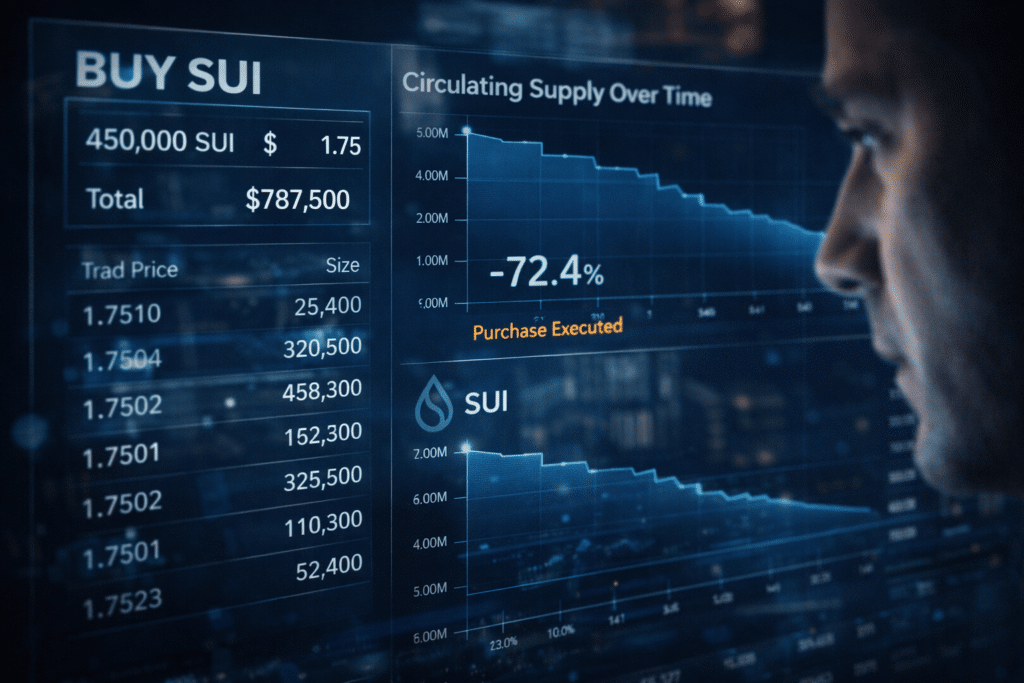
A SUI acquisition policy can create buying demand, but a buyback is not automatically a burn. Purchased tokens may be held, used or later transferred according to the relevant policy. To assess supply effects, distinguish tokens permanently removed from supply, tokens moved into a treasury, released allocations and rewards entering circulation. An announced programme alone does not establish the size, frequency or completed volume of purchases. The primary October 2025 announcement provides a description of the intended net-income mechanism; current execution needs dated records. Neither acquisitions nor a capped eventual supply guarantees a higher market price, because demand, liquidity and other supply changes can move in the opposite direction.
SUI’s Capped Supply and Fee-Burning: A Deflationary Advantage
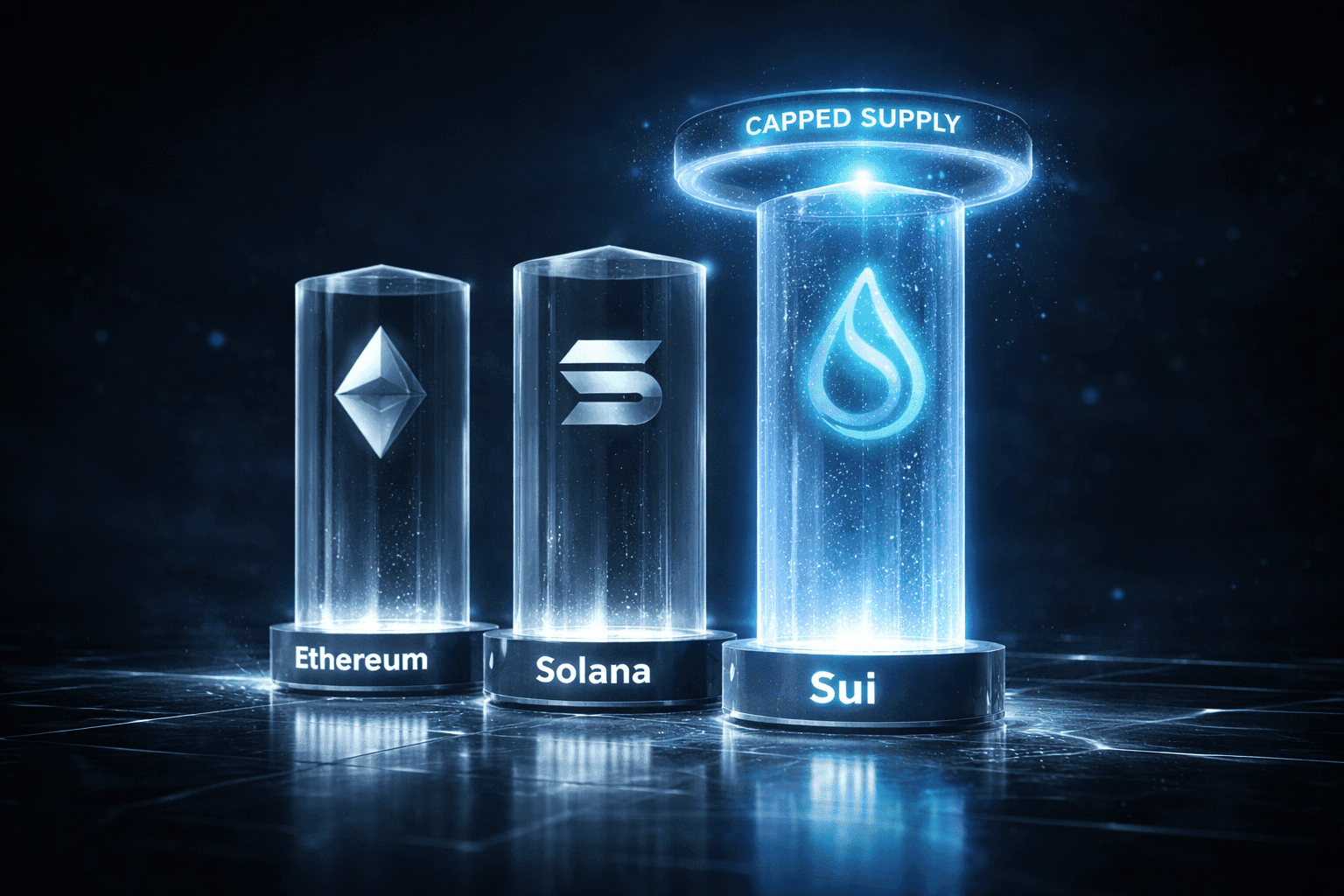
Sui’s stated maximum supply is 10 billion SUI, and the project describes storage-fund and transaction mechanisms that remove tokens from circulation. Those features should be read alongside its circulating-supply and release schedule. A maximum supply cap, a reduction mechanism and the net change in circulating supply are different concepts. Do not infer that circulating supply falls continuously simply because a burn or purchase mechanism exists. Releases and other movements can offset removals. To evaluate a particular period, compare actual supply data and documented removals rather than assume a permanently deflationary outcome or guaranteed scarcity-driven return.
Sui Group’s SUI Holdings: A Commitment to the Ecosystem
SUI Group reports its holdings and financial results in dated filings. Its annual filing is a source for the treasury strategy, reported positions and risk factors, but it should not be treated as a live quote. The number of tokens, valuation, lending exposure and transfer restrictions need to be read with the reporting date and accounting basis. A token balance and its value can change, while a percentage of circulating supply depends on the denominator used at the time. Avoid presenting an old SUI price or market capitalisation as today’s figure. Investors assessing the company also need to consider its liabilities, fees, financing and share dilution, rather than infer shareholder value from gross token holdings alone.
Sui Group’s Strategic Vision: Ecosystem Integration & Investor Value
Sui Group’s transformation from a speciality finance firm to a focused blockchain entity is rooted in a clear, ambitious strategic vision for 2026. This pivot centres on deep integration within the Sui network, forging key partnerships, and leveraging innovative DeFi products like SuiUSDE to generate substantial revenue and shareholder value. The company’s journey highlights a deliberate and expert-driven strategic shift towards embracing the future of finance.
A Strategic Pivot: From Speciality Finance to Sui Network Focus
Sui Group’s evolution from “Mill City Ventures” to its current identity represents a profound strategic pivot. The company, recognising the immense potential of the Sui blockchain, made an intentional and “hyper focus on the Sui network”. This wasn’t merely a rebranding; it was a fundamental reorientation of its business model. The company “pivoted to focus exclusively on the Sui network and changed its name” in August of the previous year, demonstrating a clear commitment and experienced hand in working through the complex digital asset landscape. This strategic shift aims to concentrate resources and expertise, ensuring that all initiatives, including SuiUSDE, are optimised to drive growth and value within the Sui ecosystem. This decisive move answers the question, “What is the long-term vision for Sui Group and the Sui network?” — a future deeply intertwined with Sui’s success.
Key Partnerships: DeepBook, Navi, and BlueFin
Sui Group’s market penetration and revenue generation strategy are heavily reliant on strategic alliances within the Sui ecosystem. SuiUSDE will make its “first markets” on prominent platforms such as “DeepBook, Navi and BlueFin,” ensuring immediate liquidity and utility. These partnerships are crucial for expanding SuiUSDE’s reach and embedding Sui Group within the network’s core infrastructure.
- DeepBook: As a “liquidity layer for Sui built by Mysten Labs,” DeepBook provides a foundational trading venue for SuiUSDE, enhancing its accessibility and market depth.
- Navi Protocol: Described as a “money market that enables lending and borrowing built natively for the Sui ecosystem,” Navi offers avenues for SuiUSDE holders to engage in yield-generating activities beyond simply holding the stablecoin, contributing to its utility and adoption.
- BlueFin: A “Sui-based derivatives exchange,” BlueFin is particularly significant as Sui Group has established a “revenue-sharing agreement” with them, “getting a percentage of the fees generated by the perpetual futures exchange”. This direct revenue stream from a high-volume trading platform demonstrates a concrete and sustainable business model, answering “How does Sui Group generate revenue from its initiatives?” and detailing “What are the key partnerships of Sui Group within the Sui ecosystem?”.
The ‘Killer Use Case’: Perpetual Futures and Capturing Wall Street Interest
Sui Group strategically identifies “perpetual futures (perps)” as “the killer use case in crypto”. This focus on derivatives trading, combined with the yield-generating stablecoin strategy, is a calculated move to bridge the gap between DeFi innovation and traditional financial markets. Stephen Mackintosh elaborated on this, stating, “We’ve gone from a company that buys and stakes SUI to an operating business that owns a stablecoin and earns revenue from a perps DEX”.
This emphasis on perpetual futures positions Sui Group to attract a different class of investor. Mackintosh observed, “Wall Street understands stablecoins far better than altcoins. This is an opportunity to capture that premium inside a public equity”. By offering exposure to the high-growth perpetual futures market through a publicly listed company and facilitating it with a stablecoin, Sui Group aims to make sophisticated DeFi products more palatable and accessible to institutional and traditional investors. This strategic angle clearly defines “What is the target audience for SuiUSDE?”—a broad spectrum from crypto-native yield seekers to institutional players looking for regulated exposure to DeFi innovation.

Competitive Edge: SuiUSDE in the Broader Stablecoin Landscape
The stablecoin market is undeniably competitive, with numerous offerings vying for liquidity and adoption. SuiUSDE enters this arena with unique differentiators, leveraging Ethena’s proven technology while carving out a specific niche within the rapidly expanding Sui ecosystem. It positions itself not just against other stablecoins, but as a key component in Sui’s broader Layer-1 competitive strategy.
SuiUSDE vs. Ethena’s USDe: Distinctions and Shared Foundations
While SuiUSDE is built on the solid foundation of Ethena’s technology, offering a “white-labeled solution,” it is crucial to distinguish it from Ethena’s native USDe. The primary differentiator lies in their deployment. Ethena’s USDe operates predominantly within the Ethereum ecosystem, whereas SuiUSDE “will not be deployed on Ethereum,” instead focusing exclusively on the Sui network. This strategic choice allows SuiUSDE to deeply integrate with Sui’s specific DeFi infrastructure and capitalise on its unique advantages, such as lower transaction costs and higher throughput. What’s more, SuiUSDE’s fee channelling mechanism, which directly funds Sui ecosystem projects and SUI token buybacks, creates a bespoke value proposition tailored to the Sui network’s growth. This targeted approach highlights that while the underlying technology is shared, their ecosystem integration and economic impact are distinctly different, effectively addressing the “Ethena USDe vs SuiUSDE” comparison.
Navigating the Sui Ecosystem: SuiUSDE vs. Sui Foundation’s USDsui
Within the Sui ecosystem itself, SuiUSDE isn’t the sole native stablecoin. It “comes three months after the Sui Foundation launched USDsui, another native stablecoin”. This indicates a developing competitive landscape within Sui. While both aim to provide stable value, their underlying mechanisms, issuance models, and strategic objectives may differ. The Sui Foundation’s USDsui, being a foundation-backed initiative, might prioritise ecosystem stability and broad utility, potentially with a focus on core infrastructure. SuiUSDE, on the other hand, with its Ethena-backed yield generation and direct SUI buyback mechanism, is designed more as a yield-earning asset and a tool for SUI’s deflationary tokenomics. Understanding these potential differentiators—from how they generate yield (or if they do), to their backing, to their primary ecosystem functions—is key for users within the Sui network to choose the stablecoin that best fits their needs. For those asking, “What are the key differentiators between SuiUSDE and USDsui?”, the distinction largely lies in their explicit economic mandates and operational models.

Layer-1 Wars: Sui’s Structural Advantage Over Ethereum and Solana
Beyond the immediate stablecoin competition, Sui Group’s strategy, empowered by SuiUSDE, reinforces Sui’s broader competitive edge in the Layer-1 blockchain wars. Stephen Mackintosh succinctly put it: “Sui has an advantage over Ethereum and Solana as its supply is capped at 10 billion tokens and its fee-burning mechanism makes it structurally deflationary”. This inherent tokenomic design stands in contrast to Ethereum, which, despite its “Merge” and fee-burning, still faces potential long-term inflationary pressures, and Solana, which has a larger initial supply and a less aggressive burning mechanism.
Sui’s capped maximum supply and its token-removal mechanisms form part of the tokenomics, but they do not establish that circulating supply always declines. The release schedule and actual removals both matter. Similarly, SUI Group’s purchases or ecosystem investments are commercial activities, not proof that SUI will outperform another network’s token. Compare deployed features, use, risk and dated financial evidence instead of treating a supply model as a guarantee of sustainable appreciation. A technical difference can be relevant without making the asset a superior investment for every holder.
Investment Implications & Long-Term Outlook
Sui Group’s innovative approach with SuiUSDE presents a multifaceted investment proposition. It not only offers a pathway for sustainable DeFi yield but also intricately links the success of Sui Group to the underlying performance of the SUI token and the broader Sui ecosystem. Understanding these dynamics is crucial for both DeFi investors and long-term SUI holders.
Sustainable DeFi Yield: Benefits for the Target Investor
For “investors hungry for DeFi yield,” SuiUSDE offers a compelling new opportunity within the Sui network. The stablecoin’s design, leveraging Ethena’s proven yield-generation model, aims to provide consistent and attractive returns. This positions SuiUSDE as a crucial component for those seeking stable, high-yield opportunities in decentralised finance, without being exposed to the extreme volatility of native cryptocurrencies. The benefits of SuiUSDE for investors include:
- Stable Returns: As a stablecoin, it minimises price volatility while generating yield.
- Ecosystem Exposure: It provides a direct way to participate in the growth of the Sui network and its DeFi projects.
- Proven Technology: Built on Ethena’s solid infrastructure, offering a degree of confidence in its operational stability.
- Deflationary Impact: Indirectly benefits from the SUI buyback mechanism, contributing to the broader ecosystem’s health.
These benefits directly address “What are the benefits of SuiUSDE for investors?” by offering a clear value proposition for those seeking reliable income in the DeFi space.

Navigating Risk: Correlation to SUI Price and Regulatory Landscape
While the potential for reward is significant, it is equally important for investors to understand the inherent risks. Stephen Mackintosh candidly acknowledged, “Our performance is always going to be correlated to the price of SUI”. This direct correlation means that while Sui Group’s initiatives aim to bolster SUI’s value, the company’s financial health, and by extension, shareholder value, will be influenced by SUI’s market fluctuations. Investors should therefore consider their exposure to SUI’s price volatility, even when interacting with SuiUSDE.
What’s more, the evolving regulatory landscape for stablecoins presents a critical, often overlooked, aspect of risk. Governments and financial authorities worldwide are increasingly scrutinising stablecoins, with potential regulations ranging from stricter reserve requirements to licensing mandates. Any significant changes in these regulations could impact SuiUSDE’s operational model, market acceptance, and overall viability. Investors must remain vigilant regarding these macro-level developments, as they can significantly influence the future trajectory of all stablecoins, including SuiUSDE. Addressing this content gap on regulatory analysis is crucial for a comprehensive understanding of crypto investment risk.
The Future Trajectory: Sui Group’s Vision for Ecosystem Dominance
SUI Group’s strategy extends beyond holding tokens into activities associated with the Sui ecosystem. In this context, DAT means digital asset treasury, not “digital asset treasury company”. A publicly traded treasury company has corporate obligations, financial statements, management costs and financing decisions that differ from a decentralised protocol. Evaluate its disclosures and risk factors separately from the network’s technical documentation. The company’s aspiration to expand an ecosystem does not establish the delivery, profitability or terms of a particular product, so distinguish reported results from management plans.
The successful implementation of their strategy – from the sustained yield of SuiUSDE and the deflationary impact of SUI buybacks to their strategic partnerships and focus on perpetual futures – could firmly establish Sui Group as a dominant player within the Sui ecosystem. This trajectory holds the potential to significantly contribute to the Sui network’s overall growth, attracting more users, developers, and capital, and further cementing its position as a leading Layer-1 blockchain. This ambitious goal directly answers “What is the long-term vision for Sui Group and the Sui network?” and positions Sui Group as a crucial catalyst for DeFi innovation.

Conclusion
SuiUSDe connects a synthetic-dollar product with SUI Group’s ecosystem strategy, but the investment interpretation requires care. The launch is documented; claims about future sustainable yield, permanent deflation or inevitable token appreciation are not established by the existence of the product. The backing and hedges, costs, customer terms and actual SUI acquisition activity should be checked separately. A balanced explanation should also distinguish the company’s shares, the SUI network token, suiUSDe and any vault position. They do not confer identical rights or expose a holder to identical risks. The value of the development is clearer when those structures are explained without presenting an announced economic mechanism as a guaranteed return.
The company’s deep ecosystem integration, bolstered by strategic partnerships with platforms like DeepBook, Navi, and BlueFin, underscores its commitment to the Sui network. By focusing on perpetual futures as a “killer use case” and aiming to capture institutional interest, Sui Group is positioning itself, and by extension the Sui network, for significant growth and broader adoption. While acknowledging the inherent correlation to SUI’s price and the evolving regulatory landscape, Sui Group’s long-term vision is clear: to be an innovative digital asset treasury company deeply embedded in the Sui ecosystem, propelling it towards a future defined by sustainable yield, solid deflationary tokenomics, and groundbreaking institutional integration.
Disclaimer: This article is for informational purposes only and does not constitute financial advice. Cryptocurrency investments are volatile and carry significant risk. Always conduct your own research before making investment decisions.
Four Different Assets, Four Different Risk Profiles
- SUI: The network’s native token. Its price depends on market conditions and demand; a supply cap does not guarantee appreciation.
- suiUSDe: A synthetic dollar targeting a stable value through a backing and hedging model. A peg target is not the same as a bank deposit or a guarantee.
- A yield or vault position: A separate arrangement whose return, withdrawal process and risk depend on its contracts and strategy. Do not assume the base dollar token pays the same yield.
- SUIG shares: An interest in a publicly traded company, with corporate costs, financing, liabilities and dilution risks distinct from holding SUI directly.
Read Ethena’s mechanism documentation alongside the applicable product terms and the company’s filing. Hedging is intended to manage exposure, but leaves funding, counterparty, custody, liquidity and operational risks to assess. A project’s description of its technology as proven does not remove those risks, nor does a future-buyback plan establish executed purchases or holder income.
A treasury company’s shares can trade above or below the estimated value of its net assets. Compare liabilities, operating expenses, financing and the share count as well as gross token holdings; owning a share does not give direct custody of the company’s SUI.