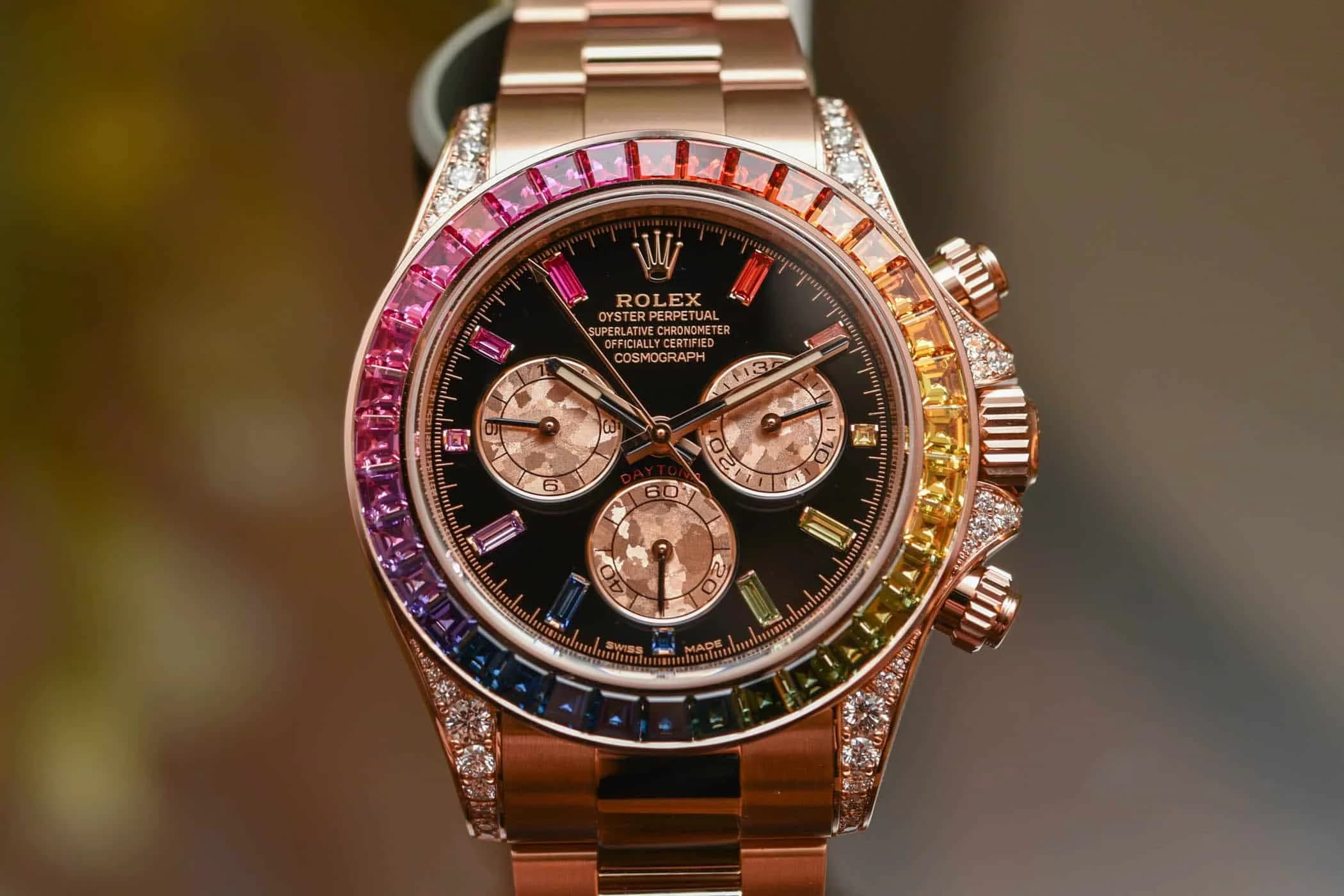
The first Rolex Rainbow Daytona was not sold for $3.5 million. That was the pre-sale expectation. The circa-1994 watch, reference 16599SAAEC, went through Phillips in Geneva on 8 November 2024, and the published lot record gives CHF 5,505,000. It is a completed auction, not an upcoming November sale or a current UAE asking price.
The auction result at a glance
| What to check | This particular watch |
|---|---|
| Reference | 16599SAAEC, not 16599SACO |
| Dating | Circa 1994 |
| Auction | Phillips Reloaded, Geneva, lot 27; 8 November 2024 |
| Published estimate | In excess of CHF 3,000,000 |
| Published result | CHF 5,505,000 |
| Case and movement | 40 mm, 18K white gold, automatic calibre 4030 |
| Strap | Leather, with a white-gold Rolex deployant clasp |
Phillips describes the lot as “most probably unique”. That qualification matters: a rare historical example is not the same thing as a numbered limited edition. The existing gallery below is illustrative, not an identification or authentication record for lot 27. Use the linked auction catalogue and its photographs to identify the actual watch.

Why the $3.5 million headline needs context
The auction announcement was a 2024 story. Phillips advertised a starting estimate above CHF 3 million, with a dollar equivalent around $3.5 million. Its dated pre-sale account explains why the watch attracted attention before the sale. The completed result now belongs at the top of the story, rather than underneath paragraphs that still invite readers to an auction that has already happened.

Keep three numbers separate when comparing auction coverage: the estimate, the hammer bid and the published sale result. An estimate describes expectations before bidding; the hammer is the winning bid. Phillips labels CHF 5,505,000 “Sold For”, so that is how it is reported here, without assuming it is the hammer alone. A result-to-estimate percentage would need the same currency and fee basis before it told you anything useful.

The original Rainbow and the models people recognise today
The important distinction is between a mid-1990s watch and the later Rainbow Daytona family. Phillips identifies this example as a predecessor to serial production nearly two decades later. SJX’s hands-on account separates the 1994 watch from the yellow- and white-gold Rainbow references introduced in 2012 and the Everose version introduced in 2018. Those watches share a visual idea, not an interchangeable reference or auction history.

That is why a photograph of a colourful Daytona on a bracelet cannot establish that it is the Geneva lot. Start with the complete reference, then compare the case, dial, movement, strap or bracelet, and documented history. For this story, the suffix SAAEC is part of the identity. Substituting SACO, or using “Rainbow” as if it were a reference number, can send a reader to a different watch.

My view: the attraction here is the place this watch occupies in the Rainbow story, not simply the amount of jewellery on it. The completed sale is evidence of what buyers paid for this particular lot in that setting. It is not evidence that every gem-set Daytona should be priced by the same multiple, or that any modern example will rise in value.

A practical comparison for a UAE buyer
If a seller uses this auction to justify a price, ask for a comparison you can actually check. Which full reference is being offered? Are the bezel and dial described as factory-set or later modified? What documents and service records support that description? Is the quoted amount a sale result or just an asking price? None of those questions is answered by attaching a celebrity photograph or a headline about a different reference.

For an AED quote, ask the seller to put the currency, the watch’s exact identity, any commission or premium, delivery and any applicable import charges in writing. This is a checklist for comparing an actual offer, not a claim about the taxes or charges on a particular transaction. A historic Swiss-franc result converted using today’s exchange rate is not a UAE landed-price quotation.

I would rather see one closely matched, documented comparison than ten spectacular but unrelated auction headlines. Condition and originality still need assessment on the watch being offered. A catalogue entry for the 1994 lot cannot authenticate somebody else’s watch, and this article is not a hands-on inspection or a valuation of a watch currently for sale.

The Rolex background worth keeping
Rolex’s story began with Wilsdorf & Davis in London in 1905, and the Rolex name followed in 1908. The brand’s early history records the 1910 Swiss Certificate of Chronometric Precision awarded in Bienne. That history helps explain the brand’s reputation, but it is not a substitute for the provenance of an individual auction lot.

The Oyster arrived in 1926. Rolex’s account of the 1927 Mercedes Gleitze demonstration describes the watch surviving more than ten hours in the Channel. A modern buyer should not turn that historic story into a water-resistance promise for a decades-old, gem-set watch: its present condition needs its own assessment.

The Daytona itself was introduced in 1963 as a chronograph associated with motor racing. Rolex’s Daytona history also explains the dial associated with Paul Newman. A Paul Newman Daytona and the Rainbow lot are distinct collecting subjects; their headline prices should not be treated as interchangeable comparables.

Where this result fits in the wider watch conversation
For a broader starting point, our Rolex model guide covers more than this one auction. The luxury-watch market overview serves a different question again. Keep a one-lot auction result separate from general market commentary and from reporting on watchmakers’ retail-price changes.

Readers interested in a different kind of watch release can compare the context of the Rolex Land-Dweller or the TAG Heuer and Kith Formula 1 collaboration. Neither is a price comparable for the circa-1994 Rainbow. The point of those links is to distinguish new-model coverage from historical collecting, not to imply that all luxury watches move together.
The result, without the investment claim
The useful takeaway is specific: Phillips records CHF 5,505,000 for lot 27, reference 16599SAAEC. The old $3.5 million figure describes the expectation before that sale. I would use this result to understand a remarkable piece of Daytona history, then start a fresh, reference-specific comparison before using it to judge another watch’s price. That is more useful than turning one exceptional sale into a promise of steady appreciation.