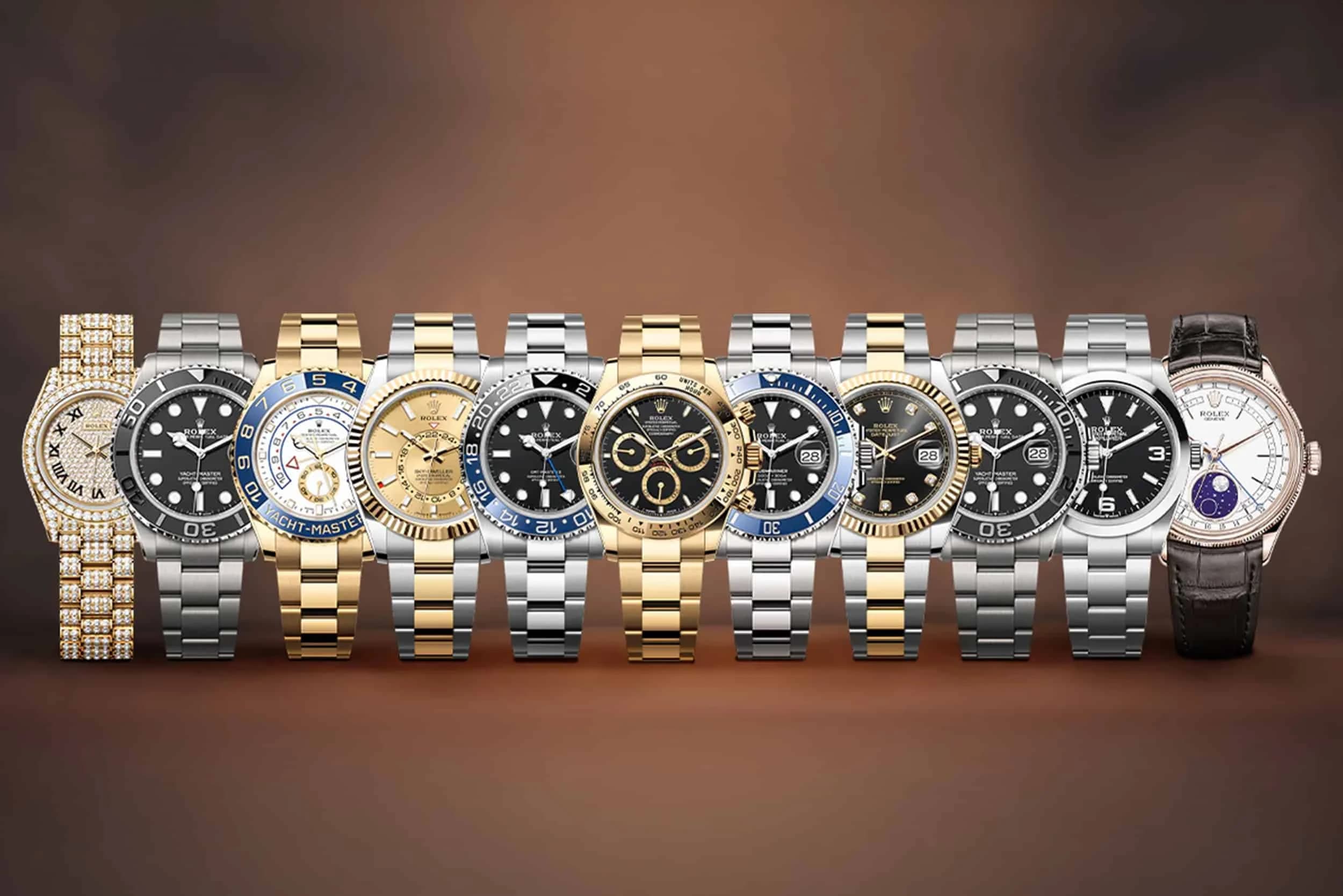
Ten Rolex model groupings ranked by design and function, from Submariner and Daytona to Datejust and GMT-Master II, with official specifications and UAE buying guidance.
The Submariner takes our top spot, but the Datejust may be the Rolex that makes most sense in an everyday wardrobe. The Daytona brings the racing drama; the GMT-Master II earns its place through travel practicality. This ranking explores ten established model groupings, choosing recognisable design and useful differences over hype alone.

The ranking is an editorial shortlist, not a survey of collectors or a list of ten individual references. Closely related models share an entry so the comparison stays readable. Exact sizes, materials and generations still matter when you choose a particular watch.

How to use this Rolex ranking
Start with the function you would actually use: a second time zone, a date, a chronograph or simply three hands. Then consider the visual character. A busier dial can be part of the attraction, but it should be a choice rather than something accepted because a model is famous.
The current Rolex catalogue includes newer families beyond this established shortlist. The selection below follows the original ten groupings while updating the descriptions against Rolex’s model pages checked on 16 November 2026.

Our criteria: identity, function and everyday appeal
Design identity comes first: how clearly does the watch express its own purpose? Function comes next: what does it offer that another entry does not? Everyday appeal is an editorial judgement about how easily that identity fits into a wardrobe, rather than a claim from an unrecorded wear test.
The order therefore does not have to be your shopping order. A traveller can sensibly choose the GMT-Master II over our first-place Submariner; someone who wants a clean dial can begin with the Oyster Perpetual or Explorer.
Use the individual sections to narrow the choice, then compare the exact reference, condition and terms. The best-known name is only the beginning of the purchase decision.

10. Rolex Sky-Dweller
The Sky-Dweller combines two time zones with the Saros annual calendar, displaying date and month as well as the time. Rolex dates its introduction to 2012 and explains how its Ring Command system links the bezel and crown to setting the functions. That makes it the more technically involved travel choice here. Choose it for the calendar as well as the travel function; if you mainly need to see home time, the GMT-Master II is the more focused comparison.

9. Rolex Yacht-Master and Yacht-Master II
The Yacht-Master has a nautical identity, with Rolex dating the line to 1992. Its current model page lists 37, 40 and 42 mm sizes and materials including RLX titanium. That breadth makes comparing the actual reference especially important: the name alone does not identify the size or material.
This is the entry for a reader drawn to a more decorative sailing-watch look than the Submariner. Compare the bracelet, bezel and material together, and try the size you plan to buy rather than assume another Yacht-Master will feel identical.
The Yacht-Master II is the separate regatta-countdown proposition. Rolex’s current page presents a new generation in 2026, with the countdown programmed using the lower pusher and remaining time displayed counterclockwise. The regular Yacht-Master’s titanium story and the Yacht-Master II’s countdown mechanism should be compared as distinct model features.

8. Rolex Sea-Dweller
The Sea-Dweller was created in 1967 for prolonged underwater missions. Rolex describes its helium escape valve as a response to saturation-diving decompression and dates the move to 1,220 metres of waterproofness to 1978.
That engineering purpose is the reason to choose it from this list. Its appeal is more specialised than a general wish for a sporty watch. The Deepsea is a separate family in the current catalogue, so a Deepsea achievement should not be assigned indiscriminately to every Sea-Dweller.
For everyday buying, compare this entry directly with the Submariner. Decide whether the more specialist diving story matters enough to you, then assess the exact case, bracelet and condition. A larger technical specification is not automatically a better fit for the way you dress.

7. Rolex Oyster Perpetual
Rolex dates the original Oyster Perpetual to 1931, describing it as a self-winding waterproof chronometer descended from the 1926 Oyster. The current watch family centres on three hands and a range of dials and sizes. That is the straightforward proposition: timekeeping with fewer visual distractions.
Choose it when dial colour, proportions and a clean face matter more than another complication. Compare the actual size on your wrist and in photographs that show its full proportions; an enlarged dial close-up tells you little about how the watch sits as a whole.
The Oyster Perpetual is a family in its own right, while those words also appear more broadly in Rolex naming. Vintage nicknames, Oyster Precision and Oysterdate references need their own identification rather than being treated as interchangeable modern Oyster Perpetual specifications.
For a first shortlist, decide whether you will genuinely miss a date display. If the answer is yes, move to the Datejust comparison before getting attached to a particular dial colour.

6. Rolex Explorer and Explorer II
The Explorer was created after the historic 1953 Everest ascent. Rolex connects its development with an expedition equipped with Oyster Perpetual watches; that does not identify every climber’s individual wristwatch. For this ranking, the Explorer’s appeal is the restrained, legible dial and a less decorative tool-watch look.
The Explorer II arrived in 1971 with a 24-hour display suited to conditions where day and night are hard to distinguish. Its current orange 24-hour hand and graduated bezel give it a different visual identity from the original Explorer.
Choose between them on that distinction: the Explorer for a simpler face, the Explorer II for the additional day/night indication and stronger accent of colour. The latter’s exploration connection includes speleologists; it should not be casually recast as a purpose-built cave-diving watch.

5. Rolex GMT-Master and GMT-Master II
The GMT-Master II displays two time zones simultaneously through its 24-hour hand and graduated rotating bezel. Rolex describes a 12-hour local-time display alongside a second zone in 24-hour format. For readers travelling between the UAE and another time zone, this is an easily understood reason to shortlist it.
It ranks ahead of the Explorer group here because the travel function can be useful even on an ordinary work trip. Choose the bezel and bracelet combination you like, but establish the reference first: familiar colour nicknames do not substitute for the watch’s identity.
The comparison with the Sky-Dweller is particularly useful. Both address travel, but the Sky-Dweller adds an annual calendar. Decide whether you want that additional display or would prefer the GMT-Master II’s more focused time-zone layout.
This entry groups the historic GMT-Master with its successor for the ranking. The functional description above comes from the current GMT-Master II page; a vintage purchase requires the specifications of that particular reference.
For an everyday traveller, this would be one of our first three families to investigate alongside the Datejust and Submariner. It offers a reason for the extra hand beyond simply making the dial look more complicated.

4. Rolex Day-Date
The Day-Date is the precious-metal statement in this shortlist. Rolex dates it to 1956 and identifies two separate windows for the date and the day spelt out in full. The appeal is immediate: a familiar dial made more expressive by the full day display and the material.
The current model page lists the day display in 26 languages, including Arabic. That is a useful detail for UAE readers choosing a watch with a more personal connection. Confirm the language on the exact offered reference rather than assume it can be changed as part of a normal sale.
Choose this family for its character as much as its calendar. If the precious-metal presence is exactly what you want, it can lead the outfit. If you want a less assertive everyday watch with a date, compare the Datejust before committing.

3. Rolex Datejust
The Datejust was released in 1945 and places the date in a window at 3 o’clock. Rolex’s current overview highlights the Cyclops lens and Jubilee bracelet among its signature features. It earns third place here because the date adds everyday usefulness without making the dial’s purpose difficult to understand.
For a broad wardrobe, the Datejust is one of the most persuasive starting points in this list. Compare the exact dial, bezel and bracelet combination: a change in finish can move the same family toward a quieter or more decorative look.
This is our practical all-rounder choice, not a claim based on a published model-by-model sales table. The question to settle is whether you like the actual configuration enough to keep wearing it after the excitement of buying has passed.

2. Rolex Cosmograph Daytona
The Cosmograph Daytona is the chronograph choice. Rolex dates its introduction to 1963 and links its identity to motor sport, elapsed-time measurement and the tachymetric scale on the bezel. That gives the subdials a clear purpose alongside their visual appeal.
Choose it if the racing-watch character is the attraction. The three-subdial layout is busier than the Submariner or Datejust, which can be exactly the point. Compare the offered reference and its condition rather than assume every Daytona shares the same materials or movement.
A key historical sale is documented by Phillips’ lot record for Paul Newman’s reference 6239: US$17,752,500 at the 2017 Winning Icons sale. That is the result for an exceptional watch with documented Newman provenance, not a representative price for an ordinary Daytona or a current claim to every auction record.
The collecting story adds interest, but the buying choice still comes back to the object: do you want the chronograph display, this configuration and this individual watch? A famous sale can explain a model’s mythology without setting your budget.

1. Rolex Submariner
The Submariner takes first place for the clarity of its design: a legible dial, a purposeful timing bezel and a shape that makes its diving identity easy to understand. That combination gives it the strongest balance of recognisability and straightforward function in our shortlist.
Rolex dates the launch to 1953, with 100-metre waterproofness at introduction. Its current overview gives 300 metres for the modern Submariner and Submariner Date, and dates the Date version to 1969. The unidirectional 60-minute bezel is the key timing feature.
The most useful first decision is Submariner or Submariner Date: the cleaner face versus the additional date display. Then compare the actual reference, metal, dial and condition. A vintage example’s maintenance and testing history matter more than a general specification copied from the current range.
That is why it leads this ranking: the design communicates its purpose without needing a long explanation. The Datejust remains our alternative for a more classic all-rounder, and the GMT-Master II for a buyer who will use a second time zone.

Before buying: the tax refund is not the whole VAT amount
I would settle the actual reference, seller and full bill before treating any ranking as a buying signal. For an explicitly hypothetical AED42,000 price including 5% VAT, the VAT component is AED2,000, not AED2,100. Under the FTA’s published tourist-refund deductions, 87% of AED2,000 minus AED3.60 is AED1,736.40. That leaves AED40,263.60 after that illustrative refund, before exchange charges or any destination import obligations.
This is arithmetic, not a Rolex price or an individual tax entitlement. Tourist eligibility, participating-retailer documentation and export validation apply. A UAE resident must not budget for a tourist refund. Nor does a potential refund prove the watch will resell for more than the cost.
Frequently asked questions
Which Rolex should I choose from this ranking?
Use the ranking as an editorial starting point, not a stock list or a promise of returns. Match the model, size, material and condition to the watch you want to wear, then obtain the terms for that exact reference.
How much does a Rolex cost in Dubai?
Use the current price for the exact reference from Rolex or an Official Rolex Retailer. This guide has not established a live UAE quote; an older price range is not a confirmed price for a different metal, dial or seller.
Which Rolex watches are available in Dubai without a waitlist?
No model-by-model walk-in availability has been verified here. Rolex directs buyers to Official Rolex Retailers for regional availability, and says those retailers independently manage allocations and sales.
What is the best Rolex for investment?
This ranking does not establish an investment winner or a dependable resale premium. Buy on the watch and purchase terms, not a promised profit; resale proceeds, fees, condition and the price originally paid can change the outcome.
Are Rolex watches bought in Dubai VAT-free?
No. A UAE purchase should not be described as automatically VAT-free. Eligible tourists may claim a conditional refund through participating retailers; the Federal Tax Authority deducts 13% of the requested VAT plus AED3.60 per tax-free transaction.
Do new Rolex and Rolex Certified Pre-Owned watches have the same guarantee?
No. Rolex states a five-year international guarantee for new watches bought from Official Rolex Retailers, subject to its conditions. Its own Certified Pre-Owned programme provides a two-year international guarantee from that purchase date. A reseller calling a watch certified does not by itself establish Rolex Certified Pre-Owned status.
Buying in the UAE: reference, seller and guarantee
Use Rolex’s own buying guidance for official retailers, regional availability and the new-watch guarantee. The Rolex Certified Pre-Owned programme is a distinct route with its own seal, card and two-year guarantee. Obtain the exact reference, written condition, guarantee terms and complete price before comparing offers.