Salik’s normal free hours are 1am to 6am; during Ramadan, the published window moves to 2am to 7am. All times are Dubai local time. The other big distinction is just as important: a cheaper crossing is not a free crossing, and the one-hour rule is not a citywide toll pass.
I would use the free window when it already fits the trip—a night shift, for example—not turn a straightforward journey into a midnight expedition to save a few dirhams. The useful win is understanding the actual crossing time, the named gate pairs and the full cost. Here is the timetable, including VAT, followed by the mistakes I would avoid.
Salik timings and charges outside Ramadan
Salik’s 2025 operational review sets out the underlying variable tariff. Its 22 May 2026 disclosure adds 5% VAT to toll tariffs and tag activation from 1 June 2026 without changing the underlying tariff structure. That makes AED 6 payable as AED 6.30, and AED 4 payable as AED 4.20.
| Day or window | Time | Underlying tariff | Including 5% VAT |
|---|---|---|---|
| Monday–Saturday peak | 6am–10am and 4pm–8pm | AED 6 | AED 6.30 |
| Monday–Saturday lower paid band | 10am–4pm and 8pm–1am | AED 4 | AED 4.20 |
| Normal overnight free window | 1am–6am | AED 0 | AED 0 |
| Ordinary Sunday paid hours | 6am–1am the following day | AED 4 | AED 4.20 |
The ordinary Sunday row excludes public holidays and events. Do not assume a Sunday holiday has the ordinary Sunday price. Check Salik’s announcement for the date rather than recycling a previous Eid or event schedule. Saturday is not covered by the ordinary Sunday discount, and Friday is not a free day.
The time that matters is when the vehicle passes the gate—not when you leave home. A normal Monday crossing at 12:55am is still in the lower paid band; a crossing at 1:05am is within the published free window. I would leave a sensible margin, not rush towards a toll gate to beat a clock.
Ramadan has a different timetable
Salik’s published Ramadan tariff table changes the time bands: 9am–5pm peak; 7am–9am and 5pm–2am lower paid hours; 2am–7am free. The table gives ordinary Sundays the lower paid tariff outside the free window, with public holidays and events excluded from that Sunday row.
Those published base rates are AED 6 and AED 4. Under the separately announced 5% VAT treatment, the corresponding payable amounts are AED 6.30 and AED 4.20. For a particular Ramadan journey, check the official schedule and any date-specific notice then in force. The normal 1am free start is not the Ramadan rule.

The one-hour rule: two linked pairs, not every gate
This is the correction that matters most if you are budgeting a longer drive. Salik’s 19 January 2024 announcement describes the Al Safa linkage as being similar to Al Mamzar’s existing arrangement. The 2025 operational review confirms the Al Safa same-direction, one-hour treatment after the new gates opened.
- Al Mamzar North + Al Mamzar South: both gates of this pair, in the same direction within one hour, attract one charge.
- Al Safa North + Al Safa South: the same linked-pair principle applies.
- Al Mamzar + Al Safa: these are not one combined pair. Passing one and then the other within an hour does not turn the whole journey into one toll.
There is no general “every gate for the next 60 minutes” ticket. Nor should an outward crossing and an opposite-direction return be treated as one same-direction passage. I would count the named pairs first, then the other gates separately, rather than count every gantry as a charge—or assume the entire drive costs just one.
A straightforward worked example
Assume an ordinary Monday outside Ramadan, with all crossings comfortably inside the same peak band. You pass both Al Safa gates in the same direction within one hour, and also cross one unrelated chargeable gate. The Al Safa pair contributes one charge and the unrelated gate another: 2 × AED 6.30 = AED 12.60, not AED 6.30 for the whole trip and not AED 18.90 for three gantries. This is a tariff illustration, not a tested route or a quotation for your journey.
I would not use a rate-boundary journey to guess the treatment of a linked pair. If the two crossings straddle a change in time band, check the operator’s applicable rule and the actual trip record. The example above deliberately avoids that extra assumption.
Where are the ten Salik gates?
The operator’s annual-report network map identifies ten gates. Keep the North/South names in your trip notes: they are essential to understanding a paired crossing.
- Al Safa North
- Al Safa South
- Al Barsha
- Jebel Ali
- Al Garhoud Bridge
- Al Maktoum Bridge
- Business Bay Crossing
- Airport Tunnel
- Al Mamzar North
- Al Mamzar South
For orientation, Al Safa North/South, Al Barsha and Jebel Ali are on the Sheikh Zayed Road corridor; the Al Mamzar pair is on the Al Ittihad corridor. Business Bay Crossing is the Al Khail Road gate. Use the exact gate name and the live route for a specific journey rather than an old generic road description. A road name is not a promise that every route along that corridor crosses the same gates.
My way to decide whether changing the trip is worth it
Start with the journey you actually need to make. I would not move an airport transfer into the early hours if that means missing a flight, paying for extra parking or making a tired driver spend longer on the road. Toll savings belong in the total travel cost, not above it.
- If the time is already flexible: compare the relevant paid bands with the free window for that date.
- If the arrival time is fixed: compare a sensible toll-free route with the tolled route, including added distance and time. A zero toll is not automatically the cheaper journey.
- If the trip repeats: multiply the number of chargeable crossings after linked-pair treatment, not the number of gates you can see on a map.
- If you are renting: separate Salik’s tariff from the rental company’s contractual fees.
What a recurring saving looks like
For an explicitly hypothetical schedule of 40 independent chargeable crossings in a month, peak pricing gives 40 × AED 6.30 = AED 252. The same 40 crossings in the lower paid band give 40 × AED 4.20 = AED 168: an AED 84 difference. Forty crossings genuinely within a free window would have no toll charge. These are alternative assumptions, not an observed commute, an automatic discount or a reason to change every journey.
My test for a detour would be just as blunt: if avoiding an AED 4.20 toll adds an assumed AED 5 of fuel, the detour has cost AED 0.80 more before you even value the extra time. Put your own distance and fuel inputs into that comparison. There is no universal “best” toll-free route.
Salik tags, account balance and rental cars
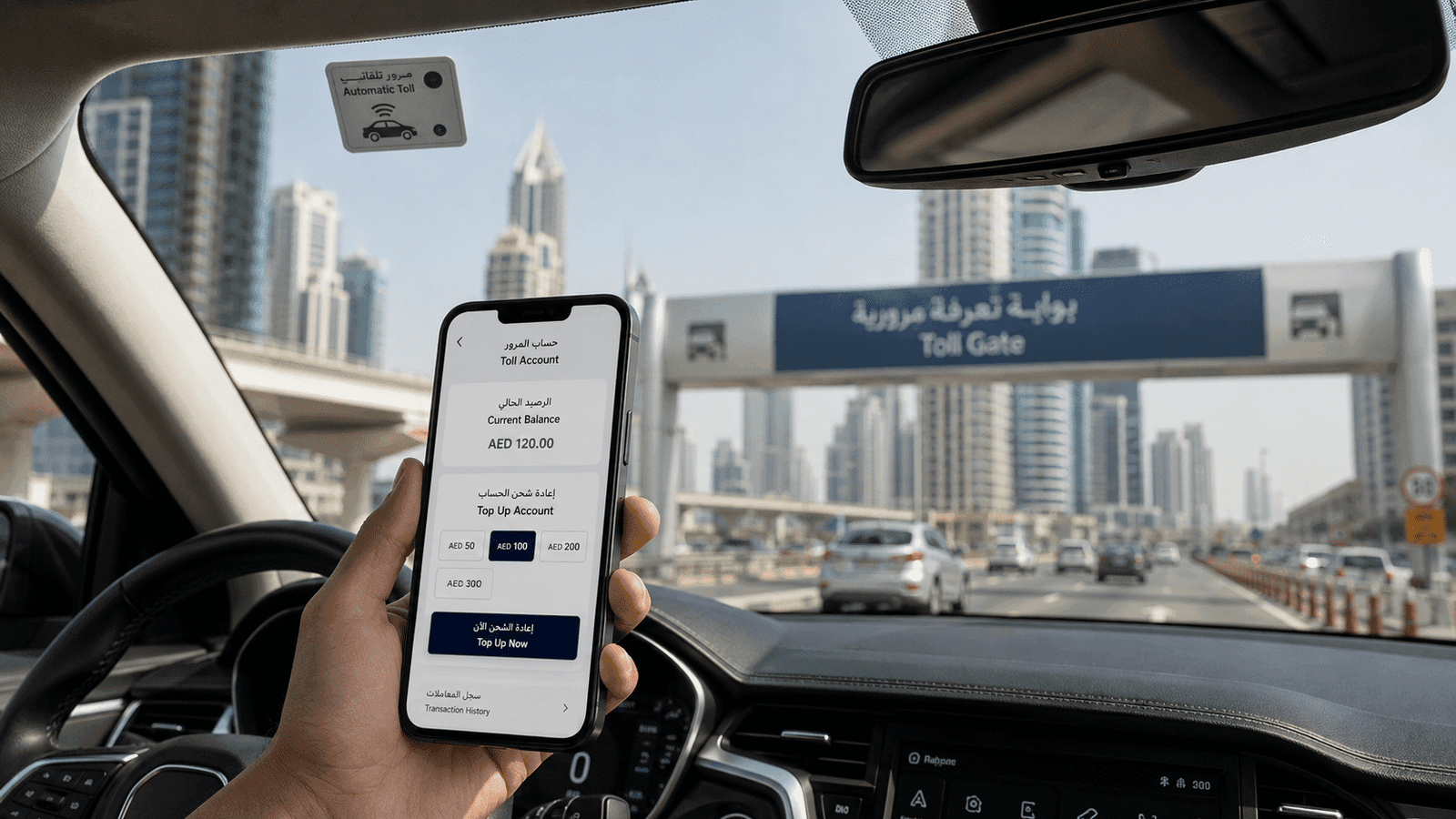
Salik uses electronic detection and an account balance rather than a toll booth. The annual report describes RFID tag detection and account deductions, with Smart Salik tools for account and usage management. Start from the official Salik site for current tag purchase, activation and recharge instructions. A nol public-transport balance page is not the correct place to activate a Salik tag.
Keep the tag assigned to the correct vehicle and follow the operator’s installation instructions. A free time band is not a reason to ignore registration or account requirements. This guide does not quote an unverified tag price or fine schedule; check the service’s current charges before purchasing or resolving a violation.
With a rental car, I would ask for the toll billing terms at collection: the underlying crossing charge, any administration fee, when the company invoices and how it identifies each trip. For a query, request the date, time, gate and vehicle details. That is far more useful than arguing over a single unexplained total.
My verdict
Use the timetable; do not chase the “hack”. The normal and Ramadan free windows are useful when they fit your life. The linked-pair rule prevents a particular double charge; it does not wipe out unrelated gates. Once VAT, rental fees, fuel and time are included, the best saving is the one that still leaves you with a sensible journey. For the wider commute, see our Dubai traffic and journey-planning guide.
Frequently asked questions
What are Salik free hours in Dubai?
Outside Ramadan, the published overnight free window is 1am to 6am. The separate Ramadan timetable shifts it to 2am to 7am. Use Dubai local time and check official holiday or event announcements for the travel date.
Is Salik free on Fridays or public holidays?
Friday is not a free day. Ordinary Sundays have a lower paid-hours tariff, not free travel all day. Public holidays and events are exceptions to the ordinary Sunday row; check the schedule announced for the date.
How does the Salik one-hour rule work?
The linked pairs are Al Mamzar North with Al Mamzar South, and Al Safa North with Al Safa South. Crossing both gates of one named pair in the same direction within one hour attracts one charge. Al Mamzar and Al Safa do not become a single pair just because they are crossed within an hour.
Can tourists use Salik?
Yes. With a rental car, check the rental agreement for how the company bills tolls and any separate administration charges. Ask for crossing dates, times and gate names if a bill needs explaining; the rental invoice is not necessarily identical to the underlying Salik tariff.
Sources and scope
Rechecked 20 October 2026: Salik’s annual-report network and normal tariff table, its linked-gate announcement and its VAT disclosure. The Ramadan table was available through the operator’s indexed earnings presentation; direct access to the main Salik service pages was blocked during this check. No live account, rental invoice, route drive or personal toll transaction was tested. Photographs are retained as context, not proof of current charges.