Read a DEWA bill using October 2026 tariffs, marginal electricity and water slabs, checked utility calculations, municipal-fee distinctions and official help routes.
Before blaming the air conditioning, I’d pull the DEWA bill apart. The total combines consumption with charges that do not all respond to using less electricity. Start with kWh, water units and the billing period, then work through the named fees. A smaller consumption figure and a corrected housing assessment are different wins, reached through different checks.
My bill-checking verdict: find the line that changed
I’d compare units before comparing dirhams, and challenge the specific charge rather than the whole total. The worked examples below show progressive bands and separate taxable amounts; keep their assumptions attached. For payment or an account enquiry, use the actual official service—not one of the illustrative screens retained in this guide.
For separate transport expenses, compare Salik account and journey costs and Sharjah parking payments; neither uses the DEWA bill’s charging rules.
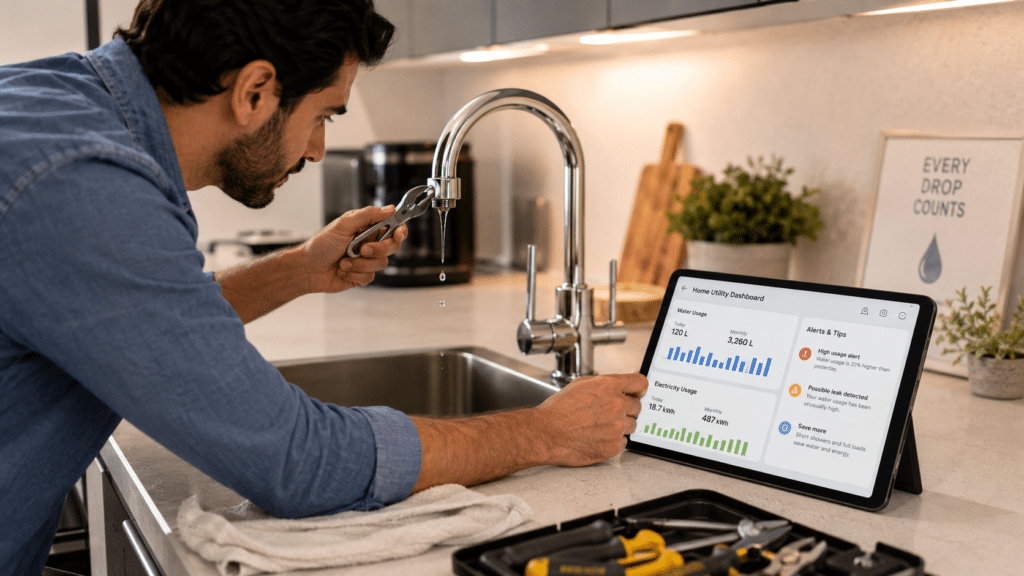
Rates and official guidance checked for October 2026. The worked examples below are calculations, not a household’s actual bill or a promise of savings. The hero and body images are illustrations: their bills, prices and app-like screens are not authentic DEWA statements or interface instructions.
Start with the charge, not the total
| Line to check | What drives it | Useful next step |
|---|---|---|
| Electricity and water | Consumption and the applicable slab rates | Compare units and billing dates, not only dirhams |
| Fuel surcharge | The published rate for the relevant month and your consumption | Check both the date and whether the unit is kWh or m³ |
| Meter service | Meter type | Match the line to DEWA’s published type-based charge |
| Housing and sewerage | Municipal assessment or applicable sewerage rules | Do not calculate either as an invented percentage of electricity |
| VAT | Taxable items, not every amount on the statement | Keep exempt municipal fees out of the taxable subtotal |
| Other services or balances | Your account and service arrangements | Check descriptions, previous balances and payments separately |
What DEWA collects
DEWA is Dubai Electricity and Water Authority. Its bill-payment service describes a package that can include Dubai Municipality housing, sewerage and irrigation charges, and partner cooling charges. Do not assume every property has every line, or that every cooling cost is part of its electricity charge. Check the supplier and arrangements for your building.
Electricity slabs: only the extra units enter the next band
The official standard residential/commercial electricity schedule is progressive. The previous version incorrectly described commercial electricity as a flat 38 fils per kWh; DEWA lists the same four bands for residential/commercial accounts, with a separate industrial schedule. Account-specific or subsidised arrangements need their own check.
| Monthly electricity band | Base rate before surcharge and VAT |
|---|---|
| First 2,000 kWh | AED 0.230 per kWh |
| Next 2,000 kWh, up to 4,000 | AED 0.280 per kWh |
| Next 2,000 kWh, up to 6,000 | AED 0.320 per kWh |
| Above 6,000 kWh | AED 0.380 per kWh |
Example: 2,500 kWh costs (2,000 × 0.230) + (500 × 0.280) = AED 600 in base electricity charges. It is not 2,500 × 0.280. At October’s surcharge, add 2,500 × 0.060 = AED 150. That makes AED 750 before meter charges and VAT, not a complete account bill.

What saving 100kWh would mean in that example
Reduce the assumed electricity use from 2,500 to 2,400kWh and the removed 100 units are all in the AED0.280 band. At October’s AED0.060 surcharge and 5% VAT, the difference is 100 × (0.280 + 0.060) × 1.05 = AED35.70. It is not a 4% reduction in the whole DEWA statement: meter charges, water and the housing assessment do not fall just because this electricity quantity changes. I would use that marginal calculation to judge a realistic consumption saving, not a percentage of the final bill.
Residential water: check cubic metres and marginal bands
| Monthly residential consumption | Base rate before surcharge and VAT |
|---|---|
| First 27 m³ | AED 7.700 per m³ |
| Next 27 m³, up to 54 | AED 8.800 per m³ |
| Above 54 m³ | AED 10.120 per m³ |
For 30 m³, the base charge is (27 × 7.700) + (3 × 8.800) = AED 234.30. Do not apply the second-band rate to all 30. Commercial/industrial water has different band thresholds; do not use this residential table for those accounts.
October 2026 fuel surcharge and meter charges
DEWA’s tariff page labels the fuel surcharge by month. For October 2026, it lists AED 0.060 per kWh for electricity and AED 1.100 per m³ for water, before VAT. These replace the old guide’s approximate figures and incorrect water-unit presentation. Check the schedule for the month you are comparing rather than treating an October figure as permanent.
Published meter-service charges are AED 5, AED 6 or AED 35 for electricity, depending on meter type, and AED 5 or AED 7 for water. The example below assumes Type 1 for both; verify your actual meter type rather than using those amounts universally.
Sewerage is not 100% of the water charge
Dubai’s Decree No. 47 of 2024 sets the amended fee at 2 fils per gallon during 2026 for the public sewerage network and private networks operated and supervised by Dubai Municipality, rising to 2.8 fils from 1 January 2027. Thus 1,000 chargeable gallons at the 2026 rate gives AED 20, not a copy of the dirham water charge.
The underlying 2015 decree distinguishes other privately operated networks and excludes units occupied by UAE nationals from its scope. Check the network, applicable category and bill units before calculating your own figure. The 2024 amendment changes specified rates, not every possible service arrangement. This guide is not a legal determination of an individual account.
Municipality fees: do not add an extra invented 5%
The previous version added a separate municipal charge of 5% of electricity plus its surcharge. The reviewed official tariff and municipal guidance do not support that formula. Do not add it when estimating your bill. Instead, read the named municipal line and its actual assessment basis.
Housing fee: rental value, not electricity use
The UAE government’s Dubai rental guidance states the tenant housing fee is 5% of annual rental charges, collected through utility bills. DEWA says the annual housing fee is divided into 12 monthly payments. At AED 60,000 annual rent, that calculation is 60,000 × 5% ÷ 12 = AED 250 a month.
It is not simply a “tenants only” issue: Dubai Municipality’s Adjust Housing Fees service covers leased and owned units based on rental value. For an owner’s assessment or an amount that appears wrong, ask the Municipality to check the value and property details it used. Do not assume a correction to electricity consumption will change that assessment, or that a refund is automatic.
VAT: separate taxable and exempt charges
DEWA’s VAT guidance states a 5% rate on consumption bills and taxable supplies, but exempts housing, sewerage and irrigation fees collected for Dubai Municipality, along with knowledge and innovation fees. Its tariff page states 5% VAT applies to the listed utility tariffs. Do not take 5% of the entire final bill without checking its taxable subtotal.
A checked example: 1,500 kWh and 20 m³
These are assumed monthly quantities, not a “typical two-bedroom” benchmark. Using October 2026 rates and Type 1 meters:
| Component | Calculation | AED |
|---|---|---|
| Electricity base | 1,500 × 0.230 | 345.00 |
| Electricity fuel surcharge | 1,500 × 0.060 | 90.00 |
| Water base | 20 × 7.700 | 154.00 |
| Water fuel surcharge | 20 × 1.100 | 22.00 |
| Assumed meter-service charges | 5 + 5 | 10.00 |
| Taxable utility subtotal | Sum above | 621.00 |
| VAT on that subtotal | 621 × 5% | 31.05 |
| Utility subtotal including VAT | 621 + 31.05 | 652.05 |
| Illustrative housing fee | 60,000 annual rent × 5% ÷ 12 | 250.00 |
| Subtotal including that housing fee | 652.05 + 250 | 902.05 |
AED 902.05 is not the final bill: sewerage and any applicable irrigation, cooling, balances, adjustments or other charges are excluded. Housing is outside the VAT calculation. Check your actual period, units, meter type and account category. This narrower subtotal is more useful than a seemingly precise total containing made-up fees.
How to pay safely
Start from DEWA’s official bill-payment page, its official app or the DubaiNow service. The payment page lists bank and partner channels, including ENOC/EPPCO and Etisalat machines; check the current channel and accepted method before travelling. Match the account and amount, then retain the receipt and check the payment status. Do not use the illustrated screens in this article as payment instructions or follow an unsolicited payment link.
My first comparison: units per day
A longer billing period can raise the total without raising the daily rate of use. In an illustrative comparison, 1,500kWh across 30 days and 1,550kWh across 31 days both equal 50kWh a day. The second total is higher, but this calculation does not show heavier daily consumption. Check the dates and readings on the actual statements; this normalisation is not a replacement tariff or an instruction to rescale DEWA’s slabs yourself.
Reduce the part you can actually control
- Compare consumption first. Review kWh and m³ for comparable billing periods. A change in occupancy, cooling use or a leak is a different problem from an incorrect rental-value assessment.
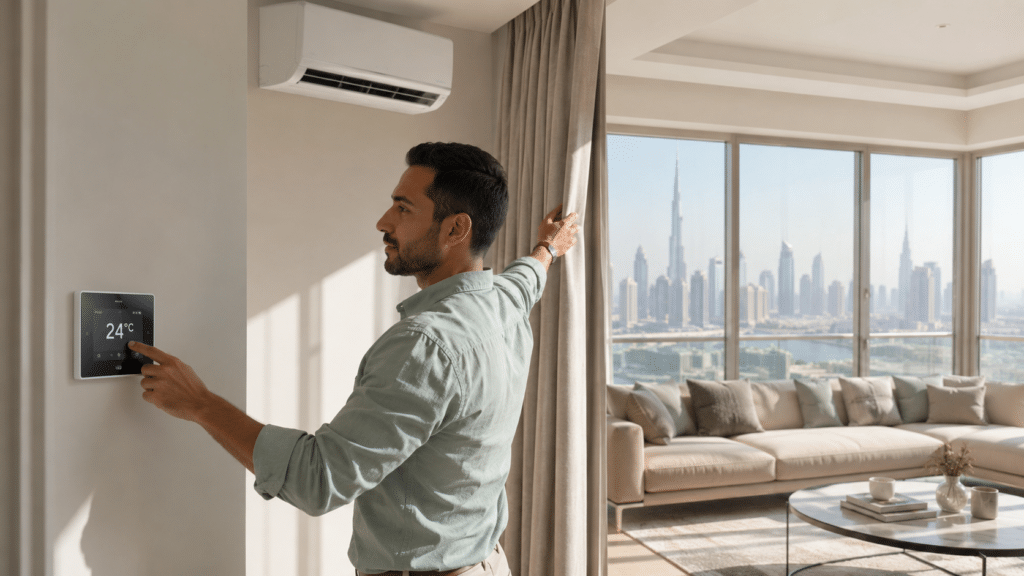
- Check cooling arrangements. DEWA’s conservation guidance recommends setting air conditioning to 24°C. Maintain equipment, use shading and avoid cooling empty rooms unnecessarily, subject to your household’s needs. Do not assume a fixed share of every home’s bill comes from AC.
- Fix leaks and watch usage. DEWA links Smart Living and High Water Usage Alert services from its consumer site. Look for unexplained changes and arrange an appropriate repair; do not undertake unsafe plumbing or electrical work.
- Separate peak-load advice from price. Reducing demand at busy times can support conservation, but the published standard residential tariff is not an hourly discount. Using fewer kWh is what changes that consumption calculation.
FAQs: DEWA bills
Why is my DEWA bill higher than my neighbour’s?
Compare the billing period, actual kWh and cubic metres, tariff category, meter charges and municipal charges before comparing totals. Cooling arrangements, occupancy and the property’s housing-fee assessment can differ even between similar flats.
Who corrects a housing fee that does not match my rent?
Dubai Municipality assesses the housing fee and offers an Adjust Housing Fees service for leased and owned units. Check the rental value and property information used, then apply through its official service. DEWA collects the fee; a consumption enquiry is not the same as a municipal reassessment.
Can I dispute a DEWA bill?
Ask DEWA to explain the disputed consumption or charge through its official app or website. Keep the bill, billing dates, readings and previous statements. Use Dubai Municipality’s housing-fee adjustment route for that assessment. Do not assume a query suspends the payment due date.
Is electricity cheaper at night in Dubai?
DEWA’s published standard residential slab tariff charges by monthly consumption band, not by hour of use. Moving the same usage to the evening does not itself create a cheaper unit price under that tariff. Peak-load conservation advice is different from a time-of-use discount.
How do I set up DEWA after getting Ejari?
DEWA’s One Step Move-in guidance says Ejari registration can transfer your details and create the account automatically. Check for its welcome message and security-deposit instructions. If that does not arrive, use the official DEWA website or app with your valid Ejari and premises information; owners have a different document route.
Official help and related guides
For setup details, use DEWA’s Move-in FAQs. For rental context, see our RERA rent-calculator guide and Salik rates and account guide for a separate household transport cost.
Review note: this update corrects the commercial electricity claim, water rates and units, sewerage formula, unsupported municipal percentage and worked example. It checks published tariffs and the cited fee, VAT and service guidance, not a private customer account, live payment transaction or meter inspection. Original publication date, author and media files are preserved.