Dubai Salik’s ten gates, VAT-inclusive crossing rates, free hours, paired-gate rules, tag purchase and recharge checks, with a worked commuting budget and separate fine/grace-period guidance.
Budget for the crossing you actually make: the gate, the time and any qualifying paired-gate treatment. I would not plan a Dubai commute around an old flat AED 4 headline. Salik’s published tariff and VAT treatment, the tag’s activation and the account balance are separate checks. A rental company’s administration charge is separate again.
My driving verdict: compare the whole journey
The monthly example below is useful because you can replace its assumptions with your own crossings. I’d compare a detour’s time and fuel before chasing a theoretical toll saving. Keep the account funded, verify that a top-up posted and read the trip record if a charge looks wrong. This guide does not calculate an individual fine deadline or settle a rental invoice.
For other journey costs, compare Dubai taxi costs and Sharjah parking rules; do not transfer one operator’s tariff to another service.
Start with three checks: the gate on your route, the time of the crossing and whether your tag is active with enough credit. A rental company’s administration charge is separate from Salik’s toll. This guide was source-checked on 19 October 2026; it is not access to your individual account or a promise about a future tariff.
How Salik works—and what a crossing costs
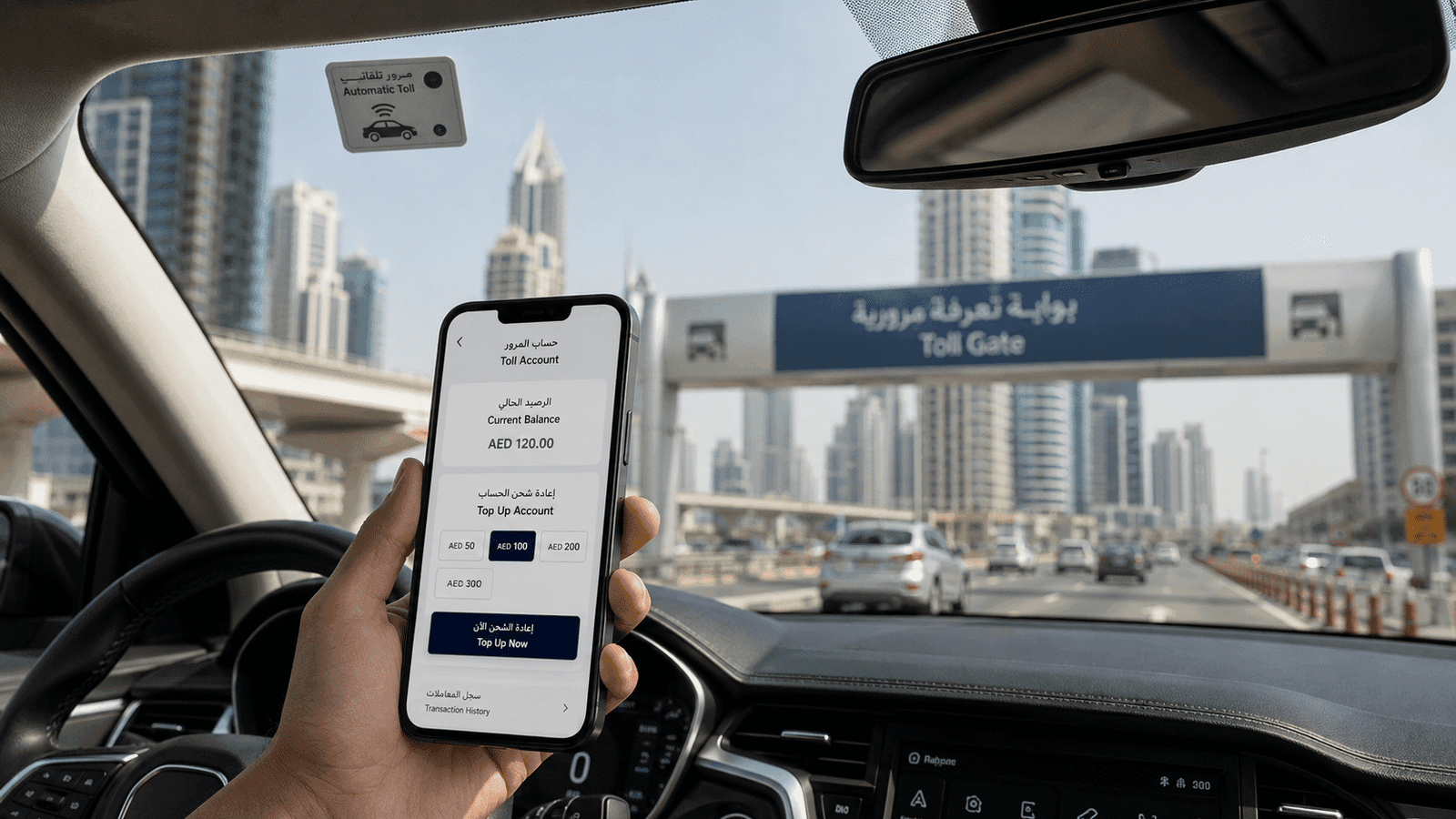
Readers detect the RFID tag attached to the vehicle’s windscreen and deduct the applicable toll from the prepaid account. You do not stop at a payment barrier. Variable pricing began on 31 January 2025; Salik’s 22 May 2026 disclosure added 5% VAT to toll tariffs and tag activation fees from 1 June 2026, without changing the underlying tariff structure.
| Normal schedule outside Ramadan | Base tariff | Including 5% VAT |
|---|---|---|
| Monday–Saturday, 6am–10am and 4pm–8pm | AED 6 | AED 6.30 |
| Monday–Saturday, 10am–4pm and 8pm–1am | AED 4 | AED 4.20 |
| Sunday, 6am–1am, except public holidays and events | AED 4 | AED 4.20 |
| Daily, 1am–6am | Zero | Free |
The official pricing disclosure gives a different Ramadan schedule: peak 9am–5pm, off-peak 7am–9am and 5pm–2am, and free 2am–7am. Its Sunday exception also excludes public holidays and events. Check the dated operator notice for a holiday journey rather than assume every Sunday follows the normal lower rate.
Two named gate pairs can mean one charge
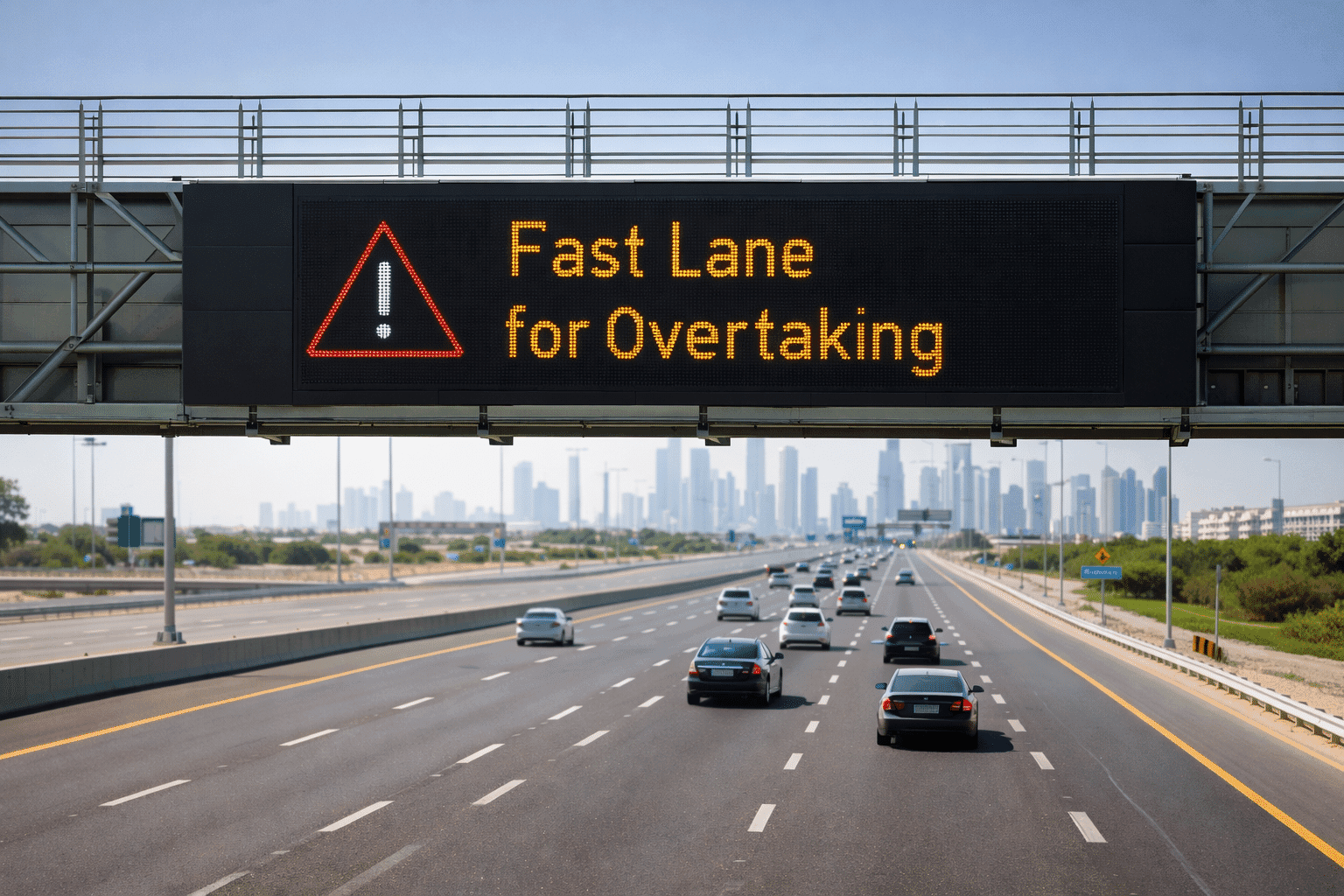
Al Safa North/South and Al Mamzar North/South have paired-gate treatment when crossed in the same direction within one hour. The disclosure says these qualifying passages are charged once. This is not a universal rule for any two gates within an hour: Al Barsha is not a substitute member of either named pair. Check the trip record before multiplying every physical gantry by a toll.
A reproducible monthly toll budget
Suppose your actual route produces one chargeable crossing each way on 20 commuting days, outside free hours. Forty peak crossings cost AED 252: 40 × AED 6.30. Forty off-peak crossings cost AED 168: 40 × AED 4.20. The difference is AED 84, not an automatic saving available to every driver. A different route, mixed timings, qualifying pairs, parking or rental administration fees change the total. Compare time and fuel costs before making a detour solely to avoid a toll.
A mixed commute is not forty identical crossings
Using the same 40-crossing example, 30 peak crossings at AED 6.30 and ten off-peak crossings at AED 4.20 total AED 231: AED 189 + AED 42. That is AED 21 below forty peak crossings, not the AED 84 difference between forty peak and forty off-peak crossings. I would budget the journey I actually make, then leave room for extra trips and parking.
When reconciling the balance, split three things: road-toll transactions, parking transactions and any separate rental-company charge. Salik’s annual report documents parking deductions from its wallet as well as road tolls. A larger balance drop is not by itself proof that a gate was charged twice; read the transaction description and timestamp first.
The ten Salik toll gates
Salik’s 2025 annual report confirms ten gates. Its network information identifies the following roads; use the official map and road signs for the precise approach, not a stylised image.
| Gate | Road or crossing |
|---|---|
| Al Safa North | Sheikh Zayed Road |
| Al Safa South | Sheikh Zayed Road |
| Business Bay Crossing | Al Khail Road |
| Al Barsha | Sheikh Zayed Road |
| Al Garhoud Bridge | Sheikh Rashid Road |
| Al Maktoum Bridge | Umm Hurair Road |
| Al Mamzar North | Al Ittihad Road |
| Al Mamzar South | Al Ittihad Road |
| Airport Tunnel | Beirut Street |
| Jebel Ali | Sheikh Zayed Road |
Business Bay Crossing and Al Safa South have operated since November 2024. They are missing from older eight-gate lists; they are not merely possible future additions. A road name alone also does not mean every trip along that road passes a gate.

Buying, activating and topping up a tag
Start through the RTA driver-and-car-owner page, which links the official purchase, activation, recharge and violation services, or use Salik’s own site. Select the right vehicle and plate details; buying a tag, activating it and adding usable credit are separate checks. Follow the current service’s requested details and installation instructions rather than moving another vehicle’s tag onto your car.
At checkout, separate the tag/activation charge, prepaid credit, applicable tax and any delivery or channel charge. The May disclosure confirms VAT on activation; it does not itemise every current purchase bundle. For an illustrative AED 50 activation line before VAT, that component becomes AED 52.50. I would not turn that component calculation into a guaranteed tag checkout total or assume it tells me how much credit will be loaded. Read both the amount payable and usable credit on the actual purchase screen.
- Open the official recharge service or app and identify the correct account or vehicle.
- Choose an amount supported by that payment channel, including enough to settle any unpaid crossings.
- Complete payment and keep the reference.
- Check the posted balance and trip record. A submitted payment is not the same as confirmed usable funds.
Salik’s app supports account creation, recharge, usage monitoring and violation management. Some parking services also debit Salik accounts: a balance reduction is not necessarily a road-toll crossing. Read the transaction description before disputing it. If a payment is missing or the plate details look wrong, contact Salik through its official service rather than paying a lookalike “balance check” website.
Rental cars: compare the invoice, not an assumed daily fee
Ask the rental company who manages the tag, how crossings are itemised and whether its administration charge is per crossing, per day or another basis. The previous universal AED 5–10 daily-fee claim was not supported. Get the actual agreement, VAT treatment and billing timetable before comparing rental quotes. Do not register or replace the rental vehicle’s tag without the company’s instructions.
Insufficient funds and an unregistered vehicle are different violations
The published Dubai implementing rules distinguish these situations. Salik’s customer terms also describe a five-working-day recharge window for insufficient funds. Treat this as a reason to act promptly, not a payment strategy or an individual fine determination.
| Situation | Published grace period | Published penalty structure after that period |
|---|---|---|
| Registered vehicle, insufficient balance | Five working days to cover the outstanding toll | AED 50 per violating vehicle per day, regardless of repeated violations that day |
| Vehicle not registered in Salik | Ten working days to register and settle the tolls | AED 100 for the first violating day, AED 200 for the second, AED 400 for the third and subsequent violating days; not a monthly AED 400 ceiling |
Keep sufficient credit for your trips; a payment channel’s minimum top-up is not a rule that the account must always remain above AED 50. Check the actual trip date, outstanding amount and violation record, and recharge without waiting for an alert. Do not rely on this guide to calculate a deadline around weekends or public holidays, cancel a fine or establish a vehicle-registration entitlement. Use the official violation service for your case.
FAQs: Salik tolls and account checks
How much is a Salik crossing in 2026?
The standard charge is AED 6.30 at peak times or AED 4.20 off-peak, including the 5% VAT introduced on 1 June 2026. The normal overnight window is free; Ramadan and Sunday/public-holiday rules need separate attention.
How many Salik gates are there?
The published network has ten gates. Business Bay Crossing and Al Safa South opened in November 2024, so a list of eight is out of date.
What if I crossed with insufficient Salik credit?
Recharge promptly. The published rules allow five working days to cover the outstanding tolls; the insufficient-balance fine is AED 50 per violating vehicle per day after the grace period, not AED 100 per crossing. Check your actual trip and violation records with Salik.
Is AED 50 a mandatory balance I must always maintain?
The rule is to hold sufficient funds for the charges incurred. A recharge channel’s minimum purchase amount is not the same thing as a permanently required account balance. Follow the current payment screen and verify that the recharge has posted.
Related Dubai driving and resident guides
- Salik free hours and timing guide
- Dubai traffic fines guide
- Bur Dubai area guide
- RERA rent calculator guide
What was checked
Checked on 19 October 2026: Salik’s ten-gate reporting, variable-pricing disclosure, May 2026 VAT disclosure, Dubai’s published fine/grace-period rules and RTA’s official service links. Some live Salik customer pages could not be retrieved during this check, so a current purchase checkout, individual account, holiday-specific notice or dispute outcome was not tested. The examples above are calculations from published rates, not personal driving records.
21 October recheck: the original 22 May VAT disclosure and Salik’s published wallet/toll description. The earlier pricing, gate-pair and violation checks remain dated above. No individual account, checkout or holiday-specific journey was accessed.