Key Takeaways
- In February 2025, Ye said he had rejected a $2 million crypto-promotion proposal. That is an attributed account, not independently proven payment or perpetrator identity.
- The retained proposal screenshot puts the second payment 16 hours after the original post—not 16 hours after the eight-hour promotion ended.
- An alleged instruction to claim an account hack does not prove that other celebrities staged their own reported compromises.
- The February story cannot establish the status or legitimacy of any later token using Ye’s name.
- A celebrity name, screenshot or familiar ticker does not verify an issuer, token contract or investment claim.
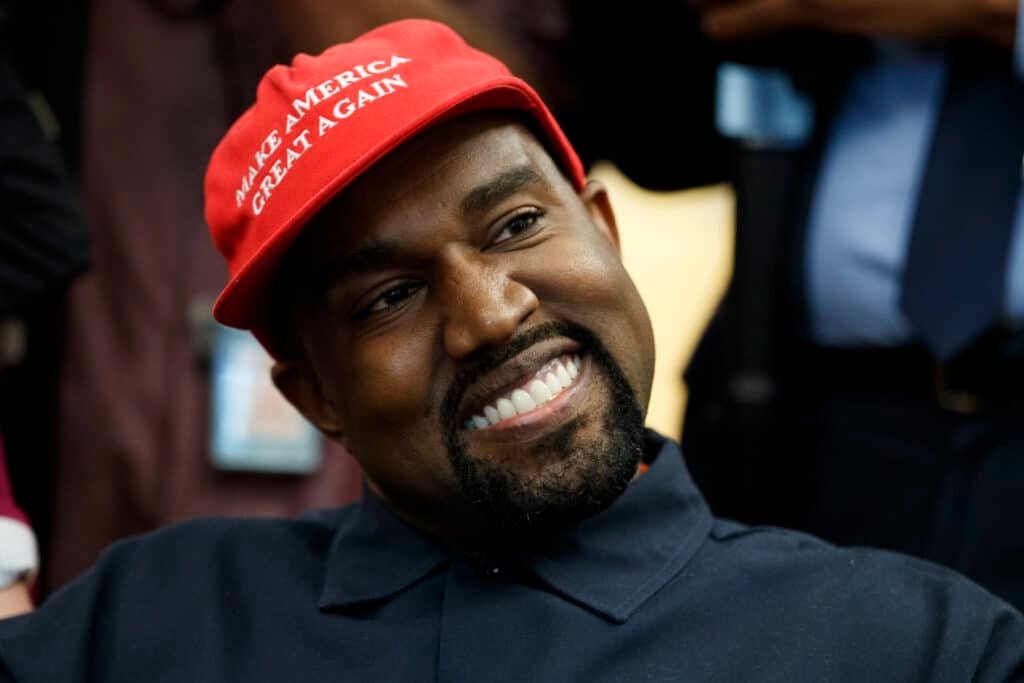
In February 2025, Ye, formerly known as Kanye West, publicly said he had rejected a $2 million proposal to promote a crypto scam through his social-media account. The claim concerned that alleged proposal, not an independently verified conclusion about every crypto project later associated with him. This article records the February 2025 statement and the risks illustrated by a promotion that could be disguised as an account hack. The screenshots and celebrity account are sources for what was claimed; proving a perpetrator’s identity or losses requires separate evidence.
The alleged mechanism depends on followers treating a familiar account as verification. A proposed endorsement fee is not a token’s market value, trading volume or victims’ losses. Those are separate claims, and the screenshot cannot supply the missing transaction evidence.
Ye Speaks Out About the Crypto Scam Offer
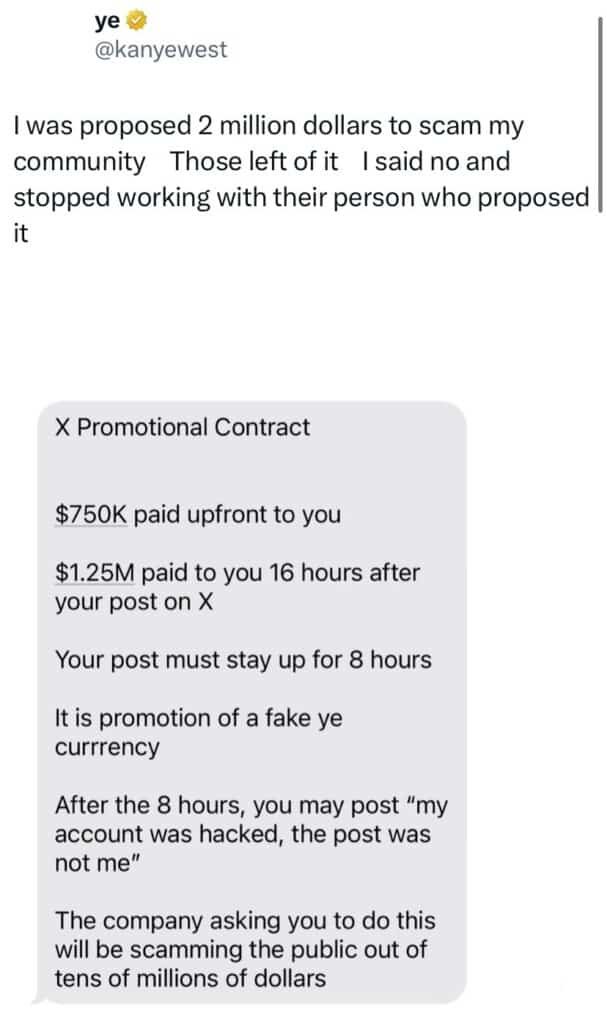
The Block’s 7 February 2025 report attributed the following statement to Ye’s X account. The linked original post could not be displayed in our browser check on 28 October 2026; the retained screenshot and dated reporting preserve the account, rather than independently authenticate the proposal:
“I was proposed 2 million dollars to scam my community. Those left of it. I said no and stopped working with their person who proposed it.”
The proposal shown in the retained screenshot offers $750,000 upfront and $1.25 million 16 hours after the original post. It says the promotion must stay up for eight hours, after which an account-hack claim could be posted. Crypto Briefing’s 8 February report describes that same sequence. The amounts sum to $2 million, but proposed amounts are not proof that money changed hands.
“The company asking you to do this will be scamming the public out of tens of millions of dollars,” the message warned.
By exposing this fraudulent scheme, Ye has sparked a major discussion on celebrity-endorsed cryptocurrency scams and their impact on retail investors. Particularly, Kanye West’s rejection of the $2M scam invites further scrutiny.
Check out: UAE CRYPTO: THE FUTURE OF FINANCE
The alleged offer’s clock: proposal, not a completed payment trail
| Point in the proposed sequence | What the screenshot says | What it does not prove |
|---|---|---|
| Before posting | $750,000 upfront. | A verified transfer or identified payer. |
| Post time to hour eight | Keep the promotion up for eight hours. | That the promotion was actually published or bought into. |
| After hour eight | An account-hack claim could be posted. | A real compromise—or that other account hacks were staged. |
| Hour sixteen after the original post | A further $1.25 million proposed payment. | A payment at hour twenty-four or verified proceeds. |
The distinction matters: a message proposing deception is evidence of what was presented, not a ledger of completed trades or victims’ losses. The promise of “tens of millions” in the quoted message is not a measured loss total. I would not use this screenshot to accuse another celebrity of faking a hack; that needs evidence specific to their account and transactions.
Kanye’s Crypto Connection?
Shortly after posting the scam details, Ye also shared a screenshot of a private conversation. In it, he asked an unnamed X user for a “crypto connect” that would bypass middlemen. The user responded by naming Coinbase CEO Brian Armstrong and even offered to connect Ye directly with him.
This has led to speculation that Kanye may be exploring the crypto space in a more legitimate way, possibly for future projects. Despite rejecting the $2M crypto scam, there might be more to Kanye’s crypto interests.
Crypto Experts Weigh In
Several prominent crypto analysts have shared their views on Ye’s revelation.
🔹 Armeanio, a well-known figure in the crypto world, suggested that instead of launching a memecoin, Ye should consider using cryptocurrency to sell his merchandise directly. It’s another reminder of why Kanye West rejected the crypto scam.
🔹 Crypto Vic believes Ye isn’t actually planning to enter crypto at all. This could simply be a marketing stunt to create hype ahead of his upcoming album release.
“He is a master marketer,” Crypto Vic added.
Memecoin Madness: The Bigger Picture
Kanye’s rejection of this crypto scam comes at a time when celebrity-backed tokens are becoming increasingly common—and controversial.
Recent high-profile celebrity memecoins include:
🚨 Haliey Welch’s HAWK Token – Launched in Dec. 2024, the memecoin hit a $490 million market cap before crashing 91% in just 24 hours. Welch later claimed she had been deceived by the project manager.
🚨 Donald Trump’s TRUMP Token – Released just before his 2025 inauguration, the memecoin saw huge gains, only to drop 38% after Melania Trump launched her own token.
🚨 A Growing Risk for First-Time Investors – A recent survey found that many buyers of Trump’s memecoins were first-time crypto investors. This highlights how celebrity tokens can lure in uninformed buyers before experiencing major losses. Perhaps Kanye West’s rejection of the $2M crypto scam will serve as a cautionary tale for new investors.
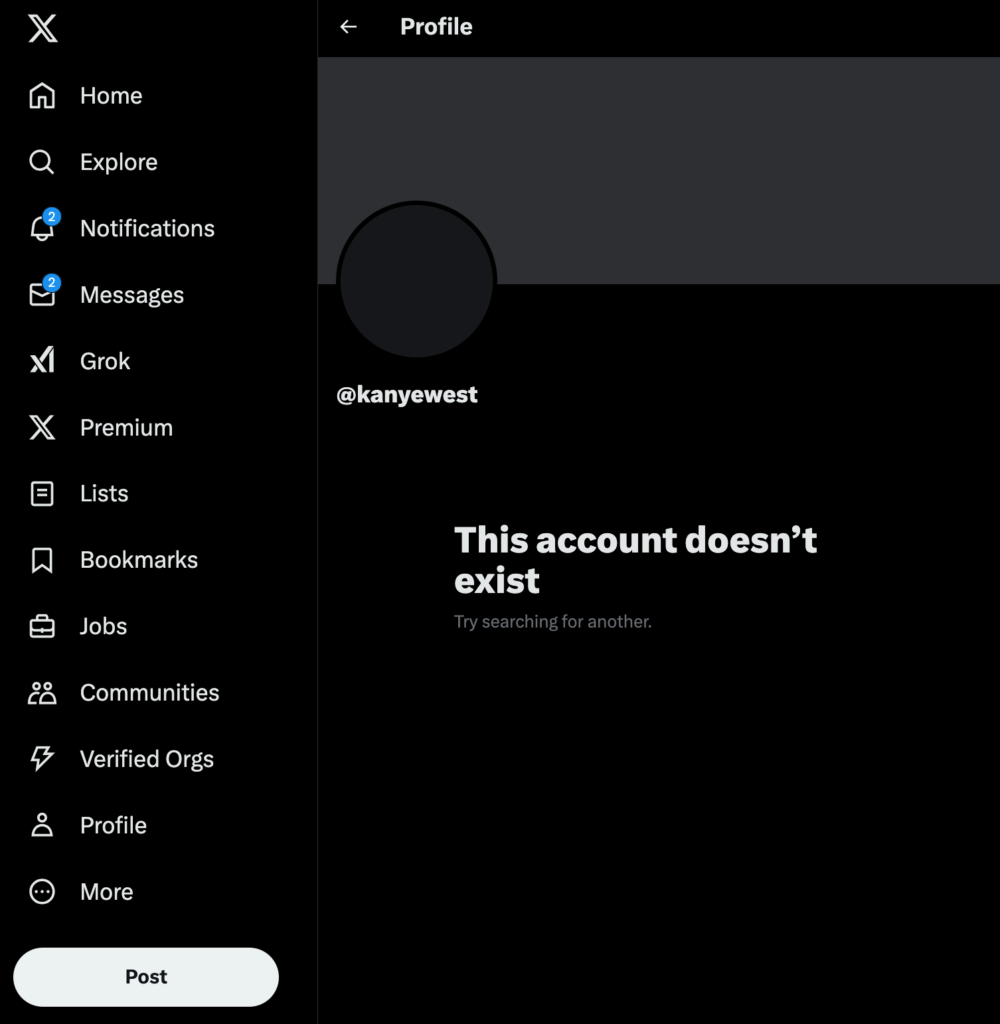
The February 2025 Account-Status Note
This account-status note refers to the February 2025 period covered in the original report. A social-media account being unavailable then should not be presented as its status today, nor as proof of the reason it disappeared. Current account activity and any later token project need their own dated sources. A report about an alleged rejected promotion cannot establish that every future involvement is impossible or that all rumours about one are true.
Final Thoughts: Kanye’s Warning to the Crypto World
While Kanye West’s $2 million rejection is making headlines, it also serves as a wake-up call about how celebrity-endorsed crypto promotions can easily turn into scams.
This is a dated account of the alleged February 2025 offer, not a current assessment of every Ye-associated token. Check any later project on its own dated evidence; neither the old rejection claim nor a later use of his name settles its legitimacy.
A Celebrity Name Does Not Verify a Token
Check a promotion through a separate official channel before acting. A screenshot can be authentic, edited, old or incomplete, and a familiar account can be compromised. Identify the actual token contract and issuer and distinguish a claimed deal from a transaction that occurred. If someone proposes buying a token on the promise of a celebrity’s future announcement, the promise is not proof of the event or a guaranteed return. Our 50 Cent GUNIT account explains why reported proceeds and chart values also need separate verification.