

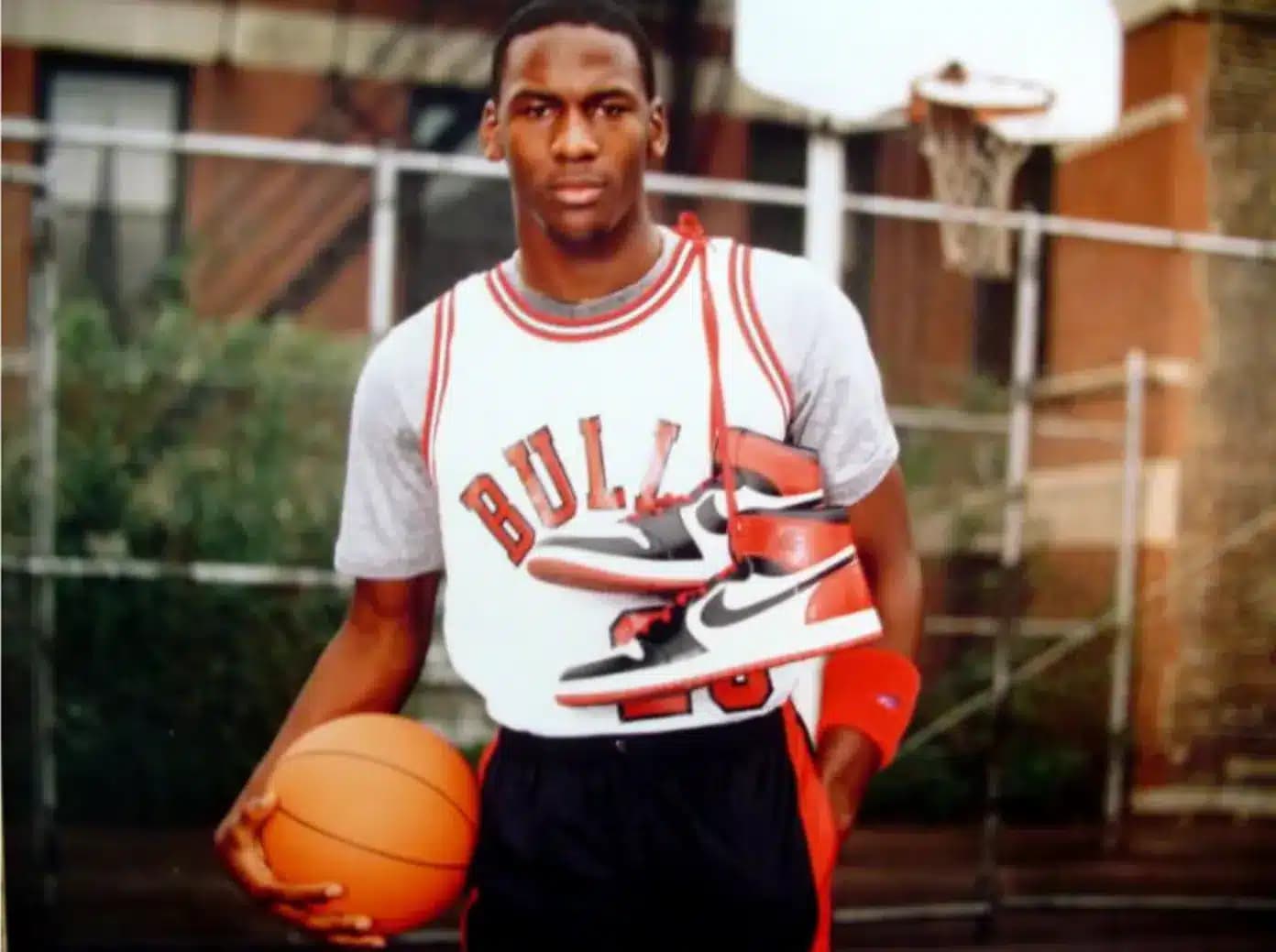
The Air Jordan story starts with Michael Jordan’s Nike partnership in 1984 and the Air Jordan 1’s public release in 1985. What keeps me interested is what happened after that: a basketball shoe became a visual language. The AJ1’s colour blocking, the AJ3’s elephant print and the AJ11’s patent shine are three very different answers to the same question—how do you make a shoe unmistakable?
My pick for understanding the line is the Air Jordan 3. The 1 starts the story, but the 3 makes the design argument beautifully: texture, proportion and a clear identity without needing a giant side Swoosh. If I wanted the sharpest contrast with it, I would put an 11 beside it. One feels grounded and muscular; the other looks dressed for the spotlight. That is a design judgment, not a claim that I have court-tested either pair.

1984 and 1985: the partnership and the first shoe
Nike’s Air Jordan 1 archive credits Peter Moore and gives 1985 as the original release year. The distinction matters: Jordan was already wearing Nike shoes during his rookie period before the AJ1 reached the public. A photograph from 1984 is not automatically a photograph of a retail Air Jordan 1.
What I love about the AJ1 is how much its identity depends on a few visible choices. The high collar, Wings emblem and contrasting panels make the outline immediately readable. The red, white and black pair pictured below is a particularly clean example of why the colour blocking works: the white side panel gives the black Swoosh room to stand out. You do not need an auction price to appreciate that.

The banned story: great marketing, messier history
The familiar version has Jordan wearing black-and-red AJ1s, collecting a fine every time and Nike paying every bill. Nike’s longer account of the controversy is more complicated. It identifies the earlier Nike Air Ship as the shoe at the centre of the original uniform dispute and explains how the AJ1 campaign inherited that rebellious image.
Nike’s own shorter AJ1 archive still uses broad “banned” language. I would read the detailed history alongside the marketing, rather than turn a threatened fine into a verified payment for every game. The advertising is a fascinating part of the shoe’s appeal; it is not a reason to muddle two models.

The designs that explain the evolution
Air Jordan 3: the one I would start with
The AJ3 archive dates the model to 1988 and identifies it as Tinker Hatfield’s first Air Jordan design. Its elephant-print detailing gives the shoe a recognisable surface language as well as a shape. For me, that is its great achievement: there is enough personality in the details to make a restrained colourway interesting. The Jumpman association also gives the model a clear place in the line’s visual history.
Air Jordan 11: bring on the shine
Nike dates the Air Jordan 11 to 1995 and credits Hatfield. Its patent-leather treatment is the reason I would choose it when the shoe is meant to be the focal point. I would keep the rest of the outfit simple—straight dark trousers and a plain top—rather than surround that glossy band with competing graphics. This is a styling recommendation, not a promise about how a particular retro fits or performs.
Air Jordan XXXI: the performance story kept moving
The numbered line did not stop at the classic retros. In its September 2016 investor-call transcript, Nike described the XXXI’s Flyweave-and-leather upper and full-length Zoom Air. That documents the maker’s technology description at the time; it does not prove every later Jordan contains the same cushioning or that an old pair is ready for hard court use today.

My three-model comparison
| Model | What I would choose it for | The design detail to notice | What the history cannot tell you |
|---|---|---|---|
| Air Jordan 1 | A clear starting point for the original visual identity | Panel contrast, high collar and Wings emblem | Whether the particular High, Mid, Low or reissue fits your foot |
| Air Jordan 3 | A textured, less logo-dominated outfit | Elephant-print detailing and the balance of the upper | The condition or construction of a different release year |
| Air Jordan 11 | A deliberate statement shoe with a simpler outfit | The contrast between patent shine and the upper | Grip, comfort or durability of an untested pair |
I would make the first choice from the silhouette, not the resale headline. Then I would compare the exact edition. “Jordan 1” is not a full product identity, and a retro’s connection to a famous season does not make every later version interchangeable.

Why the cultural side still matters
The photographs tell part of the story: basketball action, public appearances, a campaign image and shoes presented as objects in their own right. The appeal is not confined to someone who watched the original games. A reader can come for the design, the music-and-fashion associations or the pleasure of finding a colourway that works with their own wardrobe.
The campaign image below is a useful contrast with the action shots. It sells personality and theatre, not a laboratory result. That is why I enjoy the cultural side of Jordans—but I would still separate an advertising image, a celebrity collaboration and evidence that a particular shoe works for my needs.

For UAE buyers: choose the pair before chasing the drop
I would begin with the exact UAE product listing: model, colourway, style code, size category and the seller actually supplying it. Global launch coverage is good background, but it does not establish Dubai stock or an AED price. Nor does a famous collaboration automatically make the pair a better purchase than a regular release.
For a wider view of local shopping routes, our Dubai sneaker-store guide compares retailers. For a specific design’s history, see the Air Jordan 4 White Cement guide. Those are different tasks from checking whether your size is available today.
The current Nike UAE return page, checked on 21 October 2026, sets a 30-day period and requires original condition, packaging and tags. It says store purchases go back to the original store and allows one return request per order after all items arrive. I would check all sizes from an order together before raising that request. These are Nike UAE’s terms, not a promise that every reseller offers the same remedy.

Collecting: asking prices are not a business case
I understand the pull of a pair with a story. What I would not do is treat “rare” as a synonym for “profitable”. An asking price is not a completed sale, and a signature in a photograph is not proof of authenticity. Before paying a premium, I would want the exact edition, clear condition photographs, what comes with it and the seller’s written remedy if the description is wrong.
Here is a simple illustrative comparison, not a market quote: an AED 800 pair with AED 100 delivery costs AED 900 before any other applicable charges. A local AED 880 offer is AED 20 lower at that stage. If the editions, condition or return rights differ, the totals alone do not settle the choice. I would pay for the pair and protection I actually want, not an imagined future buyer.

My verdict
Air Jordan is worth exploring because the designs give you something to argue about, not because every release deserves applause. I would start with the 3 for texture and proportion, choose the 1 for the clearest link to the beginning, and pick the 11 when I want the shoe to steal the scene. Learn the history, choose your favourite and be exact about the edition you buy. That is much more satisfying than letting a countdown make the decision.
Frequently asked questions
When did Air Jordan start?
Michael Jordan’s Nike relationship began in 1984; Nike’s archive dates the original Air Jordan 1 release to 1985 and credits Peter Moore as its designer. The signing and the public shoe release are different milestones.
Was the Air Jordan 1 really the banned shoe?
Nike’s longer history identifies the earlier Nike Air Ship as the shoe at the centre of the original uniform controversy. Nike subsequently used that controversy in Air Jordan 1 marketing. The familiar story does not establish that every AJ1 appearance generated a paid fine.
What makes the Air Jordan 3 important?
Nike’s archive dates it to 1988 and identifies it as Tinker Hatfield’s first Air Jordan design. Its elephant-print detailing and Jumpman association make it a useful starting point for understanding the line’s changing visual identity.
What is the difference between an original Air Jordan and a retro?
An original refers to the first release of a model or colourway; a retro is a later reissue. The same model name does not establish identical materials, shape, branding, condition or release year. Check the actual product code and edition.
Where should I start when buying Jordans in the UAE?
Start with the exact model, colourway, product code and size on the retailer’s UAE listing. Confirm the delivered total and that seller’s return conditions. A US archive or launch page is not proof of UAE stock, pricing or app availability.
Are Air Jordans a guaranteed investment?
No. A desirable name or an expensive listing does not guarantee a buyer or a profit. Condition, size, edition, authenticity evidence and transaction costs matter. My recommendation is to buy a pair you actually want within a budget you can afford.
Sources and further reading
For the rest of our coverage, browse the Sneakers section. Archive dates and retailer terms above were checked on 21 October 2026; current stock and individual resale authentication are not established by this history guide.


