UAE unapproved weight-loss peptides: the reported enforcement action, retatrutide’s investigational status and checks for registered medicines and licensed supply.
A product name on a vial is not proof of what is inside it. That is the consumer issue behind the UAE’s action against unapproved weight-loss products—not a blanket claim that all peptide medicines are banned. Retatrutide remains investigational in Lilly’s current information. Published trial results do not authenticate an online seller’s product or make it suitable for you. Start with a licensed clinician and pharmacy, not a direct-message sales pitch.
The verdict: verify the medicine and the supplier separately
I would not treat followers, testimonials or a polished certificate as a substitute for product registration and a licensed dispensing route. Those checks answer different questions, and neither replaces an individual medical assessment. If you already bought something concerning, keep its packaging and order details for a pharmacist or clinician to assess. Do not improvise doses or identify the contents from a photograph.
The same need to match a claim to the actual product applies to the evidence behind okra-water claims and WHOOP Meridian’s compatibility limits; neither is a substitute for medical care.
What happened in the July UAE crackdown?
Gulf News reported on 25 July 2026 that EDE took measures against 71 sources marketing, promoting or selling unapproved peptide products. Its account includes 14 locally registered establishments and 14 influencers referred to the National Media Office. These are reported enforcement figures, not a new October total or a list of people convicted. Do not add the categories together as extra cases beyond the reported 71.
The regulator highlighted digital promotion as a major concern. That does not establish what proportion of all sales takes place in Instagram messages, WhatsApp groups or any other specific channel.
The danger of unapproved peptides like Retatrutide
Lilly’s retatrutide information, updated in September 2026 and rechecked for this article on 21 October, describes it as investigational and not approved by any regulatory agency. It is being evaluated in clinical trials. That investigational status is different from the UAE-approved formulations discussed below.
Research results and retail authorisation answer different questions. Lilly reports published clinical-trial findings, so saying there is “no data” is inaccurate. Those studies do not verify a vial sold online, its ingredients, its storage or its suitability for a particular person.
The US FDA warns about products falsely marketed for research while being sold to consumers for human use. Its warning concerns unknown quality, incorrect ingredients or amounts, and potential harm. This is supporting safety context, not a statement that US compounding law is UAE law. A research label is not approval to self-inject.
A legitimate clinical trial has a defined protocol and oversight; buying an unapproved vial is not equivalent to joining one. Ask a licensed clinician about appropriate, authorised options instead of treating a seller’s dosing sheet or before-and-after image as a medical assessment. This article does not provide dosing or injection instructions.
How to identify illegal weight-loss products online
Illegal sellers use misleading digital advertisements. Be wary of products marketed as ‘100 per cent natural’, ‘safe’, or a ‘magic solution‘. These are red flags used to encourage uninformed purchases on social media.
A professional-looking account, delivery promise or certificate supplied by the seller is not enough to verify the exact product’s UAE registration or the dispensing business’s licence. Check those independently with a licensed pharmacist or the regulator. We have not established a market-wide percentage of sales through private messages.
Promises of a “magic solution”, guaranteed results or pressure to buy immediately are reasons to pause. For related reporting, see our Mounjaro coverage, but do not use an article or an influencer’s experience as a substitute for a prescription and individual medical assessment.
I would keep a simple paper trail: the seller’s trading name, the pharmacy named on the supply, the invoice, the packaging and any prescription. A payment receipt proves a transaction, not medicine authenticity. Ask a licensed pharmacist to resolve a mismatch rather than accepting a screenshot supplied by the seller.
Approved vs unapproved: What you can legally buy
The EDE’s 1 June 2026 announcement confirms approval of oral Wegovy (semaglutide) for long-term weight management in specified adult groups. Approval of that formulation does not validate an unnamed compounded vial, every seller using the brand, or use by someone outside the medicine’s approved conditions.
Separately, the EDE announced Foundayo (orforglipron) approval on 3 April 2026. It is a different active ingredient from semaglutide, not another name for Wegovy. Do not assume Wegovy, Ozempic, Mounjaro or an oral alternative share identical indications, formulations or dosing. The prescriber and pharmacist should check the exact UAE-authorised product and its instructions.
Where a medicine requires a prescription, dispensing must follow the applicable prescription requirements. An influencer’s recommendation is not one. A valid repeat prescription is also different from assuming every pharmacy collection requires a brand-new consultation; follow the prescribing clinician’s plan and the pharmacy’s checks.
The cost and risk of the peptide black market
The price of an online product is not a quality test. A cheaper vial may still be unapproved, while a high price or “exclusive” label does not establish authenticity. Compare the authorised medicine and care pathway with a clinician, rather than using an unverified black-market price as a treatment recommendation.
Lilly states that retatrutide is available only through its clinical trials, not for routine public purchase. That distinction avoids the misleading claim that there is no legitimate supply in any context: investigational trial supply and unauthorised retail sales are not the same thing.
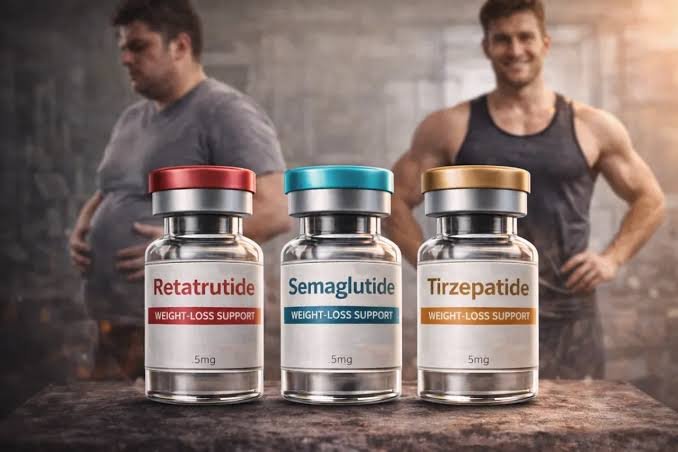
The practical question is whether the exact product and supply route can be verified—not whether a seller has many followers or persuasive testimonials. A product’s name on a vial does not establish what is inside it.
The Abu Dhabi Department of Health’s adulterated-products resource warns that some listed supplements and other products have contained biological contaminants, heavy metals or undeclared pharmaceutical substances. Its warnings cover several product categories. They are not laboratory results for every peptide vial and should not be presented as proof that each pictured product was tested.
The DoH resource was checked for the earlier 18 October update; we could not reload it at this review. For a current product-registration query, use EDE’s contact route above. If you already obtained a concerning product, keep its packaging and order details for a pharmacist or clinician rather than trying to identify the contents from a photograph.
How I would check an EDE listing before paying
Open the EDE registered medical product directory, rather than a seller’s copy of a certificate. The directory offers product-name, manufacturer and active-ingredient filters, with strength, form and status in its records. Match the exact product, not just a familiar ingredient name. An oral tablet and an injection are not the same formulation.
| What you find | What I would do next | Do not conclude |
|---|---|---|
| The name matches, but the strength, form or manufacturer differs. | Show the full packaging and listing to a licensed pharmacist. | That a similar ingredient makes the products interchangeable. |
| A matching registration entry appears. | Check the dispensing pharmacy separately and follow the clinician’s assessment. | That the entry authenticates this particular pack or seller. |
| You cannot find a clear match. | Ask the pharmacist or EDE to verify it before buying. | That an unsuccessful web search alone proves approval or illegality. |
That is my dividing line: check the product, check the supplier, then leave the treatment decision to a qualified clinician. A seller’s confidence is not an extra layer of evidence. If you have used a suspect product and feel unwell, seek medical care and tell the treating professional what you took; a directory search is not a substitute for care.
How to shop for weight-loss medication safely
| Check | What it answers | What it does not prove |
|---|---|---|
| Exact product registration | Whether the named formulation is authorised | That a seller’s vial or website is authentic |
| Licensed prescriber and dispensing pharmacy | Who is assessing and supplying the medicine | That it suits every patient or has no adverse effects |
| Prescription and product instructions | The individual treatment and dispensing directions | That another brand, formulation or online dosing sheet is interchangeable |
Keep these three checks separate. If one is unresolved, ask the pharmacist or EDE rather than filling the gap with a seller’s claim. EDE publishes 80033784 (EDRUG) for enquiries. This is a consumer-verification framework drawn from the cited sources, not a diagnosis or a personalised treatment plan.
Obtain prescribed medicines through a licensed pharmacy or authorised healthcare provider. A product being out of stock at one pharmacy does not prove that it is unapproved; equally, being offered online does not prove registration. Ask the pharmacist to verify the exact medicine, strength, formulation and authorised supply route.
Your first stop should be a licensed clinic. A doctor must assess your health to determine if a GLP-1 agonist or other peptide treatment is safe for your medical history.
Once you have a prescription, take it to a registered pharmacy. Avoid “concierge” services that offer to deliver medication without a verified pharmacy license.
Do not use products advertised only as “secret” or “exclusive” peptides as a shortcut around medical care. A clinician can assess the condition, explain the relevant medicine’s benefits and risks, and decide whether it is appropriate. Registration is a necessary check, not a promise that any medicine is risk-free for every person.
Sources and scope of this update
Reviewed on 21 October 2026 against the linked July news report, EDE’s approval announcements and directory, Lilly’s September information, and the FDA consumer warning. The DoH resource retains its earlier 18 October check. This is general regulatory and consumer-safety reporting, not an individual clinical assessment, independent testing of the pictured products or a professional clinical review.
Always consult a licensed medical professional before starting any weight-management treatment.